Welcome to all those with faith.
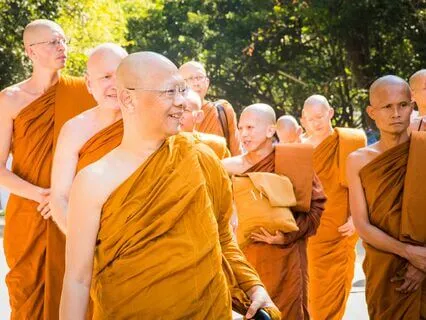
The Mahabharana is the day when the Sangha who have spent the three month rains retreat together each have an equal opportunity to tell and admonish any faults of each other.
This is done with a mind that has metta,
Loving kindness and compassion,
And imbued with good will for each other.
This is so that the monk who has been admonished has a chance to know of each of their shortcomings and then they have a chance to change and improve them.
And it's normal that over the three months for those who have lived and been practicing together there may have been things done which had good intentions or maybe it was done unintentionally or one has made a mistake and this has led to some disagreements on both sides.
And if these conflicts aren't addressed and fixed it may lead to more serious arguments and cause suffering later on.
And so this is arguing and disputes being the cause and cycle that leads to suffering for each other.
So this is important to note.
And there was once when Venerable Ajahn Mun was going for alms round and there were two other monks who were having problems with each other constantly.
Ajahn Mun warned them both to correct their views and understanding.
If they did not correct their views and understanding well,
Then it would be difficult for them to do their bhavana,
Their mental cultivation.
It would be difficult for them to practice to gain samadhi,
Meditative concentration,
And wisdom would be unlikely to arise.
So here the great teacher was there to caution,
Tell and teach them.
But when there is no great teacher that is still here that can warn us to this level then there is at the end of the rains retreat the Mahabharata day of the monastics.
And so on every uposada that has passed there was the patimokkha recitation,
The 227 precepts of the monks.
But on the day at the end of the rains retreat is a special day that the Buddha gave to do the Mahabharata together.
That is,
It is allowable to admonish each other,
Doing it through metta and compassion,
Not out of emotion and not from each person's views and ego.
Why is this done?
It is because if there is no harmony it will be the cause of arguments and disputes.
There will be a lot of troubles and difficulties arising.
And we can see that in the world in this present day,
In society or in the group,
There are differing views on various subjects and this leads to all types of problems arising.
So this harmony leads to togetherness and unity.
This is a spiritual power.
And we have heard often about the harmonious katina ceremony and the harmonious robe offering ceremony.
This is gathering together,
Having harmony and unity to do a particular thing,
Whether to build a school,
Build a hospital or build a monastery,
And then it can succeed well.
This is because for a single person to do it alone would be difficult,
Because the project they are doing is a major one.
To be in harmony means to meet in agreement,
To compromise,
To be able to get along collectively,
To not disagree,
To not argue,
Regardless of if there are differing views.
And when they can agree with each other and be good friends,
Or they are siblings and have love and unity at home,
Then they have happiness.
The harmony of a group leads to inner happiness.
If everyone in the home or in the monastery are harmonious,
Then it leads to the advancement of the town.
Or if it is in competing in various sports,
If the team has harmony and they are not disputing and bickering to be on top,
Then they can then overcome all obstacles and have happiness in body and mind too.
So one is unable to do a major project or work with big responsibilities alone.
It takes the physical and mental strength of the friends who do it together until it can be successful and have the highest quality.
So here the great teachers would emphasise on harmony a lot.
When I was learning in Wat Nong Pa Pong,
The important point that Venerable Ajahn Chah would emphasise was the harmony of the Sangha that lived together.
This would lead to happiness.
In order to have harmony,
Each person had to give up their self-centeredness.
When there was an activity or chore,
We had to gather together and help each other to do it.
Whatever there was,
We had to help each other to overcome it and to develop the monastery well.
Whether it was the regular monastic duties and practices,
The chanting pujas,
Arms round or receiving the senior monk's arms bowl,
No one could be selfish.
When it was time to wash robes,
Everyone had to help out with the communal chores in the dying shed area.
When cleaning toilets,
Everyone would help out,
Contributing their strength of body and heart.
When it's like this,
There is warmth and there is energy in doing these activities.
If there are say 20 monks and 8 or 10 monks don't go,
Then the ones who do it,
Though they can do it,
They will think of how come the friends didn't come and help them.
Even if there are just one or two persons missing,
They will feel,
Why aren't their friends helping?
It's only themselves taking up the duty.
But if it's done quickly,
Then they can quickly finish and then quickly go back to their bhavana,
Their meditation.
So this is important.
If there is harmony and unity in doing it together,
Then whether it is a monastery,
A home or various work,
Then it succeeds,
Through harmony and unity.
And what other cause or dharma quality brings up harmony?
There is metta,
Loving-kindness,
Metta in kaya-kamma,
One's bodily actions.
We must be intent in our hearts that we will have metta in doing our actions of body towards our friends in the holy life,
Whether to them or behind their back.
We help out in different activities with sincerity.
We show politeness,
Are respectful to each other,
To them and in private.
We don't gossip about each other and not to verbally abuse each other.
This is bodily action and verbal action.
Speech is called wajji-kamma.
This is practiced with friends in the dharma,
Whether to them or behind their back.
If there is anything of benefit,
We tell,
Teach and admonish them with good intentions.
It is important to have polite words and to show respect in front of them and away from them.
In regards to this,
Venerable Ajahn Chah has talked about metta of verbal and bodily actions.
The ordained monastics in the Zen tradition in Japan,
They would sit meditation and one monk would have a stick made out of rattan and he would walk and inspect the line.
If there was one monk who was sitting and nodding off,
Sitting with drowsiness,
Being unable to overcome these feelings and sleepiness,
Then the monk inspecting would take the stick and tap it on his shoulder.
That means that you are drowsy,
You are sitting in meditation and falling asleep.
You have to have mindfulness.
But they would gradually do it and hit gently and lightly.
It was just for the monk receiving it to gain awareness.
When they became aware,
Then they wouldn't be angry or enraged.
So this is metta.
This is someone showing us something valuable.
And the one receiving it gives a thank you.
Then they receive the stick.
Then he walks and takes up the duty of inspecting the other monks.
Whoever is sitting with drowsiness and nodding,
Then they will do this.
So Ajahn Chah said,
Look at this.
He doesn't hold on to his views and has no ego.
They do it with self-sacrifice.
They are intent to practice.
So Ajahn Chah took this good quality of the practice.
Even though it was from the Mahayana tradition,
He took it to share,
To teach and to apply it in the practice in the Theravada tradition.
Because in reality,
There is no Theravada,
No Mahayana.
There are just those who are determined to practice.
Whether practicing by oneself for the overcoming of suffering,
Or practicing with a group to go beyond suffering together.
And in Mahayana,
There may be a high-level leader that has parami,
A bodhisattva,
To lead one to go beyond suffering.
But if it is Theravada,
The great teacher of the tradition practices to be free from suffering and then he teaches the freedom from suffering.
However it is,
It comes together as one,
In that they are going towards the peace and happiness of the mind.
So when we have been well-established in metta and compassion like this,
Then each person is smiles and has good wishes for each other.
They see each other's face and they smile to each other.
They have good intentions towards each other.
Whatever they have,
They share it.
If they have a lot,
Then they share it.
Like in Wat Nongpa Pong,
When a lot of things are offered,
They are all gathered together communally.
And Wat Mapjong follows the monastic rules and practices of Wat Nongpa Pong.
So if there is a lot of food offered,
It is gathered together communally and shared out according to what is appropriate.
When it's done like this,
Then no problems arise.
If each individual receives and keeps their own requisites and gains as their own,
Then it's chaotic.
If there are invitations outside of the monastery,
And this house offers a lot,
That house offers a little,
Then there arises contesting,
Competitiveness,
Arguments and disputes.
It's very chaotic.
Just because of requisites.
So if there's sharing around of the requisites that are received,
Then even if they are just small quantities,
Be it sugar,
Sugar cane,
Evening allowables,
It is gathered together and shared out.
Then there are usually no problems.
So Ajahn Chah established this korwat,
This monastery practice,
And it became acknowledged within the greater public that in regards to this practice,
Ajahn Chah did not take what he received as his own personal gain.
So here there is a story that in one period,
There was an ideology that would take all things and keep it as being communal.
It would go to the central place.
It wasn't a personal possession.
And they saw Wat Nongpa Pong and said that Wat Nongpa Pong has a system that does not take the requisites as anyone's personal possession.
They gather it together and share it out.
This was very good.
They saw the good points of doing it in this way.
It's not that whoever has longer reach and can grab it gets it,
Or whatever is good is mine first.
It's not like that.
We share it out.
And Ajahn Chah urged us strongly to share all the food so that it may get to the novices.
What if it was us as the last novice at the end of the food line and we didn't get to eat?
So he said to share it so that it gets to the end of the line.
So the duty of the monks that shared out the food,
They needed to estimate whether the food would reach the novices or not.
They had to make sure that the novices would eat enough as well.
The novices are a part of the monastery that also gather together to do all the activities in each place.
They needed to dig holes and cut trees,
The things that the monks can't do.
And so the monks would have to get the novices to do it.
So the novices have value,
And they need to be given importance,
And to share out with them the evening allowables and the food so that they would have enough too,
And to have metta and compassion in doing this too.
And so when living together,
What do we need to have?
We need to be on the same level in terms of sila,
Moral conduct,
The sila that is good and pure,
Maintaining this out in the open and in private,
Have actions and behaviours that are good and beautiful,
Have honesty to each other,
Then we can live together well.
So it's not that we can practice in whatever way we want.
We can't do this because we live in a society like this.
We are not living alone.
We are living in a group.
So we need to listen to the leader that advises and teaches us.
So whether in the open or in private,
We must have views that are correct.
Views that are good and beautiful.
And so not arguing and disputing because of differing views.
These differing views are what likes to argue and cause a lot of disputes.
So this is the cause for not caring for each other and for disharmony.
So the dhamma that brings up love and harmony is the dhamma that makes us think of each other and be able to be together.
These are the six qualities which I have explained.
These six qualities are the important qualities that make us think of each other,
Assist each other,
Not argue and dispute,
And to have harmony with each other.
So may we be determined to do this.
In our life,
Even if we are not a monk,
We are a layperson and have a family,
Colleagues or friends.
Then when we are together,
We take these six dhamma qualities to practice and use.
We will have metta to each other in our actions of body and speech.
We have equal sila.
We may have differing views,
But do not argue.
We have harmony with each other.
We share with each other.
And so we practice all these constantly.
Then in all things,
We will have peace of mind arising.
This inner peace and happiness of the heart is important and is what we all want.
And this will then progress into training the mind,
Into making the mind have peace,
Making the mind have purity,
And making our minds to see and know the dhamma.
And so this all starts from these basic qualities.
So may the monks and the laity practice and train in them.
Don't be without these qualities.
Try to do them.
And by doing this,
We are giving homage to the Buddha,
Dhamma and sangha.
So today is close to the Mahabharata day,
Which I've already talked about.
And so I say that when it comes to this day,
May we bharana,
Invite each other for admonition.
Or for each of us coming together for this online session.
And we are aware that it's normal for our minds to have liking for some and disliking for others.
But all of us,
Whether monks or laity,
Are practicing to go against the moods and mental states in our minds.
So when it comes to this day,
We forgive each other.
Each person does not attach to the usual moods that come up.
We let it go,
Let it go,
And re-establish anew.
And this takes us towards a practice of virtue and goodness,
For the purpose of building our spiritual qualities and for the freedom from suffering.
So may you all set your hearts on this.
May you grow in dhamma and in blessings.
May you be at ease.