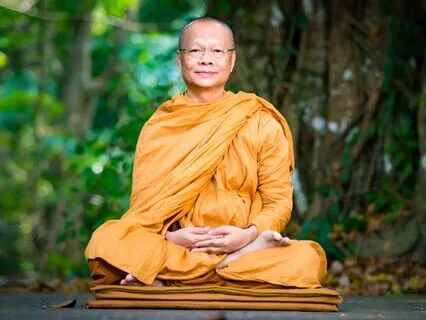
So now this opportunity that we have to sit in meditation and listen to the Dhamma.
So in listening to the Dhamma if we do that well then wisdom will arise.
If we listen while the mind is in a state of peace.
So while we are listening we can know the breath,
The in-breath and the out-breath as well which means that we have mindfulness.
And we put down all thoughts,
All proliferation,
We leave all of these things aside.
All of the thoughts about that which has come to pass already or that which has yet to be.
So the things of the past,
The things of the future.
We lay all of that aside.
So in order to see and understand the Dhamma our mind needs to be in the present moment.
So therefore if the mind is scattered,
If it's restless then we won't be able to understand the Dhamma because we're not contemplating so we won't see the Dhamma.
But if the mind has a degree of peace then we can understand the Dhamma little by little.
So we see there are these three kinds of happiness.
There's the happiness in the world,
The happiness of samadhi and the happiness of wisdom.
And all humans desire happiness,
But no one wants to suffer.
But when we want this happiness most people go about getting it in a way that causes harm to others.
They harm others for the sake of their own personal happiness.
So this is a kind of happiness but it's that without virtue or morality.
It's on the level of a Bhuttujana,
So someone who is thick with the defilements.
And this is why the world is in such a chaotic state.
But if we're going to find a higher happiness,
Well it's that of a Kalyanacana,
Of a good or a beautiful being,
One with a beautiful mind.
So someone who is generous and someone who is virtuous.
And when we're generous,
We're virtuous then we don't harm other people or other beings.
We're able to have a degree of control over our actions of our body and our speech.
We keep these precepts and so there's a peace that comes out through our actions.
And the benefits of having these precepts,
Silena sukhaṭiṅyanti,
This becomes a cause for happiness,
A happiness in sila-dhamma,
In this moral integrity.
But even though we have that,
The mind can still be chaotic,
Can still be quite a mess,
Can still be all agitated,
Can still be gloomy.
We want happiness,
But sometimes it can be really difficult for us to get that.
And then when we do get it,
We cling to that happiness.
And then that becomes a cause for suffering to arise.
So the thing that we really wish for is peace.
And so we come to train in samadhi so that this can arise.
So I asked you already,
Who wants jhanas?
Who wants a still and peaceful mind?
Who wants to get samadhi?
And everyone put their hand up.
And before I ordained I would have done the same,
And really I did,
But it was like an internal hand that I put up that I wanted this samadhi,
And jhanas I wanted even more.
Because I knew that if we're going to get this peace of mind that will come about through samadhi,
The state where the mind isn't shaken,
If we meet with a sense experience which is the stimulus for liking to arise,
But the mind doesn't shake through that,
If we meet with a sense object which is the stimulus for disliking to arise,
Then the mind doesn't shake through that.
Because it's normal being in this world that we meet with these things,
There's praise and there's blame,
Isn't there?
That there's gain and there's loss,
There's praise,
There's blame,
There's fame and disrepute,
And there's pleasure and pain.
And so these eight worldly dhammas are things that everyone who is born into this world needs to meet with.
And if the mind doesn't have stability to it,
Then it will always be running after these things,
Getting involved in pleasure towards them sometimes and displeasure at other times.
And so it's like that when the minds of beings are engulfed in this world,
That this is just their nature to be this way.
Even though you may be virtuous,
Have sila dhamma,
But the mind is still in the world and so it follows all of these sense experiences like this.
And so that's its nature,
It's normal for it to be that way.
And it's normal because there's avicca,
Tanha,
Upadana,
So this ignorance craving and clinging in the mind.
And so we have this aspiration for samadhi then,
For the mind being firm,
For it to be stable,
Because we know that this is something which is really good.
And when we have wisdom then we'll understand and see the Four Noble Truths.
So that of stress,
Of discontent,
Dukkha.
And then there's the cause for dukkha to arise,
There's nirodhara cessation and the path leading to that cessation.
And so the seeing of all materiality and mentality as anicca,
Dukkha,
Anatta.
So as things that change,
That are stressful and not self.
Because we don't want to attach to these things as being a self,
Because we've listened to dhamma talks already and so we know that that's the cause for suffering to arise.
Because if we have the self,
If we have me and mine,
Then that suffering will come up.
And so that's how it's been for us.
But then we.
.
.
And that's what we've known.
Then maybe we listen to a monk speak and they teach us that these things aren't us,
They're not me.
That physicality,
Mentality,
It's not me,
It's not you.
The mind still clings,
It still attaches,
It still has this self.
Even though we know that that's the cause for suffering to arise.
Even though we don't wish for it to be that way.
But when the cause is still there,
Then suffering,
Discontent,
Will need to come up.
And when that cause disappears,
Then freedom from suffering arises.
So when that happens,
This nirodha comes up.
But this doesn't just happen all by itself,
It doesn't happen haphazardly.
That if we have these defilements,
If they're still craving,
And we don't do anything,
Then suffering will constantly be appearing.
If we just get delighted in this world,
The things of this world,
Then the defilements grow and grow,
They don't get less.
And it's the nature of defilements to be that way.
So when we start seeing the drawbacks of this chaos,
Of things being a mess like this,
Then we start asking ourselves,
Why?
Why is my heart such a mess?
I want peace,
So why is it not peaceful?
I don't want for it to be thinking all over the place,
So why is it doing that?
I don't want for anger to arise.
Because everyone knows that this is something that isn't good.
We don't want greed,
Hatred and delusion.
So why are our minds this way?
We take this heart to be us,
Don't we?
But we don't like these things.
We want to get rid of at least some of the defilements.
We want to gain at least some samadhi.
So therefore we need to train.
So we've read some dhamma already,
Listened to dhamma already,
And so we know that we need to be generous,
We need to be virtuous,
We need to meditate,
In order to bring the minds to peace and stillness so that this wisdom can arise.
But it's not the case that we just sit about doing nothing at all and wisdom comes up by itself.
For that to happen we need to be someone who has a great amount of bhārami,
Of spiritual virtues already.
Those beings who could listen to the dhamma once,
Or two times,
Or three times,
And reach stream entry,
Or once returnership,
Non-returnership,
Or arahant.
Those who are able to just sit in meditation and their minds go straight into samadhi or even into jhāna,
That there's great stillness,
There's peace there,
The body and the mind are empty.
For that to happen one needs to have created a lot of bhārami,
A lot of these spiritual virtues before.
And so these beings are those who have a great blessing in their life,
That they've done a lot of merit before in the past,
They've meditated a lot,
They've cultivated samadhi before.
But in these nine days of us practicing together this is what we're doing,
We're creating this bhārami,
This is us forging these spiritual virtues in our hearts.
So that we're leading our hearts to knowing the dhamma and seeing the dhamma.
You can see how for some people being generous is really difficult for them.
But for those who are generous in a consistent way,
That if there's some small deed that they can do of kindness,
Of giving,
Or a big deed and they do that,
That they create this good kamma on a constant basis,
Then for these people being generous is something that's very easy.
That they do these good deeds and their heart feels comfortable,
It feels at ease.
And they try to seek out opportunities to make merit,
To do acts of goodness.
And so it's easy for them to do that.
But in order for that to be easy for these people,
They must have done this before so that in the present they can be this way.
So that they can be generous on a consistent level in the present moment.
And they see the benefits of this,
The benefits of being generous,
The drawbacks in being stingy.
There's the benefits in generosity,
The benefits of virtue.
And then for those who see the drawbacks in the chaos of the mind,
Then they'll see the benefits of seeking out inner peace.
So this is the case for all of you here,
Who have come here.
And what this shows is that all of you have created a lot of merit and a lot of Bharami spiritual virtues already.
So that you have this intent to come and to practice.
There's this wish to know the Dhamma,
To see the Dhamma.
And some people ask,
To do that,
To know the Dhamma,
See the Dhamma,
Is it necessary to be in a state of jhāna?
We can look at the Brahman Ajña-Kaṇḍaṇya,
That when he listened to the Dhamma his mind wasn't in a place of complete stillness.
So that he wasn't thinking or contemplating at all.
Because if he didn't contemplate while listening to the Dhamma of the Buddha,
Then he would have just been abiding in that state of happiness of jhāna,
But he wouldn't have seen the Dhamma.
But his mind rather was in a state of sama,
Samādhi.
This bright collectedness,
It was well established and in an appropriate state to contemplate.
So while he was listening he was contemplating in line with what he was listening to.
But that contemplation,
It's not restless thinking.
Because if it's like that then wisdom doesn't arise,
But rather it's a kind of thinking that's based in mindfulness so that wisdom does come up and we're able to understand and accept.
This wisdom manifests and we're able to know the Dhamma and see the Dhamma.
So with all of you listening to this Dhamma now,
It was like me before I ordained when I was a lay person,
I was interested in listening to the Dhamma just like all of you.
And my mind was in a really chaotic state as well.
Previously I'd sat in meditation some years before and there was stillness and peace in my mind,
But eventually I gave that up and I didn't do it anymore.
And then I got involved in this deluded delight in the things of this world,
In the sounds and the sights,
The tastes,
Tactile sensations.
But eventually I saw the drawbacks of this,
The drawbacks of saṃsāra,
Of a mind which is chaotic.
And so I started out training again,
Started out meditating.
And so I was generous,
I'd keep the precepts just like all of you,
Listen to the Dhamma as well.
And then eventually I listened to a talk by Ajahn Chah and he was talking about liberation and convention,
Vimuti and Samuti.
And this was really incredible,
Listening to this,
Because I had attached to all things,
All of these conventional things,
All of these things in the world,
I really thought that like a Dhamma hall actually was a Dhamma hall,
Really thought that there were such things as laypeople and monastics,
That these were real things,
That there was big size and small size,
That material things will have different names,
That that's how I understood it,
That a glass really was a glass,
That there was big glasses and small glasses.
I didn't really understand the nature of conventions,
But when I listened to this Dhamma talk,
Then I did understand into convention and liberation,
There was an understanding that arose,
And it was like the mind flipped over and really gathered together,
And I could see that in truth these things were not self,
That the self just wasn't there,
And see that they're really just suppositions,
Conventions.
And so through that,
Then this emptiness came up,
And it was really incredible,
Really amazing this state,
Looked at the material things and the people around me,
But I didn't see any people,
There was no being,
No individual anymore,
I didn't see those,
But that was just the sight of the Dhamma.
So there was a great joy rapture that came up in the heart for three days and three nights.
So this is something that's possible to arise,
That if we practice then we can get there.
So this can come up for months at a time,
It's possible that the mind is really peaceful,
It's at ease,
But this came from initially practicing and falling over many times and then picking myself up again.
When the mind was at peace,
Then it felt really nice and at ease during those times.
When it wasn't peaceful,
Then it was really difficult.
So this fight wasn't easy at all.
So if we carry on practicing,
Then it's possible that this peace will come up for us.
So the times that this does come up,
Then we feel like,
Okay,
I can probably do this,
I can probably do this practice,
But the days that this peace doesn't come up,
Then it feels like the defilements are just overriding the heart.
Greed,
Hatred,
Delusion come up and we can't take it.
We just carry on going with it,
Carry on trying to practice.
And so we carry on with cultivating our Bharami and we're fortunate,
Well that's fortunate,
Being close to Krupajaan,
Being close to Ajahn Chah,
That he taught me until I was able to understand,
Gain this deep understanding of the Dhamma.
So this Samadhi arose and there was coolness and peace in the heart.
And then next this came up for months at a time,
For six months,
Even for a year,
That there was this peace there.
And so it's possible for this to happen with Samadhi.
So therefore for us,
We shouldn't become dejected or discouraged,
But rather really set our hearts on this practice,
That we make this determination that what we want is Samadhi,
That what we're after is Magha,
Pala,
Nibbana,
The past,
The fruitions and Nibbana.
And so we bring up this truthfulness there,
This determination of truth,
And then really set our efforts on that.
It's not that we bring up a determination and we just don't do anything,
But rather we set our hearts and then we follow through with that.
But we need to put in our efforts,
We need to have a mind which is focused.
So there are many people who have come,
And many of you are quite young,
And this is something that's really worth rejoicing in,
That you want peace from this young age.
And for those who are elderly already,
Then don't be careless.
For those in the middle age,
You still have a good opportunity to carry on practicing,
To really set your hearts on this practice.
And before,
When I was a layperson,
I had a friend who was 60 years old.
Myself at that time,
I was 21.
And we both wanted to ordain,
But my friend told me that it's like he was walking through the forest and he come across a really beautiful tree that he wanted to use to make a house from,
But the axe that he had was damaged and blunt,
So he wasn't able to use it anymore.
And his brain had already deteriorated a bit,
The samadhi,
Or the mindfulness and the wisdom wasn't as good due to that old age.
So this was quite sad.
But we all have the opportunity to practice,
To meditate.
We have this goal of samadhi.
So what then are the obstacles to samadhi?
The obstacles are liking and disliking.
So there's anger,
Inner will,
There's delighting in forms and sounds,
Odors,
Tastes,
Tactile sensations.
There's the mind which is scattered,
There's drowsiness and there's doubts.
So these are the five things which obstruct samadhi.
So we want samadhi,
But it's these things which are getting in the way.
They don't allow samadhi to arise.
When our eyes see something,
There's liking or disliking towards that.
Maybe we get over that,
Then drowsiness arises.
And then there's restless thinking in the past and the future.
The mind gets involved in doubts and uncertainty again.
And so this samadhi never becomes firmly established.
So the Buddha said we should seek out methods to have as a mainstay for our heart,
For it to become firm.
So we can recite Buddho,
Dhammo,
Sangho.
We can know the in and out breath,
Having mindfulness there.
We need to have something to tie our minds down to,
A meditation object to use.
And when we have that,
Then when we receive a sense impression and we don't attach to it,
Well maybe there's just a little bit of attachment,
There's a bit of liking and disliking that come up,
But we're able to contemplate that.
And so we can ask ourselves,
Well why would I want to be involved in that?
That I need to die,
Don't I?
So what's the point in being delighted,
What's the point in being averse when I need to die?
Why would I want to have aversion towards something?
That there isn't me,
There's no me,
There's no them.
This anger,
It doesn't have a self.
It's just the ignorance in the heart that brings this up.
And so really there's nothing which can make us become angry.
That if our hearts have immunity,
If they're strong,
Then they won't be able to become angry.
But the fact that they do is because they have these germs within them.
The germs of ignorance,
Craving and clinging,
That there's still a self.
And so these defilements then come up,
Greed,
Hatred and delusion arise.
So we shouldn't lay the blame on things outside us,
But rather place the blame within our own hearts.
It's because of our hearts,
Isn't it?
If the mind has wisdom,
Then greed,
Hatred and delusion just couldn't arise.
It's like if we catch a cold.
The reason we've got that cold is because our immunity has fallen.
That really this virus or these bacteria,
That they're all over the place,
All the time anyway.
And if someone's immune system is working well,
Then they won't get it.
But if their immune system isn't good,
Then they do catch that.
It's because the body isn't healthy.
It's because we haven't been eating well,
We haven't been exercising,
We haven't been looking after the body.
And if we do,
Then these germs,
Even though they're there,
The body can fight with them.
And so it's the same that if the mind has this immunity,
Then it'll be able to fight with all these sense impressions.
So which means that if we're with our kamatthana object,
Our meditation object,
That if our mindfulness is well established like that,
Then our samadhi becomes more and more firm.
So this is something that we're all able to do.
It's not above our ability to give rise to samadhi like this.
If we just carry on practicing bit by bit.
If the mind is really scattered and we feel like we just can't take it anymore,
Then we can recollect the good things that we've done before.
And we can make a note of all these virtuous deeds.
So in the last ten years,
What have we done?
We've done this and we've done that.
Ten years ago,
Then nine years ago,
Eight,
Seven.
And things we did three years ago,
Two years ago,
Things we've done this year.
What meritorious deeds have we done?
So we can think about how we've gone to a kathina ceremony and made offerings,
How we've supported the building of an apostle hall.
We've maybe offered a little bit of money for the purchase of a monastery land.
So things that bring up brightness and happiness in our heart.
And then the scatteredness will reduce due to our recollection of this one object of the merit that we've done.
And we can recollect how we have taken up the precepts before we've listened to the Dhamma on many occasions.
We've taken up these eight precepts on the one Prath,
The lunar observance days.
And the heart really becomes bright and full through that.
All of these good things that we've done,
They fill up the heart and they don't leave.
So we use this as the object of our hearts to bring them to peace and to stillness,
Bring them into samadhi.
And so this is a valid method that we can use.
So it's not necessary to recite this word buddho to bring the mind to peace.
We can recollect this goodness,
Or perhaps we can be with the breath.
And as we're with the breath and the mind also fills up with that joy and that happiness,
That this brightness arises as well.
And when the samadhi becomes firm and we contemplate into conventions and liberation,
We can see all things as just being conventional,
And then this vimutti,
Liberation,
Appears.
And so the mind reaches a state of contentment,
Of great inner happiness.
It's able to separate out from the things of this world,
Able to destroy delusion and that which binds our hearts.
And when we cut these fetters,
Then there's a spaciousness and ease in the heart.
But before we just didn't know what was going on.
We didn't know that there were these fetters binding our hearts.
Because we've been used to them,
They've always been there,
And it's just habitual for us to be like that.
So when that's the case,
Then we're able to just stay along with them in this world.
We don't see that there's any problem.
But when they really start putting a squeeze on our heart,
When they start binding us really tight and we don't have any freedom,
Then that's when a desire for freedom appears.
So like when anger comes up with great intensity and we just can't take it anymore,
Or the mind is just so restless and it carries on thinking to the point where we can't eat and we can't sleep,
That's when we see the harm of these things.
We ask ourselves,
Why is it like this?
That I'd felt ease,
Comfort in my heart before,
But now it's just chaotic.
So we see that we have created this peace before.
We have been in a state of inner peace,
Maybe in a previous life,
And we're able to recollect that peace that we once had.
And we want to get back to that state.
So we start practicing anew.
And as we practice,
The mind becomes better and better,
Until wisdom arises and we're able to abandon the defilements,
Maybe just once.
But the mind then becomes very bright,
Contented,
Full.
There's this spaciousness,
This openness to the mind,
And we realize that Nibbana is right here.
We gain great encouragement then,
Great energy of mind.
And here we don't need to force our efforts,
That this just happens by itself.
We have energy by ourselves,
The mind is naturally in a state of samadhi,
That we can maintain our mindfulness,
That the mind teaches itself.
We don't need to seek out these things,
We don't need to force them,
We don't need to control them.
So the benefits of being close to an awakened teacher,
Like Ajahn Chah,
Is this.
They can lead us and they can give us great energy,
Great encouragement,
Until we can find those resources of energy within our own hearts.
So for all of us,
We just carry on practicing consistently.
Those here in the monastery,
Those joining online,
You'll do this already.
You study the Dhamma consistently,
Contemplate consistently,
Carry on going without stopping,
Putting in your efforts without stopping,
Really trying to abandon all harmful states,
Giving rise to virtuous,
Helpful states.
And if we do this,
Then in the end we need to get there.
So for myself,
When I look back to the beginning,
So to my mind which was initially in a very chaotic state,
And then eventually gave rise to peace and understanding,
And the state of the Dhamma appeared,
You can see that going back step by step,
The very first step of the journey was seeing the drawbacks in a heart that was under the control of the defilements.
Seeing the drawbacks and the pain of being stuck in this cycle of birth and death.
So may all of you really set your hearts on this practice,
And one day you'll need to get there.
If you just carry on practicing,
Carry on meditating,
So may all of you grow in blessings.