When God tells Moses to free the Israelites from Egypt,
Moses resists.
I can't do it.
Send somebody else.
God responds,
I will be with you.
And a bit earlier,
When Moses asks God's name,
The reply is the same.
In other words,
God is being.
God is not a being,
Not even the most supreme being,
But being itself.
The whole world is filled with divine presence because God is the inner beingness of everything.
You can know this for yourself by shifting your attention away from thought and into presence.
If you're ready to make this shift,
Stay tuned for this episode of the Torah of Awakening Jewish Meditation podcast on Parshat Shemot with a guided meditation based on the Hebrew letter Tet.
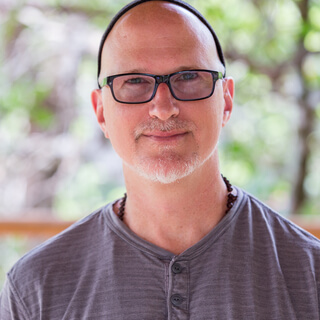
I'm Rabbi Brian Yosef Schachter-Brooks.
Enjoy.
Okay,
We're going to look at the opening verse of the Parsha.
Be'elei shemot b'nei Yisrael ha'ba'im mitzrayim ma.
These are the names of the children of Israel who came to Egypt.
Et ya'akov ish uveitoh ba'u,
With Jacob,
Each coming with their household.
There is another story about Jacob.
A disciple once asked Rabbi Abraham Yehoshua Heschel of Abt,
It says that the seven years Jacob worked to marry Rachel seemed like a few days to him because of his love for her.
How does this make sense?
If he loved her so much,
The seven years should seem even longer,
Not shorter.
He's pining away.
He's waiting.
I would think that every minute he had to wait would feel like an eternity.
The rabbi of Abt responded,
There are two kinds of love,
The kind that attaches you to the object of your love and the kind that is given freely to your beloved.
So there's a kind of love that causes attachment and a kind of love that causes freedom.
We are most familiar with the first kind.
We love someone or something and the love enslaves us.
That's the kind when every minute away from your beloved seems like an eternity.
But Jacob had the second kind of love.
His love was given away freely to Rachel and so he too was free.
In that freedom,
He wasn't longing for the future.
He was simply being in the moment.
So the entire seven years seemed like only a moment because throughout that time,
He had always been in the moment.
So what is this story talking about?
It's important to recognize that on the physical level,
We are absolutely slaves,
Right?
It's nothing to be ashamed of.
On the physical level,
We're slaves.
We're in constant need of external support to survive and this is reflected in the story.
The children of Israel are driven to Egypt by the famine and the promise of food.
They said to Pharaoh,
To sojourn in this land we have come because the famine is severe in the land of Canaan.
But once they're there,
Then they become enslaved.
Egypt enslaved the children of Israel with crushing labor.
So Egypt is Mitzrayim.
In Hebrew,
The word is Mitzrayim,
Which comes from the root that means constriction and suffering,
Hinting that on the physical level,
We are ever incomplete.
We are always in need of nourishment without which we suffer and die,
Right?
We can't even survive for more than a few minutes if we don't have air.
We're constantly in need.
Every time you exhale,
You need to inhale again.
But the physical form-based dimension of experience is not all there is.
The very fact that we can feel suffering at all means there is an awareness that feels.
That awareness,
That dimension of being without which there cannot be any experience at all,
Is itself beyond the Mitzrayim,
Beyond the constriction.
Why is it beyond it?
Because it is the thing that perceives it.
It's not stuck in it,
But rather the experience of it,
Experience of constriction,
Of suffering,
And so on,
Arises within the field of awareness.
Spacious and free,
Awareness is the ever-present openness within which all experience arises.
How do we access this dimension of freedom?
Love the moment you're in.
Now,
It's true we're often acting to bring about results that we need for our survival.
Even our next breath is toward this end.
But our actions need not only be aimed at the narrow and conditional goals of the future.
We have the power to also be in this moment lishmah.
Lishmah means for its own sake,
Being present for its own sake.
And in doing this,
We offer our presence to the inner goodness of this moment just as it is.
It's another way of saying,
Love the moment you're in.
And this is the second kind of love that the rabbi of apt was speaking about,
The love that sets us free.
To bring forth that love that sets us free,
We must remember that the inner goodness of this moment is easily hidden by our goals and time,
By our Mitzrayim,
By our thoughts,
Our feelings,
All the projections of the mind,
Which are based on aiming to secure something for ourselves.
There's a hint of this in the passage about Moses's birth.
She saw that he was good.
So she hid him.
She feared for Moses's life because Pharaoh threatened to kill him.
Moses represents the pathway to freedom,
The goodness of being,
While Pharaoh represents the encroaching and deadening power of ego that kills this simple goodness.
So,
Moses is hidden away.
Why?
Because if the inner goodness were not hidden,
There would be no desire for it,
No longing in the heart for release from Mitzrayim.
We would just take it for granted.
It's only because it is hidden that desire for freedom is born.
And like it says in this verse from Psalm 105,
That is really a summary of what spiritual practice is all about in this one verse.
Seek the divine and its power,
Meaning its power to free us from the deadening power of ego from Mitzrayim.
Search for its presence constantly,
Which is really another way of saying bring yourself back again and again to presence in whatever you're doing.
And this is the promise.
When we sincerely seek,
We don't just perpetually seek and that's it.
We find.
You can find what you seek when you become present because what we're seeking is not anywhere else.
It's hidden within this moment,
Hidden as the presence of being within all being.
Give your attention to this presence and you draw it forth.
Just as Pharaoh's daughter drew forth Moses from the river,
So too we draw forth the light of the present from the river of time.
It shines like a soft glow at first,
Then like a fire that blazes forth,
But it heals rather than burns.
All we need do is give our attention to it,
To love this moment for its own sake,
For the inner goodness to appear.
This inner goodness hidden away in plain sight is represented by the letter Tet.
So bringing to mind this basic Kavanah,
Receiving the gift of this moment,
Affirming its basic goodness,
How does that shift your perspective when you aim your Kavanah,
Aim your intention at loving this moment?
So it's not even just being aware of it,
But loving it.
This is the presence portal of the letter Tet.
And so let's chant an affirmation for this in three parts.
I am affirming.
I am positive.
I am goodness.
I am this love.
I am the light.
I am the light.
I am the light.
I am the light.
I am the light.
I am the light.
So that's this morning blessing that's said every day as we wake up and put on our clothes.
But on a deeper level,
The clothing is the form that we take,
Our bodies,
But also our personality,
Our strengths,
Our weaknesses,
Everything that is who we are moving through our lives.
There is a hidden inner goodness behind all of it,
Which is inherent in our very essence,
In the awareness that becomes present.
And so singing in our spaces.
I'll be checking your body to be in a comfortable alert position,
Conducive to stillness and bringing forth once again,
That attitude of loving the moment,
Bringing your right hand to your heart,
Attitude of generously offering your attention,
Your presence,
Your awareness to the fullness of what is arising right now with deep breath in Left hand to your belly,
Feeling awareness dropping down into your body,
Filling your belly with consciousness.
Consciousness like light permeating your organs,
Bringing energy of healing,
Gratitude,
Love for this body,
Which is the temple of consciousness flowing down through your legs.
Down to your feet into the floor into the earth and rising up chest,
Upper back,
Shoulders and neck.
Flowing down arms,
Hands and fingers back to your heart and belly,
Feeling the flow of your breathing.
Every breath of salvation.
Appreciation for being here in this body in this moment.
Coming up into your face,
Awareness permeating your facial muscles,
Brain and nervous system,
Bringing a little smile to your lips,
Being that loving indwelling presence.
Now I say deep breath in and bringing left hand to lightly touch your forehead as awareness opens up into the space around you,
Coming to rest on the boundaries of the room,
The objects,
The light,
The sounds vibrating in the air and bringing to mind that all of this perception of the world around you as well as the inner world of thoughts and feelings,
All arising within this inner goodness of awareness,
This field that has no boundary or border.
And you are this field,
You are this spaciousness,
Vast and free.
Venish ma,
Deep breath in and kissing your fingers,
Relaxing your hands.
Bless us in our practice today.
Help us to meditate deeply and powerfully.
As we begin chanting the tefillah,
You who are not separate from anything or anyone we encounter,
You who are not separate from this awareness we are.
You are Hashem.
Chanting or its variants.
Resting in the silent repetition.
And closing the meditation,
Bringing some movement to your body,
Taking a nice stretch.
Rabboni Shalom,
As we prepare to come back into our day's activities,
May we be imbued with this most fundamental,
Most important ability to focus our attention and love on that which is already here,
Instead of always aiming it,
Aiming it somewhere else.
We need to do that too,
To a certain degree.
But we can forget the supreme gift that is given to us in this moment so easily.
That's the pharaoh trying to kill the baby boys.
Moses,
Who's the path of freedom,
But he's hidden.
He's hidden right here in the moment.
So let's find him right now.
Oseh Shalom B'mromav,
Hu Ya'aseh Shalom Aleinu,
Be'al ko Yisrael,
Be'al ko Yoshevei Tevel,
B'mru,
Amen.
Shalom,
I hope you've enjoyed this Torah of Awakening.
I'm Rabbi Brian Yosef Schachter-Brooks.
Until next time,
All blessings.