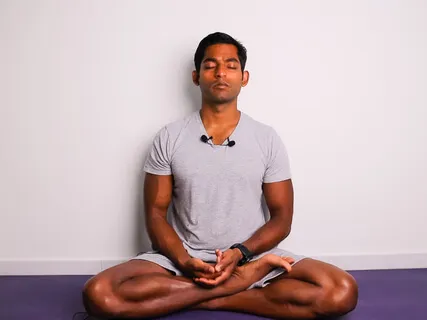
Namaste and a very warm welcome to all of you in this daily morning live meditation session with me,
Dehansi.
My salutations to Patanjali,
To the sacred knowledge of yoga,
And this opportunity for us to come together,
Take a deep dive into this knowledge,
Bring this to our life.
Those who are on this daily meditation journey with me must have experienced once in a while a glimpse of a silent mind.
A mind which is completely free of modifications.
A mind which is like the blue sky without any clouds.
Those who are on the path of meditation,
They once in a while get this glimpse,
And these glimpses become more and more,
The clouds are less and less,
And you are in the experience of life without any interruptions.
A silent mind is a mind which gives you the experience of life without any interruptions,
Without any modifications,
Without any interpretations.
For articulating,
For interpreting the experience of life,
You need the mind,
You need something in between the experience and yourself,
But that distorts everything,
That changes the taste of reality that you can have with a silent mind,
When the mind is completely calm,
Tranquil,
Like a silent lake.
This is what we are trying to establish for ourselves as the first pillar of these yoga sutras from Patanjali,
And on this journey of yoga where Patanjali has clearly emphasized to have that silent mind more and more and more,
So that your perception clears up,
So that you can see the truth,
So that you can see through the clouds or have no clouds,
And see the blue sky,
The infinite depths of the blue sky,
The infinite depths of your own being.
Let us go through a couple of sutras for today.
What that means is,
The mind becomes tranquil by cultivating the attitude of friendliness towards those who are happy,
Compassion towards those who are miserable,
Joy towards those who are virtuous,
And indifference towards the evil.
Here,
Patanjali is bringing a very clear,
Very important point on attitudes,
On what we,
When we interact with others,
The attitude that we carry in those interactions is also determining the state,
The tranquility of our mind.
So Patanjali is pointing out not in this sutra,
Not at the practice of meditation,
But how you conduct yourself.
He is saying that how you conduct yourself with others,
Determine the state of your mind,
Hence it determines your experience of life,
Hence it determines the clarity of your mind,
The inner peace,
The inner silence,
The inner awareness that you have in your daily life.
So it is important to not just have an established practice,
But also how you are interacting with others.
He says,
By cultivating the attitude of friendliness towards those who are happy,
It's a deep point because if you observe yourself in all honesty,
You will see that when you are meeting those who are happy,
That someone,
That somewhat makes you sad,
That somewhat makes you unfriendly,
Because you think that you are somewhat less.
You think as if those who are happy have taken from the world,
From the ocean of happiness,
Which has now reduced what you can have from the world.
You are in such a constant competition with everyone,
And when it comes to money,
When it comes to economics,
It can still be understood because the system is designed in such a way that one loses and you win,
You lose,
The other wins.
This is the unfortunate competition we have to live in.
But when it comes to happiness,
The mathematics of happiness does not work like this.
If the other is happy,
It doesn't mean that that has taken the happiness somewhere away from you.
So to cultivate the attitude of friendliness to those who are happy is very important.
And that can only happen when you observe yourself in those moments while you're interacting with people,
Those who are describing their happiness,
Those who are describing their joy,
Observe how you feel.
If you feel some jealousy,
You must work on changing that attitude towards friendliness.
By being truly friendly to those who are happy,
That happiness becomes your happiness as well.
You have more reasons,
You have a brighter view towards happiness,
A brighter access to happiness.
So it is important to have this sense of friendliness,
Sense of mettraya with everyone,
Especially to those who are happy because their happiness is your happiness as well.
Then he says the second point he makes within the attitudes is compassion towards the miserable,
Those who are in misery,
Those who are unfortunate and have fallen down their normal and are in a miserable state.
Be compassionate to them.
Once again,
In all honesty,
Observe yourself,
Are you feeling somewhat more important,
Somewhat bigger than you are when you are dealing with other people who are miserable and trying to help them?
That is not compassion.
That is fake,
That does not have the true nature of compassion in it.
Because that is serving your own ego that you are helping the other who is in misery.
So if you are donating something,
If you are helping out somebody who is in misery,
Observe yourself even in those moments because in those moments it is very easy for you to convince yourself how great you are,
How helpful you are,
How compassionate you are.
But that is not true compassion.
True compassion is when all your energy is flowing towards the other who is in misery.
And there is not even a thought,
There is no direction of anything flowing towards you which is serving you.
So make sure that your attitude is towards being compassionate to the other 100%,
Those who are in misery.
The third,
Joy towards the virtuous and the fourth,
Indifference towards the evil.
I think it is also important here to once again observe indifference towards the evil.
A state where we come across people who are not so nice,
People who are abusive,
People who are evil,
People who are doing the wrong things.
And when we come across those people,
If we are indifferent,
If we do not necessarily are pushing them away or trying to bring them any closer,
We are indifferent to them.
In that indifference,
That evil does not pass on to us.
In that indifference,
In that not reacting to that evil,
There is settlement,
There is the evil not getting any chance to touch you.
If you remain silent,
If you remain indifferent,
When you are coming across people who are abusing you,
Who are in an ugly state,
Who are in some sort of with an ugly motive,
Just let them be.
Be indifferent,
Give them a chance to correct that.
And you do not react to how they are,
What they are trying to do.
These are the four attitudes which Patanjali is mentioning to have,
So that you establish some tranquility in your mind.
And then along with these attitudes,
Patanjali also gives a meditation technique.
In the next sutra which is Prachardhan Vidharanabhayamva Pranasyam.
What that means is the mind also becomes tranquil by alternately expelling and retaining the breath.
So this is clearly a meditation technique,
This is clearly something that has to be practiced,
Where Patanjali is saying by bringing control over retention,
Over the flow of the breath,
That's where you can make your mind more tranquil.
You have to see that what he is referring to with breath is actually prana.
So the prana is this life force which is deeply connected with your mind,
With the states of your mind.
How your prana is flowing in your body,
If it's flowing all naturally,
Or if it's blocked somewhere,
That is what decides what is the state of your mind.
If this life energy,
If this life force,
Prana,
Chi,
Tao,
Many names in different cultures,
If this is flowing all well,
Then the state of your mind is also tranquil.
But if there is an interruption in the breath,
The mind's tranquility is also impacted.
And the other way around,
If the mind is agitated,
If the mind is all over the place,
You can see and feel in your breath that there are irregularities,
That the prana is not flowing well.
And one big access to prana is our breath.
By regulating our breath,
By bringing our breath to order,
We bring prana to order,
And bringing,
Thereby,
Our mind into order.
That is why so much emphasis on all yoga,
Meditation,
And other practices,
Other cultures,
To bring observation of the breath as a technique to constantly observe the state of your breath,
To evaluate whether you are in a state of disturbance,
Or you are at rest.
And in that observation,
You also learn how to bring yourself back,
Your breath back into a state of tranquility.
As a practice,
There is also a method to it,
Where we practice the flow of breath,
And the retention of breath in a particular sequence,
In a particular rhythm.
We will practice that today.
How we will do that?
When we inhale the breath,
We will count to four,
And we will retain the breath.
After we have inhaled,
We will retain the breath for four counts,
And then we will exhale for eight counts,
And then we will again retain the breath for four counts.
Once again,
As we inhale,
We will internally count one,
Two,
Three,
Four.
We will hold the breath one,
Two,
Three,
Four,
And as we exhale,
The count will be double,
So until eight counts,
One,
Two,
Three,
Four,
Five,
Six,
Seven,
Eight.
And as all the air is out of your lungs,
You will once again retain your breath to four counts,
One,
Two,
Three,
Four,
Before inhaling again.
Let's practice that and move into silence,
Into meditation from there.
Please close your eyes.
Make sure your posture is comfortable.
And for the next minutes,
You can focus on yourself,
On your breath.
Just take a couple of moments for the breath to become natural,
And your awareness to settle on your breath.
Draw all your attention from all different directions,
And bring them to your breath,
To the flow of your breath.
And as we observe the flow of our breath,
Let's mentally count and establish a rhythm in our breath.
Inhaling,
Four counts,
And retaining the breath for another four counts.
And exhaling,
One,
Two,
Three,
Four,
Five,
Six,
Seven,
Eight.
Hold,
Two,
Three,
Four.
Inhale,
Retain,
Exhale,
And hold.
Inhale,
Hold.
Exhale,
Two,
Three,
Four,
Five,
Six,
Seven,
Eight.
Hold.
Inhale.
Hold.
Exhale.
Do this at your own pace.
Four counts,
Inhale.
Four counts,
Hold.
Eight counts,
Exhale.
Four counts,
Hold.
Inhale,
Hold.
And with the next exhale,
Let go of the rhythm.
Allow your breath to find its natural pace.
Awareness always on the flow of your breath.
Letting it flow on its own.
Notice the mind is calmer with every breath.
Letting it flow on its own.
Letting it flow on its own.
These silent moments set your attitude towards happiness.
Be friendly.
Towards those in need,
Be compassionate.
Towards those who are virtuous,
Be joyful.
And towards those who are evil,
Be indifferent.
Let these intentions set deep in your mind,
Giving you tranquility.
Stay with awareness on your breath.
Letting it flow on its own.
Letting it flow on its own.
Simply observing the breath,
Witnessing the flow of your breath.
Letting it flow on its own.
Letting it flow on its own.
And let go of all effort.
Simply stay aware,
Stay silent.
If you wish to continue,
Keep your eyes closed.
Stay aware,
Stay silent.
Or very gently and slowly,
You may open your eyes.
Noticing the tranquility in your mind,
Remembering the four attitudes,
And taking these attitudes to your daily life.
I will see you tomorrow at 7 am,
Central European Time.
Namaste.