Hi everyone,
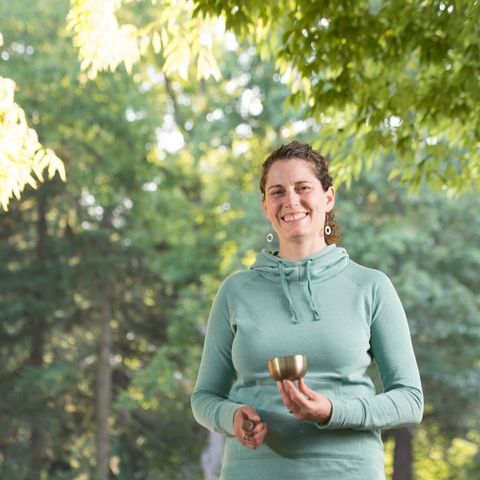
This is Dr.
Tia H.
Ho with Finding Mindful Now,
Guiding you out of your head and into your life with applied mindfulness.
Finding Mindful Now is about starting with a mindfulness practice and then seeing the capacity for us to tune in and be present with life more of the time,
Whatever we're up to.
So today we're focusing on insight showing up unexpectedly.
And with all of these I like to start with an invited arrival practice.
I call them an arrival practice because it's basically allowing through mindfulness with the body for the attention to arrive here right now in this space between us.
And today I'm going to use one of my favorite deep pressure supports called hand hugs.
For those of us with a lot of anxiety and very sensitive systems,
It can be a helpful way to gently return attention to the body without the overwhelm of a lot of sensation.
So as with any invitation,
Whether it's in this recording or with any other practice or guided mindfulness practice,
You are always welcome to change it to best fit you.
So for example,
When you hear the hand hug guidance and it's not appealing,
You are also welcome to simply notice the sensation of the clothing resting against your skin or sink into the sensation of your seat or your feet on whatever surface is gently meeting them.
Maybe you can feel the contact or the support of the ground against your feet or if you're seated whatever surface you are sitting on.
Or as I'm going through the guided practice,
You may look outside the window and let your eyes follow the motion of leaves.
You always have choice in any invitation.
So with hand hugs,
I start with rubbing my hands together and I'm going to move the microphone.
So hopefully this will catch the sound of some of these things because I know you can't see what I'm doing.
But basically what I do is I start with rubbing my hands together for a few moments rapidly,
Basically for around 30 seconds to let the blood come to the surface.
You're just doing this gently.
My hands get cold and I'm up in the Pacific Northwest on Chinook land here in the United States or Turtle Island.
Sometimes my hands get cold.
So after about 30 seconds of this quick warm up,
Then I use the palm of my hands to provide gentle and firm pressure.
So it's not feather light touch and it's also nothing painful.
And basically finding a mid range of pressure and gently pressing my hands against one another first.
So I just gently press one palm into the other palm and I just feel the temperature in my hands.
And right now as I press one palm against the other,
The very center of my palm feels warm and then the tips of the fingers feel a little bit cooler.
And that's okay.
I'm going to go ahead and tuck my fingertips in so that they're like tucked into that little spot between both of my palms where it's a little warmer.
And then I'm going to unfurl my fingers so that my hands and fingers are flat against one another again,
Gently pressing my hands together.
And then each one of these hands is going to become a small hugging implement.
And I'm gently going to put my left hand on my right forearm underneath and then my right hand on my left forearm.
And you can do it focusing on the left hand on the outer side of the forearm or the underneath forearm.
There isn't really a right or wrong way to do this.
It's just gently taking the palms of that hand,
Each one,
And gently hugging,
Gently squeezing each forearm.
And I like to move down toward my wrists and gently,
I tend to get carpal tunnel and can get really sore wrists.
So I'm gently hugging the palms of both hands,
Each of my wrists.
And then I'm going to try hugging the outside of each of my wrists with each of my hands,
One and then the other.
And then I'm going to hug gently and firmly the outside of each forearm.
And then I'm just going to move those little hugging hands up to my biceps.
And I've kind of got my arms folded a little bit in front of me and that's okay.
I'm gently pressing this hand hug on each of my biceps,
Biceps are a little bit sore.
Inhale as I press and exhale as I release.
And again,
I'm just gently taking each hand and now I'm going to move that hugging motion up from the bicep.
And again,
These invitations,
If there's one area where you just want to spend all of the rest of the time because it just wants some extra loving hug attention,
That's totally great.
I'm going to move one of my hands,
Whichever one feels good to you,
Up to the shoulders.
I'm gently,
Gently going to hug,
Gentle,
Firm pressure.
Or again,
If it hurts,
You don't need to create any pain.
Sometimes that gentle pressure can uncover soreness that you didn't realize was there and you're just giving gentle,
Firm hugs.
And I'm going to inhale and exhale as I gently move one hand up to my shoulder and I'm gently pressing the palm of that hand over my clavicle,
The upper portion of my chest,
The upper portion of my shoulder.
And then my palm can't reach that upper,
You know,
Toward where my back is so then the hug is coming through my fingers.
It's like all the fingers are pressed gently against one another so that it becomes like a flat,
Like the palm is also in the fingers in terms of that shape.
And I'm going to take another inhalation and exhalation and do the other side.
You might be using both hands at the same,
You're probably not holding a microphone so you might be using both hands but you can also do one side after another.
So I'm now taking the other hand and spending some hugging attention on that other shoulder and bicep again just because it wanted it.
And now the clavicle and the upper chest and the neck.
And if you want to give it a little bit of a massage you can do that,
It's not required,
It's just gently giving little hand hugs.
And now I'm going to take another inhalation and exhalation and I'm going to give some love to my lower and upper back,
The palms of these hands.
And then I might give some gentle hugs to my upper thighs and I've noticed that my hands are a little warmer now that I've,
Even the tips of my fingers are warmer now that I've been giving these hugs to different parts of the body.
So I'm going to end that little round of hugging and of course you can always pause this and you can keep going if you want to.
You can give some attention to your feet or your ankles or the rest of whatever portion of your body is feeling like it wants some hugs.
But I'm going to move to the next section and so I'm going to finish by pressing my hands into my face,
Basically into my face like I'm putting my hand into a warm towel.
Gently,
Gently pressing my palms against my forehead and softly into my eyes.
Again,
It's just medium pressure.
It's not,
It's not feather light and it's also not causing pain.
It's just gentle hugs like I'm pressing a warm towel or a warm blanket against my face.
And I'm going to take one long inhalation and an auditory exhalation to close that arrival practice out.
So that I can be here with you now.
So the topic of today's applied mindfulness practice is that insight can show up in any situation because it comes from inside you.
And what do we mean by insight?
So you know how the mind,
That chatty mind is so clever and creative and sometimes it will bring up the same story,
The same collection of words and sentences and just reuse them over and over and over again.
It's like you know it's kind of thrifty right there in that moment.
It's just recycling that language.
It's maybe recycling some judgments,
Recycling some storylines,
Recycling some old thoughts.
Well that creative power of the mind,
Not only can it create amazing stories that it then reuses,
But new thoughts show up all the time in this space of awareness that we are.
And sometimes that's called insight.
That's when there's some inner knowing that maybe doesn't often get recognized.
Sometimes people call this new ideas,
Sometimes people call it intuition,
Sometimes people call it following the gut.
And you know I used to think that,
You know sometimes people call this wisdom.
And I used to think that only special people had access to wisdom and insight.
That you could only get it if you worked really hard or you lived a very very long time or that you held a position of authority.
I definitely did not think that I had it.
And then some,
I met this amazing person Anna,
We were at a housing conference together and she told me you know wisdom's,
It's just built into all humans,
All people have it.
It's basically life creativity,
Life intelligence that shows up in the mind and it's innate.
It's part of the human condition.
And so I'm going to suggest a similar thing that she suggested to me.
So Anna Debenham suggested that I start noticing when I know what to do without there being internal chatter or discussion about it.
And she was reminding me that there's innate knowledge built into who we are.
You might call it the intelligence of life.
So some of that intelligence of life is the things we take for granted like a cell functioning the way that a cell functions or a cell dividing or a seed growing into a plant or humans moving through different stages of life development.
We tend to think of that as biology.
And we take for granted that there's a lot of intelligence,
A lot of wisdom that's part of that process.
And it's built into who you are.
You can access it,
You access it all the time.
It's this deep way that on an average day there's an undercurrent of knowing,
An undercurrent of life intelligence that's covered up by the chatter of the mind kind of keeping itself busy.
And sometimes you get that aha moment or some new way of understanding how the world function shows up in your mind.
And then that seems like,
Whoa,
That's brand new.
Well that's just a new piece of information showing up in the awareness that you are.
And that's often when there's a parting of some of that,
You know,
The popular tunes the mind likes to play on repeat.
So you can hear the quiet wise knowledge within.
And I invite you this week to consider various times when insight or a deep knowing showed up and it supported healing or growth or some shift in understanding even when the outer circumstances weren't a great life experience at the time.
You might think about,
We've all been,
I'm recording this in 2021 when we are still in the process of an international pandemic and it's been a very challenging couple of years.
A lot of people have not been having a great life experience and you may be one of them.
And there may still have been moments when you just knew to do something or something occurred to you and you're not quite sure why and then it supported healing or growth.
And I just want you to consider,
I just invite you to consider that this wisdom is you all the time.
It's in you.
It's part of who you are.
And you can listen to it more often.
I'd love to hear what you notice.