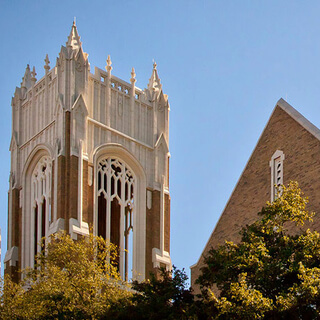
Welcome to First United Methodist Church of Dallas.
We're so glad that you're worshipping with us here today,
That you have set aside this time to give back to God and also renew your spirit in what it means to be a faithful follower of Jesus Christ.
We hope and pray that in this experience of worship,
That you have an opportunity to re-engage your faith,
Re-constitute a way of being so that as you live out your days,
In your waking and in your lying down,
That there is an opportunity for you to deepen a connection with our God.
Today,
We're focused on Psalm 1.
And in this Psalm,
We are experiencing God's grace and peace,
Not in some fantastical kind of way,
But instead through this allegory of a stream.
And so,
The question we'll end on today will be the question we begin with as well.
What may be keeping you from re-entering the flow with God?
We're so glad you're here.
Welcome to worship.
And so we begin.
We begin worship by arriving in this space.
I know that you have created a sacred space for this sacred time.
And so if it's accessible to you,
I invite you to be comfortable,
To relax in this space,
To find the grace that is surrounding and recognize the love that is here.
I'm going to guide us in an arriving meditation to fully be in this space as we enter into this time of worship.
I'll lead us through a pastoral prayer.
And I invite you to join me in the Lord's Prayer,
Spoken out loud or from your heart,
Whatever is comfortable for you.
So let's begin.
Begin by fully arriving in this space and offering this time to our God.
As it's accessible to you and comfortable for you,
I invite you to close your eyes or rest your gaze on an inanimate object.
Something that won't move so that you can be still,
Be still and know that you are loved.
Go ahead and close your eyes.
Rest your gaze away.
And begin to breathe.
I invite you to take a few long,
Deep breaths.
Just feel the movement of your breath collecting your attention.
And then let your breath resume in a natural rhythm.
Let your senses be awakened so that you're listening to the sounds around you.
I invite you now to listen inward so that you're listening to and feeling the body.
Sense now the quality of presence that is right here around you and in your body.
Find yourself in this presence.
Notice the difference between right now and perhaps when you first arrived.
Notice in this short meditation that there's much more quality of presence of here in this.
Maybe you have more of an awake heart,
Awake mind,
Awake body.
And now we turn with gratitude.
Gratitude to our God of compassion.
Whose love has no bound.
And whose presence is promised in every moment of our lives.
We pray to this compassionate one,
Recognizing that our hearts break with those who are grieving.
For those for whom pain is immeasurably deep.
For those who are experiencing loss in their lives.
That God's presence is even with those when our hearts break for the hungry.
For those who are unhoused.
For those who are incarcerated.
For those who have been told by a church or a faith community that they were unworthy of love.
Our God of compassion is still presence when our heart breaks for those who are afraid.
For those who are living in addiction and trauma.
Oh God.
Oh,
Compassionate one,
Our hearts break and break and break.
And we have caught glimpses of a world as it should be.
And it is not the world as it is.
Our greatest hope is in knowing that your heart breaks and that others of your beloveds also live with broken hearts aware of the pain and suffering of those in this world.
Allow us to let the brokenness transform us so that we can be part of a transforming world.
Re-entering your flow of grace,
Re-engaging the love that is deep and swift and everlasting.
Oh,
Compassionate one,
We unite our hearts,
Minds,
Voices and lives in the prayer that Jesus taught his disciples to pray.
Our Father,
Who art in heaven,
Hallowed be thy name.
Thy kingdom come,
Thy will be done on earth as it is in heaven.
Give us this day our daily bread.
Forgive us our trespasses as we forgive those who trespass against us.
And lead us not into temptation,
But deliver us from evil.
For thine is the kingdom and the power and the glory forever.
Amen.
Before I offer our scripture reading and passage meditation,
Let me add some context here to the book of Psalms and particularly Psalm 1.
The Psalms can be described as a collection of collections.
That's right.
It's this series of experiences with and for God.
And in these series of experiences with and for God,
They become a kind of liturgical movement.
A way to worship God,
Certainly in sanctuaries,
Certainly in guided congregational responsive readings and singing.
And also these Psalms were sung.
That's right.
They would be sung in the fields during work or on long or short passages to see family members or to Jerusalem for major life events.
These were popular songs that reminded the faithful on how God was in the flow of people's lives.
How God was essentially part of what was going on in every moment of every day in every life.
Likewise,
These Psalms are humans words to God.
Humans words to God.
Very generally speaking,
The Psalmist is writing of the Psalmist's own experience and very infrequently do we actually have God either quoted or speaking directly to the Psalmist.
So it is as if we are singing together to God out of our own experience.
And so when we enter into a sacred Psalm reading,
It's about re-entering into the rhythm of life and maybe just maybe the rhythm of your life where you begin to hear a message,
A word,
A turn of phrase,
A sentiment that speaks directly to your heart.
So that from your heart space,
You may be guided to re-enter the flow of God.
So let us begin.
Begin by reading the scripture text.
Psalm 1.
It's the very first Psalm and the very first word is happy.
Blessed,
Contented,
Blissful,
Happy.
Hear now these words from Psalm 1.
Happy are those who do not follow the advice of the wicked or take the path that sinners tread or sit in the seat of scoffers.
But their delight is in the law of the Lord and on his law,
They meditate day and night.
They are like trees planted by streams of water which yield their fruit in its season and their leaves do not wither in all that they do.
They prosper.
The wicked are not so,
But are like chaff that the wind drives away.
Therefore,
The wicked will not stand in judgment nor sinners in the congregation of the righteous,
For the Lord watches over the way of the righteous.
But the way of the wicked will perish.
Now I'm going to take one verse from our song and enter into what I'm calling a passage meditation.
This is a modified Lexio Divina.
That is a spiritual practice where we take a word,
Phrase or verse in this case and repeat it three times and listen deeply to how we respond to the words.
Responding to the words may be driving more closely to what our inner experience is in connecting with the scripture.
So I invite you to listen to my voice.
Close your eyes or read the words on the screen in front of you.
As you hear these words fall afresh on your ears.
We are like trees planted by a stream of water which yield fruit in this season.
We are like trees planted by a stream of water which yield fruit in this season.
We are like trees planted by a stream of water which yield fruit in this season.
Let's think about this song as a desert teaching.
In lands without abundant rainfall,
Vegetation flourished only where there were natural streams or humid made canals that float.
Along the Nile River in Egypt or the two rivers of Mesopotamia,
The fertile soil produced abundantly trees and they were by these streams of water and they were planted closest by the bank where their roots could dip into the stream,
The flow,
The supply of water.
Paintings from ancient Egypt depict thriving palms beside a river.
Imagine the powerful imagery and the juxtaposition of a desert landscape being watered by the flow of an unexpected source.
Luscious green foliage would prosper there.
Yeah,
This is a powerful image for the idea of God's providential source of our flourishing too,
Isn't it?
With this image,
Who wouldn't be happy?
I don't believe that happy here is a throwaway term.
I mean,
It's the first Psalm for goodness sake.
I think happy is a really powerful term here.
Its root word is in blessed or contented or blissful,
And in this Psalm there are happy,
Blessed,
Contented,
Blissful,
And there are the wicked.
The Hebrew people saw two types of paths,
The right path and the crooked path.
The right path is the shortest distance between two points and would be easy to follow.
And the crooked path is the longer path filled with peril and fatigue,
And one can easily become lost.
Those who walk on the right path would be happy.
And those who didn't,
Well,
Wouldn't.
It's really a matter of where you're planted and how you stay in the flow of what God is up to.
How God is moving through your life.
How are you planted in God's flow?
Maybe you were in contact with someone who has shown you a better image of yourself,
Or maybe you have let go of a friendship that was abusive or hurtful.
Maybe you have found yourself alone for once with your thoughts,
Your feelings,
Your perceptions,
And decided that you didn't like what you saw or heard or experienced and changed your way.
So I wonder if part of the spiritual teaching about who is happy may mean one who is boundless,
As in there are no boundaries between you and God.
Have you ever had a moment in your life where you felt like you were so unencumbered for just one moment that you were liberated,
Freed,
That you were able to take a deep breath,
Even in a difficult season?
Or you saw someone or something for what they really were,
Or you let go of whatever may have been harboring resentment,
And you freed yourself from whatever it was.
Happy as boundlessness has significant implications to how we might approach God as well.
If we approach God as one who is attempting to keep us rule bound,
Or worse yet,
Hemmed in by our sinfulness,
Then we'll never experience God as flow,
As abundance,
As a nurturing stream to be planted by.
Rather,
We see God,
Well,
As a desert,
Dry and barren and heartless and resourceless and unhappy.
I wonder if the psalmist then describes the wicked in a different way,
Not in some kind of eternal retribution,
But instead a way that the wicked keep themselves from happiness.
Because God ultimately wants us to be happy,
To be blessed,
To be contented,
To be blissful.
God wants us to be boundless.
So the question I have for you today and for me today,
What may be keeping you from re-entering the flow of God?
What may be keeping you from re-entering the flow of God?
Take a close look at those that are hemming you in,
Maybe distracting you,
Still defining you,
Causing you internal harm.
Take a moment to write down the one or two or three things that come to your heart and mind immediately.
You see,
The problem is that there's a lot coming at us each and every day,
And there's so much for us to carry.
So let's try these three practices to become more aware of what's distracting you,
Keeping you from the flow of God.
Sit in silence for three minutes.
Let your mind wander.
Don't fix anything.
No planning,
Just silence.
Let your mind do what it's going to do.
Then the second step,
Give thanks for the day.
Immediately set three daily objectives about your day.
And then in the evenings,
Sit in silence again and write down three things that you're grateful for.
Beginning our day in silence,
Ending our day in silence,
May help us fully realize the happiness that God intends for us.
The blissful,
Contented,
Boundless nature of our spirit,
Of our lives and our life in God.
As you go about your practice this week.
Go,
Go re-entering the flow of God,
Recognizing a love that never ends.
Recognizing the abundance of forgiveness and grace that is in every moment.
So that you yourself may be a beacon of light and hope for a world crying out for just the same.
May God bless you and keep you.
Amen.