Hi,
Welcome to this space within which we get to practice together.
I'm tuning in from a really lovely little island in Indonesia where there are no cars allowed and only about 80 residents.
So the sounds that you hear are of a rural,
Tiny,
Tropical island.
And I want to share that with you.
So,
Hello,
Welcome,
Let's find a comfortable seat and take a big,
Deep breath together.
And a long,
Slow exhale,
Letting your body sort of settle around its skeleton.
I wanted to just share some musings about self-acceptance.
It's such a nebulous,
Tricky thing to get a hold of,
You know,
Sometimes one minute we feel just wholly and fully accepting of ourselves,
And then the next,
That self-criticism or doubt rises like a sharp point or like a tidal wave,
However it might show up,
Sort of telling us all the things that we should or need to do or that we aren't doing well.
And so I want to cultivate in myself and share the ways in which I cultivate how we can return to that self-acceptance time and time again,
Because we're not going to live there all the time.
It's not the culture or world we live in.
It's often telling us to do more.
And so at the risk of getting caught in that and believing that,
We want to practice coming back to a foundation of self-acceptance.
So this teaching or this sharing isn't about sort of reaching a destination of self-acceptance,
It's about learning about where the life raft of self-acceptance lives in the sea of thought and shoulds and worries,
Finding that buoy,
Finding that resting place.
And then that buoy turns into a raft,
Which turns into a shore,
Which turns into a whole island like I'm sitting on,
And it gets bigger and bigger.
So it does grow.
There is utility to practicing it.
And we don't practice with this expectation that we'll be there all the time.
So we'll dip into that today,
However big that space is for you,
A buoy or an island.
We'll dip into that today,
Into our body and into our breath.
But one reminder before we do that is that there's a bit of an irony,
Or I'm not sure if irony is the word,
But with self-acceptance,
There's a bit of a ripple with it.
As we begin to accept ourselves,
We inherently become less judgmental of others.
Because if we begin believing and trusting we're deserving of acceptance,
That also means all beings are,
Because you're not more deserving of acceptance than I,
Nor is anyone else.
And self-acceptance does not generate from a sense of deserving or doing something that is acceptable.
It is actually just accepting who you are,
Where you are,
No matter what space you're in.
And so that means that everyone deserves acceptance.
And so we slowly begin dissolving judgment of others.
So you deserve,
As much as anyone else in the world,
Your love and acceptance.
And all beings deserve that.
There's an element here of trusting that even the flaws are acceptable.
Because as we begin to widen our circle of acceptance,
To include the parts of ourselves that are rusty or,
You know,
An unblunted knife that needs some sharpening,
You know?
I'm just thinking of kind of a rusty knife for some reason.
If there's parts of us that are like that,
Sharp,
Pointy,
And rusty,
Then we just accept those parts as being where they are.
And we begin there.
So all is allowed.
And that's a tricky part.
That's a tricky part.
So that's what we're going to work with today.
Amongst the sounds of the jungle.
So finding your breath,
The in-breath and the out-breath.
I'm going to invite you to lean back into your shoulders.
And I'm going to suggest on your next inhale to inhale up and out the top of your head.
So you almost imagine your inhale is going up your spine,
Lifting you up and out of your pelvis.
And then your exhale,
When you're ready,
Your exhale goes down your spine,
Vertebrae by vertebrae.
So there's this way in which on the inhale there's a bit of a lift.
And on the exhale there's a settling around the skeleton.
So the posture is awake and aware and also relaxed and settled.
Lifting up on the inhale and then exhaling to soften and settle.
Beautiful.
Let's just breathe like that for a moment together.
Finding that wave of your breath,
The wave of the inhale upward and the exhale downward.
Letting your eyeballs soften and your jaw soften.
You're sort of settling your body around your skeleton.
I heard once from a teacher,
Like a shirt around a coat hanger.
You're sort of just settling.
Beautiful.
I'm just tuning into the inhale and the exhale and I encourage you to find wherever you feel your breath most strongly.
Maybe that's the rise and fall of your chest.
Maybe that's the back of the throat.
Cold air in the nostrils.
Wherever you feel your breath most strongly,
That can be a nice anchor to return to.
Beautiful.
Now I want you to just hear the phrase,
Accepting yourself or self-acceptance.
Just let that phrase land on your ears,
Land on your heart and just notice what arises in your body.
Maybe there's a sigh of relief and a smile.
That's lovely.
For me,
I sometimes notice a little clenching in the chest or a queasiness in the stomach.
So just notice what happens in the body when you contemplate and hear self-acceptance.
Maybe you notice a furrow in the brow or maybe there's just any place in the body that just tenses a little bit.
No problem.
It's lovely that that has arisen to show us it's there and I want you to imagine your breath breathing into any place of tension,
Any place of potential resistance or confusion or doubt about self-acceptance and breathe into it like a warm,
Loving breeze.
Not intending it to go anywhere but just accompanying it,
Allowing it to be there.
And on your exhale,
See if you can soften around it.
Again,
It's allowed.
Of course it's there.
If this were easy,
We'd all do it.
So just letting that doubt or uncertainty or contrarian part of you,
The one that's like,
I don't know about this,
Accepting ourself.
What about that I need to work out more?
What about that I need to be more patient with my kids?
What about how I need to wake up earlier?
All of that.
Let's just notice that.
And on your exhale,
Soften.
It's all allowed.
Beautiful.
And then I want you,
If it's possible for you,
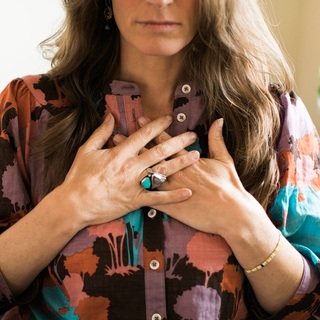
To bring your hands to your heart if that feels good or right.
Bring your hands to your heart,
Breathing into your heart and breathing into your hands.
And just gently acknowledge to these parts of you that are tense or resistant or uncertain.
Just really deeply see if you can breathe into your heart.
Exhale to soften and note internally,
I'm learning and growing.
May I accept myself just as I am.
I am learning and growing.
May I accept myself just as I am.
Noting that internally for a few rounds of breath,
Softening into your skeleton,
Softening into your heart and breath.
I am learning and growing.
May I accept myself just as I am.
Beautiful.
And as you soften into that,
Open to the possibility that everything is dynamic and living.
As you accept yourself as you are,
That is not accepting anything that is static.
You are learning and growing and changing.
That rusty knife,
Those parts of us that we would rather be different or change.
Can we on our exhale soften around those parts and trust that we'll learn and grow,
That we will polish the knife slowly over time.
We will sharpen it and we will take care of it.
We will learn and we will grow more patient and more kind.
Maybe if it serves us and is good for us,
Maybe we will start waking up earlier or exercising more.
Maybe those things will come to be.
But those don't define you or your deserving of acceptance.
So I am learning and growing and may I accept myself just as I am.
Breathing into your body,
Breathing into your heart.
Finding the inhale and the exhale wherever you feel it most strongly.
And I'll read an excerpt from Mary Oliver's poem,
Wild Geese.
You do not have to be good.
You do not have to walk on your knees for a hundred miles through the desert repenting.
You only have to let the soft animal of your body love what it loves.
Inhale and exhale.
You only have to let the soft animal of your body love what it loves.
Breathing in and breathing out the soft animal of your body.
Everybody knows how to breathe.
You can rest on your skeleton,
Let your body be breathed.
Softening into acceptance.
Releasing tension.
And I invite you as you go forth from this practice to stay curious about how showing up from this place,
Showing up in your life from a place of self-acceptance,
How does that ripple out into your life?
Just staying curious.
Lovely to practice with you.
Be well.