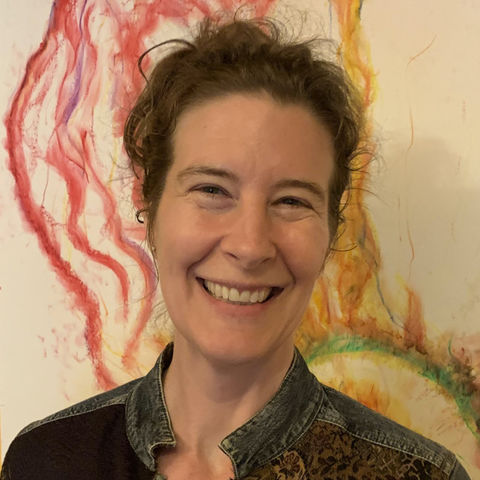
I'm Mindy Peterson and this is Enhance Life with Music,
The layperson's guide to enjoying music's benefits.
Our guest today is Pognitive Neuroscientist Julia Mossbridge,
Who joins us from Northern California.
In addition to being the founder and research director of Mossbridge Institute,
LLC,
Dr.
Mossbridge is a visiting scholar in the psychology department at Northwestern University in Evanston,
Illinois,
A fellow at the Institute of Noetic Sciences,
The science director at Focus at Will Labs,
And an associated professor in integral and transpersonal psychology at the California Institute of Integral Studies.
Dr.
Mossbridge's work has been covered in ABC News 2020,
Wall Street Journal,
Ideas in Market,
Fox News,
And other mainstream media outlets.
She has authored several books and is a peer reviewer for publications including Brain Research,
Psychological Bulletin,
And Journal of the Acoustical Society of America.
She received funding from the National Institutes of Health in her role as post-doctoral member of the psychology department at Northwestern University.
Julia has a PhD in communication sciences and disorders from Northwestern,
A master's in neuroscience from the University of California at San Francisco,
And a bachelor's in neuroscience from Oberlin College.
Welcome to the show,
Dr.
Mossbridge.
Hi,
Thanks Mindy.
This is a great podcast.
Thank you.
I appreciate that.
We Americans love productivity.
We love feeling productive.
We're proud when we increase our productivity and we're fond of anything that will get us into a flow state,
Which is also known as being in the zone,
That mental state of being fully immersed in an activity with energized focus.
Studies and brain scans have shown that certain music can bring us to a focused flow state and then keep us there,
Increasing concentration up to 400%,
Which is amazing.
Tell us about how this works.
Okay,
Wow.
Well,
So I'm the science director at Focus at Will,
And I should say from a scientific standpoint we can't say exactly how it works,
Not because it's proprietary,
But because no one knows how it works really,
But we have some hints.
You know,
We have some hints and I can talk about the hints.
Sure.
Okay.
So there are two major kinds of attention that people have that are broken up in the world of people who study attention.
And one is called endogenous attention,
Which is attention on your thoughts and ideas and internal focus.
Is that similar to indigenous?
Oh,
The root is similar.
This is endogenous,
E-N-D-O,
Rather than I-N-D-O,
But it means sort of within,
The within focus.
And then there's exogenous,
Exo,
Like exoplanet,
Which is focus outside of you.
So your endogenous and exogenous attention,
You always have some of your brain is focused endogenously inside and some of your brain is focused outside and that's safe,
Right?
You never want to be in a situation where you don't have any focus on what's going on around you.
Like even a deep sleep,
If a fire alarm goes off,
Your exogenous attention system wakes up and wakes you up,
Right?
Yeah.
But you also want to always have some focus on what's going on inside because you might have a prediction or a thought or an idea about what you should do best in a situation.
Like the fire alarm goes off,
It wakes you up and then you have endogenous thoughts about,
Okay,
I have to get my kids together.
I have to get my stuff together.
So those systems work together and you always need some activity in both.
But in this current world that we live in,
In the West,
Exogenous attention,
Which is the one that's focused on outside of you,
Really dominates during our days.
So like these notifications we get on our phones and our computers.
Yeah.
Total exogenous attention stealers,
Right?
To the point where you could start to be completely dominated and pulled exogenously outside of you without having any time to focus on inside of you,
Which is where the good creativity,
Productivity focus on what you're trying to do.
Yeah.
Boy,
That's for sure.
Yeah,
Exactly.
That's kind of a description of our society right now.
It's like constant ping,
Ping notification here.
That's right.
And these ping pings,
The reason they are auditory is because your auditory system is your first warning system.
But your visual system,
When your eyes are closed,
It can't give you any warnings.
Or when something's too far away,
But it doesn't even have to be that far away,
There's no warning because you can't see it.
But auditorily,
360 degrees around our head and through the very far distance,
We can get warnings about things.
So that's why all these notifications are auditory.
But they're stealing our chance at having any kind of endogenous focus at all.
And so you can get into this place where you almost become addicted to those exogenous pulls because your endogenous system forgets how to function.
And so you think,
Oh,
You get adrenalized every time you get a notification or a click or a ping.
You're looking for the next one and the next one and the next one because you've forgotten how to get that same kind of satisfaction from your internal focus.
So that's a long way of saying that you can use the auditory system,
Even exogenous input,
Outside input like music,
You can manipulate the auditory system so that even using this outside input,
Perceptual input,
It turns your focus inwardly.
And so that's actually the trick of,
For instance,
Lullabies.
When you hear parents sing a lullaby to their young children,
Even if they're just making up the words,
It's rhythmic,
It's soothing.
There are no quick changes in tempo.
There's no quick changes in the pitch.
There's nothing surprising.
There's nothing depressing.
And there's actually nothing too that's too joyful either.
It's like la,
La,
La,
La,
La,
La,
La.
And that's all with good reason because what they're doing is they're using the exogenous attention system,
Which is activated in a kid who wants to stay awake to actually put the focus endogenously,
To pull away from and say,
Look,
You know what?
It turns out everything's okay out here.
We're just going to repeat the same rhythm over and over.
Nothing's a big deal.
Everything's fine.
You know,
That's basically what the lullaby says.
And so what Focus at Will has done is take it from a lullaby from something that is also,
By the way,
In training infants to fall asleep,
They took it out of the fall asleep range,
But kept all the other components of no big emotional shifts,
No big changes in tempo or pitch.
Just telling your exogenous system,
You know what?
Everything's fine out here.
Everything's fine.
You can focus inside.
And it's a real powerful tool.
I actually didn't become the science director of Focus at Will randomly.
I started listening to their streaming audio to help me focus.
Oh,
Really?
Yeah.
I was writing papers.
Yeah.
For my postdoc,
I was writing papers at Northwestern and I'm like,
Oh,
I have to push through this.
This is boring.
And I would put on the Focus at Will and it worked so well that I emailed the CEO and I said,
What are you doing?
Do you have some biblical messages or what?
And he saw that I was at Northwestern and saw my background and he's like,
We need a science director.
Do you want to find out how this works and do some experiments?
Oh,
That's fascinating.
That's pretty cool.
Yeah.
And I said,
Yeah,
I do.
So I did several experiments.
I mean,
I already could understand the endogenous and exogenous thing just from listening,
But I wanted to know,
Is it a placebo?
And I did some experiments related to creativity and related to focus and related to task switching and related to prediction and found out that on some tasks,
Focus at Will didn't make a difference at all compared to sort of regular music that people would listen to.
But on other tasks,
Like task switching,
People did not want to switch tasks when there was something to Focus at Will.
And yeah,
And with creativity,
That was my favorite result was with the creativity.
People were blind,
What I had was blind judges who figured out,
You know,
What is the score for this particular creative idea when people were listening to Focus at Will versus music.
And they didn't know whether it was Focus at Will or music or even the purpose of the experiment.
But what I found is a statistically significant increase in higher rated quality,
Higher quality rated ideas when people were listening to Focus at Will.
That's super fascinating.
Wow.
Yeah.
Yeah.
So I think creative minds,
I could see being more likely to jump around more.
Is that true or not?
Well,
You know,
There has to be a certain flexibility in a creative mind.
So there's creative minds that have lots of ideas,
But never do anything.
Okay.
And then there's creative minds that have lots of ideas and actually can execute and bring things to completion.
In order to do the latter,
Which is the kind of creativity that we tend to like in the West because of course it's productive.
In order to do the latter,
You need both the flexibility to have the ideas come in and the focus to say,
Okay,
I'm not thinking about that right now.
I'm doing this.
I'm channeling the ideas into this outcome.
So task switching,
Which is changing.
I'm answering emails.
Okay,
Now I'm talking on the phone.
Okay,
Now I'm analyzing data.
Okay,
Now I'm talking to a friend.
That's task switching.
Task switching is not the friend of getting things done.
Right.
But idea fluidity is,
And my sense,
What I was measuring in this experiment was not your,
In the creativity part of this experiment was not your productivity,
But just your idea fluidity.
And that was enhanced by focus of will,
But other parts of that experiment not related to creativity showed that task switching was actually reduced.
So there's something going on.
I keep thinking that we're just at the very beginning of understanding this stuff.
And the more we understand how audio really influences mood and cognition and memory and everything,
The more we'll start to see different snippets of audio as like superfoods.
Yeah.
I remember you're reading that quote of yours that you saw music as being the new superfood.
I want to hear more about that before I do though.
I'm really intrigued by this idea fluidity phrase.
So you talked about task switching and idea fluidity.
They're two different things.
When we think of the term multitasking,
Is that just task switching or is idea fluidity and task switching sort of different sides of the same multitasking coin?
When we talk about multitasking,
We're usually talking about tasks that you could observe from the outside of a person.
So I could tell if you're talking to me or if you're looking in the dictionary or if you're driving a car or if you're trying to do all three at once.
So I can see from the outside.
Whereas idea fluidity,
That's inside the person.
No one would have to speak,
But I can have a lot of idea fluidity going on.
Yes.
Interesting.
Okay.
So music is the new superfood.
Talk to me about that.
I like that.
Well,
Yeah.
I mean,
Again,
Once we slowly but surely start to recognize that shaman and medicine people who in the past would chant or produce drumming or bells or other types of music to try to influence people's state,
Physical,
Emotional,
Mental states.
Once we start to recognize that they were onto something,
As a scientific culture,
Once that gets more recognized,
I think there will be a lot of study about how to use music to manipulate those things.
Right now people are very focused on directly trying to manipulate the brain.
But interestingly,
For thousands of years,
People have manipulated the brain through words,
Music,
Sound,
And that feels pretty safe to me compared to sticking electrodes on the brain or something.
Sure.
Yeah,
Definitely.
So it feels to me like a pretty nice way to go low intrusion,
High effect.
Yeah,
Definitely.
Now another way that I saw the focus at Will Science Music described was the key to the science behind their music working is it's keeping your mind from being distracted away from your work while simultaneously keeping you from habituating to your work,
Which I thought was kind of.
.
.
I mean,
We all know what distractions are.
Habituating to your work though is kind of this getting used to either your environment,
Your surroundings,
Or the project that you're working on,
And our brain's always seeking novelty.
And so the habituation leads us to checking social media,
Opening our email,
Calling a friend.
Is that right?
Yeah,
I mean,
So there really is a cycle of work and rest that is necessary to be productive.
And so I don't want to give the impression that if you're perfectly productive,
You will just work constantly and never change your task.
I don't think the human mind is built that way.
I think you're much more efficient if you.
.
.
The Pabodoro method,
Like working 25 minutes and then doing something for five minutes,
Doing something else.
It's just that it's the something else that people do that gets us in trouble.
So if you're a writer and you're working on writing for 25 minutes and then you take a break and you go,
Okay,
I'll check my email,
That's not a something else that is a rest.
Okay.
Right?
Good.
Yeah,
It is good to make that distinction.
You're right.
And that the science-based focus music is used by employees at Google,
Apple,
Tesla,
Microsoft.
Oh yeah,
All over Silicon Valley.
Sure.
A lot of engineers love it.
A lot of creative people.
It's interesting.
A lot of creative people love it.
A lot of engineers love it.
And people tend to think of engineers as not being creative.
But at least my data suggests that this can actually be boosting their creativity,
Which would be really good.
Oh,
Okay.
So at these different companies,
Is Google,
For example,
Piping certain music throughout the facility or is it like there's the subscription that Google has and every employee can set their own music and put it in their earbuds?
People who have a subscription,
I'm not sure they have a corporate wide subscription,
But if they do,
Regardless of whether it's individual or corporate wide,
It's always,
If you like it,
It works for you,
You use it.
At Focus of Will,
We are very clear that this doesn't work for everyone.
Okay.
So it works for probably about 75% of people.
So it would not be a good idea to force people to use this because if it doesn't work for you,
I mean,
There's multiple channels of Focus of Will,
So usually people could find something that works for them.
But if nothing works for you there,
We're like,
Okay,
Great.
Use silence.
Sure.
Sure.
One thing that I thought was interesting too is the science-based music doesn't only help us focus and maintain productivity,
It helps retain information when working,
Studying,
Writing and reading.
Is that right?
Yeah,
I think that's right on an anecdotal level.
Okay.
The scientist in you is being very careful about saying blanket yes.
People stand by this and it is the case,
I mean,
So I'm thinking back to some experiments.
So I did a word study experiment,
Word memory experiment with Focus of Will,
And it looked like there was a little bit of a difference,
But it wasn't to my standards.
So yes,
Probably a normal person who wasn't worried about precision would say that it would help retain words,
Yes.
Okay.
Okay.
All right.
No,
That's fine.
I am going to link in the show notes to several different articles that I read that were really fascinating.
One is called The Benefits of Streaming Music Through Your Office.
One is The Science That Powers Focus,
The Mind,
The Music You Should Listen To During Revision to Improve Concentration Levels by as much as 400%.
And then the one that I had referenced with you in our emails back and forth,
Einstein versus The Clash,
How I Used Music to Hack My Brain.
I get my brain waves scanned to see whether a concentration app that uses music can help achieve that all-important flow.
Now,
One thing that I thought was interesting in this article is looking at your brain scan,
You asked the author of this article if he was a musician,
And before you could answer,
You told me that you knew he was not.
And you said,
I just knew that from your brain.
So how do you know that just from looking at some of these brain scans,
If they're a computer map?
Let's see.
And that experiment,
It was hardly a real experiment.
It was more like a demo.
I just had his EEG from like,
I think,
Four electrodes.
So it was pretty,
I had scanned data.
So what I meant was,
And I would never publish this or anything,
But this was anecdotally talking to a reporter.
What I meant was,
When I look at EEG from musicians,
When I play them music,
Both their left and the right hemispheres tend to be working.
They tend to look,
At least in terms of a gamma frequency that I was looking at in that article,
They tend to be looking very similar,
Like at the same level,
Activated at the same level,
Whereas he did not.
His right hemisphere was active,
Which is commonly in right handed people,
Where you would see activity for processing music,
But not so much as left hemisphere.
Okay.
So yeah.
So I thought,
Hmm,
Probably not a musician.
I was taking,
I guess.
You know,
He sort of took it as,
Oh my God,
You can see everything about me.
Can you tell from my brain scan about me?
Exactly.
Well,
Yeah,
This is all very fascinating.
We have an improv segment on the podcast.
That's a Try This at Home,
A Hack,
An experiment that will enhance listeners' lives with music.
And I understand you have a description of sort of an experiment that listeners can do after listening to the show.
Can you tell us about that?
Yeah,
Absolutely.
You can go to focus at will.
Com.
It's just F-O-C-U-S-A-T-W-I-L-L.
Com.
And there's four areas.
Like we said,
We kind of have identified four sort of broad types of people.
So creative thinker,
Logical thinker,
Entrepreneur,
Students.
And then you go down a tunnel and it starts to ask you questions and you can listen to samples of music that we know kind of usually works for people in those categories.
So it's fun just to listen in to see if we're right.
And if you have ADD or you have a child with ADD,
Drill down until you get to the ADD channel.
A lot of people swear by it.
Really?
Yeah.
I listened to that and I was like,
Oh my goodness,
How could this be helpful for our country?
I know.
But it's kind of like,
You know how people with ADD sometimes will take Ritalin or these things that are actually stimulants and that calms them down?
Yeah.
The music is the same way.
The ADD channel is the same way.
Yeah.
Oh,
Fascinating.
Okay.
So I've really had a blast listening to those different quadrants.
I wasn't exactly sure which one to put myself into.
I think I,
Because I feel like I have some creative thinking,
But I'm also a logical thinker and I think I went with a logical thinker,
But I really liked the alpha chill was my favorite,
But I did take that little quiz that you can take.
Yeah.
And that told me your focus personality predicts the electro box channel can increase your work productivity,
So I was like,
Well,
I'll be interested to try them both.
Well,
Try them both.
I wrote that algorithm that figures out your profile and it's not a hundred percent correct.
It is highly statistically significant above chance,
But it's not a hundred percent correct.
So you try them both and see what works and over time we'll make that better.
So yeah.
Fun.
How can listeners learn more about your work and connect with you and also more about Focus at Will?
Sure.
If they want to learn more about your work,
They can go to Mossbridge Institute.
Com on the web and they can sign up for my newsletter and Focus at Will,
Focus at Will.
Com.
Check it out.
It's a really amazing tool,
Especially when you're procrastinating something.
Or you just need a break,
Like a scheduled little break for the brain,
Right?
That's right.
And you're on LinkedIn also,
Right?
Yeah.
Okay.
All right.
Well,
We end each episode with a coda,
Which is a song or a story of a moment that music enhanced your life.
And this comes from the guest.
And I was fortunate to be able to get from Focus at Will a couple different samples of their most popular focus music.
One of them is called Einstein's Genius.
And Albert Einstein is well known that he used music and violin playing to focus and get into a flow state.
So in researching this topic,
I saw his name all over the place and it makes sense that one of these focus music themes would be named after him.
So Einstein's Genius and then Alpha Chill,
Which I was excited to see that because that was my favorite.
So what I'm going to do is I'm going to play about 30 seconds,
A 30 second sample of Einstein's Genius.
And that'll kind of fade out of that and into a 30 second sample of Alpha Chill.
Focus at Will is offering a special discount for enhanced life of music listeners.
If you use the code ENHANCE15,
Listeners of the show can get 15% off the current available price right now at $69.
95 for I believe that's a one year subscription and it comes with a seven day trial period.
So taking off that 15% brings the price down to about $59.
46 for the annual subscription.
In order for that code to work,
I'm told that listeners do need to sign up from a desktop or a laptop computer and not a mobile phone.
And then once they've signed up using that code and they've gotten the discount,
Then they can download the app and log in using mobile.
So thank you to Focus at Will for that little discount.
And hopefully a lot of people will take advantage of that and experience this focus flow state inducing music.
Here is Einstein's Genius and Alpha Chill.
Thank you listeners for joining us today.
I'm excited to feature one of you again on this week's show.
Each episode includes an improv from our guest,
A try this at home experiment or hack that enhances life with music.
We recently began also featuring listener submitted improvs.
Today's listener improv comes from Ross in Maple Grove,
Minnesota.
Ross left a comment on our website saying,
A way that we use music in our everyday life as a family is to sing a brush your teeth song while brushing our son's teeth.
He never fights us during it and he knows just how long to brush his teeth.
Okay,
I'm wishing I thought of this when my kids were young because I have vivid memories of my son clamping his teeth down on his toothbrush every time we tried brushing his teeth.
I think it started as a protest because he didn't want his teeth brushed,
But then it became about getting this predictable reaction that he always got because yes,
We did need to brush his teeth.
We ended up finding a way to make the process entertaining for him so that it wasn't a fight every time.
But I will say our method required much more energy and imagination every tooth brushing event.
So I really wish I would have thought about this.
Speak up a song or find one on YouTube and you're set.
The kid finds it entertaining and fun and knows exactly how long to expect the process to last.
Thank you,
Ross.
Let me know how you enhance life with music by leaving a comment on my website,
Mpetersonmusic.
Com slash podcast by commenting on social media.
I am on Instagram,
Facebook and LinkedIn or by email,
Midi at mpetersonmusic.
Com.
Links are included in the show notes as well as details on Focus at Will's discount offer to listeners on my website,
Mpetersonmusic.
Com slash podcast.
I look forward to hearing your ideas and including one in next week's episode.
In closing,
Remember there are 700,
000 active podcasts right now,
Yet many are so niche that whenever I find one I really enjoy,
I feel like I found a new friend.
If you like what you hear on the show,
Please help others find this needle in the podcast haystack by telling a friend or sharing on social media.
Word of mouth really is the most effective influencer.
Until next week,
May your life be enhanced with music.
I really appreciate your time and this is really fascinating.
I mean,
The fact that you approached Focus at Will and said,
Hey,
How can I be involved in this?
I didn't know that.
That's really cool.
That is cool.
Yeah.
I just,
They're really cool people by the way.
Are they?
Yeah.
Oh great.
Yeah.
Yeah.
I mean,
They're just,
Just fantastic.