Welcome to the Mindfulness Meditation Podcast.
I'm your host,
Dawn Eshelman.
Every Wednesday at the Rubin Museum of Art in Chelsea,
We present a meditation session led by a prominent meditation teacher from the New York area.
This podcast is a recording of our weekly practice.
If you would like to join us in person,
Please visit our website at rubinmuseum.
Org slash meditation.
We are proud to be partnering with Sharon Salzberg and teachers from the New York Insight Meditation Center.
In the description for each episode,
You will find information about the theme for that week's session,
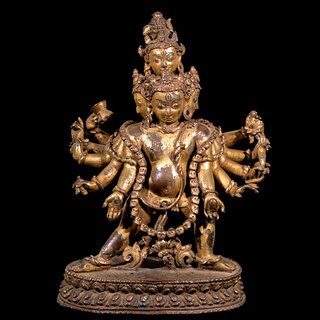
Including an image of a related artwork chosen from the Rubin Museum's permanent collection.
And now,
Please enjoy your practice.
Welcome to the Rubin Museum of Art and to our weekly mindfulness meditation practice.
My name is Dawn Eshelman.
It's great to have you all here.
And it's the greatest to have our beloved teacher,
Sharon Salzberg,
Back with us.
Welcome back,
Sharon.
We're talking about compassion this month,
And I can feel it in the room.
It's here.
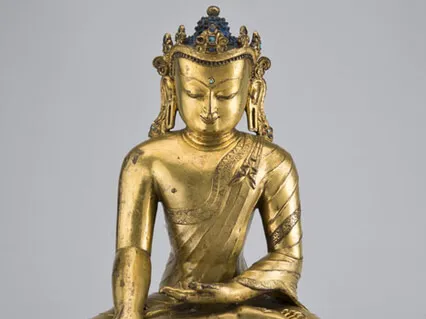
The incredible statue behind me is such a beautiful depiction of this concept.
And we're looking,
Of course,
At the Shakyamuni Buddha at the moment of his enlightenment.
And we see that he's seated on his lotus throne,
Reminding us that symbolism of the lotus,
That while we might be rooted in muck,
That it can actually be very nutritious.
And we can bloom.
We can bloom at the top,
Right?
He is seated in this meditation pose,
Of course,
And with one hand in his lap in a meditation gesture,
And the other hand touching the earth.
And he wears both the monk's robes as well as his princely crown.
And it's interesting,
We don't always see the Buddha depicted this way as both the kind of in the austere fashion of the monk and also the princely kind of royal fashion with the crown.
And the crown reminds us of his roots as a prince.
Of course,
He did give that all up to seek enlightenment.
And the crown also is something that is often used to depict a bodhisattva,
A being who is enlightened but chooses to remain on earth to help others to enlightenment,
Kind of the greatest act of compassion.
And then also the crown kind of represents also that enlightenment,
Right?
This moment that he has achieved here sitting under the Bodhi tree after many trials and tribulations and just that gentle touch down right on the earth,
Asking for the earth to be its witness.
So Sharon,
We're so happy to have you back.
And we all know all about you.
But anybody new here today?
Is anybody first day?
Oh,
Welcome.
Great.
You're here on a very auspicious day.
Sharon Salzberg is the co founder of the Insight Meditation Society in Berry,
Massachusetts.
And she is a beloved teacher and author who has written many wonderful,
Wonderful books,
Including Real Happiness at Work and Real Love.
She writes for Unbeing and the Huffington Post.
And we love her to bits.
Please welcome her back.
It's so lovely to be back.
When I walked into the building,
I thought,
Oh,
I'm really back in New York.
This is real now,
Which is a fantastic feeling.
So hi.
I think I get to be here twice this month talking about compassion.
So in my mind,
I was kind of dividing up the topic because it's so huge.
And one could speak quite a lot about compassion.
So I thought for today,
I would talk about self compassion.
How many of you have never been here before for one of these?
Okay,
So I'll just speak for about 10 minutes or so,
And then we'll sit for about 20.
So normally when we think of compassion,
Well,
These days,
It's a little more complex.
We think,
Of course,
Of compassion for others.
But there is a kind of growing movement having to do with self compassion.
And what could that possibly mean?
And can that really serve as a foundation for compassion for others?
So I thought I'd start there.
And then the next time we were together,
Then I would really talk about compassion as a kind of larger force in the world.
Because one of the things I see in myself looking back over,
Especially things I write,
Is that I have a,
I think,
A kind of mischievous side.
And I like to take words that I feel have been used now more strangely or in some way that I don't agree with or in some,
From my point of view,
Some distorted fashion and sort of poke at it,
You know,
And say,
Well,
Can we reclaim this word and use it in a different way?
Like even love or loving kindness or kindness or faith or qualities like that.
And compassion is certainly one of them.
I'm told that if you Google compassion,
And you know,
Google will offer you very quickly what it thinks you're looking for,
Because so many people have searched that very thing.
And so if you Google compassion,
Very quickly you'll see the suggestion of compassion fatigue.
That's what they think you're interested in because so many people are.
And when it comes to compassion for oneself,
It's,
It's so often equated with a kind of laziness or complacency.
I've taught many a time where somebody will raise their hand in protest and say,
Well,
That's just laziness,
You know,
To say,
Oh,
I've made a mistake and have compassion for yourself and move on and be able to begin again is not necessarily seen as resilience,
Which is what it actually is.
But more as a kind of like,
Oh,
Yeah,
I made a mistake.
I'll just forgive myself.
It's okay.
I'll make another mistake in two and a half seconds.
Doesn't matter,
You know,
Because I'm being kind to myself.
And,
And yet,
I think if we really start to understand,
I'm told that studies show that the kind of internal or external environment,
If you're trying to learn something new or make improvement in something or change a habit or something like that,
If the internal and external environment kind of harsh,
Punitive,
Stressful,
Your performance will spike,
But briefly,
And then you'll crash.
That the best way to have a sustained effort toward making a difference in some way is not that kind of stressed out harsh environment,
But it's an environment of compassion.
It's not laziness at all.
It's recognizing this is a part of life,
You know,
It's like,
Kristin Neff,
Who really helped develop strongly the notion of self compassion in Western psychology.
These days,
You know,
She,
She talks about three elements of self compassion.
And interestingly enough,
It's,
It's very different than self esteem,
Which comes into play,
You know,
You think,
Wow,
I learned how to play tennis,
Or I finally learned 18 new words in Spanish.
That's great,
You know.
And that is an important thing too,
Because we can really disparage ourselves endlessly and not pay any attention to our accomplishments or the ways we're trying and things like that.
But self compassion comes into play when we've blown it.
We've made a mistake.
You know,
Meditation classically would be you sit down with the intention to feel the sensations of the in and out breath.
And before you know it,
You're in India,
You know,
And you're doing the tour and you're learning how to cook and,
You know,
And then you burn the chipotti and then you kind of wake up,
You know,
That's the moment we need self compassion,
Not over attainment or realization,
But over distraction,
Having gone far away from our intention or our aspiration,
Having blown it in some way.
And it's really,
It's not like remedial,
It's not,
You know,
Because you don't have courage or something like that.
It's really because that is the best way to be resilient to kind of pick up to start over.
In meditation,
Again,
You know,
The common experience would be sit down with the intention to feel the breath.
And very quickly,
You go to India,
Let's say,
And then you wake up.
And you start berating yourself for having gone into that fantasy.
Why am I thinking I'm always the only one who's thinking no one else in the room is thinking.
I'm always you know,
I'm gone somewhere and you know,
Maybe they are thinking but they're thinking they're having beautiful thoughts,
They're having profound thoughts.
I'm having these stupid thoughts.
I'm never going to go to India anyway,
Not not this year.
And why am I thinking about it all I just think,
You know,
And so getting lost in that not only extends the period of the distraction,
Sometimes considerably,
But it's so demoralizing.
We're just so tired,
You know,
So if we look in a realistic way,
What depletes us?
What kind of brings us down has this feel more isolated or more shattered?
And what renews us?
What helps us start over or reach out?
It is self compassion.
So so the first element is mindfulness,
It's awareness of what we're experiencing.
And then there's kindness in response.
And then she has this interesting element,
Which she calls common humanity.
You realize it's not just me,
Which is what we tend to think I am the only one who's ever had such a nasty thought.
You know,
I'm the only one who's ever had a wandering mind and meditation or I'm the only one who's ever been afraid,
Or whatever it might be.
And so you realize you're not the only one,
You could never be the only one.
And,
And it's those three elements together,
It's awareness of what we're experiencing,
And kindness and response to it.
And then that sense of common humanity to combat the very frequent sort of isolation that comes when things are hard,
And you're in some kind of adversity,
You'll see that that different relationship to what's happening forms a tremendous difference in,
In our whole experience.
And so one of the things Christian has,
Has him do is,
Well,
Lots of ways of doing this,
You know,
One is to imagine your friend is sitting in a chair next to you.
And you begin to speak to them the way you normally speak to yourself.
And then you think,
Oh,
Maybe that's a problem.
You know,
You can write a letter,
I mean,
There are all kinds of ways of doing it.
But it's basically that sense to realize,
Oh,
We're so hard on ourselves in a way that is not productive,
It's not onward leading.
And so it's a kind of grand experiment.
And again,
You know,
It only features in times that are sort of a struggle.
And here we are,
You know,
It's a tremendous opportunity,
Not only to develop qualities,
You know,
Around balance and so on,
But,
But to really see,
What is it to be kind to myself in this moment?
And is it what I've always seen it portrayed as or believed it to be?
Or what's the strength in that?
And,
And how can I cultivate that?
So that's where we are.
So let's sit together.
And really,
We can go back to the fundamental practice and it's all right there.
If you sit and rest your attention on just the normal natural breath,
You don't have to try to make your breath deeper or different.
If you find the place where the breath is strongest for you,
Like the nostrils or the chest or the abdomen,
Just rest your attention there.
See if you can feel one breath,
The actual sensations of the breath.
And notice what it's like when you realize your attention has wandered.
You've gone to the past,
To the future,
To judgment,
To speculation,
Or you've fallen asleep.
You can just observe,
Hear that voice,
How do you speak to yourself?
And if you find a kind of perfectionistic nag,
See if you can soften,
Remind yourself,
This is what happens,
This is how minds are conditioned,
Not only my mind.
Let go more gracefully and begin again to feel.
And finally,
Invite yourself,
Get more message.
And you'll see that when you reach out to us,
This will help you.
Thank you.
Thank you for listening.
Have a mindful day.