Welcome to the mindfulness meditation podcast.
I'm your host,
Dawn Eshelman.
Every Wednesday at the Rubin Museum of Art in Chelsea,
We present a meditation session led by a prominent meditation teacher from the New York area.
This podcast is a recording of our weekly practice.
If you would like to join us in person,
Please visit our website at rubinmuseum.
Org slash meditation.
We are proud to be partnering with Sharon Salzberg,
The teachers from the New York Insight Meditation Center,
The Interdependence Project and the Shambhala Center.
The series is supported in part by the Hemera Foundation.
In the description for each episode,
You will find information about the theme for that week's session,
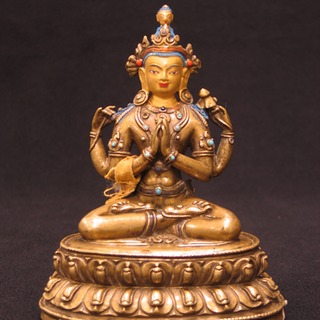
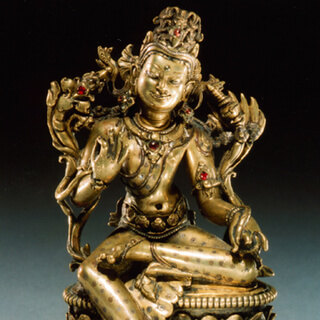
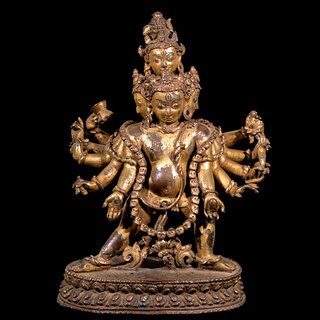
Including an image of a related artwork chosen from the Rubin Museum's permanent collection.
And now,
Please enjoy your practice.
Welcome to the Rubin and to our weekly mindfulness meditation practice.
Anybody here for the first time today?
Welcome.
Wow.
Great.
And welcome back to those of you who have been here before.
We each month select a different theme to explore together.
Last month was all about love.
It was fun.
And this month,
We're talking about listening.
And I'm really delighted that Sharon Salzberg is our teacher today because I think she will help us bridge those two subjects in a way that is really quite beautiful.
I'll let her talk to you about that.
But for those of you that don't know,
We have recently opened an exhibition up on the sixth floor and all around the museum,
Really,
That is all about sound.
It is called The World is Sound.
And it explores the concept of sound as matter throughout Tibetan Buddhism and also through the lens of contemporary sound art.
And it's also about this act of listening.
So not only are we exploring what sound is,
What it means,
And again,
Through Tibetan Buddhist lens,
The symbolism there about change and impermanence,
The utilization of sound in ritual.
But here,
We're being asked by this exhibition to really consider how we listen and what it means to listen.
We can listen with our ears.
We can listen with our physical bodies and feel vibration.
What does it mean to listen from a spiritual point of view?
What are the social ramifications of listening?
And it's an exciting thing to be talking about right now,
I think.
The phrase liberation through listening is something that you will come across in this exhibition as well.
That relates to the Tibetan Buddhist practice of the bardo,
Reading the bardo aloud to a person as they pass on,
As they die.
This is a common practice.
It takes many days of reading the bardo or the Tibetan book of the dead aloud to a person as they pass.
It's a common practice.
And the idea there is that listening can be a gateway to enlightenment.
And so it is a very central and important element to Tibetan Buddhism.
We're looking at an object that is central to the exhibition.
This is a beautiful mandala.
And in fact,
It is used in particular practices of meditation as a visual object of meditation.
We won't be using it that way today because we're not practicing that type of meditation here together.
But I think it's worth noting that indeed this is part of the reason that this object was created.
And at the center of the mandala is Manjushri,
Known as the glorious one with a melodious voice.
Manjushri has eight arms and four heads just pointing out and symbolizing his vast ability to see clearly and to take action.
And when practitioners who utilize this object as a visual element in their meditation,
When they are advanced enough in their practice,
The idea is that they will be able to talk and converse directly with this fully realized Buddha in the middle of this mandala.
So let's learn a little bit more about listening and what that means maybe in our daily lives and in our own meditation practice.
I'm so delighted that Sharon Salzberg is back with us.
And of course,
We know her as the co-founder of the Insight Meditation Society in Barre,
Texas.
And she's been studying and teaching for many decades.
She is the author of wonderful,
Wonderful books,
Including the very recent Real Love.
Please welcome her back,
Sharon Salzberg.
Hello.
It's so bright,
How wonderful.
I don't know if you know that when somebody is going to speak in one of these Wednesday events,
We're sent a selection of art to choose from to decide what's going to be up on the screen.
And I was looking at this thinking,
I think I chose this because of the colors.
It's true.
There's something about it that just looking at it put me in the most receptive kind of calm mood.
And I thought,
Oh,
That's a really good thing.
I'm not a scholar and I don't understand the symbolism of all these things,
But we have dawn for that.
So that's a good thing.
I just love the colors.
So listening,
Which seems to be at the heart of the matter.
Many years ago,
I came upon a quotation from this theologian,
Howard Thurman,
Who said,
Look at the world with quiet eyes.
Look at the world with quiet eyes.
And I just love that.
I wanted it as a book title for something I was working on.
And the publisher didn't like that.
They said,
No one will understand it because we listen quietly.
We don't look quietly.
But I tend to say that in case anyone is looking for a book title because I still think it's a great book title.
It's so beautiful.
And what if we had that sense?
So many times when we look at something,
It's almost like those cartoon characters whose eyes are out on springs.
I need one of those,
Maybe three of those.
Whereas if we have that sense of being more receptive,
Taking it in,
Not rushing to judgment.
But we have a very different way of looking.
And interestingly enough,
Listening can bring us there very quickly.
It's often done as part of a meditative process where we can see the difference between hearing a sound and it is like something washing through us.
And unless we are immediately responsible,
Which I suppose we could be,
For responding to the sound,
We can just let it wash through us.
Sometimes people fear that in the interest of mindfulness they will not pay attention to say a smoke alarm or something going off.
But I can assure you,
You will.
So let's say you don't have to pick up that phone and you don't have to respond to something.
Then the sound takes us to,
Listening to the sound with quiet ears in effect,
Takes us to a place of,
It's a very spacious place where many things can come and go and we allow them.
We're kind of interested or connected to them.
Now think about taking that capacity to a conversation,
To meeting a stranger.
It doesn't mean you never respond.
It doesn't mean you never react or do anything based on what they've said.
But we know what it's like,
All of us,
I think,
Really,
To go into a situation with a very big agenda,
Say,
About the impression we're going to make.
And so we are hardly listening to anything that's being said.
We're waiting for our moment to drop the statistic or the amazing thing we read on Twitter or whatever.
I was just sitting here and I had this kind of completely humiliating memory,
But also very poignant,
Of being maybe 13 years old,
Something like that,
Maybe a little older,
And trying to memorize jokes so that I could be witty.
Of course,
I never had the nerve to tell a single joke.
But I think about that effort,
You know,
Like,
Let me say something that would be so impressive.
And I think,
How sad is that?
When you think about connection as an adult or somebody who's lived something,
Lived through some things,
You really want a connection to be authentic,
Right?
Not a kind of pretense of some presentation,
Because what happens next?
If it's that you're up all night looking for jokes or you've read the same joke book and they know exactly where it came from,
Or,
You know,
It's not born of the moment of something that's actually happening.
And so we find that one of the most powerful ways to actually have an authentic connection with someone is to listen.
Otherwise we don't discover who they actually are.
And they don't discover who we actually are,
Because we're kind of caught in needing to get in that sentence,
You know,
Or that statistic or that joke or whatever it is.
And so it's such a sense of relief,
Of kind of dropping pretense and that need to be someone.
It's very funny,
Because when I teach an intensive retreat,
Say the Insight Meditation Society,
They're all conducted in silence.
There's teacher contact and there's always time for questions and answers and things like that,
But you don't speak over meals is one example,
You know,
And you don't talk to one another.
And almost everybody who comes for the first time comes with a huge amount of trepidation about that.
And people come and say,
I don't know if I can be silent for two days or three days or seven days,
However long it is,
Or my partner doesn't think I can be silent,
Or one woman came once and said they're doing a bedding pool at my office.
I don't think I can be silent,
You know,
Because we're like,
We're on a lot of the time and almost always at the end of the retreat,
However long it had been,
As people look back on their experience and comment on it,
One of the most beautiful aspects virtually everybody points to is the silence.
And people say,
Oh,
You know,
It,
It really surprised me,
But it was such a relief just to be.
And it's not that you live in a vacuum,
It's amazing without the word sometimes,
We just feel into other people's space.
You know,
We are very sensitive,
Actually.
And sometimes the words are blocking that.
And so there's a lot to listen to even in silence.
And I also find that,
You know,
Sounds actually evoke obviously,
You know,
Strong feelings.
You know,
There's,
There's a way in which sounds like maybe other senses as well,
I don't know,
But for me,
It seems especially sound kind of evokes a whole era of my life and the impressionistic nature of it.
It brings it all back in a rush.
So walking in 1971,
About to enter your first meditation retreat.
And there are these bells,
You know,
They're clearly not like cathedral bells,
Or it's not the same sound as being in Europe.
And it is a sound,
It's an Asian sound of like a gong,
A bell.
And it's happened every time,
Coincidentally,
I guess every time I've opened the door to come into the cafe in the last several days.
So I wondered if it is it,
Well,
It couldn't be just me,
But,
You know,
Is it every time you open the door?
Or is it just every now and then there's that sound,
But there I am,
I'm back in 1971,
Early January,
My retreat,
My first retreat begins January 7th,
I don't know what it's going to be like.
I came all the way to India to learn how to meditate,
I'm 18 years old,
You know,
And all of it is right there.
Walking into that cafe,
Being that young,
Not knowing,
Having some kind of intuitive sense like,
Yes,
This is it.
You know,
This is the truth I have been really yearning for.
And,
You know,
What is that sound?
And it's so evocative of an inner state and inner and outer being matched and,
You know,
So many things just in that moment of hearing and so it is for us.
So the more quiet our hearing is,
The less we have an agenda,
The less we have,
You know,
Kind of a rush to either get a conversation over with so we can get our email done or,
You know,
Get onto something better or having prejudged an experience,
Not really being there for it.
The less we do of all of that and the more present we are,
The more complete we are,
I think that certainly the more we get kind of the subtleties and the nuances and the different dimensions of what seems like a very ordinary experience but can be quite,
Quite extraordinary.
So,
Why don't we sit together and then we will have time for some discussion.
So if you could sit comfortably,
Have your back straight but not strained or over-arched.
Let your energy settle into your body,
Eyes open or closed.
However you feel most at ease.
And if you get really sleepy,
It is fine to open your eyes.
We are going to start by listening to sound.
It is a way of relaxing deep inside,
Allowing your experience to come and go.
There is the sound of my voice.
There are other sounds.
See if you can relax and have the sounds wash through you.
Of course we like certain sounds and we don't like others.
But you don't have to chase after them to hold on or push away.
Just let them come,
Let them go.
Okay,
Let's listen.
If there are no external sounds,
There may be internal sounds.
Notice the sound of the quiet.
You can notice the difference between the direct hearing of a sound,
And then everything that may come after that in terms of commentary,
Interpretation,
Assessment.
And if that all starts to happen,
See if you can relinquish those add-ons and come back to simply hearing.
And bring your attention to the feeling of your body sitting,
Whatever sensations you discover.
And then bring your attention to the feeling,
The sensations of your in and out breath,
Just the normal natural breath.
You don't have to try to make it deeper or different.
This is really an exercise at this point in feeling.
You may get an image of the breath,
You may hear the breath,
But see if those could be more in the background as you feel the breath wherever it's most predominant for you,
Nostrils,
Chest or abdomen.
Now in other images,
Sensations,
Emotions may arise.
You can notice them.
See if you can let go.
Bring your attention back to feeling the breath.
They come up,
All those other things,
And they're not that strong.
You can let them be in the background,
But if they whip you away and you're lost in thought or spun out in a fantasy,
Don't worry about it.
You can recognize that.
See if you can gently let go and come back.
And if being with the breath,
You feel confined,
You feel tight,
You feel somehow it's oppressive,
Go back to listening to sound,
Which will bring you back to that sense of open space and simply receiving.
And see if you can bring some of that receptivity,
That spaciousness to the awareness of the breath.
This is beautiful and beautiful.
.
.
.
.
.
.
.
.
.
.
.
.
.
.
.