Welcome to the mindfulness meditation podcast presented by the Rubin Museum of Art.
We are a museum in Chelsea,
New York City that connects visitors to the art and ideas of the Himalayas and serves as a space for reflection and personal transformation.
I'm your host,
Dawn Eshelman.
Every Monday we present a meditation session inspired by a different artwork from the Rubin Museum's collection and led by a prominent meditation teacher from the New York area.
This podcast is a recording of our weekly practice currently held virtually.
In the description for each episode,
You will find information about the theme for that week's session,
Including an image of the related artwork.
Our mindfulness meditation podcast is presented in partnership with Sharon Salzberg and teachers from the New York Insight Meditation Center,
The Interdependence Project,
And Parabola Magazine.
And now,
Please enjoy your practice.
Hi everybody.
Welcome to mindfulness meditation online here with the Rubin Museum.
Great to be here with you.
My name is Dawn Eshelman.
And if you're joining us for the first time,
Welcome.
If you're a regular,
Welcome back in between.
Remember that?
Great to hear from you on the chat too and just see where you're joining from and what you're thinking about lately with your practice,
Your meditation practice.
And we are a museum of Himalayan art and ideas in New York City.
And so glad to have all of you join us for our weekly practice mindfulness meditation where we combine art and meditation online.
As we always do today,
We'll take a look at a work of art from our collection.
We'll hear a brief talk from our teacher who today is the wonderful Rebecca Lee.
And then we'll sit together for a short time,
15 to 20 minutes guided by Rebecca.
So this month we've been talking about this idea of facing chaos,
Which is something I think everybody knows a little bit about,
Pandemic or no.
But especially lately,
We have this kind of collective shared experience of that,
Even though we're having our own different experiences within it.
And this theme is coming to us not only because of its relevance in this time and in all times,
But because it is the starting point in a new exhibition that we have just opened on Friday.
It's called Awaken,
A Tibetan Buddhist journey towards enlightenment.
And it explores the steps in the journey of self-knowledge and transformation from facing chaos all the way through until enlightenment.
So if you can come to the museum,
We're open.
We're being super,
Super thoughtful and careful about safety.
And we're also working on a lot of ways for you to understand and enjoy this exhibition from afar.
So lots of opportunities.
But here in mindfulness meditation,
This is one of them.
So again,
To this theme facing chaos,
We have selected for you an object that we'll look at together here.
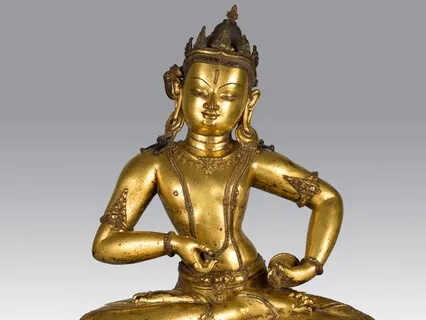
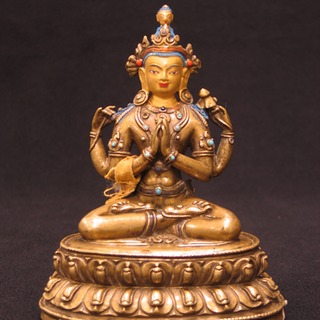
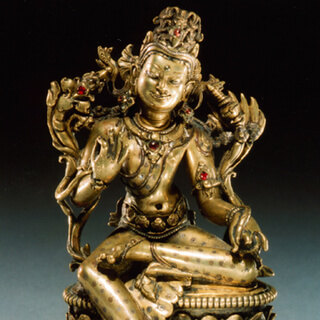
This is a beautiful sculpture from 14th century Nepal,
Gilt copper alloy.
And we see that this is a figure seated in a meditation position with legs crossed in front of him.
And with his hands,
One hand holding an object and the other hand actually used to hold an object.
And I'll tell you a little bit about that in a moment.
And then his posture is swayed to one side in a kind of elegant fashion.
And we noticed that he's quite adorned with a crown,
Earrings,
Armbands,
Necklaces,
A belt,
Even jewels around his calves and ankles here.
You may think that this looks a bit like a Bodhisattva and you would be right.
And you may also think that this looks a little bit like a Buddha,
Often the facial expression that we see here,
The very calm gaze is something that we see in this type of physical form is something that we see when a Buddha is depicted.
And this is also right.
This is Vajrasattva,
Who is both a highly accomplished Bodhisattva and a primordial Buddha.
So not the Buddha,
Right,
Buddha Shakyamuni,
But a Buddha who is often invoked to purify the errors made during ritual and other religious practices,
And whose name means Vajra being.
So he's the personification of the Vajra,
Which is a really important ritual implement in Buddhism.
It's a ritual scepter,
Which is a symbol of power,
Also this symbol of indestructibility of the enlightened mind.
So Vajra also means diamond in Tibetan,
Dorje.
And the sculpture depicts the deity holding a bell at his waist,
And he would have held a Vajra in his other hand.
And together the Vajra and the bell symbolize wisdom and compassion.
And these are the two elements that come together to really make the way through chaos towards enlightenment.
Now we'll bring on Rebecca Lee.
Dr.
Rebecca Lee is a Dharma heir in the lineage of the Chan Master Sheng Yen,
And is the founder and guiding teacher of Chan Dharma community.
She started practicing with Master Sheng Yen in the 1990s and served as his translator until his passing in 2009.
And she received full Dharma transmission from one of his Dharma heirs,
Dr.
Simon Child,
In 2016.
She currently teaches meditation and Dharma classes,
Gives public lectures,
And leads retreats in North America and the UK.
You can find all kinds of things about her,
Including her writing on rebeccalee.
Org.
And in addition,
She is a sociology professor at the College of New Jersey,
Where she serves as the faculty director of the Allen-Dolly Center for the Study of Social Justice.
And her new book,
Which was really based on the lectures that she gave after the pandemic began,
And has been championed by her students who have said,
You've got to publish this,
Is now just out.
It is called Allow Joy into Our Hearts,
Chan Practice in Uncertain Times.
Rebecca,
Thank you so much for being here.
Thank you,
Dawn.
It's so wonderful to be with everyone,
With all of you here.
I've been thinking about the topic for today,
Facing chaos and indeed,
And we have also just been around the point of anniversary.
One year ago,
We,
Our lives were all disrupted suddenly by a lot of things happening.
So when we really think about the word chaos,
Then we can think about what does it mean when we call phenomenon chaos?
Usually what that means is that what we think that what's happening really deviates drastically from our expectation of order or structure or plan.
So much so that our idea of an orderly,
Predictable world does not hold up.
It's difficult for us to hold on to that idea.
It often makes us feel frightened and threatened because of this experience.
And when we feel that we are facing chaos,
It is a good time for us to make use of our meditative practice.
We can make use of our meditative practice to help us to be fully present with our body and mind and what's going on in the present moment.
Whether in our sitting meditation,
Formal practice,
Or in our daily life,
As we cultivate our aware,
Clear awareness,
We may notice,
Most likely in times of chaos,
A more busy mind.
That's what my students were telling me,
And my,
I myself experience as well.
And in a way,
It is normal because what shows up in our mind is the coming together of causes and conditions when there are a lot of things going on,
Based on our observation of all kinds of things happening that are deviating from what's expected in the orderly world,
In our mind.
Or what we hear about in the news,
This is happening,
That is breaking record,
That is unprecedented.
There is a lot going on in our mind because of all these mental stimuli.
And we can cultivate clear awareness of all these things that are showing up,
And really no need to try to get rid of them.
Our tendency is to think that a busy mind is bad,
Something's wrong with it.
And what it is,
Is really quite natural for the mind to be a bit more busy in times like this,
Especially in the initial phase of a lot of new things happening,
You know,
What we call chaotic time.
So there's really no need to try to make the mind calm.
Now I want you to hear the word more deliberately,
I use the word making the mind calm,
Which is different from calming the mind.
If you think about what you do when you think something's wrong,
When all these thoughts are coming up,
And the mind's busy,
What do you do when you try to make the mind calm?
Chances are,
You're trying to chase away the thought,
Get rid of them.
And it's very effortful,
Very tense.
And it's really kind of like when we are sitting by the side of a pond or a lake,
And there's this water surface,
Which can be an analogy of our mind,
Then there's wind.
And when the wind blows,
That causes some conditions of the present moment,
And you create a ripple on the water surface.
Perfectly normal,
Perfectly natural,
There's nothing wrong with it.
But if we come up with this idea that there's something wrong,
The water surface supposed to be flat without any ripple,
Then we try to put our hand on top of the surface of the water to try to make the surface calm,
Flat.
What does it do?
Actually,
We are merely creating more disturbance to the water,
Right?
So,
Notice to see if we are trying to make the mind calm and inadvertently causing more agitation in our mind.
All we need to do is to allow the mind to be as it is in this moment,
Allow the thoughts to come through and recognized and seen,
And they will go away on their own anyway.
And we may also notice our reaction of feeling fear of anxiety.
And last year,
This time,
I read an article talking about anxiety really is a perfectly normal physiochemical response of the human body,
When we notice that there might be some kind of a potential danger that threatens our safety or survival,
So that we are being reminded to identify what needs to be done in this moment.
So we can think of it as sort of like a smoke alarm,
The sense of fear or anxiety,
When something unusual is going on.
And so,
Well,
If you think about a smoke alarm,
It's really there to help us keep us safe.
So let's take a look to see if there's a fire.
And sometimes,
You know,
There is no fire,
Then it's okay,
We know that we have checked.
And same thing happens.
We don't need to become agitated with the sense that there is some fear.
Remember that this is good,
Actually,
That means our brain is working.
And it is a way to help us take a look what needs to be done to keep ourselves safe.
And many of us had experienced some of that in the past year.
So we can keep an eye on this habit,
Unhelpful habit of assuming that something is wrong with us when there is anxiety or fear arising in the mind.
And perhaps generating more agitation by giving rise to aversion to it,
Telling ourselves that something's wrong with me,
I want to get rid of this fear,
When it is trying to tell us to remind us to take a look,
To check to see if there is anything threatening us,
Our safety and survival.
So the meditative practice that we've been doing trains the mind to help us maintain this subtle mind,
Cultivating this clear total awareness of the moment to moment experience of the body and mind and the environment.
And it helps us remember to see that our sense of being everything,
Being out of whack is likely an exaggeration.
Really everything,
Everything,
Because when we practice opening our clear awareness,
Then we will,
Yes,
We'll see that there is something that is unusual,
But also we'll be able to see everything else in the present moment,
Opening our awareness.
Then we will notice,
Well,
The body is still working,
The body is thankfully still breathing,
Taking in oxygen,
Keeping us alive.
And we will also be able to notice,
Especially nowadays,
Well,
Regardless of what's happening,
The birds are still singing,
And the trees are still putting out new leaves.
So when we remember to practice cultivating this total clear awareness of the emerging present moment,
We allow ourselves to notice the many,
Many things that are still working.
And now,
It does not mean that we pretend that everything's okay,
And that we don't need to do anything.
But what it does allow us to do is that we are,
We are not so overwhelmed by the sense of everything is doomed.
And the clarity then allow us to see clearly what's going on in this moment,
And identify what actually needs to be done.
And also the appropriate way to do so.
Appropriate here refers to doing something that does not cause more suffering for ourselves and for others,
And perhaps doing something that will actually bring benefits to others,
Rather than just our compulsive,
Following our compulsive feeling about what we want to do that may not be helpful,
Or may actually cause more stress for others,
For example.
So when we practice this way,
We can be more effective and put our time and energy where it is most needed amidst chaos.
So when we practice in this way,
We can stay fully present with each emerging present moment.
When we do that,
We'll notice that the mind becomes less agitated.
And when the mind is less agitated and more settled,
There's more clarity,
And we are more able to see the situation for what it is.
What we initially believed to be everything is so chaotic,
Completely out of control,
Is horrible,
Horrible.
We can see that really it is the coming together of many changing causes and conditions.
And when we can see the present moment for what it is,
Then we are less likely to succumb to our habitual tendencies to react with aversion,
Hating,
Hating what's going on.
You might remember hearing people say that,
I hate what's going on.
And because when we do that,
We are causing ourselves suffering.
And very often,
When we are suffering,
We also act in ways that cause problems and suffering for others as well.
So when we can practice this way,
What we will end up finding ourselves to be able to do is to be able to remember,
To remember to come back moment after moment,
To stay with the emerging present moment.
And as one of my students kept sharing with me that one breath at a time,
One breath at a time,
He had recently gone through a back surgery,
And also returning home to Texas when they lost power,
Lost water,
Lost heat.
But he lived through all that with grace,
By practicing one breath at a time,
Remembering to come back to the present moment over and over again.
When we practice this way,
Regardless of what happens,
Then we can appreciate it as an opportunity to practice living through it with wisdom and compassion.
So as my teacher often would say,
This is different,
And we can appreciate it and say,
This is a new experience,
And we fully experience it moment after moment and learn from it.
So let's practice some meditation together so that we can learn how to cultivate this clear awareness as we face chaos in our lives.
So I'd like to invite you to set up your body in a comfortable posture conducive to relaxation.
Make sure our head,
Our neck,
And our spine are in a straight line facilitated by tucking our chin slightly.
Our eyes relaxed.
If we meditate with our eyes closed,
Be sure not to shut it,
Causing tension around our eyes,
Allowing some light in to avoid drowsiness.
And we begin.
Feel the relaxation of the top of the head.
Directly experience the subtle sensations of the relaxation of the crown as we allow,
Allow the tension to melt away.
And feel the relaxation spread to the forehead.
Check to see if we are holding tension in this area,
Perhaps from worrying.
Right here,
Right now,
We can allow,
Allow the tension to melt away.
And feel the relaxation spread to the eyeballs and eye muscles.
We hold a lot of tension in these muscles in our daily life,
From all the judging,
Comparing,
Analyzing.
Right here,
Right now,
There's no need to do that.
We can give these muscles a vacation and allow,
Allow the tension to melt away.
And feel the relaxation spread to the facial muscles.
Check to see if we are holding tension in some part of our face by habit,
Maybe to hold up a certain facial expression for the world to see.
Right here,
Right now,
There is no need to do that.
And we can give these muscles a vacation and allow,
Allow the tension to melt away.
And feel the relaxation spread to the entire head.
And feel the relaxation spread down the neck muscles.
Directly experience the subtle sensations of these muscles softening,
Like melting butter,
As we allow,
Allow the tension to melt away.
And feel the relaxation spread down the shoulders,
Down the arms and the forearms,
All the way to the fingertips.
And feel the relaxation spread to the chest area.
Check to see if we are holding tension in this area,
Perhaps from anxiety,
Sadness,
Grief,
Sorrow,
Worry,
And right here,
Right now,
We can give them a rest and allow,
Allow the tension to melt away.
And feel the relaxation spread to the lower abdomen.
We tend to hold a lot of tension in this area.
Trust that the skeletal structure can hold up the body.
And these muscles do not need to work so hard.
We can give them a vacation too.
Allow,
Allow the tension to melt away.
And feel the relaxation spread to the upper back,
In the muscles between the shoulder blades.
Feeling these muscles softening,
As we allow,
Allow the tension to melt away.
And feel the relaxation spread down the back and all the way down to the lower back,
Down to our buttocks,
Where we feel the pressure of our body sitting on the chair or cushion.
And feel the relaxation spread down to the thigh muscles.
And all the way down,
Legs and the toes.
And feel the relaxation of the entire body sitting right here,
Right now.
Cultivate this clear awareness of the subtle changing sensations of the body sitting right here,
Right now,
Moment after moment.
And we will notice the subtle movements of the body breathing.
And we can stay with the changing sensations of the body moving as the body breathes,
Allowing the body to breathe on its own.
That body knows how to breathe.
It's been doing so since the moment we were born.
We don't need to take over.
Just allow,
Allow the body to breathe on its own.
And all we need to do is to be here to experience it.
And we can use the changing sensations of the body breathing to anchor us gently to the emerging present moment.
We notice the mind drifting off,
Losing contact with the body.
No problem.
We can make use of that as an opportunity to practice remembering to come back,
Come back to the changing sensations of the breathing body.
And if we notice thoughts coming through,
Not a problem.
Allow it to be there.
There's no need to chase them away.
Allow it to be seen and heard and felt fully.
And too is part of the present moment.
And when it's time,
We'll move on.
We can let it move on.
Present moment after moment.
Cultivate this clear awareness with this gentle,
Wakeful mind.
Staying with the changing sensations of the breathing body.
Cured through and driven from become subtracting it.
You you you you you you you maintain this clear awareness of the changing sensations as we transition from stillness to motion we can begin to move our hand our body take good care of this transition so that we can bring our meditative practice and the clarity and stability of mind into our daily life thank you Rebecca thank you it's good practicing with everyone today we'll see you next month that concludes this week's practice if you would like to support the Rubin and this meditation series we invite you to become a member thank you for listening