Welcome to the mindfulness meditation podcast presented by the Rubin Museum of Art.
We are a museum in Chelsea,
New York City that connects visitors to the art and ideas of the Himalayas and serves as a space for reflection and personal transformation.
I'm your host,
Dawn Eshelman.
Every Monday we present a meditation session inspired by a different artwork from the Rubin Museum's collection and led by a prominent meditation teacher from the New York area.
This podcast is a recording of our weekly practice currently held virtually.
In the description for each episode,
You will find information about the theme for that week's session,
Including an image of the related artwork.
Our mindfulness meditation podcast is presented in partnership with Sharon Salzberg and teachers from the New York Insight Meditation Center,
The Interdependence Project,
And Parabola Magazine.
And now,
Please enjoy your practice.
Hello everybody.
Welcome to the Rubin Museum of Art and to our weekly mindfulness meditation practice.
My name is Dawn Eshelman.
So good to be here with you today.
I know that last week and recently in many settings,
We've all celebrated a very welcome new year.
And then this week had some feelings that maybe 2020 isn't quite over yet.
I hope you've been taking care and that your practice has been serving you well.
And of course,
I'm referring to the events that happened on Wednesday where a riot occurred in our nation's capital.
And I just,
I'm not going to get into it too much.
I just want to acknowledge that that happened and that it's affecting many of us in many different ways.
And that I hope that your practice has served you well during this time.
And I am so pleased that Sharon Salzberg is here with us today to really help us just remember and re-practice why we do this practice and how it can help move us all forward.
So we're talking about renewal this month as we begin 2021 and remembering that there's always a chance to start over and begin again and yet how important it is to build on all of our learning collectively as we move forward,
That we're bringing our history with us too.
So we are looking at a work of art today as we always do.
Then we'll hear from our wonderful teacher,
Sharon Salzberg,
And we'll have a short sit about 15 to 20 minutes.
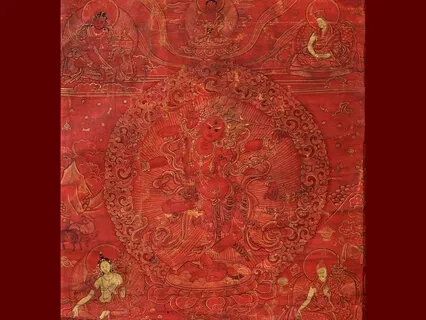
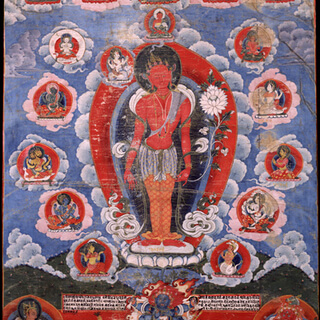
So we're looking today at this beautiful,
Rich,
Red and gold Tonka painting.
This is a figure that I think will be a beautiful one for us to think about today.
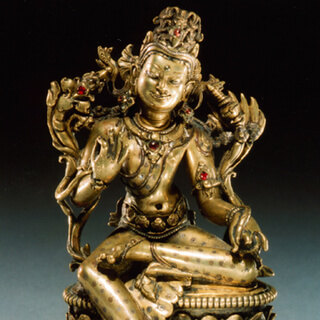
This is Krukule.
And this is a goddess of power known to Tibetans as a deity of the Lotus family associated with the activity of magnetization or enchantment.
And she's known for creating auspicious conditions to reach awakening and wisdom.
So really bringing about the conditions for wisdom.
And now bring on the wonderful Sharon Salzberg,
Who will guide us in our practice today.
And Sharon is the co-founder of the Insight Meditation Society in Barre,
Massachusetts.
Hello there.
She's guided meditations and retreats all over the world.
And she just celebrated 50 years of practice,
50 years of since her first retreat.
So congratulations to you,
Sharon.
And her latest book is Real Change,
Mindfulness to Heal Ourselves in the World,
Which sounds like a really good book for right about now.
And we are so happy to have her often here at the Rubin.
Sharon,
Thanks for being here.
Okay.
So I also want to just give a shout out to the Rubin Museum and the staff here,
Which this is such an important time,
I think,
For community and to appreciate those entities or those organizations that are allowing us to gather together as a community and enabling that and facilitating that.
Because it makes a very big difference,
Doesn't it?
Like I was here just last week and we were,
I was exalted at the beginning of 2021.
But there's a lot to be said about that.
And even in the context of renewal,
Because I think one of the implications of the term renewal,
As Dawn,
I think is really brought up already,
Is that sense of cultivating and deepening and developing our inner resource.
Because as we face adversity and scary things and painful things and all kinds of situations,
It's not that we don't try to do anything about the situation.
We do.
But the source of the strength for sustained effort,
For feeling pain and grief and fear and also having energy to go on,
The ability to even explore the power of compassion,
The possibility of compassion and the possibility of taking strong action in response to situations that maybe those responses don't need to be born out of a sense of hatred or kind of utter division and really being even willing to undertake that exploration.
It takes some energy.
All of that takes just like the life force that we have available to us.
It takes some energy.
And so it's not selfish and it's not self-centered and it's not indulgent to spend time looking at what helps build that sense of inner resource.
And that is what renewal is actually based on.
So I began last week talking about renewal almost in the sense of subscribing.
It's what are we aligning ourselves with when you get a renewal notice in the mail or online for something.
There's that moment like,
I don't remember signing up for this.
Why did I do that?
Maybe I better not let it go.
Or,
Oh,
I actually haven't looked at the last six issues.
Is this still relevant to me or whatever it might be?
And it's that moment of introspection,
However brief,
To say,
Okay,
What are my values?
What's important to me?
Do I want to align myself with this?
Do I want to keep getting this in the mail or is it time to let this go?
There are many notices they then send me about what I'm missing.
And I talked about it in one context last week.
Another way that is often used in terms of our meditation practices,
What within the Buddhist teaching is known as the four great efforts.
And that is something that,
Um,
If you don't know that particular perspective,
Then it can seem that mindfulness is awfully passive.
You know,
You're looking at mind States,
Let's say fear,
Anguish,
Uh,
Rage,
And you're just accepting them the way that they are.
Uh,
That's not wrong,
But that's also not passive.
It doesn't mean you're just sitting back,
You know,
And saying,
Oh yeah,
You know,
I'm like torn apart over this.
And I think I'll just let that go,
You know,
And let it go in the sense of,
Let it go on.
Um,
Doesn't matter.
Or,
You know,
I'm consumed with this desire.
I think I will just go out,
Get in my car,
Drive an hour and a half,
You know,
Get the thing only to come back and,
And we'll get it and say,
Why don't I do that?
Um,
You know,
So before we get in the car,
Before we take action,
Before we get consumed by something,
As we are accepting things,
Which means we're not fighting them,
We're not hating ourselves for what we're feeling.
We're not adding shame to what we're feeling.
We're not over identifying like this is who I really am.
This is the only thing I'll ever feel that all is like the bundle of consequences of being able to accept things,
Which means acknowledge it like,
Yes,
This is what's happening right now.
But along with that moment comes a moment of discernment.
And this is very empowering.
It's not always talked about.
It's where our sense of agency first arises in that we see,
Oh,
That's a very familiar old pattern.
That's my fear of public speaking.
That's my,
Uh,
Fear of never doing the right thing or doing enough,
Or that's my fear of saying the wrong thing in the presence of someone's pain or grief.
Maybe that's totally irrelevant.
Maybe it was relevant at one point and it's not any longer.
So we see that patterns arise that are kind of old.
We know that they're not speaking the truth.
Actually we are quite capable as one example of giving this talk.
Right.
And so we see a pattern.
We understand from experience,
From life,
It's not based in the truth.
It's just like this old tape that is playing and we can let go of it.
No blame.
It's just like,
No,
You can go,
Go,
You know,
Have a cup of tea somewhere.
Relax.
But no,
You're not going to take over.
You're not going to dominate my choices.
So,
Uh,
That would be one example.
So the,
The four great efforts are,
Um,
Seeing some unskillful,
Which means that which leads to pain.
When we get lost in it,
We see unskillful states arise.
We let go of him.
We see skillful states arise.
You know,
That first tremulous thought like,
I'm going to reach out something like that.
And we bolster it rather than pile on,
Like,
You know,
You can't do enough and you never do the right thing or whatever.
It's like,
We see that like little green shoot coming up and we say,
I'm going to water that.
I'm going to nurture that.
We also see that,
Um,
There are certain unskillful or painful states where the conditions for their rising are not so present.
And we have a sense of commitment.
Like I'm not going to go out and do the thing or bring myself into proximity to what will likely bring that on,
Hopefully more unskillful state up.
So maybe,
You know,
That,
Uh,
Drinking is an issue.
You don't go to the bar really.
It's not smart.
Or the other night,
Um,
I was saying before we started formally on Wednesday,
The,
Um,
The day of the terrible events at the Capitol,
I was working on something I didn't really tune into the news,
Which I always do through Twitter.
And,
Uh,
I turned on Twitter sometime in the late afternoon,
Uh,
In order to find out the further results of the election in Georgia.
I know someone's on here from Georgia.
Um,
And I just looked at it and I said,
Oh my God,
Look at this.
And I was up the entire night,
Just hot and looking at the news.
So one thing I want to say is I realized I'm too old for an all nighter.
I can't do that anymore.
Uh,
There's a reasonable amount of sleep of rest of not being consumed.
That is not stupid.
And it's not being avoidant or in denial,
But it's realistic,
Which we talked about earlier.
You know,
It's important to not put yourself in a position to the best of your ability where,
Uh,
You don't have that in a resource cooking in order to be able to meet adversity.
And then you might realize that,
You know,
The conditions are not really in place for,
Um,
This kind of gratitude to arise,
Which I know will strengthen me,
Or they're not really in place because I'm not paying attention in that way to that sense of community,
Which I know will really strengthen me.
And so we make the effort to go toward the conditions,
Doing something like this,
You know,
Being here together.
So that's the four great efforts.
We see that which is unskillful,
Which is arising.
We let go.
We learn to let go more readily,
More gracefully.
We see that which is arising,
Which is skillful,
Which is leaning toward the good and we strengthen it.
We see that which is unskillful,
Which is not really very prevalent,
But we know it's a tendency.
We help create the conditions so it doesn't come up strongly.
And we see the good that we know we also have an affinity for and is not really arising.
And we see if we can create those conditions.
So that is really what brings discernment and understanding and that sense of agency along with the,
The acceptance of mindfulness.
So let's sit together now.
If you want to just sit comfortably,
Close your eyes or not.
You can start by listening to sound and sounds of my voice or other sounds.
That's a way of relaxing deep inside,
Allowing our experience to come and go.
It's like the sounds wash through you.
And bring your attention to the feeling of your body sitting,
Whatever sensations you discover.
Okay.
Bring your attention to your hands and see if you can't move to the level of picking up direct sensation.
Pulsing,
Warmth,
Coolness,
Whatever it might be.
You don't have to name the sensations but feel them.
And bring your attention to the feeling of the breath,
Just the normal natural breath.
Wherever you feel it most distinctly.
Nostrils,
Chest or abdomen,
Bring your attention there and just rest.
See if you can feel one breath.
And if images or sounds or sensations or emotions should arise but they're not very strong,
If you can stay connected to the feeling of the breath,
Just let them flow on by.
You don't have to follow them,
You don't have to fight them.
Your breathing.
If something comes up and it's much stronger and it's pulling at you,
Take a look at it.
Recognize this is something you'd like to let go of or something ultimately you'd like to cultivate and just make a note of that.
And then see if you can come back to the feeling of the breath.
And for all those perhaps many times you are just gone,
Completely lost in thought or you fall asleep,
Truly don't worry about it.
We use the next moment as a moment of kindness toward ourselves,
Practicing the ability to let go and just bring your attention back to the feeling of the breath.
Right?
You you you you you you you you you you you you you you you you you you And when you feel ready you can open your eyes or lift your gaze and we'll end the meditation you Thank you so much Sharon So good to have you here and thank you.
We'll see you in February.
Yeah.
Okay.
Take care That concludes this week's practice if you would like to support the Rubin and this meditation series We invite you to become a member Thank you for listening