Welcome to the mindfulness meditation podcast presented by the Rubin Museum of Art.
We are a museum in Chelsea,
New York City that connects visitors to the art and ideas of the Himalayas and serves as a space for reflection and personal transformation.
I'm your host,
Dawn Eshelman.
Every Monday we present a meditation session inspired by a different artwork from the Rubin Museum's collection and led by a prominent meditation teacher from the New York area.
This podcast is a recording of our weekly practice currently held virtually.
In the description for each episode,
You will find information about the theme for that week's session,
Including an image of the related artwork.
Our mindfulness meditation podcast is presented in partnership with Sharon Salzberg and teachers from the New York Insight Meditation Center,
The Interdependence Project,
And Parabola Magazine.
And now,
Please enjoy your practice.
Good afternoon,
Everybody.
Welcome to mindfulness meditation online with the Rubin Museum of Art,
And I'm Dawn Eshelman.
So glad you could join us today.
We are talking about love this month.
Also it is the month of Valentine's Day,
But also the month of Losar,
Tibetan New Year and today is the 10th day.
This is Padmasambhava Day,
Guru Rinpoche Day.
And so happy Lunar New Year,
Happy Tibetan New Year to those of you who are celebrating.
And thanks for joining us here.
If you're new,
We are a museum of Himalayan art and ideas in New York City,
The Rubin Museum of Art.
We're so glad to have you all join us for our weekly program where we combine art and meditation online.
We'll look at a work from our collection together.
We'll hear a brief talk from our teacher,
Who is today the wonderful Sharon Salzberg.
And then we'll sit together for a short sit,
15 to 20 minutes,
Guided by Sharon.
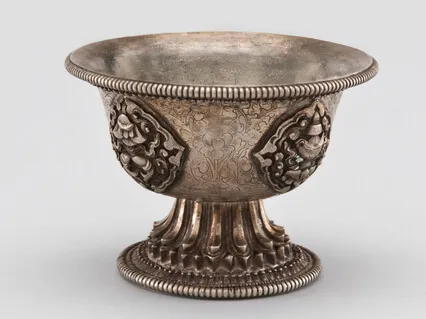
We are looking at a beautiful object,
Which is a stemmed offering bowl.
This is from Nepal,
Mid 20th century.
It's made out of silver and it's a ritual object.
And this is a bowl,
One of seven,
That would be placed in the shrine,
A practitioner's shrine and filled with water.
And this is one of the many ways that offerings are made.
And this is a sign of a symbol in a way of love,
Of appreciation.
And it can remind us that the water inside,
Which is,
You know,
Something simple,
But that,
You know,
As we've seen in the news lately,
We should never take for granted.
But our love can be free flowing just as water can be.
It can be life giving and feel like a simple element in our lives,
But we remember that it's necessary and important and it can flow between us.
The object here is this stemmed bowl.
So it's on this kind of pedestal that reminds us of the Lotus throne that we see many of the deities sitting upon.
And I believe etched in the background there of the actual bowl itself are images of lotuses.
And then you see on either side,
The more 3D images that are coming out are two of the eight auspicious symbols.
So on the right hand side,
We see a treasure vase.
This represents long life and prosperity.
And then on the left hand side,
We see a parasol or umbrella,
And that represents protection,
Protection from suffering.
So I think it's a,
It's also a beautiful sort of thing to note here that you can give a gift,
But that it also must be received.
So there's this giving and receiving aspect of the symbol of love.
So let's bring on our teacher today,
Sharon Salzberg.
And Sharon,
As many of you know,
Is the co-founder of the Insight Meditation Society in Barre,
Massachusetts,
Which has just celebrated its 45th anniversary on Valentine's Day.
And Sharon has guided meditation retreats worldwide for many years.
Her latest book is Real Change,
Mindfulness to Heal Ourselves and the World.
But just before that book,
I believe,
She wrote the book Real Love.
So I'm so happy that she is here to talk to us about love today and many other wonderful books that you can purchase wherever books are sold,
As they say.
But you can also make that purchase through the Rubin Museum gift shop,
Which would be a wonderful gift to us.
So Real Happiness is another of Sharon's most popular books.
And we're so delighted to have her here.
You can learn all about her on SharonSalzberg.
Com.
Please welcome Sharon.
Hi.
Hi there.
It's so delightful to be with you all again.
And I wear my loving kindness emoji t-shirt for all you folks who can see.
Not everyone can see,
Of course,
It's not a visual medium of podcast,
But some of you are able to watch.
And it's,
Of course,
My favorite thing of all to ever,
Ever talk about.
So here we are.
We did move into the building that is the Insight Meditation Society on Valentine's Day 45 years ago.
And when we bought it,
When the nonprofit that we formed bought the property,
It was owned by the Catholic Church and run by this group called the Fathers of the Blessed Sacrament.
It was an officiate at the time.
So it has very cute little social amenities,
You know,
Like it had a swimming pool,
Which we filled in.
It still has a one lane bowling alley.
And when we moved in,
They left us a room full of like bowling shoes and bowling pins and things like that.
So people do walking meditation on there sometime.
And the Dalai Lama did bowl there when he visited in 1979.
People always say to me,
Like,
How do you do?
I think I don't remember.
I was just sort of in shock.
And when we first were looking at the building,
Trying to decide whether to buy it and then ultimately moved in what it said above the doorway and these very large letters was Fathers of the Blessed Sacrament,
Since they were the people that were running the officiate.
And once we bought it,
We had to decide what are we going to put up there,
If anything.
So we had a number of letters to play with.
And we got somebody to get up in a very tall ladder and a very cold day and said,
See if you can arrange these letters to say something about us,
About who we are,
About what we want to present to the world.
So they came up with Metta,
Which is still there,
M E T T A,
Which is the Pali word,
Pali being the language of the original Buddhist texts for loving kindness in Sanskrit.
It's Maitri.
Um,
And there it was now we were a group of young people.
It was 23,
Uh,
Westerners doing the best we could to somehow try to land an Eastern tradition in the U S and,
Um,
We debated everything,
Like absolutely everything was a matter of conversation.
So that was a very big question.
Do we have a word up there that people in general in Barre,
Massachusetts are not going to understand what it means?
You know,
Isn't it odd and somehow exclusionary to have a word that,
That doesn't,
Um,
Invite people in,
In the sense of,
You know,
Oh yeah,
This,
This place is for you too.
You will understand everything that goes on here.
On the other hand,
I really liked the word and it meant something to me that delivery person say would call for,
Uh,
Instructions and where in the world it is.
And whoever answers the phone would get to say it's a large brick building with white pillars and it has this word up above the portico and it says meta M E T T A.
And then the person would say,
Well,
What does that mean?
And we get to say that means love or that means loving kindness.
So that means friendship in some way.
And that was the point of view that prevailed.
And I'm very happy that it did,
Even though I well understand the other side and have been on each side of that conversation about various different things.
I think it's a wonderful thing to present this as this is who we are.
It's like,
This is our highest aspiration.
This is the North star by which we seek to guide conversations,
Encounters,
Meeting a stranger like that delivery person,
Remembering to thank somebody,
Um,
All the exchanges seemingly small of a day where we have a chance to remember our priorities,
Remember our values.
This is not to say we live up to it at all times,
Any one of us,
But I think it's extremely meaningful in a life to have that sense of a path,
Something that is onward leading to have encapsulated and expressed what we care about more than anything.
Cause then we can always go back to that.
Well,
I didn't make this happen.
That didn't work,
But I approached that person.
I was dealing with,
With respect and,
And the sense of meeting what I would consider everyone's potential.
It's almost as though if you believe that there is a seed within everyone of possibility,
Not actuality,
But possibility for connection,
For growth,
For understanding,
Uh,
For wakefulness,
For awareness,
Then in some ways,
As we speak,
As we pursue some project,
Whatever it might be that has us engage with this person,
We are also talking to that seed.
We're also addressing that sense of possibility.
And somehow,
Uh,
Looking at that offering cup,
That's what it reminded me of.
Sometimes we return to our own seed of possibility,
Right in the act of giving,
Right in the act of acknowledging somebody.
It's almost like it flows both ways.
If we cultivate that sense of confidence in the power of love,
If we cultivate a sense of confidence in our own ability to keep growing and changing within that domain,
Then we will be more likely to bring it into life and to,
Uh,
Maybe be more generous as one example,
Which isn't only material generosity,
Although it could be,
It's also our time,
Our energy,
Our gratitude,
Whatever it might be.
It's an offering.
And we have,
We have that impetus to keep bringing it into life because we've strengthened it within.
And I have found that if we undertake the practices of generosity of giving,
Of caring,
Of acknowledging,
Of remembering,
Um,
Of including every joy,
Seeing someone else's joy,
Whatever it might be,
All acts of generosity that they actually function the other and the other direction to that in that action,
We are for that time returned to a place inside of us that is whole.
That's not lacking that is able to give that has a sense of inner abundance or at the very least inner sufficiency that cares.
We know we don't in the best case scenario,
Give an object to somebody because we want them to be worse off.
You know,
We care.
We would like them to enjoy,
To feel more secure,
To,
Uh,
To have the opportunity that they might not otherwise have so easily had.
That's the impetus for the giving and we are returned to that acknowledgement in that moment.
So,
Uh,
Every time we make an offering of some kind,
Even if it is a symbolic ritual that we're engaged in,
It is in part for the purpose of returning us to that place inside of us that is full of possibility and the possibility of connection,
The possibility of caring.
So we don't struggle in this sense to be able to love,
Uh,
And the most unimaginable way.
It's quite imaginable.
We experience it however briefly and we can return to it.
We return to it through our actions.
We return to it through our remembering and we return to it through our meditation practice,
Which is designed,
Whatever kind of method you use is designed to increase the power of love,
The power of kindness,
Both toward ourselves and toward others,
The ability to give and to receive and the acknowledgement that always this potential is within us.
Whatever we may have gone through,
Whatever we may yet go through as a possibility,
As a capacity,
It's always within us.
So I would like us to meditate some in just this way.
And in honor of,
Uh,
Love,
I thought we could actually do some loving kindness meditation,
Which is its own particular method.
Some of you may be familiar with it,
Others,
Maybe not so much.
And if for some reason you feel it's not working for you,
That's fine too.
You can just sit and be with the breath and be in the moment.
Loving kindness meditation works in a way where I call it a stretch where we are intentionally moving the way we pay attention from the ordinary way,
Which may be full of criticism,
For example,
Toward ourselves to one of wishing.
Well,
May I be safe?
May I be happy?
The thread in loving kindness meditation is generosity.
It's gift giving it's offering.
It's like handing someone a birthday card and saying,
May you have a great year?
May you be safe?
May you be happy?
Something like that.
Because we start with ourselves and it's framed as may I people often say to me,
Who am I asking?
And really we're not asking anybody anything.
We're gift giving.
We're offering first to ourselves and then to others.
And it's,
It's just like an expansion.
You know,
There are many beings in our lives.
Some of you wrote down things about essential workers and in the chat,
There are many beings.
In our lives,
Many people in our lives,
We might ordinarily look through,
Just count,
Objectify.
And the practice of loving kindness is one of calling them to mind.
You may not know their name even,
But you can call them to mind and offer them the phrases of loving kindness,
Which is a way of looking at them instead of through them.
So there's,
There's a kind of active component to this meditation because we are intentionally shifting the way we pay attention,
But it's very true.
It's not phony or false.
You don't have to force yourself to feel anything that you're not feeling,
You know,
Some ground emotion.
It doesn't matter.
We rest our attention on the repetition of certain phrases.
We gather all of our attention behind one phrase at a time.
And then when our attention wanders and we just lost somewhere,
We see if we can let go and,
And begin again,
Just come back to the phrases.
So I'll guide you through one of many,
Many variations of doing this.
You can sit comfortably close your eyes or not.
However,
You're most at ease,
Common phrases because they need to be very general.
So you can offer them to yourself and to others.
Common phrases are things like,
May I be safe,
Be happy,
Be healthy,
Live with ease.
Which means,
And the things are day to day life,
Like livelihood and family may not be such a struggle.
May I live with ease.
May I be safe,
Be happy,
Be healthy,
Live with ease.
Can repeat these phrases or other phrases.
Very simple.
Gather all your attention behind one phrase at a time.
You don't have to be in a big rush.
You can do it with enough space and enough silence so that the rhythm is pleasing to you.
And when your mind wanders or you fall asleep,
Don't worry about it.
See if you can let go and begin again.
May I be safe,
Be happy,
Be healthy,
Live with ease.
Happy,
Be happy,
Be happy,
Live with ease.
Gather all your attention behind one phrase at a time.
You you See you can call to mind a benefactor a benefactor is someone Who has inspired you maybe from afar?
Maybe you've never met them or someone who's helped you in some way?
Maybe they've helped pick you up when you've fallen down could be a mentor Could be somebody who embodies the force of love for you an adult a child a pet Buddhist texts say this is the one who when you think of them you smile So is there someone like that in your life,
And if there is you can bring them here Get an image of them or say their name to yourself Get a feeling for their presence And offer the phrases of loving kindness to them May you be safe Be happy Healthy Live with ease and even if the words don't quite work It's fine because they're carrying the energy of the heart they're serving us as a vehicle Maybe safe Be happy be healthy May you be safe Be healthy Live with ease You You You You You And just for fun for a few minutes,
Let's have that benefactor offer loving kindness back to us so you can feel yourself as the recipient as that puppy looks at you or Whomever is making this kind of offering to you of attention regard respect as You gently repeat the phrases may I be safe Be happy Be healthy Live with ease or perhaps this benefactor is themselves saying the phrases to you And all kinds of different feelings may come up you may feel embarrassed you may feel unworthy you may feel delighted,
But whatever happens See if you can wash through you as you steady your attention on the repetition of the phrases You You And we're gonna have a gathering just whoever comes to mind friends family colleagues puppies I Will offer loving kindness to the collective to the group as beings appear May you be safe Be happy Be healthy Live with ease You You You You You you And then all beings everywhere all people all creatures all those in existence,
Near and far,
Known and unknown.
May all beings be safe,
Be happy,
Be healthy,
Live with ease.
You you you you you you When you feel ready,
You can open your eyes,
Or lift your gaze,
And we'll end the meditation.
Thank you Sharon.
Thank you all beings.
Thank you all.
That concludes this week's practice.
If you would like to support the Rubin and this meditation series we invite you to become a member.
Thank you for listening.