Welcome to the mindfulness meditation podcast presented by the Rubin Museum of Art.
We are a museum in Chelsea,
New York City that connects visitors to the art and ideas of the Himalayas and serves as a space for reflection and personal transformation.
I'm your host,
Dawn Eshelman.
Every Monday we present a meditation session inspired by a different artwork from the Rubin Museum's collection and led by a prominent meditation teacher from the New York area.
This podcast is a recording of our weekly practice currently held virtually.
In the description for each episode,
You will find information about the theme for that week's session,
Including an image of the related artwork.
Our mindfulness meditation podcast is presented in partnership with Sharon Salzberg and teachers from the New York Insight Meditation Center,
The Interdependence Project,
And Parabola Magazine.
And now,
Please enjoy your practice.
Hello,
Tashi Delaik.
Tashi Delaik and welcome.
Welcome to our weekly mindfulness meditation.
I am Tashi Chodron,
Assistant manager to Himalayan cultural programs and partnership.
We are a museum of Himalayan art and ideas in New York City,
And we are so glad to have all of you join us for our weekly program where we combine art and meditation online.
You can book your tickets in advance and come visit our beautiful exhibition,
Mandala Lab,
Where emotions can turn to wisdom,
Which explores five thought-provoking playful experiences,
Controlling video,
Sense,
Sculptures,
And curated percussion instruments that guide you along an inner journey focused on self-awareness and awareness of others designed to inspire connection,
Empathy,
And learning.
So inspired from the exhibition,
We will take a look at a work of art from our collection.
We will hear a brief talk from our teacher,
And then we will have a short set,
About 15 to 20 minutes,
For the meditation guided by our teacher.
So the theme for this month is transforming afflictive emotions.
Our new installation called the Mandala Lab,
Where emotions can turn to wisdom,
Is now open on the third floor of our museum.
The Mandala Lab is an interactive space for social,
Emotional,
And ethical learning.
And today's art connection is,
Let's look at the beautiful art.
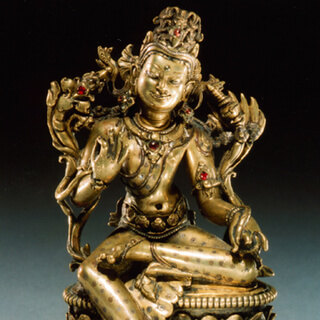
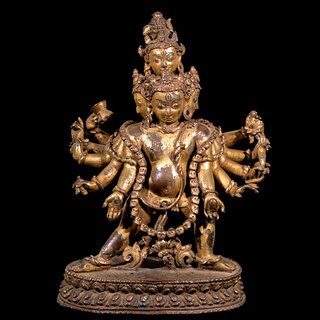
It's the Vajra Yogini.
Let us see.
So this,
As you see here,
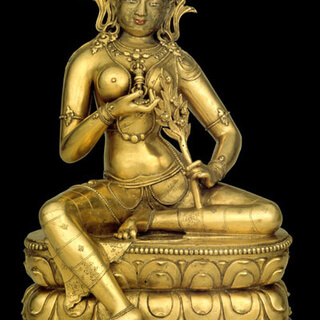
This beautiful sculpture,
It is called Vajra Yogini.
In Tibetan,
It is Dorje Nen Joma.
So Vajra is indestructible,
Thunderbolt.
Yogini is the female wisdom dakini.
She is known to be a meditational deity.
Vajra Yogini is omniscient Buddhahood in female form and associated with wisdom,
Which is usually considered a feminine form in Vajrayana Buddhism,
Which is Tibetan Buddhism.
Although in Buddha actually stated that men or women alike can achieve spiritual liberation,
Some Buddhist traditions have believed that women are not capable of becoming fully awakened in female form.
But according to tantric Buddhism,
Which is Tibetan Buddhism in Vajrayana,
Tibetan Buddhism,
One can become fully awakened in one single lifetime through transformative practices,
Whether in a male or female body.
So Vajra Yogini acts as a meditational deity,
Usually appears in red in color.
And Vajra Yogini is a key female figure in the advanced Tibetan Buddhist practice of chöd,
Which means to cut.
And to cut from what?
To cut from all the affective emotions,
The dualistic mind and dualistic thoughts.
Now let us bring our teacher for today.
Our teacher for today is Rebecca Lee.
Dr.
Rebecca Lee is a Dharma lineage holder and Chan Master Shen Yan,
Founder and guiding teacher in the lineage of Chan Master Shen Yan.
Master Shen Yan is the founder of Chan Dharma community.
Dr.
Rebecca Lee started practicing with Master Shen Yan in 1990s and served as his main translator until his passing in 2009.
Dr.
Lee later trained and received full Dharma transmission from one of his Dharma lineage holders,
Dr.
Simon Child in 2016.
Dr.
Lee teaches meditation and Dharma classes and gives public teaching and leads retreats in North America and UK.
Dr.
Lee leads talks and writings,
And she can be found in more description and information on drrebeccalee.
Org.
She's also a sociology professor at College of New Jersey,
Where she holds talks and writing.
More information can be found on rebeccalee.
Org.
So please let us welcome Dr.
Lee.
Thank you.
Thank you so much.
Thank you,
Tashi,
For your wonderful introduction and description of today's beautiful artwork.
And it's really lovely to be here practicing with all of you dialing in from around the country,
Many parts of the country,
Perhaps other outside the country.
And also for those of us,
We will be celebrating Thanksgiving this week.
So lovely to be here with you.
And today's topic is a topic that's very close to home for many of us trying to think about how to work with difficult emotions,
Which can sometimes feel like it's afflicting us.
This topic reminds me of a recent encounter I had with someone who has been practicing for 27 years,
A very dedicated practitioner and a meditation workshop.
And I asked how he's doing.
And he said,
Well,
I'm just getting like,
I'm fine,
But I'm getting tired of this,
Referring to this whole situation we're in with the pandemic.
And about an hour later,
After we had done about 50 minutes of meditation,
He talked about feeling joyful.
And I want to share this story to help us remember that like sometimes when we are really feeling some strong emotions that are really bothering us,
To remember that it is,
Even though it might feel like it is not going away,
It too is impermanent like everything else.
So the meditation that we did together,
Which I would like to share with you today,
Is this meditation,
Silent illumination,
Where we cultivate total clear awareness of the body and mind in the space in the present moment.
And it is a meditation that allows us to fully experience ourselves and the emotion still there and we're able to experience how it changes and you're at the midst of everything else in each emerging present moment.
And so that the emotion that might feel very powerful may no longer feel as overbearing or overwhelming.
And as we saw,
We're less compelled to give rise to aversion or just really hate it and want to get rid of it and locked in the battle with this emotion.
And if we have ever been in a space like this,
We know it is a lot of suffering.
And also we're not going to be a very pleasant person for others to be with.
So to understand a bit more how to engage in this practice will help us work with this very difficult emotions.
And when we think about sort of very powerful,
Difficult emotions,
Perhaps one way to think about it is like when we hear some really obnoxious sound or music playing,
Some part reason started playing in a room and we are often habituated to really react strongly with aversion,
Which is like,
I really hate it and want it to go away,
Just want to go away,
We get locked into this battle against it.
And as the results become controlled by it,
So you might be able to relate to it.
So we get very,
Very upset when this music,
The sound that we find unpleasant is playing very loudly.
And then when the volume goes down,
Then maybe even just like a moment when it's gone,
It seems to be gone,
We're like relieved,
Oh,
Thank goodness it's gone.
And then you're here bracing,
Hoping that you won't come back.
And of course,
Dreading is returned.
And then when it comes back again,
We get all upset.
So what happened is that we are completely controlled by it.
We have given it power over our life in those moments.
So we might believe it is the tear in this case,
The sound,
The music that's causing us suffering,
But it is our habitual reactivity,
Giving rise to aversion,
Getting into a fight with it that is causing us a great deal of suffering.
When we can see it clearly,
We see that like,
Well,
It is just sound and it is our reactivity.
We're reacting with aversion and craving for it to go away that is causing us a lot of suffering.
So well,
What to do?
Because we are habituated to want to just get rid of it.
And so you might have heard the wise advice of going out to get some fresh air and we can think about it as literally and figuratively.
So when we think about it,
If you are in a room with this very obnoxious music or sound that is bothering you,
Go outside.
At least the sound will be lower in volume.
And figuratively,
It really means to allow ourselves to open our awareness and it can involve literally going outside,
Changing our physical environment.
And the most important thing though,
Is not about blocking out the emotion here or trying to like tap out your,
Block out the sound,
But allow everything to enter our awareness and see directly for ourselves that this powerful emotion that's bothering us is just one of the many sensations in this present moment.
So when we open our awareness,
Again,
We stay with this analogy of the sound,
We notice other sounds in the environment,
Maybe traffic,
Or maybe the birds singing,
We heard children laughing while they're playing.
We also notice other sensations,
Sensations of the body touching the breeze,
Or right now the sensations of the body sitting here or if we're outside walking.
And we may notice the sight of leaves falling from the tree moving around in the air.
What it is is that we allow our heart to open and be touched by everything that's happening in this emerging present moment.
And what we'll find is that this powerful emotion that was bothering us,
It may still be here,
And you may still feel it as some residual fragment of past moments,
But we were able to see this present moment as it is,
That this emotion,
It is not taking over because it's not the only thing in this present moment.
It's not taking over and overwhelming us,
Making us feel compelled to fight against it because there is no need to do that.
We allow it to be here.
We may also notice our tendency to identify with this emotion as we may notice these thoughts that,
Oh,
I'm an angry person.
We notice anger when the reality is that there is anger arising.
It is a transient sensation of the mind.
It is very strong,
But it's not permanent.
If we allow ourselves to be fully here,
Making use of our meditative practice to stay with each emerging present moment,
Moment after moment,
We allow ourselves to directly experience that truly what's going on that we call anger is constantly changing.
We'll also be able to notice what the label we use to describe this emotion,
Perhaps anger.
It's actually inadequate.
We will notice that it is actually not just anger,
Not purely anger.
We will notice that there might be maybe love because we love something.
It will surely also bring about some upset emotion or maybe fear or maybe some kind of a pain that we had projected on it.
We really care about something a lot.
That's why there is this reaction.
So what we label it is actually greatly simplified.
All this has allowed this clarity of what's going on.
And we allow everything to be fully experienced,
Felt,
And seen and heard.
And we may notice that the strong emotional response actually is a way for us to tell ourselves something important,
Tell ourselves something that we have been overlooking.
So for example,
Some of us may have experienced that,
That it is a response to,
Maybe it's a response to a similar situation.
Something to something upsetting in the past and help us when we cultivate this total clear awareness,
We can,
This experience is actually helping us recognize and acknowledge how upset and hurt we were in that situation in the past.
We may realize that we had been denying and repressing the feeling,
And this allow us to see clearly how we felt.
And also we can at the same time see clearly that this moment is a different situation involving different people.
And also it's a different me.
I'm not that same person that was experiencing that past situation that I am bringing into this moment.
And all of this is about seeing the situation,
This present moment as it is,
Without distorting it with the ghost from the past.
And when we allow ourselves to stay in the present moment,
Opening our hearts to the moment as it is,
We will also notice that we can allow gratitude to arise,
Gratitude of opportunity to gain some clarity about our tendencies,
Which we wouldn't have been able to see without the arising of this very powerful,
Maybe difficult emotion.
And we gain this opportunity to understand ourselves better.
And with this gratitude to this experience of this difficult,
Powerful emotion,
It also shifts our perspective.
What we thought was so awful and we tried to get rid of and locked in a battle against is no longer our enemy.
And in this moment,
We release the compulsion to fight against and hate this emotion.
And the releasing of this compulsion allows us to relax truly into the present moment,
To really be fully here with this body and mind in this space.
And what we're doing is to unlearn the habit of being afraid of difficult emotions.
And the habitual agitation that we give rise to in the mind when we hate and try to fight against these emotions,
They stop.
When this ceases,
Suffering does not arise.
So when we can stop turning these sensations into afflicting ones,
And I hear the title of the topic of the theme is afflictive emotion,
We are able to see that they are emotions.
They don't have to be afflictive.
So we can see that these are emotions just like all sensations,
Like the changing sensations of the body and mind as the body is breathing.
Allow them to move through the body and mind like clouds in the sky,
Moving through the sky and fully engage with the experience as it is,
Or you can say to be fully here with the show that is life.
And we look at the sky,
Sometimes they're puffy clouds,
Sometimes they're stormy ones with lightning and thunder.
That is what is going on.
And we allow them all through with this clear awareness also of the urge,
Our habitual tendency to want to fight against it.
And when we see this habit,
We are more likely to not succumb to it.
And in this way,
We're not driven by difficult,
Powerful emotions to inflict harm on others.
And cost ourselves a lot of unnecessary suffering.
That is the cultivation of wisdom and compassion.
So I'd like to invite you to practice this meditative practice to cultivate this total clear awareness of our body and mind in this moment.
So we can set up our body in this comfortable posture,
Conducive to relaxation.
The body can relax.
The mind also relaxes.
Now take you through a whole body relaxation.
Feel the relaxation of the top of the head.
Directly experience the subtle sensations as we allow,
Allow the tension to melt away.
And feel the relaxation spread to the forehead.
Check to see if we're holding tension in this area by habit,
Maybe from worry.
And allow,
Allow the tension to melt away.
And feel the relaxation spread to the eyeballs and eye muscles.
We tend to hold a lot of tension in these muscles by habit.
From all the comparing,
Analyzing,
Judging,
Planning,
Right here,
Right now.
We don't need to do that.
And we can give these muscles a vacation and allow,
Allow the tension to melt away.
And feel the relaxation spread to the entire face.
Check to see if we are holding tension in these facial muscles by habit.
Perhaps from having to hold a certain facial expression for the world to see.
And from having to hold a certain facial expression for the world to see.
And from having to hold a certain facial expression for the world to see.
And feel the relaxation spread to the entire head.
And feel the relaxation spread down to the neck muscles.
Directly experience the subtle sensations of these muscles softening like melting butter.
As we allow,
Allow the tension to melt away.
And feel the relaxation spread down to the shoulder muscles.
And feel down the arms to the forearms.
And all the way down to the fingertips.
And feel the relaxation spread to the chest area.
Check to see if we are holding tension in this area by habit.
Maybe from anxiety,
Sadness,
Fear,
Grief.
Right here,
Right now,
We can give them a rest.
And allow,
Allow the tension to melt away.
And feel the relaxation spread down the torso.
All the way down to the lower abdomen.
Trust that the skeletal structure can hold up the body.
And these muscles do not need to work so hard.
We can give them a vacation.
And allow,
Allow the tension to melt away.
Just feel the relaxation spread to the upper back.
Directly experience the subtle sensations of these muscles softening.
As we allow,
Allow the tension to melt away.
And feel the relaxation spread down the back to the lower back.
To the buttocks where we feel the sensations of the body sitting on the chair or cushion.
And feel the relaxation spread down the thighs,
Down the legs.
And all the way down to the toes.
Just feel the relaxation of the entire body sitting right here,
Right now.
Moment after moment.
With this clear,
Wakeful mind.
And we will notice the subtle changing sensations.
As the body breathes.
We can stay with this subtle changing sensations.
To anchor our attention.
To each emerging present moment.
Gently.
And allowing the body to breathe on its own.
The body knows how to breathe.
It's been doing so since the moment we were born.
And if we notice that the mind drifts off,
Losing contact with the subtle changing sensations of the body breathing,
Not a problem.
Make use of that as an opportunity to practice remembering to come back.
To reconnect with the direct experience of the subtle changing sensations of the body breathing.
And we may notice thoughts coming through.
Maybe memory of past conversations.
Images.
Some may come with emotions.
Allow them to come through.
They're already in your awareness.
No need to educate the mind by pushing them out.
And allow them to be fully felt and seen and heard.
And when they're ready to move on,
Allow them to move on.
Like everything else,
They will move on.
Moment after moment.
Practice with this clear awareness of this body-mind sitting in this space.
Thank you.
Maintain this clear awareness as we transition from stillness to emotion.
Thank you.
Thank you so much,
Dr.
Becca Lee.
Such a beautiful session.
That concludes this week's practice.
If you'd like to support The Rubin and this meditation series,
We invite you to become a member.
If you're looking for more inspiring content,
Please check out our new podcast Awaken,
Hosted by Laurie Anderson.
The 10-part series features personal stories that explore the dynamic path to enlightenment and what it means to wake up.
Now available wherever you listen to podcasts.
Thank you for listening,
And thank you for practicing with us.