Welcome to the Mindfulness Meditation Podcast presented by the Rubin Museum of Art.
We are a museum in Chelsea,
New York City that connects visitors to the art and ideas of the Himalayas and serves as a space for reflection and personal transformation.
I'm your host,
Dawn Eshelman.
Every Monday we present a meditation session inspired by a different artwork from the Rubin Museum's collection and led by a prominent meditation teacher from the New York area.
This podcast is a recording of our weekly practice,
Currently held virtually.
In the description for each episode,
You will find information about the theme for that week's session,
Including an image of the related artwork.
Our Mindfulness Meditation Podcast is presented in partnership with Sharon Salzberg and teachers from the New York Insight Meditation Center,
The Interdependence Project,
And Parabola Magazine.
And now,
Please enjoy your practice.
Tashi Delek,
Welcome.
Welcome to Mindfulness Meditation Online with the Rubin Museum of Art.
So happy to be here with you.
I am Tashi Chodron,
And we are a museum of Himalayan art and ideas in New York City.
So wonderful to have all of you joining us.
This is our weekly practice where we combine art and meditation online.
Thank you for those of you who are joining us many times.
And for those who are joining us for the first time,
Welcome.
So for today's session,
Inspired from our collection,
We will take a look at a work of art from our collection.
We will hear a brief talk from our wonderful teacher,
Sharon,
And then we will have a short set,
About 15 to 20 minutes,
For the meditation guided by our teacher.
The theme this month is care.
What are you caring about right now?
Now,
Let's take a look at this beautiful work of art together.
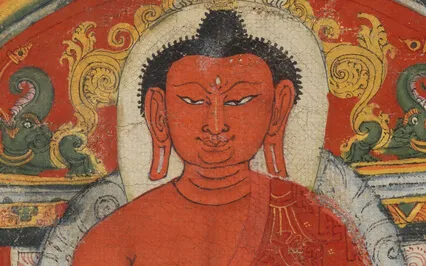
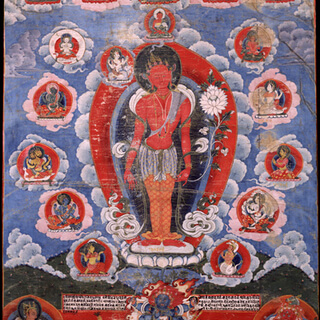
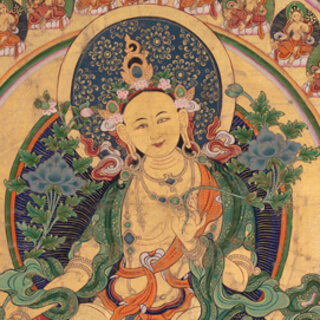
It is a Medicine Buddha Thangka.
And it's a very unusual,
I was sharing earlier,
It's a very unusual Thangka.
Medicine Buddhas are often depicted in blue in color,
But you see here,
The central figure is red in color.
In Tibetan,
Medicine Buddha is called Sanjay Menla.
Origin is Himalayan region,
15th century Thangka painting,
Mineral pigment on cloth.
This is about,
It's a smaller Thangka than our usual Thangkas that we have shown in the past.
It's about 12 and a half inches height and about nine inches width.
This is a very small painting,
Most likely comes from Ladakh in the Western Himalayas,
Where a number of monuments are decorated with similar paintings.
This painting style is strongly inspired by Nepalese art,
As visible here in the yellow dividing lines,
Structuring the painting and the details of the back of the throne.
When I say throne,
If you look at the Buddha's the ear level,
You see those green kind of alligator looking like on both sides of the Buddha's ear level or head level.
Those are called Makaras and they are very Nepalese art aesthetic,
As you see here.
And then there are other minor details,
Such as the clothing of the four guardian kings.
It's right at the bottom of the Thangka,
Indicating the Ladakhi aesthetic.
So this red Buddha is in a hand in the supreme generosity,
As you see the right hand in a supreme generosity giving,
And one of the eight medicine Buddha,
Most likely known as Abuna Raja,
In Tibetan is Gönkhön Gyalpo,
Who occupies the northeastern direction in the medicine Buddha mandala.
The Buddha is flanked by two Bodhisattvas,
The white Bodhisattvas in fact,
And how you can say that this is a Bodhisattva is you look at the figure,
Totally beach world with omelette,
Anklets,
Necklaces and crowns and so forth.
So along the bottom,
Starting on the view on our side,
The left one,
It's called Yaksha as sort of the yellow tone color holding a mongoose.
And then the next to the yellow one is a white color Ishana riding a buffalo.
And the next to that is Budevi in yellow color.
And the rest of the four to our right side on the bottom,
They are the four guardian kings who are known as the four guardian kings.
And now let's bring our teacher for today.
It's my great honor to bring Sharon Salzberg,
Our teacher for today.
Thank you.
And Sharon is the co-founder of Insight Meditation Society in Barre,
Massachusetts,
Has guided meditation retreats worldwide since 1974.
She's a weekly columnist for On Being and the author of several other books,
Including the New York Times bestseller,
Real Happiness,
The Power of Meditation and also Loving Kindness,
The Revolutionary Art of Happiness and The Real Love,
The Art of Mindfulness Connection.
Sharon has been a regular participant in many onstage conversations at the Rubin.
Sharon's book,
Real Change,
Mindfulness to Heal Ourselves and the World is now available for purchase.
Sharon,
Thank you so much.
Thank you so much for being here.
Well,
Thank you so much.
And thank you so much for the beautiful description of that very,
I say,
Charming medicine Buddha who I think has the kindest face.
So that was really lovely.
And thank you all for coming and joining us here.
You know,
When I hear the word care,
I actually think of two different things.
One is the line from the T.
S.
Eliot poem,
Ash Wednesday,
Where he says,
Teach us to care and not to care.
Teach us to sit still.
And I was really taken by that line because there are,
I think,
Many different levels or aspects of that idea of not caring.
One,
Of course,
Is the cruelty and the terrible acts we see in the world every day of people who are indifferent,
Who objectify others,
Who really create an other so that there's no resonance,
There's no empathy,
There's no sense of the consequences of actions.
It's one thing,
Of course,
To kick a table.
It's another thing to kick a human being or an animal,
Feeling as though you're kicking a table.
That is really trouble for all of us.
And so when I say,
Or I imagine when T.
S.
Eliot says,
Teach us to care and not to care,
He's not talking about that.
He's talking about some state of repose,
Some state of patience,
Some state of allowing things to unfold,
Some state of balance.
I would say the second thing it reminds me of,
Connected to the first,
Is the ability to infuse our caring with wisdom.
I think that's why it's followed with teach us to sit still,
Which doesn't mean be inert or indifferent or passive,
But can our actions to remedy something,
To try to make a difference,
Can they come out of a place of stillness and balance?
So the balance is between caring for others and caring for oneself.
It's not totally uncommon for someone to feel,
Yes,
They have loving kindness,
They have compassion for others.
It is not necessarily the case that they have such great loving kindness and compassion for themselves.
And certainly it's the case for many of us,
At least at different times due to our conditioning,
Where we have a lot of self-absorption and self-preoccupation and a genuine lack of understanding that it's through caring for others that we will come to a different level of fulfillment and happiness ourselves.
And so it's really a movement that's kind of,
It's got a lot of mutuality in it and ultimately some kind of balance.
And that's really important.
If you think about caring without wisdom,
For example,
Then we're burnt out.
We're overwhelmed.
We're exhausted.
We're depleted.
Wisdom doesn't have to be cold or uncaring in and of itself,
But it's basically saying there are limits in life.
That's realistic.
I will do everything I can and things aren't going to just behave themselves.
People aren't going to behave themselves according to my will or my wish.
Life unfolds.
Conditions come together.
Something arises.
Conditions come apart.
Something falls or it vanishes.
That's actually the rhythm of life.
That's the nature of life.
We do everything we can because we care.
We understand that we are interconnected,
That what happens to someone else matters to us in the end.
And yet we always want wisdom to accompany that.
We want the balance of caring for ourselves as well as caring for others.
That's not something selfish or self-preoccupied or self-engrossed.
That's understanding,
You know,
That we want to be able to sustain an effort.
We want to not fall into tremendous frustration when our expectations are not met,
Or not met in the timetable we have laid out.
We want that patience.
We want that stillness.
We want that ability to hang in there.
And that means,
Logically,
Having a space of replenishment,
Of resilience,
Of caring for ourselves as well as caring for others.
And wisdom will manifest as boundaries,
As an honest,
Truthful,
Realistic set of expectations.
I'm sure I've quoted many times,
Being with you all,
This time that I was with a group of people,
I think it was New York City,
And I said,
You know,
I really feel like if I were only in charge of the universe,
It would be a lot better world.
And someone in the group protested.
They didn't like that.
So they said,
Are you sure?
And I responded by saying,
I mean,
I'm really sure.
It would be a lot better.
It would be a lot better.
But you know what?
That's not life.
That's not the nature of things.
Which doesn't lead me,
Or don't have to lead us,
To a feeling of not caring and wanting to shut down and not doing anything.
It's the holding space.
It's the environment within which I can manifest that caring.
Not having unreasonable expectations.
Not feeling so frustrated,
So impatient,
So alarmed,
When in fact it's proven again and again that I'm not in control.
So we learn to care,
Which includes ourselves.
We learn to infuse all of that caring as much as possible with a sense of wisdom.
So let's sit together in meditation.
If you want to sit comfortably,
You can close your eyes or not,
However you feel most at ease.
They say right away there's some sense of balance in our posture.
You want some energy in your body,
Which implies your back being straight,
Not like so much energy,
You're really stiff and uptight.
You also want to be relaxed.
You can start by listening to sounds,
Whether it's the sounds of my voice or other sounds.
It's a way of relaxing deep inside,
Allowing our experience to come and go.
Of course we like certain sounds and we don't like others.
But we don't have to chase after them to hold on or push away.
Just let them come,
Let them go.
Bring your attention to the feeling of your body sitting,
Whatever sensations you discover.
See if you can feel the earth supporting you.
See if you can feel space touching you.
And bring your attention to the feeling of your breath,
Just the normal natural breath,
Wherever you feel it most distinctly,
The nostrils,
The chest or the abdomen.
If you find that place,
Bring your attention there and just rest.
See if you can feel one breath.
And if the breath doesn't work for you,
Too much emotion or you have some physical limitation,
That's fine.
Choose something else that's happening anyway.
Listening to sounds,
Other sensations in your body.
Not something you have to create and rest your attention there.
Let's say it's the breath.
You can also use a quiet mental notation like in,
Out,
Or rising,
Falling to help support the awareness of the breath.
But very quiet.
So your attention is really going to feeling the breath,
One breath at a time.
And if you find you're lost in thought,
Spun out in fantasy,
Or you fall asleep truly,
Don't worry about it.
We use the next moment after we've been gone as a chance to let go gently and return to the original object.
In this case,
Perhaps the feeling of the breath.
And this is also a good moment to just notice the quality of self-care or lack thereof.
How do you speak to yourself when you realize you've been gone?
And can you make that voice a little bit more gentle and appreciative of your efforts?
We let go and we begin again.
I've always found it just extraordinary that as far away as my attention can go,
For however long,
I can always,
Always let go and begin again.
When you feel ready,
You can open your eyes or lift your gaze and we'll end the meditation.
Thank you for that.
Thank you.
Thank you so much,
Sharon,
For that beautiful session.
That concludes this week's practice.
If you'd like to support the Rubin and this meditation series,
We invite you to become a member.
If you're looking for more inspiring content,
Please check out our new podcast,
Awaken,
Hosted by Laurie Anderson.
The 10-part series features personal stories that explore the dynamic path to enlightenment and what it means to wake up.
Now available wherever you listen to podcasts.
Thank you for listening and thank you for practicing with us.