Welcome to the Mindfulness Meditation Podcast.
I'm your host,
Dawn Eshwar.
Every Wednesday at the Rubin Museum of Art in Chelsea,
We present the meditation session with Sharon Salzberg and the teachers from the Interdependence Project and the New York Insight Meditation Center.
And I'm just curious for those of you who practice here on a regular basis,
If this is a new thing for you to experiment with using mantra in your practice.
Anybody?
Uh-huh.
A few.
And if you feel like sharing,
Are there are those of you who use mantra on a regular basis as part of your practice?
Great.
So that's great to see it here that there are kind of some different approaches in the room and something we definitely try to make space for here in this offering.
Lots of ways to practice.
And mantra for us this month is really an experiment on shifting the focus from the breath,
Which is the traditional mindfulness practice,
To a mantra of some kind.
And just to see what that does to our practice.
So we first explored the kind of essential mantra,
Om,
And then Om Mani Padme Hum.
And then today we are learning a little bit about the mantra of green Tara,
Which is Om Tare Tu Tare Tu Re So Ha.
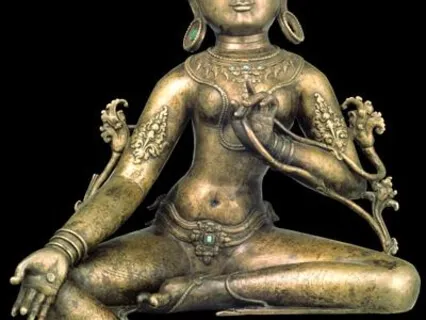
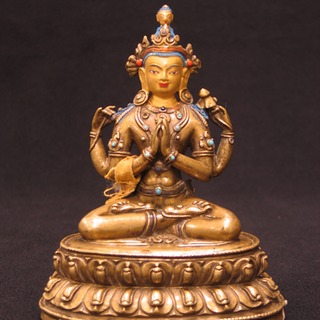
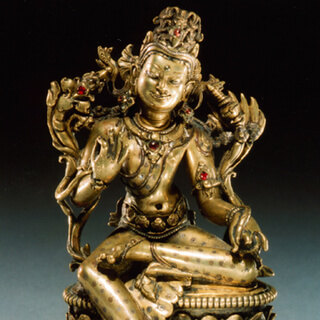
And we're looking at green Tara right here behind me.
She is an elegant princess in this depiction here.
And this is a 13th century sculpture of green Tara.
She is depicted as an Indian princess.
And we can tell that because she is bejeweled and she has some pretty,
Pretty great earrings going on there.
She is seated in a pose that is very traditional for green Tara,
Which is this very kind of elegant,
Flowing posture and a leg out.
Some say it is so that she can jump up and help you when you need it because she is after all really an offer of compassion and embodying compassion and is considered by some the female Buddha.
The pose itself though is known kind of from an art historical point of view as the pose of royal ease,
Which is always fun to think that there's a pose for that.
If you ever want to feel like a royal at ease,
You can try this at home.
The mantra Om Tare Tu Tare Tu Re So Ha or So Ha,
As some say,
Really asks Tara for that,
Which she is most known to give that sort of liberation from fear,
Liberation from suffering.
And as we've talked about in the past,
The actual literal translation of the mantra and of each kind of syllable and word is really less important than the experience of hearing or listening in your mind to the mantra.
It's really meant that to the power of the mantra is really said to be in the actual sound and experience of these syllables that are conveyed.
So you have the not only the meaning,
Literal meaning,
But also that experience.
So I hope that you enjoy that today,
The really the ticking in the sounds as you hear or imagine them for this mantra.
We are back with Sharon Salzberg today.
So great to have you back again,
Sharon.
And we'll go a little deeper into this idea of mantra with Sharon today.
She is,
Of course,
The co-founder of the Insight Meditation Society in Berry,
Massachusetts.
And she has been teaching and practicing for decades.
She is the author of many really wonderful,
Helpful,
Practical,
Lovely books.
And you can find a couple of those up in our shop,
Real Happiness at Work.
And the one that she's just about to release is all about real love.
And Sharon will be back with us in June,
Right?
Twice.
So we'll have her here as our regular practice.
But then she'll be here at the end of June for a special evening program,
Which will be book release program that we're excited to be presenting with her.
Tickets will be on sale in just a couple of weeks.
But that is for her new book,
Real Love.
So we'll be talking all about love.
Doesn't that sound nice?
Please welcome her back,
Sharon Salzberg.
Hello.
I feel so lucky I get to talk about love.
It's so great.
Actually,
I will be here twice in June.
I'll be here for Wednesday,
The seventh,
I think,
June 7th.
The book comes out June 6th.
So the very next day I'll be here for this sitting.
And there will be books.
I'll stay on for book signing and people are invited to come even just to the book signing if they for some reason don't want to meditate first.
We're going to keep on talking about mantra.
How many of you here for the first time?
I'm curious.
It's a question I always ask.
It's great.
In classical Hinduism and classical,
Certainly Tibetan Buddhism,
The particular mantra,
The particular sound or seed syllables or sentence phrase are associated with a particular figure.
It's an archetype,
Right?
And so that symbolic figure is representative of something,
Tara,
Representative of healing,
Of fearlessness,
But a very gentle fearlessness,
Not like a warrior pose.
She's a healer.
And people say that you turn to Tara if that's your orientation.
You turn to Tara when you're afraid,
When you don't see your way out of some situation,
When you're seeking healing.
And the concept in Sanskrit is called an ishtadev.
It's like your personal benefactor or the being that you think of that lifts your spirits,
That reminds you there are many possibilities in life that we don't know the end of the story,
That there's a bigger picture than what we find ourselves mired in and almost defined by day to day.
So sometimes you receive that figure,
And of course it can change over the course of a life,
Sometimes you receive that figure from a teacher.
They kind of look at you and they think,
Sometimes it's a question of balance,
You know,
Could use a little toughness or whatever,
Or maybe calm down a little,
Whatever it might be.
And so that's the deity with the attendant mantra that you're assigned.
So I've often said,
I've actually said on this very stage one evening that my own ishtadev,
My own personal pivotal symbolic figure is the Statue of Liberty.
And I just love her.
And she means something so profound to me in kind of obvious ways,
Belonging,
Welcoming,
Boundless compassion,
No one left out,
And strength.
She's not like a cowering figure.
That tremendous dignity and the rightful pride in that stance,
No one left out.
You know,
I am strong enough to hold everybody,
You are all welcome.
And from the time that I was a child,
Fortunately I grew up in New York City,
Given my obsession with the Statue of Liberty,
She has meant everything to me.
I said when I was here before that I've even been tempted,
If I see like a little green,
You know,
Eraser shaped like the Statue of Liberty,
I get happy.
And I've been tempted to like,
Not really tempted,
But I've had the passing thought to buy like a,
You know,
Five foot Statue of Liberty and have it be like the only thing in my living room.
These days I'm really into the,
There's an emoticon that's the Statue of Liberty.
And if somebody writes and says,
Oh,
Just got back to New York,
I'm so happy because then I can put it all over the,
You know,
The message like,
Welcome back Statue of Liberty,
Statue of Liberty.
And I realized she is serving me in the way that a deity might serve me if I were born in that culture.
She's the only thing to me of greater possibilities that says something about me.
It's not just the externalized figure,
But it's what that says about each one of us as a human being with the capacity,
The possibility of much greater aliveness and power and love and presence and all of that.
So with the Statue of Liberty,
Even though there's of course the whole poem,
I would have to make up the mantra basically.
You belong,
We all belong,
Something like that.
And that would work in that way.
With figures like Tara,
There is the mantra in Sanskrit or Tibetan.
I'm Tare Tute Tare Tude Swaha.
And so this is really what we're doing,
Whether we are first finding our own tremendous source of inspiration.
And I think that in itself is a great exploration.
Is there a symbol?
Is there a person?
Is there a historical figure?
Is there a kind of mythological figure that for you represents that moment of,
Wow,
Look at that.
In doing loving kindness meditation,
When we offer loving kindness to a benefactor that's someone who's helped us,
They may have helped us directly,
Like helped pick us up when we've fallen down or they may,
Maybe we've never met them,
But they've inspired us from afar.
And the texts say,
This is the one whom when you think of them,
You smile.
It's like there's such a sense of like,
Oh,
Right,
There's something bigger.
And there's love in this world.
Or there's that kind of strength in this world.
So is there somebody,
Whether a human being or mythological being or statue that has you smile when you think about them?
And is there a word or sound that would accompany that recollection,
That bringing them into this place?
That could be your mantra.
So for our time here sitting,
I'm going to give you a bunch of alternatives.
One is,
As we did last week,
As is also done many times,
Attaching a word to the feeling of the breath.
So the practice is similar to what many people have done,
Just feeling the in and out flow of the breath and bringing forth the word,
Peace,
Joy,
Love with that.
Another alternative is not really breath oriented,
But more along the lines of what I've just been talking about.
Maybe beginning with feeling your way into,
Is there that figure?
Is there that being even symbolic for you?
Maybe see if you can get an image or just absorb what is important about that being for you.
And then see if there is a word or a term and just rest your attention in the repetition of that word.
Now in both cases,
The skill set is exactly the same.
Almost certainly your mind will wander far,
Far,
Far,
Far away.
I may start out with an image of the Statue of Liberty and repeating a word like welcome or a term like everybody belongs.
It may not be long before I'm thinking about my next birthday,
Whether I should go out to the Statue of Liberty,
Whether I should have a party out there.
Is it closed?
Is it open?
I forget.
How hot is it going to be?
My birthday is in August.
Maybe I should go somewhere air conditioned instead.
Because one's mind does that,
Right?
So you realize you're a million miles away.
See if you can gently let go and come back to the chosen object,
Whether that's the breath with the word or just the repetition of a word or a phrase.
We just keep letting go and coming back.
And for those of you who would like to experiment with the Thar mantra,
Silently,
It's up there behind me.
And you can just,
If your eyes have been closed,
You can just open your eyes if you forget what it is and say it silently to yourself.
And if you feel more confident,
You can close your eyes,
But just keep opening them if you need to be reciting it.
Okay?
Okay,
We'll begin.
You can sit comfortably,
Close your eyes or not,
Let your energy settle into your body.
And either with the feeling of the breath,
See if there's a word you would like to have accompany it or experiment with a particular kind of energy configuration,
Fierceness,
Gentleness,
Love,
Strength,
And see if there's an embodiment of that.
With that knowledge,
You can keep repeating whatever word or phrase comes along with that.
Okay?
Arm.
Okay.
Thank you.
Be happy.
That concludes this week's practice.
If you'd like to attend in person,
Please check out our website,
Rubinmuseum.
Org slash meditation to learn more.
Sessions are free to Rubin Museum members,
Just one of the many benefits of membership.
Thank you for listening.
Have a mindful day.