Welcome to the mindfulness meditation podcast presented by the Rubin Museum of Art.
We are a museum in Chelsea,
New York City that connects visitors to the art and ideas of the Himalayas and serves as a space for reflection and personal transformation.
I'm your host,
Dawn Eshelman.
Every Monday we present a meditation session inspired by a different artwork from the Rubin Museum's collection and led by a prominent meditation teacher from the New York area.
This podcast is a recording of our weekly practice currently held virtually.
In the description for each episode,
You will find information about the theme for that week's session,
Including an image of the related artwork.
Our mindfulness meditation podcast is presented in partnership with Sharon Salzberg and teachers from the New York Insight Meditation Center,
The Interdependence Project,
And Parabola Magazine.
And now,
Please enjoy your practice.
Hello,
Tashi Delek,
Tashi Delek,
And welcome.
Welcome.
Welcome to mindfulness meditation online with Rubin Museum of Art.
I am Tashi Chodron,
And we are a Museum of Himalayan Art and Ideas in New York City.
And we are so glad to have all of you join us for our weekly program where we combine art and meditation online.
The museum is open to all,
And our staff on ground is following strict protocol such that our wonderful visitors can have safe and enjoyable experience.
You can book your tickets in advance and come visit our beautiful exhibition,
Awaken a Tibetan Buddhist Journey Towards Enlightenment,
Which explores the steps in the journey of self-knowledge and transformation from chaos to awakening to everything in between.
So inspired from the exhibition,
We will take a look at a work of art from our collection.
We will hear a brief talk from our wonderful teacher Sharon Salzberg,
And then we will have a short sit,
About 15 to 20 minutes for the guided meditation by her.
So let's take a look at today's theme and the artwork.
So the theme for this month,
August,
Is offering.
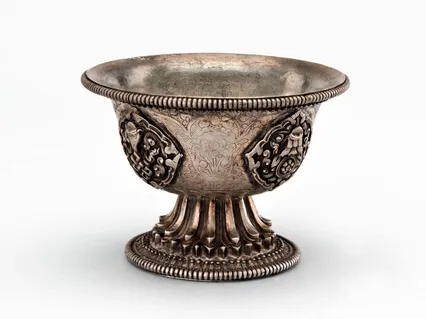
And the artwork that Sharon selected from the list of the art from our collection is this beautiful stemmed offering bowl.
And this is about a mid 19th century,
If I'm not wrong,
And it's a beautiful silver ritual object,
Stemmed bowl,
Ritual object from Nepal.
And so these offerings,
Those of you who have been up in our gallery on the fourth floor,
The Tibetan Buddhist Shrine Room,
You will see the seven bowl water offerings,
And sometimes you will also see eight offerings.
So don't be confused.
And most of the time you will find seven bowls,
Water offering,
But they symbolize in the recitation,
There is argam,
Pargam,
Dup,
Aluki,
Gendi,
Niveda.
So there's all that recitation symbolizing offerings of pure water,
Offerings of incense and flowers,
And so on and so forth.
So these bowls will be filled with all these different offerings or commonly the living tradition you would find water,
But they symbolize all these different offerings in order to accumulate merit.
The belief is that in the Vajrayana Tibetan Buddhism,
When you make these offerings,
You don't have to have the real substance.
One can visualize and just make offerings and still receive blessings and merit.
And having merit gives us all these positive energy and fluidity and all of that.
So I'd like to now bring our teacher for today,
Sharon Salzberg.
And Sharon is the co-founder of Insight Meditation Society in Barre,
Massachusetts,
Has guided meditation retreats worldwide and very renowned,
Of course,
And been guiding since 1974.
Sharon's latest book is Real Change Mindfulness to Heal Ourselves and the World.
And she's the author of many,
Many books,
Including the New York Times bestseller,
Real Change Mindfulness.
And in fact,
Sharon's website will have all of the information.
Sharon just mentioned earlier that Sharon has a book club reading in September with Insight Meditation.
Thank you so much for joining,
Sharon.
And thank you.
Thank you so much.
I am in Barre,
Massachusetts.
Yesterday we had no power for a while,
So I was a little bit anxious about the session,
But here we are so far.
We're all empowered and that's terrific.
And I did choose that extremely beautiful piece of art,
The offering bowl from amongst the different suggestions that the staff at the Rubin Museum sent me to look at for the topic of offering.
And I chose it in part because it reminded me of offering the best of what I have and how the theme of offering symbolizes for me both a sense of inner abundance.
It's like the best of what I have.
I'm offering,
I'm surrendering,
I'm relinquishing the hold on and also a kind of humility.
I think about that offering bowl being filled with water and water in a way has both those qualities.
It's obviously fluid,
It can adapt to the shape of its container,
Of its vessel,
And there's a kind of relentlessness or determination in water.
Like over time,
Water can wear away rock.
So there's incredible strength and softness.
So there's a lot in that aspect of making an offering and we do touch the best within us instead of feeling what we might normally feel.
I have nothing to give,
Nothing much to contribute.
Anything I do could never be enough.
In that act,
We are affirming a kind of inner worth or inner abundance out of which the best kind of generosity comes.
We realize that I don't lose anything.
I'm not bereft.
I'm not missing in the act of generosity.
It's kind of an ever replenishing pool within from which I can give.
And that what I give,
What I offer is kind of not the main point.
It doesn't need to be bigger,
Grander,
More flamboyant,
More excessive than my neighbor's offering.
It's of the heart and it's that act of giving that is most important.
And there's also a kind of humility there in that we're using that offering to connect to something greater than ourselves,
Whatever that might be.
It may be symbolized in iconography,
Say a Buddha statue or statue of Kuan Yin,
Something like that,
Or it may be an offering to kind of benevolent forces in the universe,
Trying to enlist them for the good of many.
It may be an offering to the greatest wisdom we have had so that we are connected to something bigger,
To a sense of truth that is more enduring perhaps and more uplifting than the particular circumstance.
We're facing or we're watching others face at this moment.
And all of that comes together in the offering of merit,
Which I want to talk about a little bit because we're going to once again,
Do that at the end of the meditation.
So the belief within the Buddhist tradition is that when we do something toward the good,
We're kind,
Uh,
We're generous,
We meditate,
Even if it feels like we have terrible concentration,
We learn,
We want to study,
We want to understand,
We ask questions.
All of that produces like a positive energy.
It's a generative,
It's like the energy of good heartedness of goodness and engaging in any of those actions,
Also acts of restraint,
Like it would have been awfully easy to tell a lie and we don't,
We speak the truth.
All of that generates this energy and,
Um,
Very traditionally or classically,
You might say to a meditation setting or,
Or do retreat or,
Uh,
Go to the monastery in Asian countries and offer food to feed the meditators,
Um,
After which you don't kind of loll about thinking,
I'm like the greatest person I made so much merit,
But you dedicate it,
You offer it,
You actually feel that positive energy and you make an offering of that,
Uh,
Very commonly to those who've helped us,
Those who've picked us up in some way,
Or maybe they've inspired us from afar,
But they're like a beacon of light in our lives.
We make that offering to them.
We make that offering of that positive energy to those we know who are hurting or we're struggling and there are so many beings,
Um,
In that place,
Certainly right now.
And we make that offering as an affirmation of the fact that say you've been meditating and that's the source of the merit.
Our inner work could never be just for ourselves alone.
It really is about that connection to others.
We make that offering,
Um,
Say for this group who's gathered here together as we co-create this experience.
And we make that offering to all beings everywhere,
To all of life,
Those whom we know,
Those who we don't know,
But we dedicate that force of goodness.
We have managed to tap into through some action to the welfare that benefit the happiness of all beings everywhere.
So in,
In very,
Um,
Kind of traditional Buddhist cultures,
A country like Burma,
For example,
Which is a place I did some practice,
Some intensive practice.
This is also a ritual that's done very often for someone who's died.
It's a way of commemorating them,
Of remembering them and the belief in that culture,
Which we of course may not necessarily share,
But the belief in that culture is that the strongest way to make a connection with someone,
Because remember they believe in rebirth,
The strongest way to make a connection with someone is through the force of our own good heartedness.
And so it would be very common,
For example,
In the monasteries where I practiced for a family member,
If somebody had died,
Um,
For the family to come and offer to feed as many people as they possibly could afford to.
And then there would be a ceremony of dedicating the force,
The positive force of that generosity to this person who has died.
And we,
Of course,
You know,
As I said,
May not at all share that belief system,
Uh,
But it is a way of drawing close to the memory of somebody.
And I remember once when I was in Burma practicing,
The,
Um,
Mealtimes,
Um,
Are very kind of formal and there's like a formal processional,
And you come into the dining room,
There are tables of like three or four people on the floor,
You sit on the floor,
Um,
And the food is served family style.
So you come into the dining room,
You bow to the Buddha image,
You sit down,
Um,
And you begin to eat.
So I did that one day and I took a look at what was on that little round table and it was looking to me like a Jewish meal.
I thought that's like white fish salad,
That chicken soup.
And this is really weird.
I thought,
Oh,
My meditation has like gotten weird.
I've gone off.
I'm hallucinating.
But it turns out that there was a,
Like a minuscule Jewish community in Rangoon and somebody had died.
And so the family had come and not only had offered the money to have the kitchen staff provide the meal,
They'd offered the recipes.
So it was like a whole Jewish meal.
And there was a sharing of the merit ceremony afterwards.
You know,
So whatever your belief system,
I think we can feel that our own acts of good heartedness do generate a kind of energy.
And it's a beautiful offering to remember that having been generous or been kind or gone out of your way to help somebody or when you meditate,
Whatever the meditation feels like,
It's the fact that you sat down to do it.
That's significant to recognize at the end that it's not really just for us and that it is a way of making an offering in honor of our connection to others and ultimately to all beings.
So let's sit together and I'll guide you through a sharing of the merit at the end.
You can sit comfortably.
Just be at ease.
You can close your eyes or not.
If your eyes are open,
They can also be like a little bit open.
You could find a spot to rest your gaze.
Let it go.
You can start by listening to sound.
I can hear the rainfall.
I don't know if you can hear the rainfall around me or just the sound of my voice.
Maybe rainfall or something around you.
And unless you are responsible for responding to the sound,
See if you can just watch through you.
And bring your attention to the feeling of your body sitting,
Whatever sensations you discover.
See if you can feel the earth supporting you.
Feel space touching you.
Bring your attention to your hands and see if you can make the shift from the more conceptual level to the world of direct sensation,
Picking up warmth,
Coolness,
Pulsing,
Throbbing,
Whatever it might be.
You don't need to name those things,
But feel them.
You don't need to be ashamed of them.
And bring your attention to the feeling of your breath on the same level of picking up sensations.
See if you can find the place where your breath is strongest for you or clearest for you.
Maybe that's the nostrils or the chest or the abdomen.
You can find that place,
Bring your attention there and just rest.
See if you can feel one breath.
Without regard to what's already gone by,
Without leaning forward for even the very next breath.
That's this one right now.
If images or sounds or sensations or emotions should arise,
But they're not all that strong if you can stay connected to the feeling of the breath,
Just let them flow on by your breathing.
You don't have to follow them,
You don't have to fight them.
Just one breath.
But if something is strong and it pulls you away,
You get lost in thought or spun out in a fantasy,
Truly don't worry about it.
You realize you've been gone,
Maybe fallen asleep,
Maybe you've just taken a trip around the world,
Whatever.
You realize you've been gone,
See if you can let go gently and bring your attention back to the feeling of the breath.
You can find that place,
Bring your attention there and just rest.
That's it.
You you