Welcome to the mindfulness meditation podcast presented by the Rubin Museum of Art.
We are a museum in Chelsea,
New York City that connects visitors to the art and ideas of the Himalayas and serves as a space for reflection and personal transformation.
I'm your host,
Dawn Eshelman.
Every Monday we present a meditation session inspired by a different artwork from the Rubin Museum's collection and led by a prominent meditation teacher from the New York area.
This podcast is a recording of our weekly practice currently held virtually.
In the description for each episode,
You will find information about the theme for that week's session,
Including an image of the related artwork.
Our mindfulness meditation podcast is presented in partnership with Sharon Salzberg and teachers from the New York Insight Meditation Center,
The Interdependence Project,
And Parabola Magazine.
And now,
Please enjoy your practice.
Hello,
Welcome.
Namaste and Tashi Del Lake.
Welcome.
Welcome to mindfulness meditation online with Rubin Museum of Art.
I am Tashi Chodron.
We are a museum of Himalayan art and ideas in New York City,
And we are so glad to have all of you join us for our weekly program where we combine art and meditation online.
So today is a wonderful connection to the theme of awaken or awake,
Connecting to our most recent exhibit,
Awaken,
A Tibetan Buddhist journey towards enlightenment,
Which explores the steps in the journey of self-knowledge,
Awareness,
And transformation from chaos that we have explored last month to awakening and everything in between.
Now,
When I talk about everything in between,
There is a Tibetan word called in between is par do.
Let's take a look at the art for today's session.
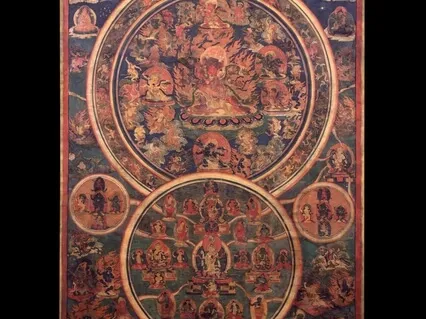
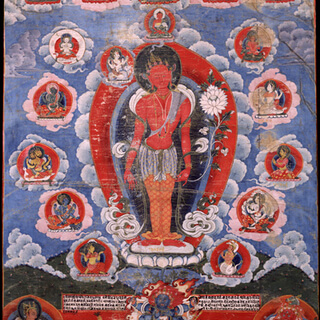
And now you're looking at this beautiful thangka painting,
Which is a squirrel painting,
Mineral pigment on cloth.
And what you're looking at here is called par do,
Which is peaceful and wrathful deities of the par do,
Which is translated in Tibetan as shit ro,
Peaceful on the upper circle that you see,
The fierce wrathful,
And then the lower,
The second biggest circle is the peaceful deity.
So these are the peaceful,
Wrathful deities of the par do thangka.
This is a beautiful instruction on how the Tibetan Buddhist,
When a person leaves this body,
What we call death,
Then the belief is that,
You know,
We go through different stages based on one's own action and karma.
We face different things during the 49 days after we leave this body where the consciousness comes through different deities.
And then if we are able to recognize,
Then we find a clear and better path towards the enlightenment.
So our guest teacher for today is Tracy Corinne.
I am so honored and thrilled to introduce Tracy.
Tracy has been a student and teacher of meditation and spiritual practice for decades.
She's the founder of Hudson River Sangha,
Which is now virtual and open to all.
The link can be found on tracycorcoran.
Org website.
In addition to Rubin Museum,
Tracy has taught mindfulness meditation and mindfulness writing at New York Insights Meditation Center,
As well as to many schools and corporate and other venues,
You know,
Nationally and internationally.
Tracy is also writer and editorial director of Parabola Magazine.
In fact,
I just found out that the new Parabola Magazine is out.
You can also find the magazine at the Rubin Museum gift shop as well.
And her writings and podcasts and other details can be found on her website,
Tracycorcoran.
Org.
So thank you so much,
Tracy.
It's my great honor.
Well,
Thank you,
Tashi.
And it's humbling to be here with that great work of art and with you.
And after that introduction.
So I'm happy to be here with all of you.
I wish I could see you.
And I would like to introduce a couple of simple ideas for how we can relate to that beautiful artwork,
Sacred artwork,
Tanka,
And also the concept of the bardo,
The transition state.
And I have found that it's extremely helpful and even fun to remember that this state called awakening is always a verb.
It's never a fixed state.
It's always something fluid and changing.
And as I was waiting to come on,
I was experimenting with something I'd like you to experiment with right now,
Which is to just bring your attention back to yourself and let yourself kind of melt,
Kind of soften just a little bit as you listen to me.
And I have come more and more to think of this process we call awakening as a process of melting,
Of becoming less solid,
Less separate.
The late great travel writer Anthony Bourdain once said,
Maybe it's enlightenment enough to know that there is no final resting place for the mind.
No smug conclusion that we reach.
And it's natural when I began meditating back in the Andalusian age,
It was natural to strive,
To understand,
To get somewhere,
To finally see.
And slowly over the years,
I began to see that I was actually trying to climb up out of this mess,
This mess being my life.
So often things aren't clear or they hurt or there's confusion.
And I slowly,
Slowly began to see that maybe there's no escape from certain basic facts that I'm alive.
There's no way to avoid confusion and loss and aging and death and illness.
No way to avoid any of those things.
And yet I also began to see that at certain moments I can be much softer,
Much more fluid with what's happening.
It might be a moment in nature.
It might be a moment of just being still.
It might be a moment of just plain giving up.
Those moments that can come to a person at 3 a.
M.
When you find yourself spiraling and spinning through regrets or anxiety about the future or wishing to undo or unsay something you said or change a choice you made.
And you spin and you spin and you spin and then out of sheer fatigue sometimes you just let go and breathe and sense yourself just lying in bed,
Alive.
And sometimes in that moment you understand what images like this great and beautiful image of the Bardo can mean.
And it's added not to I think of it almost like a Star Wars where we're in we've dropped into the strangeness of our lives,
The unknown of it.
And we see all different kinds of creatures,
All different aspects of ourselves sometimes.
And some that look strange and fearsome turn out to be approachable.
Not just approachable but beings that hold a key or truth that can help us on our way.
And we begin to understand what Carl Jung said when he said that enlightenment doesn't consist in imagining creatures of light,
All angels as we picture them,
But in making the darkness visible.
Awakening consists in letting go of the tight circle of the known,
Everything we think we have,
Because all of that is based on past experience and instead opening to the unknown,
Opening to see with new eyes,
With an open heart these strange creatures in the dark,
These feelings,
These moments,
These forces,
Just allowing them to appear,
Allowing them to be met.
And we begin to discover,
And this is a work of moments,
Small moments,
Many times that we are literally more than we think.
We're more than we think.
We are also eyes that see without judgment.
We're also a heart that can open to what appears,
Even our own sorrow.
Being open that something new and unimaginable may appear,
That inside that sorrow there might be tenderness,
Responsiveness,
A capacity to be with something completely new,
That under that anger that we're frightened of there might be again some sorrow,
Some sensitivity,
Something that can reveal something that can help us enlighten our way.
Once upon a time I had the great pleasure of spending a day with Ram Dass and I asked him,
I was trying,
Trying,
Trying to think of a question or something that he hadn't been asked before,
Which I thought would be impossible because he'd been so often interviewed and written about.
And so I asked him if there was anything in his life that foretold somehow or helped him after he had his stroke.
And he said,
You know,
There is one thing.
I used to have this dream long before I had the stroke.
I had this dream that I felt like I was awakened.
I felt like I was getting somewhere and I approached this arena full of,
And again think of the part how this huge place filled with all kinds of beings and when I got to the door I was always barred from entrance so they would say no he can't come in,
Can't come in.
And after the stroke he told me he had that dream and when he got to the door,
Same place,
Full of creatures,
Beings,
All kinds,
They said now he can come in.
Now he can come in.
The gift of this path is to see that the way we're headed isn't towards things being peaceful all the time or easy all the time or without troubles or pain.
No,
It's a path where those troubles and that pain and those things that seem so frightening are actually our teachers.
And as we accept them as such we find that we've melted,
We've softened,
We've opened to a world of company,
A world of forces that support us,
Of friends who might look wildly different than us but who share our pain.
So let's sit together and take a comfortable seat with a straight back,
As straight as you can comfortably sit and let the head rest easily on the neck.
And just check in with your state today.
And think about it,
Just take in an impression.
Notice how that attention that you bring begins to soften you.
Let tension be present.
If it's here don't strive to change.
Let everything be okay.
And see how this acceptance softens and relaxes you.
Just a bit.
And let the attention come to the feet.
Noticing how it feels to have weight,
To be subject to gravity.
And let the attention come to the feet.
And see that when your attention drifts towards thinking that this is completely natural.
And gently come back again to the sensation of sitting in a body,
Breathing.
And notice that this movement of coming home to the body opens you to the life inside and inside,
To sensations and breath and impressions of all kinds.
And notice that when your attention drifts towards thinking that this is completely natural,
This is completely natural,
This is completely natural,
This is completely natural,
This is completely natural,
This is completely natural,
This is completely natural,
This but flowing alive you you When you get lost in thought just come home back to the body and breath And and the tension that see is without judging you you you See how it feels to let yourself be Just like this Completely acceptable just like this Seen by an attention that doesn't judge or comment you just receive you you you Notice how the stillness surrounds you you accompanying you so that you feel less alone you you you you Notice how it feels to let stillness touch everything unsettled unclear unknown and just let it be welcoming it just as it is you you you resting in stillness welcomed to be present just like this.
Accompanied by great and mysterious forces.
By wisdom and compassion.
And love.
Accompanied by great and mysterious forces.
Accompanied by great and mysterious forces.
Thank you.
Thank you,
Tracy,
For that wonderful experience.
That concludes this week's practice.
If you would like to support The Rubin and this meditation series,
We invite you to become a member.
Thank you for listening.