Welcome to the Mindfulness Meditation Podcast presented by the Rubin Museum of Art.
We are a museum in Chelsea,
New York City that connects visitors to the art and ideas of the Himalayas and serves as a space for reflection and personal transformation.
I'm your host,
Dawn Eshelman.
Every Monday we present a meditation session inspired by a different artwork from the Rubin Museum's collection and led by a prominent meditation teacher from the New York area.
This podcast is a recording of our weekly practice,
Currently held virtually.
In the description for each episode,
You will find information about the theme for that week's session,
Including an image of the related artwork.
Our Mindfulness Meditation Podcast is presented in partnership with Sharon Salzberg and teachers from the New York Insight Meditation Center,
The Interdependence Project,
And Parabola Magazine.
And now,
Please enjoy your practice.
I am so happy to be here with you.
My name is Tashi Chodron and we are a museum of Himalayan art and ideas in New York City.
And so wonderful to have all of you joining us.
This is our weekly practice where we combine art and meditation online.
So nice to see so many of you here.
And welcome to those who are joining for the first time and many of you,
You know,
May hopefully are back here for many more times.
And so for today's session,
Inspired from our collection,
We will take a look at a work of art from our collection.
We will hear a brief talk from our teacher and then we will have a short sit,
About 15 to 20 minutes for the meditation guided by our teacher.
Our theme this month is care.
What are you caring about right now?
Let's take a look at this beautiful work of art together.
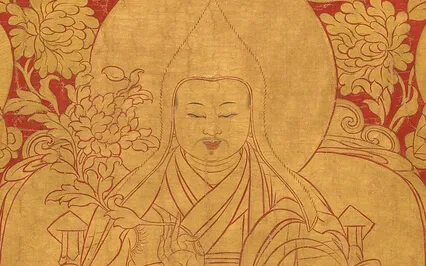
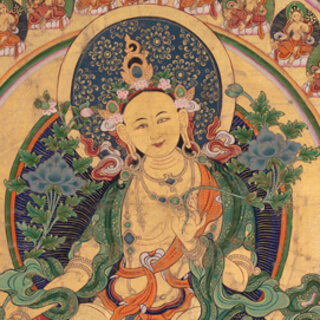
This is a beautiful thangka.
My colleague can bring the art connection for today.
So this is a thangka and thangka is a mineral pigment on cloth from Tibet.
Date ranging about 1600 to 1699.
The size of this thangka,
If you were to be in front of this,
The size is about 26 inches to 16 inches.
As you see here,
It's red background,
Very unique on gold.
It's on cotton.
And the central figure,
Thanks for zooming that,
The central figure here is Ngawang Lopsang Gyatso,
The great fifth Dalai Lama.
I hope and I am sure most of you or all of you may have heard of our great His Holiness Dalai Lama.
So the present Dalai Lama,
If I were with you in person,
I would probably quiz what number is the present Dalai Lama,
The reincarnation.
So this particular thangka,
The central figure is going back to fifth Dalai Lama.
And the present Dalai Lama that we have all seen or heard is the 14th reincarnation.
So this great fifth Dalai Lama is the period 1617 to 1682.
And as you see here,
It's surrounded by previous reincarnation,
The previous Dalai Lamas.
In fact,
He is holding,
The central figure,
Of course,
Is holding a stem of the lotus blossoming over the right shoulder and the left hand holding a long life vase in the lap,
As you see here in the lap.
This painting is in gold,
So you can,
You'll have to look very carefully and you can see a long life vase.
This long life vase is an indication that the painting is a portrait commissioned during the life of the fifth Dalai Lama,
Wearing this very sharp pointy hat,
Which is often known as the pandita hat.
He sits atop a cushioned throne.
So we are very familiar with the lotus throne.
But the fact that the central figure,
Fifth Dalai Lama,
Is sitting on a cushioned throne,
Which means they'd be alive during the fifth Dalai Lama,
Is when this painting was commissioned.
So directly above is the Bodhisattva of Compassion,
Avalokiteshvara,
Right on top there,
Known as Chendrik Zik in Tibetan word.
And at the left is the king,
Tsong Zang Gampo,
Actually,
The Tsong Zang Gampo.
Yes,
Right there.
And to the right is the Trom Tsen Pa,
You know,
To the right on the other side.
Yes,
Trom Tsen Pa is one of the very important students of Atisha,
The great scholar that came from India.
So at the middle left is the first Dalai Lama,
Gendun Drup.
And then the middle right is the second Dalai Lama,
Known as Gendun Gyatso.
So Avalokiteshvara,
The Chendrik Zik,
Is the patron deity of Tibet.
And His Holiness Dalai Lama are known to be the emanation of Avalokiteshvara.
Now,
This beautiful red background painting is in fact associated with the Buddha Amitabha and then the overcoat of gold.
So when there's a lot of gold,
It says that the commissioner has spent more money,
As we all know,
It is more expensive,
In which the practitioners also believe that much more merit when you spend,
You know,
More valuable things on the painting.
So now we can move on to bring our teacher.
Our wonderful teacher for today is Tracy Cochran,
Who will talk to us on the theme of care.
What do you care,
Right?
Our care.
And Tracy has been a student and teacher of meditation and spiritual practice for decades.
She is the founder of Hudson River Sangha,
Which is now virtual and is open to all.
More can be found on her website,
TracyCochran.
Org.
And in addition to Rubin Museum of Art,
Tracy has taught mindfulness meditation and mindful writing at the New York Insight Meditation Center,
As well as schools,
Corporations and other venues nationally and internationally.
She is also a writer and editorial director of Parabola magazine.
You can also find the magazine in our gift shop at the Rubin Museum.
You can find more information on Parabola and Tracy's schedule on Tracy's website.
Thank you so much,
Tracy.
It's such a great honor to introduce you and thank you for being here.
Tashi,
Thank you so much for that beautiful introduction and that description of this beautiful thangka.
And I'm very happy to be here today to talk about care,
Because there is no better time.
And I know from speaking with my friends in the Hudson River Sangha and elsewhere,
That we're all feeling enormous care about what's happening in the world.
And as it happens,
I've just returned from Europe.
My daughter lives in Europe,
And people in Europe are also feeling the same care.
So we hearken.
It was wonderful to choose that illustration because there's something in us that wants great guidance,
Great leadership,
Something we can hold on to that we can really trust.
So I thought I would share with you a little story from my travels.
So just,
I invite you to relax.
And among the places I went was a medieval city called Toledo in Spain.
And it was in a section of the country called La Mancha.
So everywhere I went in the three days I spent in this medieval city,
There would be images of a man.
And I bet most of you know what I'm going to say,
The man from La Mancha,
Don Quixote.
And I realized that the story really has something to teach us because Don Quixote felt that something had really gone out of life,
Something had really gone amiss.
And that chivalry,
That nobility that he longed for was gone.
And he'd read and read and read.
And this is very much like many of us,
Or certainly like me,
Who've read many books about Buddhism,
Many books about the Dalai Lama,
5th and 14th,
Yearning for a way to live a noble life,
To know the noble truths,
As the Buddha put it.
So Don Quixote gets in a state,
He's in a complete battle with reality.
And he insists on seeing the people around him,
Not as they are,
But as he wishes they were,
He projects.
And we know how that feels.
So he insists that an innkeeper knight him.
And he goes off on a great quest,
Accompanied by a down-to-earth farmer,
Someone who repeatedly in this great work touches the earth and tries to convey reality,
Sancho Panza.
And off they go on this quest.
It's both comic and tragic.
Because Don Quixote cannot see what's in front of him.
He cannot accept it,
Because he so longs for something else.
And you might say he is a victim of caring,
In a sense.
But what kind?
He's insisting that his life conform to his imaginary earlier standard.
And I know exactly how that feels.
I have gone on retreat and spent my time longing and imagining what it's like to be an earlier Buddhist,
A real Buddhist.
So,
And most of us know many pieces of the story.
He tilts with windmills,
Imagining that they're giants.
He creates all kinds of trouble for himself.
In fact,
The word Quixotic arose even at the time of this novel,
Which was from 1500.
It's a word that means to cling to this kind of doomed,
Idealistic quest.
And it doesn't end well.
Or it ends,
As you might predict,
That he's lying in bed,
Exhausted,
Defeated.
And he gives up his battle with reality.
He gives up his fanciful standards for what is good and noble,
And who the best teachers were.
So,
This might sound downbeat to you,
But it's actually the opening of something extraordinary.
When we begin to touch in with our living experience,
And I invite you to do that right now,
Even as you listen to me,
To just lay your attention,
Come back to your own experience.
You discover that there's more to you inside than your thinking,
Than your imagining,
Than your projection.
There's also sensation,
A living body,
As loyal and good as Sancho Panza.
It's life.
It carries you.
It walks with you.
A beating heart,
Feelings,
Responsiveness.
A connection with life that comes in with each breath.
When we give up our insistence that things be different than they are,
Or insisting on clarity in a time of upheaval,
Or insisting on permanence when we find impermanence,
When we let that go and just come to rest in the body,
We begin to find that what we've been seeking,
When we think of the perfect ancestors,
The perfect teacher,
The perfect guide,
There's something that's present right here and right now.
As Mary Oliver,
The beloved poet,
Put it so memorably,
I know the soul exists,
And I know it's made entirely of attention,
Of attention.
I invite you to see,
To sense,
As you sit here with me,
That there is an attention in you.
It's different than thinking.
It's open,
And that's inherently kind,
And that it's here with you,
Even when you're worried,
Even when you're pining,
Even when you're thinking,
Thinking,
Thinking,
What will I do?
What will come?
What will happen?
What comes next?
There's something else here that's compassionate and caring,
In the sense of kindness,
And love,
And beauty.
I'll just finish before we sit.
Some of my friends from Thudson River Sangha have heard me mention this,
But after I left Toledo,
I went to Madrid,
And I visited Picasso,
And I got his great masterpiece about the horrors of war.
It just captured my attention and my daughter's attention.
It seems like the last word,
But when we left the museum,
And we left after,
We were so full of it,
We didn't look at anything else.
We emerged into a sight and a sound.
I won't forget.
The plaza was full of people,
Full of people,
Including a choir,
With Ukrainian flags flying gently in the night air,
And they were singing Mozart,
The most beautiful music,
As a collective prayer for peace.
It embodied in that moment what I was wishing to convey in this talk,
That even in times of fear and violence in the unknown,
There is also compassion.
There is also beauty.
There is also an attention that embraces us all,
And that in a very real sense,
This is a practice for remembering that,
Bringing our attention home to that.
Let's sit together now and see for ourselves.
Take a comfortable seat with a straight back,
And notice how it feels to bring great kindness and care to this body,
Your own body,
Letting it know that it's completely welcome to be here,
Just as it is today,
No other way.
Notice that there's an attention present in you that can touch the sensations it finds,
The feelings,
The thoughts,
Whatever arises without comment.
It goes to tension if you find it.
It accepts and opens to feelings of fatigue or density or distraction.
It just shines like sunlight.
If you wish,
You can bring the attention to a point like feet on the floor,
Or hands in your lap,
Or the rhythm of the breath.
Whatever feels natural.
Notice how it feels to rest in attention and presence,
To sit with others seeking the same rest,
The same presence.
Notice that you can let everything happen the way it happens,
Thinking,
Sensing,
Picture.
And when you find yourself hooked by a thought or an image,
You can gently come back again to being present in the body in this moment.
Just rest in a presence that's innately caring.
Notice that every difficult feeling or reaction that starts to arise can be met by this attention,
This presence that doesn't judge.
And notice that stillness is not silence but softness,
Unstriving.
Notice how it feels to be completely acceptable.
Every part of you,
Every reaction,
Every thought,
Embraced by a presence that's vast,
That cares.
Notice how it feels to be completely,
Completely allowed to be every part.
And notice that with this movement to the body,
And this relaxing into acceptance,
With that an opening to a light,
A light awareness,
A warmth,
We begin to remember how alive we are,
Our response to breath,
To impression.
As we come home to the body and the living experience of the moment,
We open to presence.
We remember that we belong.
We are not separate.
And we begin to remember our basic goodness,
Our responsiveness,
Our caring,
Our love of life.
Noticing that no matter what comes up inside you,
Fear or hatred or pain,
It can be met by this attention that cares without judgment,
That's curious.
Noticing how it feels to be seen with kindness,
Just as you are softening and opening into your natural compassion,
Caring,
Responsiveness to life.
Notice as we sit together,
As we make this movement of coming home,
This sensation,
We also open.
We become more part of life,
Less separate.
Notice that there is an energy of compassion inside you,
And an attention,
A light that's clear.
Notice that coming home to your living experience opens you to a connection with all beings and to an energy of care and compassion that is healing and free,
Free from hatred and greed and delusion.
Compassionate.
Thank you.
Thank you,
Tracy,
For that beautiful session.
That concludes this week's practice.
If you'd like to support The Rubin and this meditation series,
We invite you to become a member.
If you're looking for more inspiring content,
Please check out our new podcast,
Awaken,
Hosted by Laurie Anderson.
The 10-part series features personal stories that explore the dynamic path to enlightenment and what it means to wake up.
Now available wherever you listen to podcasts.
Thank you for listening,
And thank you for practicing with us.