Welcome to the Mindfulness Meditation podcast.
I'm your host,
Dawn Eshelman.
Every Wednesday at the Rubin Museum of Art in Chelsea,
We present a meditation session led by a prominent meditation teacher from the New York area.
This podcast is a recording of our weekly practice.
If you would like to join us in person,
Please visit our website at rubinmuseum.
Org slash meditation.
We are proud to be partnering with Sharon Salzberg and teachers from the New York Insight Meditation Center.
In the description for each episode,
You will find information about the theme for that week's session,
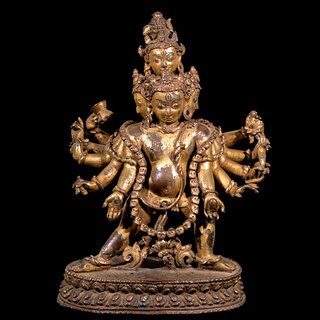
Including an image of a related artwork chosen from the Rubin Museum's permanent collection.
And now,
Please enjoy your practice.
Hello,
Hello.
Good afternoon.
How are you all?
How are you doing?
Okay,
Great.
Great to be here with you.
And thanks for joining us here at the Rubin Museum of Art for our weekly mindfulness meditation practice.
So the power within us and between us.
It's been what we were talking about all year long.
I'm just kind of curious.
For those of you who have been coming regularly,
When we first introduced this topic,
I heard from people that it sounded kind of strange for a museum of Himalayan art to be exploring this topic.
And I guess I'm wondering,
Has spending time with the topic of power and unpacking it a little bit here together or in our exhibitions or other programming,
Has it changed the way you think about it at all?
Raise your hand if that's a yes for you.
Just curious.
Okay,
Cool.
So from the Tibetan Buddhist perspective,
The path to real power,
Which is enlightenment,
Is through this kind of marriage of two concepts or two actions.
And that is wisdom and compassion.
So the vajra and the bell,
The deity and the consort.
And wisdom is what we're talking about here today.
We spent a little bit of time talking about compassion earlier this year.
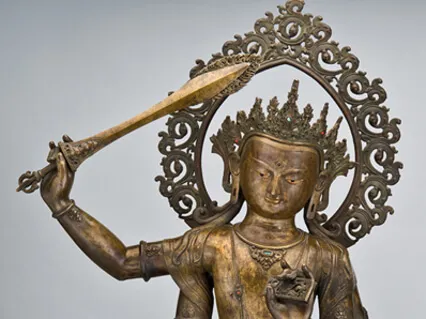
So we're looking at an object today that depicts a figure that kind of exemplifies wisdom.
And wisdom to the Western thinking is often considered kind of a more practical and functional approach.
And in Buddhism,
Wisdom is insight into the true nature of reality.
So you can think of it,
The difference between knowledge and wisdom is what if you have a lot of knowledge but not very much wisdom?
It's not going to get you very far,
Right?
So in terms of this figure,
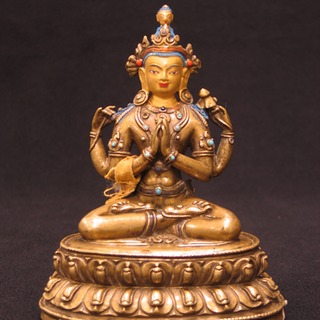
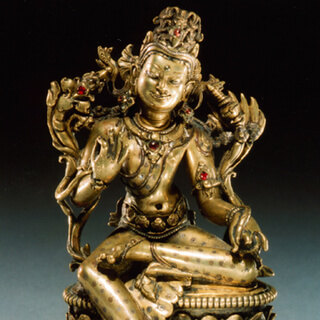
This is Khanna.
And this sculpture here is from Tibet,
16th century.
It's on our masterworks floor,
Third floor upstairs.
And Khanna was a figure who lived in India around the seventh and eighth centuries.
And he originally was a Hindu yogi.
And if we just take a look at him here,
This is a really quite simple and elegant sculpture,
Especially compared to the more ornate things that we commonly see.
And you can see that he has just some very basic jewelry on.
And then you may be wondering what is that thing around his leg there?
That is actually a strap that aids in meditation.
So for the lotus posture,
Kind of keeping your legs where they need to be there.
And then he's kind of gazing up towards his right hand there,
His fingers,
And has this kind of furrowed brow,
Or maybe it's a look of concentration on his face.
And then a big pile of hair there at the top.
So this yogi,
Originally a Hindu yogi,
Actually came to encounter a tantric Buddhist master,
Virupa.
And Khanna changed his mind.
He then became part of the lineage transmitting Buddhist teachings after having met with this teacher.
And so I think that's an interesting type of wisdom,
Being willing to change your mind.
So I invite you to think of a time when you changed your mind and it felt wise to you.
So Virupa inspired Khanna and passed down these teachings to Khanna.
And this is a different kind of wisdom.
This is the passing down of wisdom from one generation to the next in terms of that very special teacher to student relationship.
This is really how that knowledge was maintained and passed along for so many years.
It was an oral tradition,
Right?
So that relationship was incredibly significant.
And eventually that Khanna became so significant in the world of Buddhism that he came to form the foundation of the Sakya tradition.
And this is one of the four main schools of Tibetan Buddhism today.
So we will hear a little bit more about this idea of wisdom from our teacher today,
Tracy Cochran.
Nice to have you back,
Tracy.
She is the writer and editorial director of the quarterly magazine Parabola.
So if you're in the market for some good beach reading,
Check it out.
It's a beautiful slim little volume.
It'll fit right in your bag.
And this month,
You can find it at the shop,
Of course.
And this month it's all about the wild and features the incredible Mary Oliver.
So in addition to the Reuben,
Tracy teaches at the New York Insight Institute and every Sunday at Hudson River Sangha in Tarrytown.
Her writings and teaching schedule can be found online via Parabola,
Facebook,
Twitter,
And TracyCochran.
Org.
Please welcome her back,
Tracy Cochran.
It's good to be back and sitting beneath this figure who changed his mind.
And it's interesting to think,
How can we relate to this beautiful object if it's not our tradition and especially if people are just listening?
How can we relate to the idea,
The simple idea of somebody who thought he knew the story and he knew the path?
And then everything changed.
Everything was disrupted maybe.
And he encounters a person who seems to embody wisdom,
Never mind what the texts say.
He was in front of somebody who knew,
Who had it.
And I was thinking,
I wonder how often,
Because I was first thinking,
I wonder if I've ever had that experience.
But I think,
And I wonder if you do,
That it's at times when everything is up in the air that we're more open to seeing the qualities that other people in other situations present.
Suddenly wisdom,
That quality of really seeing to the root of suffering or compassion,
That capacity to be kind,
Suddenly it matters when the chips are down.
And I was thinking,
Today is a beautiful summer day in New York,
But we know that this could change,
Right?
Just a couple of days ago,
It was,
There were floods and subways and unbelievable heat.
And of course,
All over the world,
People are suffering not just the effects of climate crisis,
But fear connected to it.
What comes next?
And it's interesting to remember that the word emergency is the same root as emergent.
Really,
That in times of emergency,
Other qualities come out.
Compassion,
Wisdom,
Courage.
And just to illustrate this,
I wanted to share the story of a tornado victim in this country,
In the Midwest,
We're seeing lots of tornadoes,
As you know.
And this is a story about someone named Dorothy Gale from Kansas.
And Dorothy suffered a huge tornado,
As you know,
And it uprooted everything.
Her house was blown away,
And she ended up in the strangest place called Oz.
And everything was different,
Completely different.
It was completely technicolor,
Suddenly.
And she was surrounded by these little characters called munchkins that were singing to her.
And she was completely terrified and disoriented.
And just then,
She looked up into the radiant phase of Glinda the Good Witch,
Who just appeared,
Or did she?
Was she there?
And suddenly,
Dorothy was aware of her radiant compassion and kindness.
And Glinda said,
Don't worry,
Just follow the yellow brick road.
And she gave her some special shoes to wear,
The ruby slippers,
As you remember.
So Glinda said,
I mean,
Dorothy,
With Glinda's support,
Set out on the yellow brick road.
And very soon,
She encountered three friends,
Which was a great comfort to her.
Because what was comforting about her friends,
Her Sangha,
You might say,
Is that just like her,
They felt like they were missing something to feel completely complete.
Dorothy was desperate to go home.
This scarecrow was really sad because he felt like he didn't have the wit,
The,
You might say,
Wisdom he needed to really function like he would like to.
The tin man felt like he was missing compassion,
Like he was missing a heart.
And the cowardly lion,
Of course,
Felt like he lacked courage.
We all feel like we're missing something.
The heart of wisdom in Buddhism is the knowledge that we all suffer,
Every single one of us.
So comforted by having friends who are in the same boat,
She went down the path.
Just like the Buddha,
When he had his emergency,
And you could consider awakening a kind of emergency,
A moment when everything changes,
He said he rediscovered an ancient path.
He didn't invent it.
He found it.
Just like Dorothy.
So they come to the Emerald City,
And here she meets the teacher,
The great master,
The great and powerful Oz,
Who has been promised to be the answer to her desire to go home and everybody else's longings.
But the great and powerful Oz acts more like a traditional teacher.
He tells them in this mighty roar with lots of special effects that they have to prove their worth by bringing back the witch's broomstick.
The object that will prove to Oz that his own deepest fear has been vanquished,
The Wicked Witch of the West.
Remember her?
So off they go to the castle of the Wicked Witch.
They're going right into the heart of their deepest fears,
Especially the poor lion.
And remember it's dark and it's frightening,
And they're going lions and tigers and bears,
Which is,
Remember,
Lions and tigers and bears,
Oh my,
Oh my,
Which is kind of weird because he is a lion.
He's afraid of himself.
So they get to the witch's castle and Dorothy is captured by the Wicked Witch.
And Toto takes off to find the others who are outside.
Dorothy is snuck in ahead of them.
And in the singing,
Barking,
Help,
Help,
Please help.
And they have to master their fear and don the disguise of the guards and go into the castle.
Compassion takes over.
Courage appears in the midst of crisis,
In the midst of emergency.
Stories appear that we don't know we have.
And inside the castle,
The witch sets a scarecrow on fire.
And Dorothy picks up a bucket of water and douses a scarecrow and splashes a witch who melts,
Remember?
And she melts saying,
What a world.
What a world.
What a world.
What a world,
Which is kind of another story.
And everybody rejoices.
It's so interesting because even the witch's guard feels liberated and happy.
Even those terrifying flying monkeys,
Remember them?
Everybody is happy.
So off they go,
Free of fear,
Full of hope,
And bring the broomstick to the great and powerful Oz,
Hoping that he will empower them to accomplish their goals.
But he's strangely reluctant.
Why?
And Toto rips back the curtain and we see a completely ordinary human being.
What's up with that?
And he confesses that he too was lost here and looking for a way home.
And so hardened by the end of his fears,
They rig up a balloon and we know what happens next.
Toto takes off,
Gets distracted.
It's like your mind when just when you're on the brink of waking up,
You start thinking about pistachio ice cream,
You know,
Or something.
The mind takes off.
So the balloon goes and Dorothy,
Of course,
Has set out after Toto.
And she feels completely bereft.
My last hope is gone.
And who appears but that radiant,
Merciful friend,
Linda,
Who says,
Don't worry,
Dorothy.
Don't worry.
And this is when I discover the secret teaching that Linda directs Dorothy.
And I want you to do it right now with me.
She directs Dorothy to her feet to have a sensation of her feet.
To come down out of her fear and her anxiety and her thinking that it's curtains for her.
And this is the end of her story.
And there will be nothing but despair.
And Glinda reminds her of the ruby slippers and what's inside the slippers.
And she reminds her that she's already home.
That when you come home to your body and your breath and your heart,
You're home.
And she's heard this.
She heard the lion be told,
You have courage.
And the tin man be told,
You have compassion and heart.
Look at what you did with the lion and the scarecrow.
You have wisdom.
Look at how it's come out of you.
So now Dorothy's hearing that she's home.
So get ready,
Because this is going to kick off our sitting.
This is going to kick it off.
She was told to repeat the great American mantra.
There is no place like home.
There is no place like home.
There is no place like home.
And she awakens,
Just like we're going to right now.
So take a comfortable seat and bring your attention to your feet.
And if you wish,
You can picture ruby slippers.
And if you don't wish,
You can just picture your feet feeling very comfortable inside their shoes and rooted to the earth,
Planted firmly.
And notice the rest of your body,
How it feels without making it feel any particular way.
Just send it welcome,
Welcome.
And notice that bringing this kind attention to the body just as you find it begins to soften it,
Relax it,
As if you're under the gaze of a very benevolent being.
Who loves you exactly as you are and brings welcome.
And when you feel ready,
Bring the attention to the breathing.
Without changing it,
Just notice in-breath and out-breath.
Noticing how it feels to be in a body right now.
Let everything happen to you.
Sensation,
Thinking.
And when you find yourself taken away by your thinking or emotions,
Come home.
Come home to the body and the sensation of the feet on the floor.
See that there is a light of attention inside you.
That isn't thinking.
That doesn't judge.
That sees with kind acceptance.
No tonality.
Let yourself see that stillness doesn't mean silence or quiet inside or outside.
It means softening,
Not resisting so much,
Letting be.
Let yourself see that stillness doesn't mean silence or quiet inside or outside.
See that when you get taken you can just come home again.
Begin again,
Trusting that you can always come home to the body and the breath and the light of an attention that doesn't judge.
Let yourself see that stillness doesn't mean silence or quiet inside or outside.
Notice that there is a sensation in our soul.
And notice that there is a sensation in us that's finer than tension.
That's the sensation of being present.
Let yourself see that stillness doesn't mean silence or quiet inside or outside.
Imagine.
You may feel that this presence doesn't stop with our borders.
It's part of a greater presence,
A greater life.
Let yourself see that stillness doesn't mean silence or quiet inside or outside.
Let yourself see that stillness doesn't stop with our borders.
As we soften,
As we come home,
We also open.
We thaw.
We feel more open to life and supported by it.
Let yourself see that stillness doesn't stop with our borders.
Let yourself see that stillness doesn't stop with our borders.
Let yourself see that stillness doesn't stop with our borders.
See how it feels to be completely accepted by this gaze,
This attention that doesn't judge.
Notice how it feels.
Notice how it feels to remember our own warm-heartedness and responsiveness and deeper wisdom.
Which isn't words,
But presence.
Knowing that it's good to be here.
Let yourself see that stillness doesn't stop with our borders.
Let yourself see that stillness doesn't stop with our borders.
Let yourself see that stillness doesn't stop with our borders.
As we prepare to close,
Knowing that we're home,
We belong here.
We are home.
Thank you.
I look forward to seeing you.
That concludes this week's practice.
If you'd like to attend in person,
Please check out our website.
Sessions are free to Reuben Museum members.
Just one of the many benefits of membership.
Thank you for listening.
Thank you.