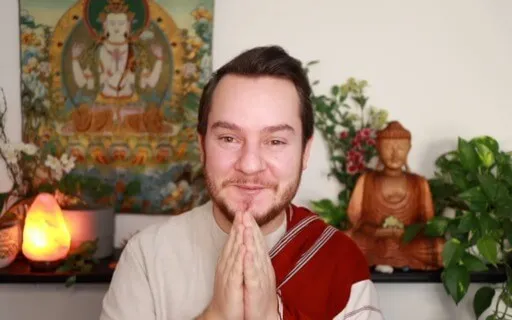
The following talk is from one of our weekly online guided meditation and discussion groups.
We invite you to join us on Sundays at 10am UK time to share in the guided meditation and discussion.
You can find out more on our website.
I hope this talk resonates with you.
This morning it was mentioned that perhaps I could talk about expectations.
And so some of you,
Particularly if you've been on our retreats or you've heard me talk about attachment,
Then expectations always comes up because expectation is an expression of attachment.
And so some of you will know this advice from the Dalai Lama that was given to my teacher when he went on his first solo retreat.
He was being guided by His Holiness the Dalai Lama in that retreat and he went to him for advice and he came bouncing with lots of ideas of what he would do,
How it would go.
And the Dalai Lama said to him that expectation is the foundation of failure.
And it's one of those really great pithy sentences from the Dalai Lama.
And it doesn't just apply to practice but it applies to everything.
Expectation is an expression of our desire to control things,
To have things turn out a certain way,
Isn't it?
It's an expression of our attachment,
Our craving,
Our need for things to be one way and not another.
And it can express itself in subtle ways and very obvious ways.
But it's all because we see that desired result,
That thing that we're expecting as necessary for our well-being,
Necessary for our happiness,
Our comfort,
Our ability to be content,
To be fulfilled.
We see it as a source of happiness,
A source of pleasure in some way.
And so this idea of expectation is the foundation of failure means that without expectation there's no failure.
If you weren't expecting a certain outcome then there's no ability to feel like you failed.
And so without expectation there's no disappointment,
There's no frustration,
There's no annoyance if that desired result doesn't turn out to be.
Because without the attachment,
Without that expectation,
There is no disappointment,
There is no frustration.
It needs it to be.
And so if we think of an example,
If I can think of an example,
Expecting for people to behave the way you want them to,
Perhaps we have this expectation that our conversation is going to go a certain way or that our partner is going to do a certain thing or our family is going to behave in a certain way and then they don't because humans cannot be controlled,
They cannot be manipulated like we want them to.
And so they behave in a different way,
They don't do what we wanted them to do.
And so we get stuck there,
We get stuck in the fact that it didn't turn out the way we wanted it to,
We get stuck in the stories of it's not fair,
This shouldn't have happened,
This should have happened instead,
Why didn't it turn out this way?
It becomes very me-focused,
Isn't it?
Very self-focused.
I wanted it to turn out this way and it didn't.
And so what happens is then we get stuck in that story and the disappointment to the extent that we're unable to see the reality of the situation.
We're unable to just be like,
Okay,
This is what happened because we're so wrapped up in that little story and then that prevents us from actually just taking action or making decisions that would be in our best interest because we just get stuck there.
We're not thinking,
We don't have our rational mind online.
Some people think that without expectation of a certain result we will feel motivated to do something.
Some people say,
Well,
How do you reconcile those two?
If I don't have expectation how do I get on and do things?
But I think that's a misunderstanding.
So a question that I'm often asked is how do you have aspiration?
How do you have desire,
Wholesome desire,
Not craving desire,
Without expectation?
Because right now it can be difficult to see the two separately because the two arise inseparable in many ways.
We have an aspiration for something but sneaking along with it is this expectation of it turning out the way we want it to.
And so the answer of how we can have one without the other is with wisdom.
It's perfectly good and necessary to have aspiration,
Isn't it?
How would you aspire to help others to achieve awakening,
To improve your skills and abilities,
To be a better person?
Maybe more day-to-day aspiration,
To move house or to change job because it will suit our well-being,
Our family life.
But sometimes those desires,
Those aspirations,
They come with the expectation.
And so your desire to help others,
Maybe you have that very wholesome desire,
I want to help people,
I want to help my family,
I want to help friends,
I want to help people at work.
And so you have that desire.
But along with that desire,
There is this idea,
This expectation that it's going to go well and that they're going to appreciate it.
I'm going to be able to help people and they're going to appreciate it and it's going to go well.
But we've all probably had that kind of situation where you offer your help to somebody or you try and help somebody and actually it's met with somebody being quite offended at us helping or it didn't help.
We wanted it to help and it didn't help.
And so we become disappointed,
We become a bit upset and it's because,
Not just because of the desire,
Well I wanted to help,
But we actually thought it would help and we expected it to help and it didn't turn out that way.
And so there's these two coming along with each other.
If you just wanted to help and it didn't,
What would be in your mind was a continuation of,
Well how can I help now or what can I do now?
And maybe it is instead to back off,
To not be as dominant as we were trying to be in the situation,
But we see maybe there's a softer approach that might help more.
If there's expectation in the mind,
Then instead of thinking,
Well how can I help now,
We become stuck on the aversion to the situation,
On the fact that we wanted it to help and we're a bit frustrated and maybe it comes out as anger or annoyance.
My desire to improve my skills,
Very wholesome,
Very good,
But we have this idea that it should be smooth,
It should be linear,
It should be a nice linear progression without bumps,
But that's not always what it is.
And so when we hit bumps in the road to improving our skills,
Then there's that frustration,
That annoyance because we're being,
Somebody's getting in the way of our potential wellbeing,
Our potential happiness,
Our desire to change a job or move house perhaps,
You know,
But it needs to be this job in this place with these people and we have these set expectations and requirements and then when they're not met,
There's that disappointment.
And so aspiration,
It leads us to act.
And when you have aspiration in your mind without expectation,
What is the object?
What is the focus of your mind?
The actions,
What is needed to be done?
That's what's important.
So if you have the desire to achieve enlightenment,
For example,
Then what's in your mind is,
Okay,
Well,
I need to achieve shamatha,
I need to then apply shamatha to vipassana,
I need to,
You know,
When you have those steps in mind and so you focus there very diligently,
You just practice,
You do your practice.
My focus is not on looking ahead,
How far have I got?
How long is this going to take?
Why am I not there yet?
All of those,
You know,
Thoughts,
Because those are expressions of attachment.
That's the clinginess of expectation.
And this is what expectation does,
It compares with what is,
With what we want,
And then gets upset that the two are not the same.
This is what I wanted,
This is what's happening,
They're not the same,
And we just get upset and we get bothered and then we shout and scream and who can I blame?
And who's the,
You know,
Who's the cause?
And so it's a,
It's throwing the toys out of the pram,
Isn't it?
It's a very unrealistic mind in a way.
Because the world doesn't conform to our wishes,
Does it?
Often our expectations do not match up with reality.
We all have expectations.
And it's fine when they turn out okay,
When they meet with reality,
All good,
Nothing,
I didn't see any problem.
But when our expectations don't match up with our reality,
Then there's that frustration,
That disappointment.
And because of that we suffer.
The Buddha said this is the clinging at the root of our suffering,
Rejecting reality,
Believing our projections,
Our way of saying this isn't fair,
This shouldn't have happened,
This should have been.
It puts us at odds with our world.
Because the world doesn't operate according to your whim,
You know,
However you feel today.
It operates quite naturally,
Out of causes and conditions,
Everything originating in dependence upon everything else.
There is a reason for everything,
Not necessarily a sort of a reason from on high,
Somebody did this,
A reason for my getting sick,
A reason for my,
You know,
To challenge me or you know,
Like some higher power gave it to you,
But a mechanical reason.
You know,
If I plant a mustard seed,
I get a mustard seed.
But our expectation is unwilling to separate what should have happened with what we wanted to happen.
You know,
So mustard plant arises,
And I wanted a sunflower,
And I'm upset that I don't have a sunflower.
I was hoping and I was expecting to get a sunflower in my garden.
I think it should have been a sunflower.
Why?
Because I say so.
Well,
That's not how the world works,
Is it?
And so this,
What should have happened is that a mustard seed would appear.
That is what happened,
Because the mustard seed was planted.
And so our expectation is just unwilling to see that.
And so while we have attachment,
There will be expectations present on our mind.
Until we've achieved complete freedom from attachment,
There will be expectations in our mind.
But if we want greater peace,
Greater joy,
And ability to rise to the challenges of life with well-being,
Patience,
Understanding,
We need to check these expectations.
We need to look at them.
When any unease is arising in our mind,
Ask,
Am I believing that something should happen here?
Is this expectation realistic?
Is it attachment based?
You know,
Am I believing that the outcome I want is necessary for my well-being?
That I lack something,
I need something.
Because remember that attachment is born out of a feeling of lack.
Something's missing.
I don't have something.
Something for my well-being.
Something is not right and I need something.
But if we feel grateful,
If we feel abundant,
If we feel content,
If we are really,
Truly,
Fully connected with our inner well-being,
Our inner contentment,
Our inner fulfillment,
Then we don't need anything.
We don't need anything external.
We don't need anything outside.
And the expectations can fall away because you have everything you need.
And so you might have an expectation that something turns out one way and not another,
But when it happens,
You won't be as disappointed if you feel very grateful for everything you have.
You feel quite content.
You feel quite fulfilled inside you have inner well-being because c'est la vie.
It doesn't matter.