Hi everybody,
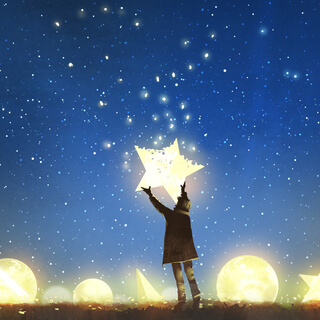
Today we're going to go outside and practice and what we're going to practice is something called stargazing.
Now if it's nighttime that means you're going to look at the stars.
If it's daytime it means you're just going to look at something out on the horizon or something in the distance outside.
So before you go outside make sure that you've got the right clothes on,
That you're comfortable,
That you're warm enough,
That you have a floppy hat or sunglasses to keep the sun out of your eyes if it's very sunny,
And that you have a comfortable place to either sit or lie down where you can look out into the distance and see something that's pleasant to look at.
Okay so you ready?
Alright before we start this practice let's do what we always do,
A quick check-in of our mind and body and just see how we're feeling right now.
Is your mind restless?
Is your mind concentrated?
Is your mind busy?
Is it quiet?
Is your body comfortable?
Is your body tense?
Is your body something in between?
Just notice how it feels right now and then set yourself up in whatever comfortable posture you're going to be in to sky gaze.
So that can be sitting,
Leaning against the back of a chair,
Looking out on the horizon or it can be lying down,
Often with your head propped up a little bit on a pillow or on a blanket so you can look out into the horizon.
And find a spot out there in the horizon where you can softly rest your gaze.
You're not going to focus in on it tightly so no,
You know,
Scrunched up foreheads as you're concentrating really tightly on what you're looking at.
And you're not going to fall asleep either,
You're going to find the balance in between and just rest and look out on the horizon.
And let's start by really noticing our exhale.
What does it feel like to breathe out?
Let's do three breaths with the count after the exhale this time.
One Two Three Now just noticing the gaze,
Just gazing out into a spot on the horizon.
Just rest and really feel the movement of breath in your body and just keep your eye out there,
Some spot in the distance.
And if your mind wanders and you start thinking,
Don't worry about it,
That's what minds do.
Just notice that you've been thinking or planning or whatever it is your mind's been doing and bring your attention back to whatever it is you're resting your gaze on out there in the horizon.
And if it's helpful to you,
You can also just feel the movement of breath through your body.
In this practice,
We're really going to rest our attention more on the out breath.
Sometimes that's helpful with relaxation.
Right now there's nothing more important to do.
There's no place you need to go.
This is the best work you can be doing right now in this moment.
Seeing your attention lightly on the out breath and gazing softly into the horizon.
If your mind wanders,
That's okay,
That's what minds do.
Just notice your mind has wandered and bring it back to your gaze,
What you're looking at.
If you'd like more of an anchor,
You can use the anchor of your breath or the sounds around you to just stabilize that attention.
Once your attention's stable again,
Just open up your awareness and rest.
Okay,
We're going to close this practice right now for the younger children,
But if you're older and want to keep practicing,
Just go right ahead.
Just remember everybody when you're through with the practice,
Just to scan your body and mind again and notice how you feel and see if you feel relaxed,
Settled,
Grounded.
And if you do,
Think about ways that you might be able to use this practice of stargazing in your daily life.
Thank you.