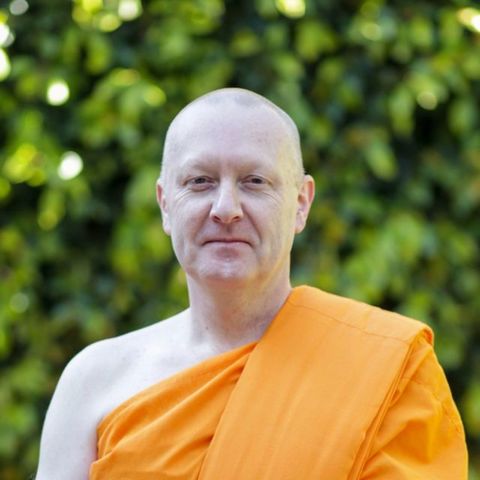
Last time you saw me we looked at blessing number one,
Not associating with fools.
To number talk today we will continue our series on enlightened living with blessing number two,
Associating with the wise.
The second blessing of the 38 concerns how in our self-cultivation we can successfully close the door on unwholesomeness in our lives,
To prevent ourselves from slithering any further down the slippery slope of spiritual entropy.
At this point,
When our discretion and sense of conscience is still not very accurate,
We are not yet sufficiently versed in spiritual ways to become a wise one ourselves.
However,
What we can start by doing is to learn how to recognize others who are wise and to associate with them so that some of their discretion can brush off on us.
A wise one is distinguished by his or her wisdom.
Before starting this blessing it's important to clarify that being wise is not the same as being educated.
That wisdom referred to in this blessing is a discretion as to what is real profit in life was already hinted by omission in our description of fools in blessing number one.
In fact,
Being educated is also a blessing but its details are elaborated later in blessing number seven.
The word wise one of this blessing comes from the Pali word Pandita,
Borrowed into English as the word pundit.
Some people believe that you can become a pundit simply by getting yourself a degree from a reputable university.
Of course,
If you've got all the credentials,
Set yourself up in business and made a success of it,
You will earn praise and respect from many other people.
However,
There is no small number who end up behind bars despite all their academic knowledge.
Consequently,
In spite of all their good intentions,
It is reasonable to assume that such pundits are not truly wise,
But only wise in the ways of the world.
The sort of wisdom we are interested in,
In terms of spiritual knowledge,
Is the sort of wisdom that will,
At the very least,
Keep us on the straight and narrow and ensure a wholesome profit,
Both in this lifetime and the hereafter.
This sort of wisdom is the spiritual knowledge we met up with in the previous blessing,
Although admittedly the wise person of the present day would ideally have wisdom both in worldly and spiritual ways.
Being an educated person is not the same as being wise,
Since knowledge exists on three levels – theoretical knowledge,
Hands-on knowledge,
And insight knowledge.
Though we will revisit these three categories in more detail again in blessing number seven,
Suffice it to say for today that insight knowledge or spiritual knowledge is the definitive domain of the wise one.
As a human being,
Having a body and a mind is standard equipment,
So what can be blamed for the different amounts of success people meet with as they go through their lives?
Assuming it is exposure to wise people and their surroundings that makes a difference,
Then zeroing in on such success relies on us identifying the wise ones around us.
Pinpointing the special features of the wise one can be achieved in four interrelated ways.
Firstly,
By identifying their habitual behaviours.
Secondly,
Their virtues.
Thirdly,
Their perception of profit in life.
And fourthly,
Their quality of mind or discretion.
In effect,
These four definitions overlap,
The difference only being in emphasis.
So the first way we are going to try to define the wise one is by their habitual behaviour.
A wise one is someone who habitually thinks,
Speaks,
And acts in a good way,
Unlike the fool,
The wise one has thought characterised by loving kindness in place of hatred,
Generosity in place of greed,
And right view in place of delusion.
Furthermore,
The wise one is wont to speak habitually in a good way.
They are people well spoken in contrast to the fool who has only a babble of insults to decorate their intelligence.
There are four ways in which the wise speak good words.
They avoid telling lies,
Avoid using divisive speech,
Avoid the use of swear words and harsh speech and they avoid idle chatter.
Lastly,
The wise one is wont to do only good deeds,
With an emphasis on being compassionate,
Earning an honest living and marital fidelity.
If we were to divide people according to the quality of their minds,
We can generalise people into a minimum of three different types.
Those whose mind is usually clouded,
So the fools,
Those whose mind is usually clear,
Which means the wise,
And those half in between,
Whose mind is neither entirely clear nor completely obscured by defilements.
Most well intentioned people in the world are included in this third category.
Traditionally in Buddhism,
These people are referred to as Galiyana Pala,
Where the prefix Galiyana means beautiful or good,
While the suffix Pala is one you will recognise from the previous blessing as meaning a fool.
The combination of the two words adds up to a well intentioned fool.
So people like ourselves are sometimes a fool and sometimes a wise person,
But not exclusively one or the other.
Another traditional term used in Buddhism for people like ourselves,
Who are halfway a fool and a wise one is Putojana,
Where the prefix Puto means thick and the suffix of Jana means person.
Being a thick person doesn't mean that we lack intelligence,
But refers to the way we have a rind covering our mind that is thickened by defilements.
Those whose rind of defilements is not too thick to block out the voice of reason can be referred to as a Galiyana Putojana,
Because they still have some hope of scrubbing through those defilements to reach the innate wisdom that lies beneath.
First step for a Galiyana Putojana in working their way towards their own wisdom is to be able to recognise wisdom amongst their acquaintances,
So they can reference those wise character qualities when elevating the quality of their own mind.
If you can't tell a wise one by their habits,
You might try instead to identify them in terms of four traditional virtues.
A wise one is said to exemplify the four virtues of gratitude,
Self-purification,
Purity and endearingness.
By gratitude I mean they recognise the debt of gratitude they may have to others.
By self-purifying I mean they work to purify themselves of all unwholesomeness.
By purity I mean they encourage others to purify themselves of all unwholesomeness and by endearing I mean they make themselves useful to society.
If we are still unable to recognise a wise one from their habitual behaviours or their virtues then we might instead try noticing the way they perceive profit in life.
In blessing one we have already seen that the discretion concerning the nature of profit in life for a fool is different from that of a wise one.
Profit in life in this second blessing should mean both profit in the here and now and profit in the hereafter.
We would retort four ways in which the wise one perceives profits in the present lifetime or to use the Pali word dittat dammikattat payochana.
In Thai culture they are colloquially referred to as the four chambers of the millionaire's heart or more simply the way to set yourself up in life.
As we have said being a couch potato is not a good predictor of success in life.
Success doesn't come unearned.
Uncomfortable comfort in one's old age must come from hard work in one's youth.
The wise will,
While they are still young,
Store up the means to live comfortably in their old age when they are no longer able to earn for themselves.
There are four virtues which the wise ones use to seek profit in the present lifetime.
These are firstly diligent acquisition or utthanasampattha which means going out to earn a living instead of sitting around all day and waiting for money to appear magically.
The second quality is stewardship or arakkasampattha which means both saving and protecting what you have already earned.
Thirdly,
There is the quality of associating with good friends or kalyanamittattha which means the same as associating with the wise which is the title of this blessing while avoiding associating with the sort of people who hang around all day at the bookmakers or even at the pub.
Fourth and last,
There is the quality of not living beyond your means or sammajivittha this means being thrifty and spending your earnings.
It doesn't mean that you shouldn't spend anything on yourself but rather to enjoy your hard-earned income without undue extravagance.
Since the wise person recognizes that they cannot live by bread alone,
A second important level of profit in life is spiritual profit better known as profit for the hereafter or samparayikattapayochana.
This again consists of four virtues the first being faith or confidence or satha as it's known in the Pali language.
This means faith that doing good deeds will lead to good outcomes for the doer and that doing unfortunate deeds will lead to bad retribution.
Such faith will motivate a person to perform the maximum of good deeds throughout their life.
Those who are not fully endowed with faith have what's referred to as turtle head faith which means and rather like a turtle when the going gets tough in doing good deeds they will hide their head inside their shell but those who have strong faith even though the going gets tough they will still remain resolute in their faith and not have doubts.
The second virtue bringing profit in the hereafter is to keep the precepts or sila as it's called in the Pali language.
Any person needs to keep a minimum of five precepts because the precepts indicate the level of your humanity.
If your precepts are less than perfect then at some stage you will start to take advantage of those weaker than you.
If you are a person who is unable to keep the five precepts some people might prefer to share their home with a wild animal rather than sharing it with you especially if they are constantly having to worry about whether you're going to harm them or steal from them.
The precepts are a second important factor that contributes to happiness in the hereafter.
The third virtue bringing profit in the hereafter is generosity or chakha as it's called in the Pali language.
That we are alive and well today is only because since birth we've relied upon the generosity of others.
If we had been abandoned at birth it's unlikely we'd have got to be where we are today and there are many forms of generosity we've benefited from and to redress the balance we should look for ways to practice similar generosity towards others whether it be the giving of things time help or knowledge or even the gesture of forgiving other people.
Fourth and final virtue bringing profit in the hereafter is wisdom or bhanya as it's called in the Pali language.
To be specific anyone who is diligent in studying the teachings of what the Buddha taught will attain wisdom eventually which is the mark of a wise person.
On the contrary anyone who lies around in bed all day has no chance of accruing wisdom at least not unless they watch Dhamma talks on YouTube all day.
So if the knowledge of life and the world we fill our heads with is accurate then wisdom will be within our reach during our time in this world.
The fool is one whose understanding of profit in life conforms neither with material nor spiritual profit in life.
Thus we can say that the wise person is one who understands and works toward profit both in this lifetime and in the hereafter.
Finally if we are unable to identify the wise by their habitual behavior virtues or perceptions of profit in life we might still be able to define the wise by their quality of mind especially their sense of discretion.
The mind of a fool is dominated by thoughts that are confused and stubborn rather like glass that is opaque or frosted distorting and darkening whatever they look at.
By contrast the mind of a wise person is like crystal clear glass.
Everything they see is clearly defined as it really is.
This is why they can respond to the world in a way that's appropriate and ethically sensitive unlike the fool who is caught up in their own egotistical view of the world.
The wise person is one whose mind is habitually pure and such a mind has a snowball effect on those around them.
You might wonder how such a vague notion as the mind could have such a powerful influence on people's destiny but the way every dealing we have with the world passes through the channels of the mind means that we cannot ignore its importance.
Consider looking at the world in mirror.
Whatever is situated in front of the mirror will be reflected instantly.
Even a pocket sized mirror is large enough to reflect an entire mountain.
All it needs is for the mirror to be really clear in order to capture any object in a way indistinguishable from the real thing.
So if the mind is crystal clear it too can instantly notice,
Scrutinize and understand any situation according to its reality.
If our mind is not yet fully clear meditation is the main means by which we can upgrade its quality.
Once we realize the peril of having a mind which is dull,
Clouded and of generally low quality we can start to appreciate why meditation is so important in the prevention and cure of problems in our lives.
At the very least to iron out the roller coaster of fluctuations in the quality of our mind throughout any day.
By means of mental clarity a wise one can discern what behavior is wholesome or unwholesome,
Good or bad,
Right or wrong.
Many of the characteristics of a wise one mentioned before may not be immediately apparent to us because they are not overt.
This is why we have to look at another five characteristics which are more easily noticeable from their outward actions.
In the Samanya-Pālasutta,
In the time of the Buddha,
There was a renegade monk called Devadatta who was jealous of the Buddha and wanted to lead the Buddhist community in his place.
Since he wanted to boost his own influence he carried favor with royalty,
Namely Prince Ajāsatru.
He knew that Prince Ajāsatru was impatient to replace his father King Bhimbisara on the throne.
He therefore tried to win over Ajāsatru by performing a minor miracle of shapeshifting his appearance from himself into a child and back again.
This convinced Ajāsatru that Devadatta must have higher knowledge,
Although it was the monastic equivalent of a parlor trick.
Having won Ajāsatru over,
Devadatta gently groomed Ajāsatru to go against his own better judgment and depose his father,
Later imprisoning him and starving him to death in order to win his place on the throne.
Later when Ajāsatru's own first son was born,
He realized the love between father and son and felt remorse for his actions,
Seeking out the Buddha who put him on the right track but too late to save him from his retribution of the heavy karma of killing a parent.
How much better Ajāsatru would have been if he had gone to the Buddha in the first place and associated with a wise one like the Buddha instead of a fool like Devadatta.
Although both the fool and the wise person are influencers in their own way,
But their persuasion leads to different results indeed.
Secondly,
The wise person takes full responsibility for the things that are their own business.
Apart from being responsible,
They will influence those around them to be responsible in the same way.
What the wise won't do is interfere in other people's business.
They know where to draw the line in order to avoid nosing into others' affairs.
The fool by contrast is much more interested in interfering in other people's business than they are in taking responsibility for what they're meant to be doing.
Thirdly,
The wise favor the honest and the decent.
It's no use trying to corrupt them because they are above those sorts of things.
The fool by contrast is proud of the fact that they can get away with anything in a race to the bottom.
Fourth,
The wise person is not easily angered.
They are grateful for criticism from others unlike the fool who,
Even if criticized in the politest of ways,
Will lose their temper.
This is why if you recognize yourself as hot-tempered,
It's especially important for you to associate with the wise as a way to gradually cool down your fiery temper.
However,
You shouldn't confuse the cool-tempered wise person with certain inert and unresponsive characterists who spend the whole day napping and seem to do everything in slow motion.
These dopey sorts are unresponsive to nearly everything around them,
Whether good or bad,
And cannot be counted as wise ones.
Lastly,
The wise favor self-discipline and orderliness.
When we share society with a huge number of other people,
If we consider ourselves above the law,
Then we'll end up as sociopaths.
As we shall see,
The good thing about associating with the wise is that it will develop our discretion to mimic the wise with whom we associate,
And on the inside it will allow our mind to become bright and clear like that of a wise person.
It turns out that in addition to the tell-tale signs of habitual behaviors,
Virtues,
Perception of profit in life,
And quality of mind or discretion mentioned earlier,
The wise one can also be identified by their ability to be a true friend,
Who through their friendship shows responsibility for their own personal dignity,
For the human dignity of others,
And for a fair economic system.
In our association with such wise ones,
We will be able to recognize their level of responsibility by the way they treat us,
Which also happens to be the qualities that facilitate good habits brushing off on us.
Again,
The Sīgala-Vādā Sūtra is our source for the qualities of true friendship by the wise.
In the northern quarter of the Sīgala-Vādā Sūtra,
It illustrates how good friends should treat each other,
At least in broad brushstrokes.
The Buddha divided true friends into four groups.
Firstly,
Those who are helpful and act for others' welfare.
Any compassionate person,
When a friend experiences hardship or suffering,
Would do anything to help their friend escape that hardship.
Secondly,
They will be consistent in their friendship.
However they have behaved towards their friends in the past,
They will not suddenly change to treat them better or worse because of force of circumstances.
They will not suddenly ghosting friends who fall on hard times or sucking up to friends when they come into some money.
Third,
They will be a friend of wise counsel.
And lastly,
They will be a sympathetic friend.
These broad brushstrokes are expanded in detail to ten duties between friends,
In one place in the same Sīgala-Vādā Sūtra and sixteen in another place.
As there is some overlap to save time,
I will combine the repetitions.
So in being a true friend and fostering virtue in those around them,
A wise one will be generous.
Any compassionate person,
When seeing friends experiencing hardship or suffering,
Would sacrifice anything to help their friend escape that hardship.
They will have kind words and show their friendship by habitually speaking only words that are polite and true.
Thirdly,
They will never tell lies to those they count as their friends.
Lastly,
They will even show due respect to other members of our family,
Our children and our grandchildren and even those to whom we have debts of gratitude,
As if they were part of our own adoptive family.
Furthermore,
A wise one will be a helpful friend by protecting you even when you are off your guard.
If we are careless or behave recklessly,
They will look out for us.
They will help protect our property even when we neglect it,
For example,
Returning our cell phone if they notice we have forgotten it somewhere.
They will be our refuge in times of danger,
As the saying goes,
A friend in need is a friend indeed.
And to keep it practical,
The scriptures mention that a true friend always provides you with twice as much as you ask for.
A wise one will be a constant friend in bad times and good by confiding in you,
But they don't go spreading your secrets around.
They don't abandon you when you fall on hard times and they would even die in your place.
Wise one will be a friend of good counsel by warning you against unwholesome behavior,
Encouraging you towards wholesome behavior,
Saving up new things to tell you and having your spiritual welfare at heart by pointing you in the direction of heaven.
Lastly,
A wise one will be a sympathetic friend by not laughing at your misfortunes,
By congratulating you when you have good fortune,
By speaking out against anyone who maligns you and standing up for those who speak well of you.
The friendship of the wise one is all about bringing out positivity in a person and at this point we might reflect on how our own friendship to other people measures up to the standards set by a wise one.
If we have ever had the luck to come across such a genuine friend,
We should take care to associate closely with them and treat them with the utmost respect.
It is pertinent to observe that such a genuine friend could only arise in the world as a result of an amenable environment which we will see more of in blessing number four,
Especially their human environment when growing up.
In order for the wise one to have stored up such high standards of friendship,
It is such people that society really is crying out for because such a person has tremendous power of virtue stored up inside them,
Sufficient power to elevate the moral tone of society and of the economic system.
The Buddha taught seven ways we can effectively respond to the friendship of the wise.
If your association lacks any of these seven factors,
The chance for good habits to brush off on us will be diminished.
The seven features start with meeting up with them frequently.
If you know someone has the characteristics of a wise person,
You ought to seek them out and visit them regularly.
If you hear that such and such a temple is attended by wise people,
Then you should visit regularly.
Generally,
There will be a sense of recognition when you first meet your wise one as if you have already been friends for a thousand years or over many lifetimes because both of you have spiritual truth in your hearts,
And that is a spiritual truth that binds your association.
Secondly,
We need to make ourselves known to the wise.
What this means is that having met up with a wise person,
You should make yourself known to them,
Not just sit out of their line of sight around the corner or hide when the monks are coming.
And it goes further than just taking a selfie with the meditation teacher.
Third,
We need to be sincere towards them.
How can they help fix your faults if you lie about what you've done?
There should be no secret which a wise one can't ask you about and get a straight answer.
Fourth,
We need to have a loyalty towards them,
Which means that the apprenticeship is not entered into lightly.
Traditionally,
The functions that illustrate loyalty are that you should speak out against those that malign the wise and stand up for those who speak well of them.
Fifth,
We should help the wise in times of need.
Whenever we notice the wise person is busy with something that we could help with,
We should offer our assistance without reluctance.
In this way,
We can start to observe the habits of a wise one behind the scenes and learn from their example as well as their words.
Sixth,
When we are free,
We should join up with the wise one to talk or eat together,
Since free time spent together will be the opportunity to discuss the Dharma and to clear up any doubts we have,
Rather than being the chance to gossip about the neighbours.
Lastly,
We need to reflect on whatever Dharma the wise have imparted to us and get down to practising it in earnest.
This is the most important component of association.
Even if you have diligently followed the previous six steps but omit the seventh step,
Then you cannot call it true association.
Also if you do none of the first six but do the seventh one,
It is as good as true association because ultimately the outcomes of association would be for us to end up practising self-discipline or Sila,
Which would give rise to a well-focused mind or Samadhi and eventually wisdom in ourselves or Panna.
The behaviour we refer to as association means that whatever happens,
You will do things in togetherness,
Remembering the three words we mentioned in the previous blessing,
Joining,
Receiving and giving.
If there is a task,
You will work together accepting each other's help.
Anything good you have will be something you want to share with them and ultimately you will start to share each other's view of the world.
If there are no genuinely wise ones to be found in society or if those posing as wise fail to cherish others as advised by this blessing,
A lot of harm will come to society on the level of the individual,
Interpersonal and social levels.
Even if the potential problems can be extrapolated from the individual neglect to the way those in power treat the individuals who they are supposed to serve.
In certain countries where those in power fail to offer a wise friendship to their citizens,
The problems reach the national level.
This is particularly seen where the great and good act in a way that is irresponsible towards human dignity.
On an individual level,
They can't be bothered to keep the five precepts,
Have negative worldview and mistreat their friends.
They disrespect the human dignity of others by harboring prejudice,
Being unpatriotic and abusing their position.
The responsibility for human dignity on the economic level may mean that they get involved in corruption,
Especially concerning the roads to ruin.
Some of these problems are brought to light in the press,
Others remain hidden.
This is why in this social perspective on the fools and the wise in society,
We can use the same principles by electing wise ones rather than fools into positions of authority.
In the meantime,
We should use all the definitions of the wise one and the characteristics of friendship we've studied today to scrutinize ourselves and in the meantime associate with the wise so that our goodness can start to repair the shortcomings in our own character.
In a world of clear dichotomies,
We would be able to separate clearly between those who are 100% fools and those who are 100% wise with no middle ground.
The reality,
However,
Is that there is an extensive grey area in between.
Of course,
There are those who we could count as truly wise,
Which might include the Buddha and those who have attained various levels of Buddhist enlightenment.
However,
This doesn't mean that we should dismiss anyone else with a lesser degree of wisdom as no use to us in our search for noble friends to associate with,
Even if someone is partially wise but has more wisdom than us,
It is still useful to associate with them.
For example,
The partially wise might be monks who are training themselves earnestly in meditation but who have not yet reached enlightenment.
In our lives,
There may be many people who we'd consider our elders and betters who are also partially wise but who have bad habits as well.
They might be parents or teachers.
In such a case,
It might not be our place to take the moral high ground.
Nonetheless,
We should try to sift out any wisdom that they can offer us and learn from that while not joining in with anything that is obviously a bad habit,
Whether it be drinking alcohol or visits to the turf accountants.
We have to do our best to learn only from their good points and mimic only these.
If that person has their faults,
It's not our place at this stage anyway to criticize them for those habits because for as long as we haven't come to an end of defilements ourselves,
We would be better at criticizing ourselves rather than other people.
In the meantime,
Don't let others' minor faults blind you to all their virtues.
If you're only interested in other people's faults,
By the time you have picked on everyone else's weaknesses,
There'll be only one person left in the world who you think is any good and that will be yourself.
If you keep this advice in mind,
Both the fully wise and the partially wise are beneficial to associate with.
Just as with fools,
Although we might reassure ourselves that we would never succumb to fools or need to rely on the wise one in the outside world,
There's another level of meaning that none of us can ignore.
Broadly speaking,
There are two categories of the wise.
The wise ones in the outside world and the wise ones inside us.
You may have noticed that sometimes when we think of doing something unwholesome,
There will be a little voice inside that warns us not to do it.
Have you wondered where that little voice inside comes from?
Usually we cannot see whose voice it is,
But if we meditate until our mind is much clearer,
We'll be able to see the wise one inside us who is the owner of the voice.
That still small voice,
Whether it be in the form of knowledge as a voice or the content of a dream or sixth sense,
Is transferred down the line from deep inside ourselves like a baton between runners in a relay race.
So I'd like to finish off with a story to illustrate how brief contact with the wise one can turn around a person's destiny in life.
There's a Buddhist story to illustrate,
Dhammapada verse 100,
Which says,
Better than a thousand words that are senseless and unconnected with the realization of the Imbana is a single word of sense.
If on hearing it,
One is calmed.
The story tells of a public executioner in the ancient Indian city of Rajagaha.
The executioner was a scary looking guy with a red beard,
Copper colored teeth,
Torny skin and a body covered in scars.
He wanted to join a band of 500 thieves,
But for a long time,
The ringleader refused to accept him because he looked so untrustworthy.
In the end,
He was allowed to join the band of thieves,
But surely afterwards,
The thieves were rounded up by the army and no one could be found to execute them.
The red bearded guy,
Whose name was Dhammadattika,
Agreed to do the executions in return for his own freedom.
So he wasn't even loyal to his fellow thieves.
He betrayed all his colleagues and executed all 500 of them.
He was so admired for his stamina that they offered him a career as a public executioner and he continued in post for 55 years.
When he became too old to behead a prisoner with a single blow,
He was allowed to retire.
The tradition for retirement was to be given a golden handshape consisting of four gifts,
A new set of clothes,
A milk porridge made with fresh ghee,
Jasmine garlands and perfume.
So to prepare for his retirement gift,
He went to the river and bathed.
Having done so,
He put on his new clothes,
Decked himself with garlands and anointed his limbs with perfume before going home and sitting down for his meal.
They set the delicacy before him together with some water for rinsing his hands.
Just as he was about to start his meal,
The Venerable Sariputta,
Who had just arisen from a long meditation,
Stood within sight of the executioner's door,
Gathering alms food.
Seeing the monk,
Tambadattika thought to himself,
Throughout my life I have done nothing but execute people.
For once in my life I should do a good deed.
So he invited Sariputta to come in and respectfully offered the special retirement delicacy to the monk.
After the meal,
Sariputta taught Dhamma to the executioner,
But Tambadattika could not pay attention because he was extremely disturbed by recollections of his past career as an executioner.
This mental disturbance did not allow him to concentrate properly.
Sariputta realized this and in order to put the man in a proper frame of mind,
He asked Tambadattika tactfully whether he had chosen to execute others or had simply done it because he was ordered to do so.
Tambadattika answered that he only did his duty as an executioner to follow orders.
If that is the case,
Sariputta answered,
Then what do you have to worry about?
Thus reassured,
Tambadattika's mind became calmer and he requested Sariputta to continue the sermon.
As the executioner listened to the Dharma attentively,
His mind became tranquil and he became more patient and more understanding.
After the discourse,
Tambadattika accompanied Sariputta for some distance and then started to walk back towards his home.
Still contemplating the purity of mind he had learned from Sariputta,
On his way home,
However,
He was suddenly caught to death by a mad cow.
When the Buddha visited the congregation of the monks in the evening,
They informed him about the death of Tambadattika and wanted to know where he had been reborn.
The Buddha told them that although Tambadattika had committed unwholesome deeds throughout his life,
Because he had comprehended the Dharma,
He had been reborn in the fourth level of heaven.
The monks wondered how it could be possible that such an evil ruffian could accrue such great benefit after listening to the Dharma only once.
Buddha said that the number of times one listened to the Dharma was immaterial,
Because even one single sentence of the Dharma correctly understood can produce much benefit.
So just as Tambadattika could benefit so much from associating with a wise one for only a short time,
We also need to seek out the wise ones in our own lives and find the best ways to associate with them.
If we know that anyone is a good example,
Then we should make sure we get to know that person.
That way,
The good character that makes that person wise will start to brush off on us as well.
Secondly,
Once we have seen the nature of those who are a good example to follow,
We should start to cultivate wisdom within our own mind.
If we already have inner wisdom,
Even if we never encounter a wise person again,
It will not matter because we already have secured our inner source of wisdom from which we can be a good teacher to ourselves.
So this session I have introduced blessing number two,
Associating with the wise to you.
For my next session,
I'll move on to the third blessing on the topic of respecting those worthy of respect.
Hopefully as a result of today's session,
You will be equipped to recognize wise ones in your lives and in yourself.
And now you will have a strategy for associating with them to the full.
So for today,
This is me Pratniklas Tannisros signing off for this session.
So long folks and stay safe.