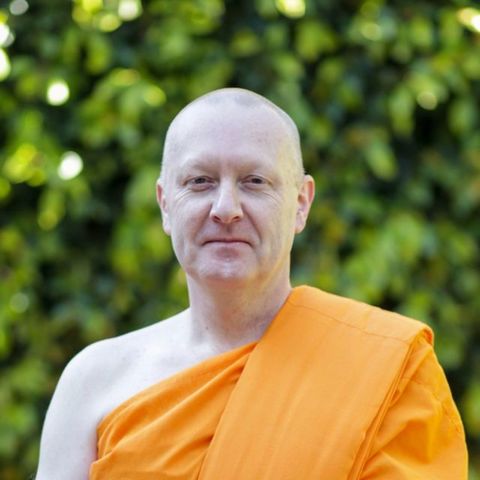
Last time you saw me,
We looked at blessing number 22 on respect.
With the time it took today,
We'll continue in our series on enlightened living to the second blessing in the instilling oneself with basic virtue subsection,
That is,
Number 23 on humility.
In our search for higher virtue,
There are many obstacles which may stand in the way of our transcendental attainment.
As already mentioned,
Virtues do not exist unpackaged,
But come as part and parcel of the people who are endowed with them.
If we are unable to see deeply enough into the qualities of people,
If we judge them only by their superficial appearances,
We might overlook their deeper worth.
By overlooking their qualities,
We tend to assume they have less than us,
And when assuming ourselves to be superior,
Arrogance becomes our normal state of mind.
This is why,
At this point in the blessings,
Avoiding delusions about our self-worth is important as we till the ground of the mind in preparation for sowing the seeds that will eventually lead on to the higher virtues that we would recognize as authentic enlightenment.
People tend to become arrogant and egotistical because they measure their own worth in terms of superficial things,
And for anyone who is particularly interested,
There is a full list of 12 items available in the Mahani Desa.
Today we will mention just six,
Namely our ancestry,
Wealth,
Beauty,
Knowledge,
Rank,
Or number of followers.
For people who become arrogant as a result of their ancestry,
Because they are born with the proverbial silver spoon in their mouths,
They tend to think,
I have come from a large and influential family,
I am tenth in line to the throne,
I am descended from celebrities,
My dad had a walk-on party in a Hollywood movie,
I can get away with anything I want,
No one else can even compare to me.
Thinking in this way,
A person tends to look down on everyone else.
However,
In reality,
Coming from an influential family does nothing to guarantee that someone will have a bright future.
It's often harder for a person with famous parents,
As compared to a nobody,
To overcome the chip on their shoulder and establish an independent reputation.
It's been said that the children who are constantly name dropping or using their parents' importance as an excuse to cut corners will eventually come to grief.
Eventually when they no longer listen to anyone else's advice,
They will be beyond help.
For the people who become arrogant as a result of their wealth,
They tend to think,
I'm so rich,
There's nothing I can't buy,
So there's no reason why I should show any deference or consideration to anyone else.
Consequently,
They tend to look down on everyone else.
In reality,
Wealth does not guarantee a bright future for oneself.
Just a few slip-ups in their tax returns may mean they become tomorrow's paupers or debtors.
Even if you manage to hang on to your riches until the end of your life,
You cannot take them with you when you go.
If you don't appreciate applying your wealth for the cultivation of good deeds,
Even though you may be wealthy,
It may not help you to escape from suffering in life.
And the richer you are,
The more worries you'll have,
Because you will constantly be haunted by the fear your riches will disappear or be stolen.
For those who become arrogant as a result of their physical attractiveness,
They tend to think,
I look nicer than everyone else,
Everyone else pales by comparison,
My skin is so unblemished,
My nose shows breathing,
And I've got great bone structure.
Everyone in this universe would be jealous.
So they tend to look down on everyone else,
Even though in reality an attractive appearance does nothing to guarantee a bright future for oneself.
People may even be attracted to you for the wrong reasons,
And even supposing you and your plastic surgeon live to the age of 70,
You could be sure your beauty won't.
Some people become arrogant as a result of their education or expertise.
They tend to think,
I'm so smart,
I have a master's degree,
I don't need to listen to anyone else's advice anymore.
Such a person tends to look down on everyone else in spite of their academic knowledge doing nothing to guarantee a bright future.
You can end up being such a snob that you make yourself unemployable.
The people who become arrogant as a result of their rank or position in a particular organization,
They tend to think that even outside the organization everyone else should listen to them.
Unfortunately positions come with responsibilities,
And if we don't have the virtues requisite for fulfilling those duties,
Those ranks or titles can be our downfall,
Ruining our reputation.
In any case,
After retirement we will be yet another has-been reminiscing over our former glory.
The people who become arrogant as a result of their number of followers,
And here I cannot avoid thinking about the new generation of online influencers,
They tend to look down on others less popular than them,
Even though often despite their number of followers they have nothing coherent to say.
In reality,
Quality of friends and followers does more to ensure a bright future for oneself than quantity.
If we only have followers who are yay-sayers,
It can be our downfall.
We will find that bolstering our ego with online ratings can be fickle,
And all it takes is to be no-plot-formed or to get kicked off your social media network.
The world tends to measure our worth in terms of these six factors,
While common sense tells us that none of these six things can actually stay with us permanently.
Most are out of our control.
If you examine what we can actually call our own,
You will eventually find that all we can call our own are the good virtues that we've cultivated in our hearts.
Furthermore,
You should ask yourself what is actually improved in the world by you looking down on other people.
Does it make others appreciate us more,
Or does it irritate other people so that they will never want to do anything to help us a second time?
It's like a person who wants to be praised for their wealth and who behaves like a big spender in spite of the fact that they can't really afford to do so.
Because of their frivolous spending,
They go further and further into debt day by day at the price of their pretentiousness.
Those who are really endowed with virtues will retain their humility even when praised by others in a way that self-pride will not cause them to look down on others for fear that they will lose future opportunities to improve themselves.
In the previous blessing,
We already explored the character quality of respect,
And on the surface respect and humility might look as if they are about the same thing.
But in fact there are a few differences.
The idea of respect is to teach us to be active in our search for the virtues contained in others.
A respectful person would be someone who actively looks for the good things about other people instead of finding fault with them,
And who expresses their respect through their thoughts,
Words,
And deeds.
They would be a person who is able to recognize people's worth according to reality rather than superficial appearances.
Humility by contrast is a virtue based on the way we see ourselves.
To be a humble person is to reflect on one's own weaknesses,
Finding fault with oneself,
And estimating one's own worth according to reality rather than superficial appearances.
A humble person is not someone to boast,
But someone who shows deference to others in order to maximize the amount of goodness absorbed from them.
A humble person does not overestimate themselves in terms of their good qualities in relation to others to maximize the chance to learn from them.
A respectful person may not necessarily be a humble one.
A respectful person who has no humility might be observant enough to recognize the good qualities in others,
But they may not be able to bring themselves to show any deference to such a person in order to learn from them.
Instead they always like to compare themselves to other people in an unrealistically favorable light.
They say to themselves,
Even though you are the best at this,
I am the best at that,
So I am as good as you.
If they were a little less arrogant,
Even though they may already be good at one thing,
They would always be looking to improve themselves at things that they had not yet mastered,
Instead of complacently sitting on their laurels.
So not overestimating ourselves while avoiding the arrogance of looking down on others is the main objective of studying this blessing about humility.
Loss of humility,
Judging our worth in superficial terms and arrogantly looking down on others,
Causes three sorts of harm to ourselves,
Others and society at large.
In terms of damage to yourself,
You lose your opportunity to absorb goodness from other people.
When you estimate your own worth too highly,
You will tend to think you are already good enough and have no room for improvement,
Failing to see anyone who matches your own talents.
In terms of damage to others,
Often people's arrogance starts with good intentions such as not tolerating fools gladly.
However,
Their haughty discrimination will degenerate into being touchy about trivial things and will end up causing disagreements that destroy friendships.
It's rather like a building with a narrow foundation,
Generally it cannot be built very tall without toppling over.
Similarly,
Arrogant people will not get far in teamwork,
Because of the conflicts they always have,
They will always prefer to work alone,
So their life's achievements will never amount to much.
In the words of the famous Buddhist master of meditation,
Luang Por Wat Pak Nam,
To look down on others even without realizing it,
Seeing others as weaker than oneself,
Speaking irreverently to them,
Is like stoking a fire which will spread from the lowest stories eventually to reach the gables.
Even the smallest house fire will spread to the gables,
And in the same way the resentment of juniors can destroy the person who governs them,
Unless they are compassionate and wish only happiness to those working for them,
Especially those less privileged than themselves.
In terms of damage to society at large,
Arrogant people have many negative consequences for society namely the breakdown of law and order and disharmony.
In terms of the breakdown of law and order,
Arrogant people don't tend to respect the law and always expect to be treated as an exception to the rule.
Society will break down if it encourages such behavior.
In terms of disharmony,
Social instability and vulnerability to colonization,
In a society where arrogance prevails,
It will be difficult for any lasting harmony to come about.
A society where arrogance is widespread is like sandy soil which cracks into individual clods in the drought of the dry season.
But even when the rains come,
Although the ground is wetted,
The soil will still remain rigidly cracked into its individual clods.
In a similar way,
When differences arise in a group of arrogant people,
Even though they have the opportunity to reconcile them,
Vengeful thoughts keep them polarized.
A better example to follow is that of the clay earth which also becomes cracked in the dry season.
However,
All it takes is a shower of rain and it will soon return to normal with no remaining cracks.
In a similar way,
When differences arise in a group of humble people,
As soon as they have the opportunity to reconcile themselves,
They will soon be back on the same side again.
The caste system in India in the olden days was so rigid that each caste became arrogant and inward-looking.
And even when enemies were at the door,
Such as the British colonists,
Instead of thinking to unite to defend the independence of their country,
The superior castes all thought themselves too superior to deal with the practicality of national affairs.
Meanwhile,
The lower castes and the untouchables shrugged their shoulders and reflected that if the worst came to the worst,
It would teach the arrogant superior castes a lesson.
The castes were so busy arguing amongst themselves that they failed to defend themselves against the colonists,
Who were many thousands of times less numerous than themselves.
Because of the arrogance rife in society,
The usual policy by the Brits of divide and rule was easy to deploy,
Although it would be inaccurate to blame the Indian society entirely for its plight,
Because the British committed many atrocities in the name of bringing civilization to India,
Which involved somewhere between 35 million and 1.
8 billion Indians dying of deprivation,
In order that the British Empire could appropriate $45 trillion worth of their wealth between 1765 and 1938.
The tendency towards arrogance and disharmony,
Though,
Did nothing to help the situation.
By comparison,
Thailand has a special self-confidence in the region,
And I will try not to call it arrogance,
Because in that country humility is more well regarded as a social virtue,
Where even if there are serious agreements on a national level,
Even a coup d'etat from time to time,
The transitions usually take place with a minimum of bloodshed.
In any community or society where humility prevails,
Even when a conflict should arise,
Before long people would be reunited again in harmony.
These are all good reasons why we should cultivate humility.
The word for humility in the Pali language,
Or Nivata,
Used in this blessing,
Actually means someone who is without,
Ni,
E,
Vata.
The word is applicable to someone who is not inflated by their own self-importance.
If you were able to see into the mind of a humble person,
You would notice that they have the characteristics of freedom from false view,
Self-pride,
Self-importance,
Stubbornness,
And by contrast workableness of mind.
In terms of freedom from false views,
We should refer to erroneous worldview,
Concerning the nature of life in the world,
So negative or out of keeping with reality that they obscure any intention to cultivate oneself for the better.
In terms of freedom from self-pride and self-importance,
Self-pride means the belief that you are always superior to others.
Aristocracy looked down on the clebs,
The rich looked down on the poor,
Townsfolk looked down on the country bumpkins,
And in a nutshell people tend to be proud of themselves for the wrong reasons.
In terms of freedom from stubbornness,
The mind of a humble person is flexible like greenwood rather than being tough and brittle like deadwood.
Deadwood stands unyielding in the wind,
If the wind gets stronger it will remain unmoving,
However if there's a gale it will break in two,
Pushed to its limits the damage to the deadwood is irreparable.
No matter how much more water or fertilizer you give it,
It will not come back to life again.
This can be compared to an arrogant person who will never show any reference to anyone else and thereby forgoes the opportunity to absorb virtue from others.
By contrast,
Greenwood is soft and flexible,
In a breeze it will bend and twist with the wind,
If the wind gets strong then it will bend double or even go flat to the ground,
When the wind has passed then it will stand upright like before.
If you give it a little water after the dry season it will soon break into leaf.
This can be compared to a humble person who will adapt themselves faithfully to any situation or person from whom they can absorb virtue.
So in terms of workableness of mind,
The person with humility has a character that allows them to adapt appropriately to any situation.
A humble person tends to behave as if they are of no importance,
Their virtues speak for themselves and they don't need to advertise them,
It's like a diamond which will always be a diamond whether you advertise it or not.
A humble person doesn't need to show off their strengths,
To be stubborn or to make a fuss,
For this reason a humble person is sometimes compared to a bottle that is full of water which makes no noise when shaken.
Similarly,
A person full of virtue doesn't need to boast about the virtues they have.
However,
A bottle that is half full of water is noisy when shaken,
Like a person lacking in virtues who feels compelled to boast about what little they do have.
Because humble people know their own worth according to reality and they are characterized by humility through the channels of body,
Speech and mind.
In terms of humility through physical actions,
A humble person is not arrogant in their body language or their manners,
But at the same time they are not obsequious.
They know how to make themselves endearing to others by their behavior,
But at the same time they have confidence in themselves.
It is someone who is always ready to mold themselves to the convenience of others like a piece of soft clay.
They will be able to get along with everybody and fill the gaps in situations of social disharmony.
They will be good mannered to seniors and subordinates alike.
They give things due respect rather than pretending that they are the equal of others out of their league.
They are always careful to be consistent in their cultivated manners,
No matter what walk of society they are dealing with.
They mold themselves favorably to any situation that will bolster their virtue or reduce their bad habits.
This is in stark contrast to the body language of arrogant people.
Arrogant people will often be physically unable to bend their body to express humility,
Such as bowing or even lowering their head in deference.
In terms of humility through verbal actions,
A humble person is not arrogant in the way they speak.
Their words express the purity and good intention in their heart.
Their words are soft rather than being sarcastic or boastful.
If they make a mistake,
They will be quick to admit responsibility.
If they receive praise from others,
They will be quick to thank them for the compliment.
They don't do others down for making mistakes.
If they see good someone else has done,
They will be quick to congratulate them for it.
Because their thoughts are without guile,
The words that come from their mouths are always considerate.
The manner of their speech is gentle but not weak.
They refer to people by their appropriate titles.
Their speech is therefore endearing to all who hear it.
And this is in stark contrast to the rigid speech of arrogant people,
Characterized by patronizing comments about others,
Or who never let others forget how they are related to the royal family or have a high rank in civil service.
The words they say are nauseating to all who hear them.
In terms of humility in their thinking,
A humble person is not arrogant even in the way they think.
They may be soft and gentle in their approach to all things,
But it doesn't mean that they are weak or indecisive.
Never complacent about their abilities,
They will always be looking for ways to improve on them.
They don't assume that they are always right and they are open to others' opinions.
They don't get angry if they don't get their own way,
But they look for ways to adapt their thinking to the needs of others within the framework of scrupulousness laid down by the Buddha.
This is in contrast to the unframed mind of an arrogant person,
Which will tend to be subject to abuse,
Especially those concerning self-importance.
In any situation where they must forego their individual whims in order to better work as a team,
They will often find it hard to adapt.
They will always want to be the leader of the group,
Even if they don't have the capability.
So,
Now we have time for a quick story from the time of the Buddha,
Which deals with the damage coming from the arrogance between royal families at that time.
Though the Sakya clan were the ancestors of the Buddha,
They had one weakness,
Which was their arrogance about the long pedigree of their clan,
Which led them to look down on everyone else.
Normally,
They would not even deign to marry outside their own dynasty.
This is why when King Pathanadi of Kosala,
Hoping to secure good relations with the Sakyans,
Asked for the hand of a Sakyan maiden in marriage,
They had a difficult decision to make.
In the end,
They succumbed to their normal arrogant ways and instead of sending a real princess,
Sent an illegitimate half-caste daughter born out of a relationship between a Sakyan king Mahanama and a slave girl.
The child was therefore an untouchable.
King Pathanadi didn't know,
So he had a huge state marriage organized.
Later,
A prince was born out of that marriage,
Called Prince Vidutappa.
He was very clever because of hybrid vigor.
He wanted to know about his maternal relatives.
When he grew up and went to visit his maternal city of Kapilavastu,
He was still looked down upon by all the Sakyans,
And he was given reluctant hospitality.
On the way home after such an inhospitable visit,
One of Vidutappa's generals remembered he had forgotten something important in Kapilavastu.
So he returned to the city and found that the Sakyans were scouring the palace with milk.
When he asked the reason why,
They told him that Vidutappa was an untouchable and they must disinfect every place he had trodden or sat.
When Pathanadi heard the news,
He removed both the queen and the prince from their positions and was going to invade Magadha.
The Buddha talked him out of it,
Explaining that whether Pathanadi attacked them or not,
The Sakyans would receive the fruits of their own karma.
The Buddha also advised Pathanadi to reinstate the queen,
Saying that the paternal blood was more important than the maternal.
Pathanadi followed the Buddha's advice,
But Vidutappa found it less easy to forgive the Sakyans.
He vowed that as soon as he became king,
He would wreak vengeance and scour the earth of Kapilavastu with the blood of the Sakyans.
Before long,
Vidutappa ascended to the throne and marched against the Sakyans.
The Buddha knew what would happen and appeared to Vidutappa at a sand heap on the road between Savatthi and Kapilavastu.
The Buddha appealed to Vidutappa to stop and the first,
Second and third times he managed to turn the army around.
The fourth time Vidutappa marched on Kapilavastu,
The Buddha didn't stand in his way.
He thought it was karma and it was unavoidable to the Sakyans because of their past arrogance.
Even though many of the Sakyans had ordained,
Many had attained degrees of enlightenment and all of them kept the five precepts,
They still maintained their arrogance.
The Sakyans all came out in defense of their kingdom,
But they were more scared of breaking their precepts than they were of death.
They shot arrows harmlessly into the turbans of the Kossilans,
Into the flags and into the wagon wheels.
They were too afraid to hit any living target.
Vidutappa conquered the Sakyans easily and slaughtered them.
He spared only the life of King Mahanama.
He said that he would have one last meal with his grandfather.
Mahanama was still so arrogant that he would not even eat at the same table as his untouchable grandson.
He threw himself off the castle ramparts,
Into the water and drowned himself.
This is an example of the damage done when people are arrogant.
So to return to our subject matter for today,
It turns out that humility is one of those subjects that is easy to understand in theory,
But difficult to develop for real in one's character.
So for what it's worth today,
I'll start with a general writing on the wall about becoming more humble before moving on to some specifically Buddhist advice for its cultivation.
Perhaps a good place to start with cultivating humility might be the recognition that you are not always right and you do not always have the answers.
It also requires an acceptance of yourself once and all,
Which many of us will find challenging.
It's relatively easy to be humble when you are at the bottom of the food chain,
New in a job or very junior.
However,
The more senior you get,
The more likely people will start to treat you as an infallible person with all the answers.
If you are not careful right at the moment when you most need the humility,
You can end up in a senior position suffering from a chronic case of arrogance.
Being humble is one of the best and most admirable characteristics a person can have.
Unfortunately,
It is rarely seen in today's world.
A humble person doesn't go out of their way to show off their accomplishments.
In fact,
If you don't ask,
Then you might never know.
They tend to be understated about everything,
And other people tend to regard them as being nothing more than a kind and sympathetic person.
These kinds of people are confident in who they are in a way that doesn't have a need for other people's validation for their accomplishments.
More importantly,
Humble people never forget that they are likely not the best person in the room.
They actually might thrive in connecting with people more experienced and well-versed than them,
So this means that they can learn from them.
So to see how we can get to this point,
I have summarized down to 12 tips that have received advice on the cultivation of humility.
The first thing is to admit that you're not the best in everything,
Even though you have tried your hardest to achieve that.
It is the point where you're okay with admitting that there will always be someone better than you.
The second thing is to recognize along with the best parts of ourselves that each one of us has our flaws.
Recognizing that being human comes with both strengths and weaknesses,
And the faster you accept both,
The more humble you can become.
The third thing,
Although there is a blessing to deal specifically with its development later on at number 25,
Is that we need to learn to be grateful for what we have.
If you can be thankful for everything you possess and achieve,
In other words,
To take the time to count your blessings and be thankful for them,
Taking time to stop and remember what you have to be grateful for,
Is a good way to cultivate a more humble and positive frame of mind.
The fourth thing is to admit when you have made a mistake.
The only people who make no mistakes are those who never do anything in the first place.
So,
When as a result you are an activist you do make a mistake,
Instead of denying responsibility,
Be quick to admit that you made them.
Avoid deflecting or being defensive,
As there's nothing humble about that.
The fifth way to become more humble is to ask for help when you need it.
There is a form of pride that lies in being able to solve our own problems.
Humility therefore lies in recognizing when we need help and being able to answer it appropriately.
The sixth thing is to patrol your speech for language that betrays self-pride,
Arrogance,
Smugness,
Snobbery or vanity.
It can sometimes be hard to avoid feeling slightly proud of ourselves and by extension vanity or even snobbery.
It is often quite pleasant to feel like that,
For example if we've done something good and everyone is praising us.
However,
We tend not to call these emotions by their proper names because the words themselves carry negative connotations.
To cultivate humility you need to ask yourself,
Was that snobbish?
Was I being a bit vain there?
And be honest about the answers.
Recognizing and naming these feelings for what they are is a good step towards humility.
The seventh thing is to avoid bragging.
The unspoken rule about being humble is that if no one specifically asked,
You shouldn't mention your accomplishments.
Even when questioned specifically,
You might mention your achievements obliquely and without exaggeration.
Nobody wants to be around someone who brags about everything in their life as it can be perceived as self-centered.
The eighth way to become more humble is to learn to be more considerate to others as you may have no idea of what other people are going through or what they are feeling.
So by trying to be more empathetic to what others are feeling,
It will help to make you less self-centered.
The ninth thing is to appreciate others because this is the source of a lot of the kindness and purity we see in humble people.
If you want to be more humble,
Then show others more appreciation,
Whether it's in the form of kind words or actions,
Because although you may not realize it at the time,
An act of appreciation means a lot to someone on the receiving end.
Tenth thing is to learn to put others first.
When you're someone who has a naturally selfless nature,
It's easy for you to be humble since you always put the needs of others above your own and attune yourself to others' feelings.
The eleventh thing is to spend time listening to others.
The factor that sets apart humble from arrogant is that a humble person will go out of their way to listen to what others have to say,
Whereas an arrogant person will dominate a conversation to get more opportunity to speak about themselves.
It's significant to become a good listener if you aspire to be humble.
A key quality of humility is to value others and enable them to be heard.
Spending time listening to others and drawing out their feelings and values,
Enabling them to express themselves,
Is a very powerful way to create change for the good in those around us.
It's important to remember that you're not always trying to solve another person's problems and sometimes it's not even important that you have an answer to them.
What is important to the person you're listening to is that you respond to them as a fellow human.
The final thing is to seek feedback on a regular basis.
Whether good or bad,
Humble people aren't afraid of receiving the full spectrum of feedback in their lives,
Especially when they know it can be potentially very beneficial in order to improve their lives,
And as a consequence they would welcome constructive criticism even when it's negative feedback,
Which isn't always the easiest thing to hear out.
After all,
Nobody wants to hear about their faults and wrongdoings from someone else.
Seeking feedback from others on a regular basis is particularly important for leaders who otherwise end up isolating themselves.
In practicality,
You may need to provide the time or opportunity for others to give you feedback anonymously if necessary to make it clear that you welcome their opinions.
Listen to the feedback openly and then be grateful.
Everyone has tendencies towards arrogance and these are often worsened when people get hot under the collar about their identity or loyalties.
Amongst football hooligans,
Supporters can get violent even about the colour of a soccer scarf,
Whereas pandering to a person by flattering them,
Which is equivalent of getting them enamoured by their own reflection,
Can be a surprisingly efficient way of getting them to stop being obnoxious.
So knowing how deeply ingrained arrogance can be,
Even from an early age,
There are some additional Buddhist trainings that help a person to restore humility to their character,
Namely by avoiding flatterers,
Being more thorough about our actions,
And cultivating mindfulness.
The first Buddhist way to cultivate humility is to avoid flatterers.
If we have the feeling that we have a tendency towards arrogance,
The sort of person most likely to encourage our arrogance is the flatterer.
Instead of succumbing to popularity with flatterers,
We need to seek out those who,
On a regular basis,
Dare to point out our delusions.
Such people may be found amongst our teachers or elders,
But they might even be responsible friends or those who have a lot of virtue.
Such friends will give us accurate feedback about ourselves instead of telling us what we want to hear.
The second Buddhist way to cultivate humility is to try to be thorough and think carefully before you do things.
There may be seemingly trivial things that you do that may seem trivial to you,
But which come over as arrogant in other people's eyes,
Whether it be the way you dress,
The car you drive,
The opinions you express,
Or your claims on the ownership of ideas.
Even in a supposedly egalitarian society,
Lack of care in any of these behaviours can be irksome to superiors in the workplace,
Or elders and veterans more generally.
The third Buddhist way to cultivate humility is to practice mindfulness and focus on the present.
A key part of mindfulness is accepting a situation for what it is.
An important element of mindfulness for humility is accepting yourself with all your faults in order to give yourself the motivation to improve while not looking down on others who might have the ability to teach you something useful.
Another aspect of this mindfulness or recollection of death which will remind you of the urgency to collect good deeds for your remaining time on this earth.
In practice,
The sort of mindfulness of death which will encourage you to be less narcissistic may include recollecting the frailties of our human life,
Whether it be your own impending old age,
Sickness,
Or death.
In this respect,
There is a story about the right-hand disciple of the Buddha whose name was Sariputta.
And although this story could very well have been a story about the development of mindfulness,
It does show a clear link between mindfulness and the development of humility.
Once there was a monk in the Buddhist monastic community who had a certain grudge against Sariputta and made a false accusation to the Buddha claiming that Sariputta had bumped into him without apologizing.
Having been accused of arrogance,
The Buddha requested Sariputta to speak up for himself to defend his standards of humility.
Sariputta explained,
Because I am a person who is steadfast in mindfulness,
I am careful of everything I do,
I am mindful of the body with just the same care as a man would carry a tray filled to the brim with oil while being stalked by a sword-brandishing guard threatening to cut off his head should he spill a single drop.
My humility can be compared with a rag-duster,
A bull with broken horns,
Like an untouchable child who blunders into the village of another caste,
All of whom have no opportunity to indulge in their self-importance.
Despite his attainments both before and after his ordination,
He made no mention of these because Sariputta had no trace of self-importance or arrogance.
If such gifted monks in such an elevated position can be so humble,
Then who are we to look down on others?
A final Buddhist way to cultivate humility is seen in the Buddhist tradition for students to pay respect to their teacher.
In this ceremony,
Humility is one of the virtues heavily emphasized along with patience and self-discipline.
It is a ceremony practiced by schools and educational institutions annually throughout Thailand and other parts of Asia too.
At this ceremony called Waikul,
There are three symbolic gifts which are traditionally presented by students to their teachers in the ceremony.
Eggplant flowers,
Horsegrass and popcorn,
And each has a symbolic meaning for the qualities the students hope to exemplify.
The eggplant flower is a symbol of humility because every flower that will give rise to a fruit must bow its head towards the ground.
Flowers which hold their head high will give no fruit and in the end will wither.
In the same way,
Humility is a quality of every student who will receive a teacher's knowledge to the full.
Just as water must flow down to a lower level,
A student who is humble will receive the most knowledge most quickly.
This is why the ultimate in humble scholars is compared with the ocean which is the lowest lying of all bodies of water in the world.
As such,
All the waters of all the rivers of the world must flow towards it.
In the same way,
The deference showed by a humble person will lead all the virtues exemplified in other people in the world to flow towards them.
Next comes horsegrass which is a symbol of patience.
This sort of grass can endure being parched during the dry season.
It can endure treading and crushing by countless feet at the side of a footpath while other plants may have withered and died.
In the same way,
Only the student with patience can endure the full duration of the course,
Doing whatever is needed to succeed in their studies.
Lastly comes popcorn which is a symbol of self-discipline.
When by exposure to heat upon the stove,
Only the corn which can stay in the cooking pot without jumping out before time will be sweet,
Tender and ready to eat.
In the same way,
The one who can keep to the discipline they have set themselves will succeed in their studies.
The one who cannot stand the discipline and has to give up halfway can be compared to corn which is charred but not popped and ready to heat.
These were the three qualities of the effective learner.
Humility is the first and the two others are covered in blessings 9 and 27 respectively.
With sensitivity to self-improvement or willingness to hear out,
Criticism of oneself dealt with in blessing number 28.
So for today,
In our exploration of humility,
We will finish up with a quick historical story about the humility of a monarch in the way slavery was abolished in Thailand.
In most countries when slavery is going to be abolished,
It will lead to some of the most terrible cases of civil disorder and bloodshed.
In America it caused a civil war between the north and the south.
However,
For the abolition of slavery in Thailand in the reign of King Rama V,
Going back to the late 19th century,
Not a single drop of blood was spilled.
How did he manage to do this?
Father King had gone to the advisors in his palace and followed their advice to just get a foot in the door.
They knew that slaves were the most important convenience to all the most influential people in the country.
99% of them would instantly refuse if the king were to change the law.
He sent his researchers out into society and asked them to find out what people's attitudes were to slaves.
The king found out that many of the old slaves had been slaves since they were children.
Some were 60 or 70 years old.
Even if they were to be released,
They wouldn't be able to support themselves any longer.
What should they do?
Well,
The king was very humble.
He made a simple law in 1874 stipulating that those born into slavery since 1868 be free upon reaching the age of 21 years old,
And that no more youngsters would enter slavery from that year onwards.
Ten years later,
All the old slaves had passed away.
The slave masters looked for new slaves,
But the young teenagers were protected by the law.
As that generation grew up into the next one,
Slaves had become freemen,
And because the process was fragile,
Not a single drop of blood was spilled along the way,
All because of the humility of the king.
In summary,
Being humble is important because it improves and develops the quality of your relationship with others when you make more of an effort to listen rather than talk about yourself.
At the end of the day,
Humility says more about your character and values than anything else,
So the best thing you can do is to choose to be a humble person.
While the humble path doesn't come easy,
It's a significant part of your self-development.
When you're someone with humility,
People will always remember you for your kindness and modesty,
As it is the most admirable trait in anyone.
You can have all the accomplishments in the world,
But there's something to be said when a person chooses to be modest with these accomplishments rather than to be boastful about them.
So this session I have introduced to you Blessing 23 on Humility.
For my next session,
We'll continue in the seventh group of blessings with Blessing number 24 on Contentment.
Hopefully,
As a result of today's session,
You'll better understand how to overcome any arrogance still lingering in your mind,
While allowing humility to take root in your body,
Speech and mind.
So,
For today,
This is me,
Praniklos Danisouro,
Signing off for now.
So long folks,
And stay safe.