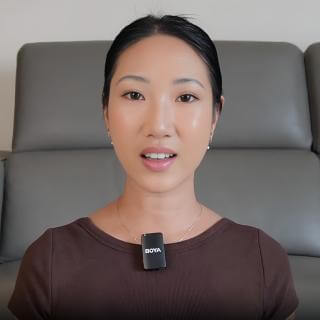
Hi,
I'm Dr Kim.
This practice is designed to calm acid reflux by restoring ease and movement to the diaphragm,
The muscle that plays a central role in both breathing and digestion.
When the diaphragm is tight,
Elevated or not moving properly,
Pressure builds in the upper abdomen.
That pressure can push stomach contents upwards,
Contributing to reflux.
By softening the diaphragm,
The lower neck and the upper belly,
We reduce that pressure and signal safety to the nervous system,
Allowing digestion to settle.
This is about teaching the body that it's safe to breathe and safe to digest.
Find a comfortable place to lie down and dim the lights.
Place one or two pillows under your upper back,
Shoulders and head so your chest is gently elevated.
Your upper body should be slightly propped up.
Allow your lower back and hips to rest comfortably.
Let your arms relax by your sides and allow your eyes to close.
Let your shoulders soften downwards.
Release the tension around your eyes.
Allow your jaw to drop slightly.
Teeth gently separated.
Soften your belly.
Bring your hands to the lower part of your neck.
Place your fingertips on the backs and sides of your neck.
Begin to massage this area slowly using alternating pressure,
Left and right,
Left,
Right.
Move your fingertips in small gentle circles.
Allow your elbows to drop towards your chest and let the weight of your arms do the work.
Allow your head to sway gently from side to side,
Fully relaxed as you gently massage your lower neck.
The nerves in this region communicate directly with the diaphragm.
Massaging here sends a signal of safety.
Downwards into the diaphragm.
Bring your hands back to stillness.
Take a deep breath in and as you exhale,
Trail your fingertips down through the front of your neck,
Down your chest,
And let them rest in the soft area underneath the bottom of your ribcage.
This is an important acupressure point for the upper gastrointestinal system.
Begin to gently massage this area.
Move your fingers in small circles.
Notice any tightness or tension.
Allow your breath to soften this area.
And bring your hands to stillness.
Move your fingers one to two inches to the right,
Finding the border of your ribcage.
Press your fingertips inwards and upwards as if you are trying to reach underneath your ribcage.
This is where your diaphragm lies.
Keeping firm pressure,
Begin to glide your fingertips slowly from side to side.
This may be uncomfortable if your diaphragm has been stuck for a long time.
Try to let your belly completely soften.
Here,
We're clearing out any adhesions that have been preventing your diaphragm from moving properly up and down.
And relax your arms.
Allow the circulation to return to your fingertips.
Bring your fingertips back to stillness.
Bring them back to the center point and move one to two inches to the left.
Find the border of your left ribcage and press inwards and upwards.
Glide your fingertips from side to side,
Keeping that firm pressure.
And notice any difference between the two sides.
Perhaps one holds more tension than the other.
Soft belly.
Note any discomfort.
And release the pressure.
Place both hands on your lower belly below your belly button.
Bring your awareness to your diaphragm,
Which sits at the lower edge of your ribcage.
As you inhale,
Consciously move your diaphragm downwards.
Your hands should rise as a side effect.
And with every inhale,
Move your diaphragm downwards even further.
Imagine it moving smoothly and with ease.
Feel the air fill your lower belly.
And when the lower belly becomes full,
Allow your chest to expand.
Deepen your breath as much as your body will allow.
See the air fill your lower abdomen,
Your chest,
And then even your head.
Feel the oxygen flood your cells as your diaphragm moves freely.
And now allow your breathing to return to its natural rhythm.
Using a firm pressure,
Begin to massage your abdomen in a slow clockwise direction.
Up the right side and down the left side.
Move at a slow,
Soothing pace.
You're inviting movement through the tissues and fascia of the front of the body,
Creating space and ease.
Notice any firm points.
Encourage them to move and disperse with your massage.
And bring your hands back down to your lower belly.
Notice the sensation of your breath,
The softness in your upper belly,
The sense of space through your chest.
Take a moment to enjoy this feeling.
Stay here for as long as you need.
If this practice was helpful and you'd like to go deeper,
I invite you to explore my Mind-Gut Connection course here on Insight Timer.
In this course,
We work deeply with the nervous system,
Breath,
And somatic release to solve digestion,
Reflux,
And gut-related tension at the root level.
For now,
Take this sense of ease with you and return to this practice daily until your symptoms change.
Have a wonderful day or night.