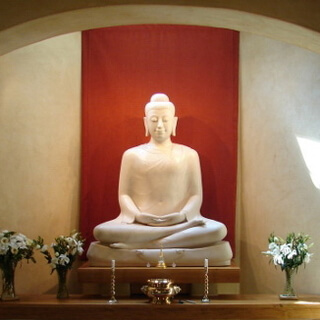
So I was just reminded today that this is the last afternoon we have together.
It wasn't really taking note,
It was rolling along.
So there's a couple of things I'd like to offer,
Present.
One is some time to sense,
Be with nature,
Sense the rest of the biosphere,
As humans.
And the other is reclining meditation.
So first of all reclining meditation.
Just to mention it.
I would mention sometimes with the upright axis,
Actually though that's true,
You don't actually have to be upright to experience it.
It's a natural channel or core or something to do with balance.
And sometimes you experience it better when you're lying down.
It's rather like just the centre line in the body.
And as I say you don't necessarily feel it because it doesn't have a sensation.
It's more like a sense of balance,
Collecting as presence.
And that kind of quietness actually is still quietness.
So you can't get there by trying.
It's much softer than that.
But when one's awareness opens and is balanced,
You get that sense of having an inner balance.
When we recline actually what occurs is a lot of,
Naturally the muscles tend to relax.
And because it's a kind of,
You know,
It's what it is.
Reclining is generally a sense which you relax,
Deep relaxed.
And you can recline where you feel safe and comfortable.
And it's not your social person.
So various things can help just subside a little bit.
You can't really get a lot of trying going and lying down.
You try to lie down.
So it just helps the kind of softness because as I said,
You know,
This isn't done through trying.
Trying is a quality of attention and intention has its relevance and purposes.
But it's often something that's a bit worn and overdone because we've tried so much.
So it has a relevance but it's much more relative.
And there's something about just being present which really just means that.
And it means often when we're just being present,
There's certain things are moving around.
You know,
Things are coming and going.
And,
You know,
Our practice is just to allow things to arise and pass.
And stay in touch with body,
Breathing in,
Breathing out.
Not even breathing in,
Breathing out,
But just being in touch with the sense of having a body.
So anyway,
It's incredibly simple.
And naturally the mind,
What we're supposed to do and so on.
You know,
This week,
We know what lying down is.
But essentially lying flat on your back and relatively straight,
Without being rigid.
Just straight and reclining and you can either place your hands,
Palms on your abdomen or on your chest.
So they're together or on the floor on either side.
So really the palms,
The awareness of the palms.
So the palms can be touching your body or touching the ground.
So the palms are really helpful.
Maintaining that sense of open contact.
That's not gripping.
So as one reclines,
Place your hands in a way in which the palms are in touch.
The sense of touch is light and there,
Present,
Could be on your own body or on the floor or wherever you're lying down.
And just for a few moments,
Getting the sense of the completion of the body from the head down to the feet.
Soles of the feet are also helpful if you can feel those.
They're open too.
Steady down to the soles of the feet.
And here's the feet,
There's ankles,
There's legs.
There's the pelvis,
There's the lower back,
Middle back,
Shoulders,
Neck,
Head,
Crown of the head.
And this is all settled,
Just as if as we're reclining,
The ground underneath is like a big cushion or something that you can sink into.
And it's quite happy to receive your weight.
So you can really just let yourself go into that.
And all the soft qualities,
Tissues of the body,
As you breathe out,
Just let them sink down back into the earth.
As if you can almost slightly sink into the earth with that.
And your practice as such is to just keep that awareness from,
Like I sometimes imagine it to be like when there's dome tents or bubble tents when you have a tent.
So it arcs from your head over an arc down to your feet like a rainbow or something.
So you've got this canopy above your head and also on either side like a giant ball.
And you can keep your eyes half open.
Or then,
Because it's not about anything you can see,
It's just a sense of having a protective or present bowl over the body.
And you always imagine how big that is.
So it's not lost in it,
It's not tight,
It's just a comfortable canopy.
And breathing in,
Breathing out.
Then feeling the experience of the body.
And being aware of the tendency to localize,
That is there can be a tendency where the attention just starts to contract into a small area,
Just keep extending it through the entire form.
And that's it.
The rest is what unfolds.
It could be the case that one just falls asleep,
But there's worse things.
The point is we do lie down every day I imagine so why not make practice out of it.
And perhaps when one is more awake.
So if you fall asleep you fall asleep and then you wake up a little later.
So offer this as something to cultivate and I'll get back to that.
The other thing is to mention spending some time walking,
Standing,
Sitting outside.
And as direct as you can,
It's not about going anywhere in particular,
It's just as you walk you first of all unplug the stride that's intended to go somewhere special.
I mean you can say I want to get up to that plateau up there,
First level and then I'll just cruise as it were.
So you know you can have a certain aim,
But it's not an automatic,
You know what you're feeling and as you walk you're feeling the textures of the ground underneath the feet.
As long as it gets as direct as possible to the experience of the body and the earth elements touching each other.
So that the ground,
The temperature,
Any kind of breeze on the face,
Get as close as you can to the direct physical impression.
And then even you see something,
You know like a tree or a lizard or whatever is out there.
Pausing,
Noticing.
Something you're actually coming into the center of your body and just imagine you're opening to that.
Like you,
It's almost like you're preparing to meet it.
A sense of opening in the center of the body,
Preparing to meet.
So you're starting to see the experience,
The rest of the biosphere no longer as just you know dumb matter,
But as living being and we are part of.
Now,
Naturally these things are not going to seemingly respond,
But in a way there is a response and the response is felt in oneself.
There's some sort of connection that occurs,
Some feeling of being in this nature that can occur through that.
And listen,
Notice creatures,
Things moving,
Cheeping,
Twittering,
Being around,
Be with that.
It's as much what it clears away as what's present,
The complexities and the speed,
The holding.
So those two practices and I'm suggesting we take them to,
People take them to a three,
So people who like to have a come for some jigong,
We could have that at three.
Now just going to 140,
So you might want to consider maybe half an hour or so of reclining or some walking or all the time reclining if you like or all the time walking,
But this is up to you.
As far as reclining goes then clearly,
Obviously it could be the case that one feels much more comfortable in one's own secluded space and that's understandable and fine.
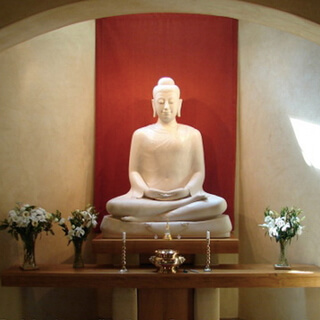
If you want to recline in here then make sure you have plenty of space and the simple protocol is you don't point your feet to the shrine so you can recline,
But make sure you have plenty of space,
You're not all bunched up in there like in their red shelter or something.