Gaining the Power of Sound by Amba Kadevi Copyright November 25,
2021 Read by Amba Kadevi OM GAM GANAPATAYE NAMAHA The use of sacred chants has become incredibly popular since 2013 when Oprah and Deepak Chopra launched their first of what would become a successful series of 21-day meditation challenges.
As an assignment from my PhD professor back then,
I began following the global phenomena to report back about what was being used as tools for the participants.
The experiences focused on a variety of wellness topics ranging from self-love to manifestation.
Each day,
Recipients received encouraging thoughts by Oprah,
Followed by a new mantra presented with little explanations from Chopra.
He would then lead a meditation with background music and bring the listeners back to the present moment with the sound of chimes.
As a master's student studying the language of Sanskrit,
I was trained to understand the potency and power of this ancient mother tongue.
My professors were very particular and taught me the importance of perfect pronunciation.
They remain valued friends and teachers as I continue to study,
Publish,
And teach this topic.
When I questioned one of my professors about the mispronunciation presented in the meditation challenge style I had encountered,
My esteemed professor said this to me,
Imagine you are standing on the threshold of a door,
It is an obstacle you wish to get through.
On the other side is great healing or knowledge you crave.
In your hand is a ring of keys.
One of these could potentially open up that mystical door.
The transcendence you hunger for is on the other side of that door and the proper mantra can open it.
When you mispronounce the mantra that you think is correct or use it at the wrong time,
You will never be able to get it to open.
Instead,
You stand there jiggling the keys and cannot get one into the lock.
Mispronunciation cannot only prevent entry,
It can cause harm.
Some cultures have known the healing power of sound for centuries.
In the beginning,
There was sound.
This is found in all of the ancient scriptural books.
I have been taught the transcendent nature that properly pronouncing the word samskritam,
Which is the way to say the name of the language Sanskrit,
Activates the pineal gland in such a way that it can urge a release of the sweet nectar known as ojas.
This mysterious essence translates to splendor,
Vitality,
Power,
Lustre,
Appearance,
And bodily strength.
You can think of ojas as the container that holds your happiness.
It is the purest essence of kapha dosha,
One of the ayurveda qualities of the body's humours.
In the physical body,
Ojas is related to the reproductive hormonal cerebrospinal fluids.
A sound,
Just like a smell,
Can induce an instant reaction.
As a very young yogi,
I learned in study of the ancient Vedic text,
Known as the Upanishads,
That each sound from the Sanskrit alphabet resonates and vibrates with one of the corresponding fifty petals of the first six chakras.
These profound energy centers are anchors of layers that compose our bodies,
Minds,
And spirits.
Try to imagine these as multidimensional,
Rather than thinking of them as flat disks,
Spinning like wheels.
Yes,
In the two-dimensional artwork,
We see chakras imagined to be like flat disks,
Like lotus flowers,
Each possessing specific numbers of petals.
We can also see this idea expressed in the more modern Huangdinejing,
Known as the Yellow Emperor's Classic of Medicine,
In the modern translations of the text.
Keep in mind that in the ancient times,
There were no autopsies performed.
Therefore,
The culture did not know what the organs looked like,
And imagined them to be like multi-petaled flowers as well.
Perhaps this interpretation came by way of the ancient artworks of the chakras?
In the model of the chakra petals,
We focus on the first six chakras.
The first chakra,
Muladhara chakra,
Commonly called the root chakra,
Has four petals with four corresponding sounds.
There are six sounds for the petals of Swaritthana chakra,
The second,
And ten held in the third,
Manipura chakra.
Anahata chakra,
The fourth,
In the location of the heart center,
Carries twelve sounds,
And Vishuddha chakra,
The fifth chakra of the throat,
Has sixteen petals.
The third eye,
Ajna chakra,
Carries the final two in its scarab-like shape.
The seventh chakra,
Sahasrara chakra,
Known as the crown chakra,
Has one thousand petals.
It is seen as the highest spiritual point,
And is beyond this reality.
It is not included in this progression.
I know that Oprah and Chopra had good intentions when they set out to create their programs.
But in the mishmash of mantras,
What I perceived happening was the creation of a toxic sound soup of confusion.
My professors concurred.
Before you become frustrated by this,
Please allow me to offer some explanation.
Let us also keep in mind that we are only scratching a bit of the surface here.
Yes,
You may feel like you are going back to the beginning on some concepts that you already know.
I do hope to shed light upon any you may have missed or forgotten.
Vak Yoga is the Vedic name of Samskritam.
This adds another layer of mystery to a much more vast amount of knowledge.
Now let us consider that when we want to open a path,
Alter a mood,
Or fully change course,
That it is a good idea to utilize the correct key and to be standing at the intended door at the best time possible.
The classical phrases and recommended articulations were first passed on by voice to voice,
Ear to ear,
And taught only in this way.
This ensured precision and patience.
Tone,
Rhythm,
And timing are all key components.
It was not until much later that any idea of written language was etched into leaves and later inked upon paper to capture these teachings.
In a seeming game of broken telephone,
A game children play,
Whispering a single phrase to then be passed through a succession of ears,
Has resulted in much the same way.
An indistinguishable garble at the end.
Let us all make an effort to be more mindful of this and continue to dive deeply into this knowledge.
It has now become popular to refer to Vak Yoga as Mantra Yoga.
You can begin learning more about Vak Yoga and the teaching brand of Yoga Samskritam University on their site,
Ysam.
Org.
You can learn even more about proper pronunciation of the language,
Which is Vak Yoga,
In the video I have provided for you in the article that accompanies this recording.
Now we have identified that sacred mantras are composed of particular sounds with precise rhythms and intonations to be used at specific times of day or night.
The precise choosing of a moment in time is measured by Jyotisha,
A sister discipline to yoga.
This is the science of light,
Also known as astrology.
Yes,
The timing of when to use any given sound sequence holds tremendous importance.
In order to choose this demands a great understanding of the cosmic rulership of each day,
Hour and minute.
Consideration must also be taken as to when the mantra is to be chanted and for what purpose.
This is a science and not a free flowing art form.
Every moment is ruled by specific energies of the universe.
To engage the full power of chanting a mantra is to practice a transcendental form of yoga.
Therefore,
These sacred utterances can be considered as mysterious invocations designed to shift the energy of the practitioner,
Those listening,
The local environment and the totality of the reality perceived around them.
A mantra can therefore be imagined to be a form of supernatural manipulation as these yoga practitioners have the power to intervene with the cosmos,
The fortunes of individuals and Mother Nature's processes.
This is why those not understanding the full force of mantra yoga can be mistaken for spellcasters and sorcerers.
The Latin languages utilize a great deal of sounds as well as grammar from the language of Sanskrit.
We can see this in the etymology of many words in our own mother tongue of English.
Given the principles we are now decoding,
I hope that we can now agree that every single shaping of syllables through the use of our very sacred throat chakra is a potentially powerful architect.
In addition,
Let us realize now that thought is a matrix creatrix.
Let's go on a little journey.
Imagine the first pop of an idea that is to become a spoken utterance.
It happens so quickly that we do not even have time to grasp the moment unless we are in the state of meditation.
In order for this seed idea to become a word,
The original impression must dive down to the center of the heart space,
The chamber of the unstruct sound,
To collect air from the lungs.
Next,
As it gains momentum,
The magical seed becomes a single syllable,
A fragment of,
Or complete thought to be expressed as a word.
The original spark travels onward to exit through the mouth.
On its way there,
The smooth tissue of the vocal cords strike together.
This sets off a sequence of oscillations that could be full of grace and curative,
Or disharmonious,
Causing distress.
Think of the photography experiments of the brilliant Dr.
Masaru Emoto.
He discovered the shapes of sounds,
Which in the veras are referred to as yantras,
Expressed in his perfect frozen sound images.
I've also given you some examples in the written article.
To learn more about this,
I suggest reading these two books by Dr.
Emoto entitled The Hidden Messages in Water and The True Power of Water.
If you have not seen the film What the Bleep Do We Know,
You might find that interesting as well.
Another film I often suggest to my students is The Connected Universe by Nasim Haramein.
Also be sure to look into his work with the Resonance Science Foundation.
Again all links are provided in the print version of this article.
Let us continue to follow the path of sound,
And consider that the sounds we make not only vibrate specific patterns of petals in the system of dynamic anchors,
Strung together to form the chakra system.
They also circulate back into our own heads,
Thereupon influencing our bodies,
Minds,
And spirits.
Now let's ask ourselves,
What occurs when a phrase has great intention and it is mispronounced?
I hope this is expanding your enthusiasm to create positive and correct sounds in any practice such as mantra yoga.
Does it now make sense that both thought and the formulation of sound affects everything?
Just in case you feel any discouragement,
I have good news for you.
We can begin gently to explore these concepts and to gain sensation from them while avoiding any possible mistakes.
This is a safe exploration of your body as an instrument of sound.
To do this we are going to use vowel sounds along with specific consonants to safely produce bodily felt sensations.
This is going to give you the opportunity to prove and know the full effects of your own voice.
Here is something you can try.
Place yourself in a very quiet environment,
Free from electronics and distractions.
This is preferably 30 feet from wifi and bluetooth devices.
Place your body in a comfortable seated position with your back as straight as possible.
If this is not available to you,
It is okay to be in a reclining position as long as your breathing path is clear.
It is most important to feel relaxed.
Begin by exhaling and then by taking a few very long,
Deep cleansing breaths in and out through your nose.
Once you feel that you are able to breathe deeply,
Progress to the next step.
As I am asking you to do this in a recording,
I do not want you to practice any further until you are still.
Please do not be driving a car or operating any heavy equipment.
If you are listening while you are driving,
It is okay to listen to the material I am sharing but please do not practice it until later when you are quiet and alone and still.
Now use the exhalation following one of your deep breaths in through your nose to make the sound TUM out through your mouth.
It will sound something like this.
This short vowel sound is pronounced UH as in the words BUG and CUP.
As you make this sound,
Allow your tongue to gently strike the soft tissue of the roof of the mouth just behind the teeth rather than directly against the teeth.
Repeat this for a minimum of 4 times.
As you practice this,
Consciously become aware of the sound inside your body.
Be neutral as you observe this and know that there is no right or wrong way.
Continue to consciously experience the silence outside of your body.
Let each sound go out slowly and fully without force.
Gently allow the sound to taper off on its own through natural nasalization as your lips close towards the end of the audible sound.
Experience the trailing off of each sound like the tapering off of the ringing of a bell or gong.
Follow the dissipating sound as it disappears.
After each sound ends,
Experience the totality of the silence.
Allow yourself ample time to engage with the bubble of energy this has created.
Observe it.
Take the next breath.
Continue in the sequence as many times as you desire,
Each time becoming the witness.
Next repeat the practice just as before with a new sound,
TOM.
It will sound something like this.
The vowel sound is AH as in the word log or bog.
Go through the same sequences as before with this new sound.
Observe as you did before,
Soaking in the effects and the after sensations.
In the written article,
I've provided you with a link to explain further about these two vowel sounds.
It is very important to only use the sounds explained here for this particular experiment.
Please do not use other sounds as this is a specific practice that originates from Yoga Samskritam University,
Which you can find at ysam.
Org,
And is an outreaching from Yoga teachings that are rooted in the Bhagavad Gita and in Patanjali writings.
Next,
I invite you to write responses to the following questions in your journal.
Analyze the state of your body before,
During,
And after the experience of each sound.
Ask yourself if it is relaxed,
Tense,
Or neutral.
What do you sense?
Pay close attention to any and all changes.
Likewise,
Monitor the sensations of your breathing and its capacity before,
During,
And after each experience.
Ask yourself if it seems normal,
Slowed down,
Or modified.
Further,
Observe the state of the mind before,
During,
And after this sound experiment.
Always see the mind as unified and therefore not possessed by an individual.
We do not see possession of the body either,
But I did not want to completely confuse you in this article.
Ask yourself whether the body seems more calm,
Peaceful,
And joyous.
Are you feeling inspired?
I hope so.
May we all become more aware of the words we use every day in speech about ourselves,
Others,
And our environment.
Let us remember that pronunciation and timing matter,
Especially when we expect to receive particular outcomes when using the practice of Vak Yoga.
The information I have shared with you here is just a launch point for the vast science of sound that is a substantial cornerstone supporting the philosophy of Yoga.
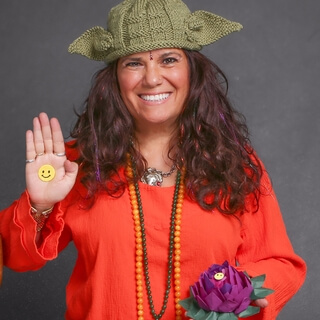
Ambukkadewi is an international award-winning best-selling author,
Expert astrologer,
Meditation Jedi,
Speaker,
And storyteller with a passion for your happiness.
Meditating since the age of six with 44 years of teaching experience,
13,
000 plus hours of study,
And having taught over 19,
000 people the art of meditation,
She gives you five clear steps that lead you directly into a deep state of meditation.
Visit her at ambukkadewi.
Com.
Thank you for listening.