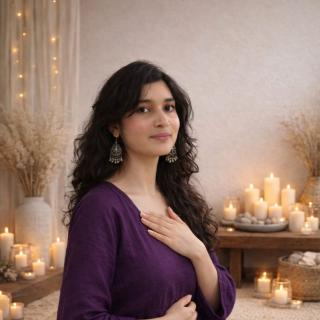
Hello wonderful being,
Welcome to this track.
I am Aneesha and thank you for choosing me to be your guide on this journey.
Do you remember the soothing warmth of a gentle tap on your back while you were hugging someone you love,
Or perhaps the tender touch of your mother's hand softly tapping your head as you drifted off to sleep?
Those moments just melt our hearts,
Don't they?
So today we will explore a technique called the butterfly hug and the aim of this practice is to evoke a similar sense of comfort within you.
So in this track first we will do the practice together and then I will explain why that practice works and what are the benefits of doing this practice.
So before we begin the practice,
Let's check in with ourselves,
Take a moment to turn your attention inward,
Noticing how are you feeling right now,
Name the most dominant emotion present in your body right now.
Now rate the intensity of this emotion on a scale of 0 to 10,
Where 0 means the absence of this emotion and 10 is the highest intensity,
So how would you rate the strength of this current emotion?
Very good,
It's not easy to get in touch with our difficult emotions,
So we will see what can we do about this intensity using this practice.
So now that we know exactly where we are,
Let's start the practice.
Find a calm and comfortable space where you can sit or stand without any distractions.
Maintain a straight posture to facilitate relaxation and focus.
Take a deep breath in,
Coming home to this present moment and a slow breath out,
Letting go of the need to be anywhere else or to do anything else.
Continue to take a few more deep breaths,
Inhaling deeply through the nose,
Allowing your abdomen to expand and exhaling slowly through your mouth,
Releasing any leftover tension in the body.
Now I invite you to cross your arms over your chest so that the tip of the middle finger from each hand is placed below the collarbone.
In this position,
Your palms would be touching your chest,
Your hands and fingers should be as vertical as possible,
Pointing upwards towards your neck and not towards your arms.
You can interlock your thumbs to form the butterfly's body with the extension of your other fingers outwards,
Forming the butterfly wings.
So it's like a butterfly is sitting on your chest.
As you are in this position,
Your other fingers should be resting on your chest with thumbs pointing towards your chin.
I hope that the instructions were clear.
If you have any doubt,
You can go on the internet and search for butterfly hug hand position.
So now that we are set with the position,
Start gently tapping your chest with one hand after the other,
Alternating between left and right,
Left and right,
Mimicking the flapping of butterfly wings.
Remember to only tap one side at a time.
So first tap on one side,
Then another,
Then again on the first side and then another and so on.
Maintain a slow and steady rhythm,
Breathing and tapping.
You can adjust the pace and intensity of the tapping based on your comfort level.
As you continue to tap,
Pay attention to any thoughts,
Emotions or physical sensations that arise.
You don't need to get hooked by them.
Allow them to come and go without any judgment.
Similar to watching clouds pass in the sky.
You see everything that comes up in your awareness as clouds passing in the sky.
You don't need to cling to them and you also don't need to avoid them.
Just witness them come and go and continue to tap one hand at a time.
So left and right,
Left and right,
Left and right.
So I will stay quiet for a few moments so that you can continue to breathe and tap at your own pace.
Very good.
Usually after tapping for one to three minutes,
We again check in with ourselves to assess our physiological and emotional state.
So on a scale of 0 to 10,
Where 0 means no distress at all and 10 means the maximum distress.
Can you rate your current level of distress?
If you notice that the distress level fall below 5,
Then if you want,
You can stop tapping.
Because this is a level that you can handle.
So you can try sitting with your emotion now.
And if you need guidance on that,
I will share where you can find it towards the end of this track.
So for now,
Let's continue.
So if the distress is still above 5,
Then you can either continue to tap on your chest or you can extend the tapping to other body parts.
So try tapping on your shoulders.
So with your arms crossed over your chest,
Place your hands on opposite shoulders and gently tap your shoulders alternatively.
Tap on the left side and the right and then again at the left,
Then right,
Left and right.
And continue at your own pace.
Now the next body part that you can tap is your upper arms.
So place your right hand on your left upper arm.
And your left hand on your right upper arm.
And again,
Alternatively tap on each side.
Very good.
Now,
If you prefer,
You can continue to tap on your knees or thighs.
So in this case,
You can cross your arms and tap alternatively on your thighs while sitting comfortably.
So your right hand is on your left thigh and your left hand is on your right thigh.
Now,
At last,
Try tapping on your knees.
So you can slide your hands towards your knees.
So that your left hand is on your right knee and your right hand is on your left knee.
And you can continue to tap alternatively.
And don't forget to continue taking in deep breaths.
Very good.
Now,
Gradually stop tapping.
You can uncross your hands and place it in your lap or on your knees.
Whatever feels more comfortable to you.
Now,
I invite you to again check in with yourself.
And take a moment to notice how are you feeling right now.
Has your emotional landscape shifted in any manner since we began?
Are you still feeling the same emotion that you were feeling initially?
If you said no,
Then can you name the new emotion that has arisen as a result of this practice?
And if you are still feeling the same emotion,
Check if the intensity has changed in any manner.
So,
Re-read the intensity on a scale of 0 to 10.
It's okay if the intensity has changed by just one point.
You have done a great job.
And if the intensity is still above 5,
You can replay this track to continue tapping with me.
So,
Now we are going to end this practice.
So,
Place both your hands on the heart.
Connecting with your heart.
And thank yourself for taking out this time to make your nervous system feel safe and calm.
If your eyes were closed,
You can gently open them and connect back with your surroundings.
Okay,
Wonderful.
So,
Now let me explain why and how this works.
So,
This butterfly hug is rooted in the principles of bilateral stimulation,
Which involves activating and balancing both hemispheres of the brain.
This technique can help facilitate the processing of traumatic memories because bilateral stimulation activates the brain's natural ability to process and integrate memories,
Often leading to a reduction in the emotional charge associated with these memories.
And this is why this technique is often used in therapy while processing trauma.
Also,
The rhythmic tapping and the deep breathing promotes a state of relaxation,
Which helps lower the cortisol level,
Which is a stress hormone,
And hence it encourages a calming response in the body.
So,
Coming to when can we use this or how much can we use this,
You can tap for one to three minutes or more in one go until you feel some reduction in the intensity of the emotion.
So,
If you found this track helpful,
Then you can replace this track two to three times a day and practice with me.
I would recommend you to practice this particular technique for the rest of the week so that this way you will be able to develop a habit and it will become easy for you to use this technique immediately in times of crisis.
Regularly practicing the butterfly hug can offer profound benefits for overall well-being.
Beyond its calming effects,
Research suggests that this simple yet powerful technique can help alleviate anxiety,
Help with depression,
And even support recovery from trauma.
It also promotes a sense of safety and help you regain your focus and composure.
While butterfly hug is a gentle practice,
It's always essential to listen to your body.
So,
If crossing your arms or tapping causes discomfort or pain,
It's best to avoid this technique and instead explore alternative regulation techniques.
Additionally,
If the practice triggers any overwhelming emotions or memories,
Then I would recommend you to seek support from a mental health professional.
Remember,
Everyone's journey to inner peace is unique.
While butterfly hug offers a powerful pathway to that peace,
It might not be the perfect fit for you.
So,
If this doesn't work out for you,
Don't worry.
There is a tool out there for you.
Feel free to explore other techniques on my profile to find the right fit for you.
So,
Thank you for listening.
You being here means a lot to me.
See you soon.
Take care.
Bye-bye.