We begin preparing for our talk and meditation today by centering in the here and now.
From the external to the internal.
Hi,
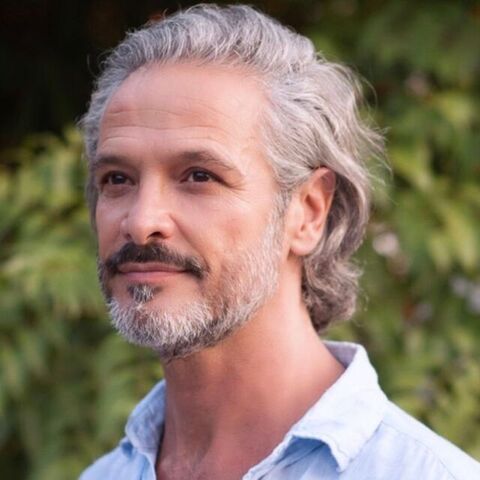
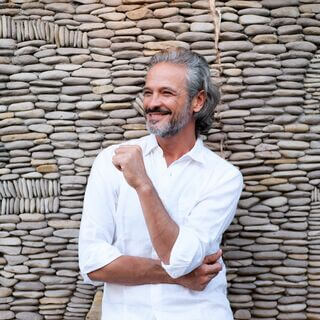
I'm Bassem.
Thank you for joining me.
And in this refocusing or reorienting of my attention,
Deep calming begins to occur.
My attention,
Which is usually focused outside,
Externally,
Is now focused internally.
I begin to feel the being of myself.
I begin to experience my breathing.
I begin to experience a release,
Perhaps,
Of tensions that I may not have been aware of.
Simply by becoming aware that the here and now is not an external phenomenon,
I begin to feel a natural inner calming occurring.
As you sit in on this conversation,
Your primary task is not to listen.
Your primary task is to be centered in the here and now within you.
All of us experience stress and anxiety.
And for some,
This experience is quite frequent.
In Australia,
The three main mental health conditions are stress and anxiety,
Depression,
And number three is substance use.
Today,
It is about learning self-care methods that you can do on your own.
Practices like breath work,
Mindfulness,
Meditation.
I also want to introduce the idea of phantom anxiety.
You've probably read about people who get amputated.
Maybe they lose their hand or their leg.
They say they can still feel their amputated arm or their leg.
This is a phantom sensation of something that obviously doesn't exist anymore.
Similarly,
We can have problems that don't exist anymore,
But we still feel them.
So we can have a trauma in early childhood,
And we might have done the work on this trauma,
But it seems to continue to exist.
We may have mentally,
Even emotionally,
Dealt with the situation,
But the body is still needing to release the experience.
The problem here is to be careful of hooking into the body's experience mentally and convincing ourselves that we still have that problem.
The body is releasing,
Feeling that phantom problem that's no longer there.
We have to be careful not to mentally hook into the experience,
Not to recycle it into being.
Mentally,
I have addressed the situation.
I keep hooking into my body's experience.
The mind must learn to support the body's process of releasing and not hooking into it.
The body keeps the score,
So how do you release stored trauma without falling into the mental trap?
My body contracts.
I tighten up.
My heart starts to beat faster.
I become irritable,
Anxious.
I can't concentrate.
Some of us slow down.
Some of us speed up,
Become shallow breathers.
Our belly tightens up.
My mind is interpreting not only the situation outside as threatening,
But it's also interpreting my body's reaction.
Externally,
I'm saying something wrong is happening,
And internally,
I'm saying that I should not be feeling this.
I see someone walking towards me in the dark.
My mind tells me this is something terrible.
My body reacts.
Terror sets in,
And then the person just passes by,
And I feel like such a fool.
An important component of dealing with anxiety is awareness.
So I need to notice these components physically,
Emotionally,
And mentally.
I've seen one time of a New Zealand Maori woman on the beach here in Sydney on a very packed,
Busy,
Sunny summer day.
Two families.
She had a little boy,
And the other family had another little boy.
They were playing together on the beach,
All having fun.
Then it was time for one family to leave.
The Maori woman's child had borrowed something from the other kid.
Now it's time to give it back.
He starts making an extraordinary tantrum in the heart of where everybody was relaxing on that sunny afternoon.
And the mother just grabbed the little boy,
Put him on her bosom,
And not once told him to stop crying.
Not once tried to talk him out of his tears.
Not once did she look at anybody else on the beach and say,
I'm sorry about this,
He'll be okay in a minute.
All she did was to simply hold the child and tap on his back.
And I heard her say,
There,
There,
There,
There,
There,
There.
How do we meet the anxiety?
Do you meet it with an idea that what is happening is wrong?
What is happening in the reaction is also the releasing.
An anxiety attack is a body releasing pent-up energies from the past.
If I can be with those energies,
I can allow them to release.
You simply be with it,
Knowing that it is an expiry date.
I can isolate from the situation,
Take myself into a quiet room and lie down with the anxiety,
With the stress,
With the emotional reactivity,
Without needing to change anything,
Without needing to fix.
To simply be like a married mother with the anxiety,
With the hurt that the body is experiencing.
Treating it with understanding,
With wisdom,
Being there with it.
The anxiety knows you don't want it to be there.
The child knows.
We meet it with courage and daring.
We meet it with patience.
We meet it with love.
To master anxiety,
You must become a master.
You must become aware.
So I can separate,
I can be with my anxiety,
And I can allow it to come up,
Understanding that it has an expiry date.
If you treat anxiety as a problem,
You're not approaching it in a way that allows the child to release trauma.
His good karma was the mother who simply allowed him to release the trauma.
The past of his past,
Without making a problem.
Most of us have these experiences.
We judge them.
We interpret them negatively.
We repress them,
Deny them.
It's an energetic experience.
Don't label it.
Don't judge it.
Until it releases.
At some point,
You realize that tremendous healing is happening.
I judge the situation as something shouldn't happen,
And I perpetuate a cycle of suffering.
So first we have to understand,
Anxiety is not a problem.
Anxiety is the body's reaction to a memory or negative thought.
Auto-emotional response.
In having the right attitude,
I am accepting the opportunity.
So I find the space where I can allow the energy to release,
And I practice self-compassion,
Self-care,
Allowing this anxiety to do its thing.
To become more aware,
More present to meet anxiety without reactivity.
I want to share with you this three-step breathing technique.
The first step is called conscious connected breathing.
It's basically 20 breaths broken into four cycles.
This is a breathing technique that was discovered by Leonard Ohr,
The founder of rebirthing breathwork.
20 breaths divided into four cycles.
Each cycle is five breaths.
So four times five equals 20.
In and out through the nose.
The first four of the five breaths are fast,
And the fifth is long and deep.
It's like this.
Now the fifth is long and deep.
That was one cycle.
I'm going to do two now.
You can join in if you want.
Immediately to the second.
And last fourth.
And last fourth.
That was it.
Let the breath return to normal.
Feeling change of inner climate.
And then you start to do in two,
Three,
Hold two,
Three.
In two,
Three,
Hold.
Now,
Some of you may be able to in to four,
Hold for four,
Out for four.
And then five,
And then six,
And then seven.
So in for seven,
Hold for seven,
Out for seven,
Hold for seven.
Third step is called anapanasati,
Breath awareness.
You simply let go the breathing.
For about a moment,
Just feeling.
And now,
For the next five minutes,
Where the nostrils join the upper lip,
Put your attention there,
And you simply feel that area.
Naturally,
The breathing.
You don't control your breath.
You don't speed it up.
You don't finesse it.
Sometimes,
The breath will hardly be there.
But you could still sense the contact between the nostrils and the upper lip.
And as the body releases,
You just keep returning to this area.