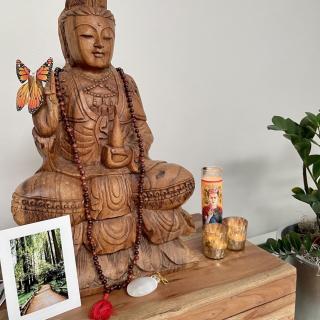
This is a 10-minute guided meditation on awareness of thoughts.
You can have your eyes open or closed.
If they're open,
Just find a soft gaze,
About a foot in front of you on the floor.
And you want a posture that feels alert while also allowing ease.
That could be sitting,
Standing,
Or lying down.
So let this beginning be a threshold,
A small crossing from what was to what is here.
You might imagine placing whatever you were carrying outside the door for now.
You can pick it up later.
Feeling your feet on the ground,
Or the points of contact beneath you.
Gravity doing what gravity does.
There's no need to hold yourself up right now.
You might even sense the bones in your body stacking against each other in rest.
And then slowly letting your awareness draw inward from the edges of the room to the outline of your body to the rhythm of the breath arriving.
We'll begin by resting our attention on an anchor.
We'll use breath or sound for this practice.
If you use a different anchor,
Feel free.
So noticing that the body is breathing and bringing your attention to the in-breath and the out-breath.
You might notice where it rises and falls in your body.
Not trying to make your breath be any certain way,
But watching it come and go on its own.
If you prefer to work with sound,
Noticing what's close in and what's far away.
Perhaps the quiet in between.
Each time your mind wanders,
Gently return to the breath or sound.
Now you might expand your awareness to include thoughts.
Some feel frustrated or discouraged when the mind wanders.
And you might instead think of it as a moment of being present,
Of noticing what you're up to.
So every time a thought comes up,
You might just notice thinking and then bring your attention back to the breath or sound.
We wanna bring a lot of patience and kindness to this process.
Our mind generates dozens of thoughts every minute or so.
So you might be redirecting your attention hundreds of times.
This isn't a problem and we're not here to change it.
We're only trying to notice what the mind is up to.
And thinking happens all by itself.
And we don't need to take that personally.
It's just what our minds do.
Each moment of noticing that a thought has arisen and coming back to your anchor of sound or breath is a moment of strengthening your wiser relationship with your own mind.
When thoughts arise,
You might find it helpful to name them softly to yourself.
It could just be thinking,
Thinking,
Planning,
Worrying,
Judging.
Knowing that the mind is thinking.
That's all we're doing.
We're not getting engaged with the narrative of the thoughts.
We're naming them,
Noticing them.
And this helps us not feed them.
You might even greet them with a light curiosity.
Oh,
That's an interesting story.
And then let them pass.
You might play around with allowing your thoughts to arise and dissolve on their own.
There's really nothing to figure out,
Nothing to do.
Just noticing,
Oh,
Here's a thought.
And then noticing when that thought has gone.
And then coming back to the breath or this sound.
Some of our thoughts are repetitive thoughts and they keep returning.
It can help to sometimes drop below the thought and see if there's an emotion underneath.
So if there is,
You can also softly name that emotion to yourself.
And as you're doing that,
You might ask yourself of the thought,
Is this true?
Sometimes,
Very often,
Our thoughts don't have our best interests in mind.
And if a thought becomes persistent,
Working with it in the body can be helpful.
So dropping in to the emotion behind it,
And then the sensations in your body,
Breathing with them,
And also holding that all very lightly.
This often can feel like a metabolism of thoughts.
And when the experience dissolves on its own,
Like waves into the ocean,
You can again return to the breath or sound.
As we come to the end of this sitting,
You might rest with some questions.
What is aware of the thoughts and who is thinking them?
And then sensing into that loving witness inside of all of us,
Which is big enough to hold it all.
So whenever you're ready,
You can begin returning to your body.
You might sense again where your body makes contact with your seat,
Sensing the quality of the air in your space,
And coming back into your room and opening your eyes whenever you're ready.