Hello,
My name is Chantelle Walker,
Registered Psychologist in Alberta and Saskatchewan.
Welcome to the meditation Awareness of Breathing and Challenging Sensations.
So taking a moment,
I'm inviting you to adopt an erect,
Dignified and comfortable posture.
The chest and spine are rising,
The neck is long with the chin in line with the navel.
You're sitting on a chair,
It may be helpful to place your feet flat on the floor with your legs uncrossed.
Gently closing your eyes if that feels okay or taking a half-open receptive gaze a few feet in front of you on the floor.
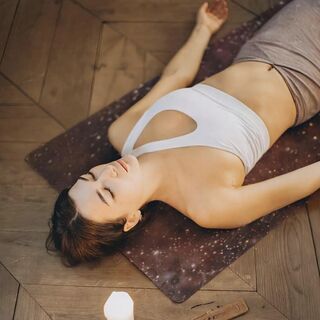
You're lying down,
Letting your feet fall away from one another and again taking a half-open receptive gaze or closing your eyes.
Bring your attention to the level of the physical sensations by focusing on the sensations of touch and pressure in the body where it's making contact with the floor or whatever you're sitting on.
Just spending a few moments to settle in,
Allowing the earth to do the job of holding you up and letting your body relax to the level that you're comfortable with.
Now turning your attention to the sensations of breathing wherever they're most vivid,
Perhaps at the nostrils,
The chest or at the level of the abdomen and honing your attention here.
Not needing to do anything in particular or change your breathing,
Simply observing what it feels like to breathe.
You're noticing you're breathing at the level of nostrils,
Perhaps attending to the cool dry air going in and the warm moist air going out.
Your attention is at your chest,
Perhaps attending to the expansion and contraction of the ribs or at the belly,
The stretch of the abdominal wall and the in-breath and the deflation on the out-breath.
As best you can,
Just picking one place in the body and holding your attention here.
Staying with the movement of the breathing as you breathe in and out.
In and out.
When your attention moves away from the focus that you have your attention on,
Perhaps to hearing,
Thinking,
Remembering,
Then gently and kindly bringing your attention back as best you can to your breath,
Just recognizing that this is part of the practice.
And every time you catch yourself with your attention wandering away,
Just noticing that this is a moment of mindfulness as you bring your attention back.
Perhaps moving in and out.
And although you're not trying to breathe in any particular way,
You're simply allowing your breath to breathe itself.
Breathing in,
Breathing out.
Breathing in,
Breathing out.
Each breath,
A new breath coming and going gently.
Breathing in,
Breathing out.
Letting the breath do whatever it does.
Making room for it.
Being with it just as it is.
Attending to the physical sensations of breathing moment by moment.
And when the attention is drawn away from this object of focus,
Seeing if you can gently bring it back to the feeling of the breath in the body,
Without judgment,
Without story.
No need for harshness.
Simply learning this way of attending,
Of being with the body,
Breathing moment by moment.
Breathing in,
Breathing out.
And now,
On the out breath,
Letting go of this primary attention on the sensations of breathing in the body.
And on the in breath,
Bringing attention to the entire body.
Allowing the breath to fall into the background and letting your body come into the foreground.
Taking an open and receptive stance to whatever experience is happening in this present moment.
When a particular sensation calls for your attention,
Bring curiosity to it.
Investigating its shape,
Depth,
Parameters,
And any other qualities,
Like throbbing,
Warmth or coolness.
Really getting to know the sensation.
And once you feel ready,
Letting go of that sensation,
Waiting for another sensation to capture your attention,
And then investigating it.
At this point,
You may be noticing particularly intense physical sensations arising in the body.
If this is the case,
Noting them and bringing curiosity to them.
Exploring their characteristics.
Really getting to know them.
We have a tendency when sensations are intense to want to move away.
But in this case,
The invitation is,
As best you can,
To become curious about these sensations.
Noticing their tops,
Bottoms,
And sides of the sensation.
Whether sensation is lingering or whether the sensation is intermittent.
If at any time you find that the sensations are too intense,
Then perhaps breathing with the sensation.
Or trying to expand into them on the in-breath.
Softening and opening on the out-breath.
However,
If you feel you need to change position,
Doing so with intention and deliberation.
And then returning to your original posture.
Coming back to focus in this practice,
Which in this moment is the physical sensations,
And wherever they are most dominant for you.
And when the attention moves,
Which it naturally does,
Simply escorting your attention back to the body as best you can.
Without rigidity.
Without judgment.
With a sense of gentleness and kindness.
Coming back to this gentle curiosity of sensations in the body as they arise and fall.
Remembering that coming back and bringing your attention back is a part of mindfulness.
The moment that you become aware your attention has moved,
This is meditation itself.
And now,
On the out-breath,
Shifting attention away from the physical sensations,
Allowing them to be present in the background.
And moving your attention to the sensations of breathing in the foreground.
Returning the primary focus to where the sensations of the breath are most dominant.
And as best you can,
Maintaining your attention here.
Noticing the rise and the fall of your chest or your belly as you breathe in and out.
Or the coolness and warmth of the air at the level of the nostrils.
Recognizing that the breath is always with you.
Always present and always changing.
It can be an anchor to the current experience.
Breathing in and breathing out.
Now coming to the end of this practice,
Just taking a few moments to stretch your body.
Gently opening your eyes if they've been closed.
And now,
Using this sense of settledness for the rest of your day.
Have a wonderful day.