Namaste and a very warm welcome to all of you in this daily live meditation session with me,
Dhyansa,
Where we are going through yoga sutras of Patanjali.
These sutras,
Whether you are listening to these sutras,
Tuning into these sutras now,
Or in 50 years,
Or in 100 years,
It does not matter.
These sutras belong to eternity.
These sutras were relevant thousands of years ago.
These sutras will be relevant thousands of years in future.
These do not belong to time and space.
Why?
Because time and space,
It belongs to the division.
Yoga is exactly the opposite.
It is the union.
It is not the division.
Division is what creates time.
It is what creates space.
It is what creates this understanding of life as we have it,
And in time,
In space,
Captured.
But yoga is what takes us from this division to unity.
Unity that takes us to this eternal nature of our being,
Because we are not just division.
We are also unity.
And if we live too much in time,
Too much in the space of today,
In the space in the time and space of today,
In the division of today,
We forget that we belong to the eternal.
We forget that we belong to the union as well.
And this is the reminder of yoga as well,
While going through these yoga sutras that move from division to union.
Another thing that happens on this path of movement from division to union is that you move from the physical to the non-physical.
You are both physical and non-physical,
But the way your mind is trained,
The way the entire world is trained to think about themselves,
To realize themselves,
To realize what the other is,
What this whole world is,
To make sense out of this world,
We rely only on the physical.
We rely only on the division.
Because the non-physical,
The union,
The intangible is requiring a sort of sensitivity,
Is requiring a growth of consciousness to see it,
To recognize it,
To appreciate it.
Just the physical,
Anyone can see the physical.
Just the division,
Anyone with basic level of intelligence,
With an average intelligence can appreciate the division between A and B and understand this world,
Enjoy life in only divisions of shape,
Of size,
Of color,
Of any kind of form that is created by dividing.
But when your sensitivities,
When your awareness is going beyond the division and towards the non-physical,
Towards the union,
Towards the intangible,
Towards where you require high sensitivity,
Only then the experience is complete.
It is like when you see a flower.
The division will say the flower is red,
The leaves are small,
They are large in number,
And so on.
The subtle,
The intangible is the fragrance.
You may still classify this,
Whether it's a good smell or a bad smell of the flower,
But there is so much more to it.
There is so much more of the non-physical to the experience of a flower.
And as simple an object as a flower,
What about the entire life that we are given?
Such a multidimensional experience,
And if we just rely on the physical,
On the tangible,
On the analytical,
Then we miss much.
Then we lose much in life.
That approach is not the most intelligent approach to life.
In that approach,
There is yes,
Security of what you can touch,
Of what you can feel,
Of what you can rationally agree with.
But that's just the training of the mind.
If the mind is once again trained to appreciate the whole,
To move beyond the rational,
Beyond just what it can perceive as physical,
Then it becomes complete.
Then the mind also allows you to experience together with awareness,
Together with the body,
Everything,
Your body,
Your mind,
Your heart,
Your awareness,
All function in synchronicity,
Together in a union where there is no division and the experience is whole.
It becomes holy.
It becomes divine.
That's the attempt of yoga throughout eternity to take you from the divisions and the physical towards the more sensitive,
Towards the more non-physical,
The higher experience,
The higher intelligence of life,
The wisdom of life.
On this path,
Right now we are exploring the third pillar,
Which is Vibhuti Pada.
Vibhuti Pada means the path of accomplishment.
You can call it as the path of powers.
This means that along this journey towards raising the consciousness,
Towards raising the awareness,
Towards raising the sensitivity,
There is also a lot of what we call as powers to be gained,
To be achieved.
Not to get caught up in the idea of becoming powerful,
Not to get caught up in the chase,
In the attempt to have powers,
But along this journey towards liberation,
Towards that higher you see that there are some jewels all along the way,
There are some abilities that arise naturally along the way,
If you come across these powers,
If you come across these abilities along the path of yoga,
You should know what they are,
You should know how to deal with them.
This is why Patanjali wrote the entire section on Vibhuti Pada,
To not let his yogis and meditators just also dabble with what they have accidentally acquired or realized that they have this and that ability and only get caught in it.
So once again he takes the meditator,
The yogi from even getting attached to the supreme abilities,
To superior abilities,
To supernatural abilities that one can get access to while they are on the path of yoga.
The way to do that,
The way to achieve that,
The way to go through this path is by training the awareness and thereby training your mind along,
Training your body along,
Training your entire life along in a way that all forces are pulling in the same direction,
Taking you higher,
Raising your consciousness,
Raising your awareness towards liberation.
And this training involves what we were discussing yesterday,
Three,
Four practices,
Three,
Four different types of practices that are training your awareness.
The first one we discussed yesterday was dharana and I gave the example that if you have a light source and if you have an object,
Dharana means that you can focus that light source on that object so that you can finally see the object and you stabilize that object in the awareness.
Second is dhyana.
Dhyana is when your light source is moving closer to the object,
Meaning the object is illuminated even more,
The shine is even more,
The brightness is even more,
You can see even more the object,
You can see the details and you can see the whole,
You can divide and you can unite at the same time in meditation.
And the third,
When the object and the source of awareness,
That is you,
They merge together,
They are one,
That is samadhi,
These are the three different types of training in awareness.
And there is a fourth one,
Which is when you can combine these three,
When you can learn to first of all hold your awareness on an object through the light of your awareness on an object,
Then you learn to move closer to the object and third you merge with the object.
When you do that step by step,
When you do this repeatedly,
The dharana,
The dhyana,
The samadhi,
The projecting the light on the object,
Moving close to the object,
Merging with the object,
When that happens,
This is known as samayama.
This is an advanced practice in training of awareness.
Out of this practice arises all knowledge.
Whichever object you choose and you use this training of samayama,
The concentration,
The meditation,
The contemplation,
Or in more accurate terms,
The dharana,
The dhyana,
The samadhi,
When you put them together on one object,
It reveals its true nature and that's how you learn about everything from the small to the large,
From the divided to the undivided,
From the manifested to the unmanifested.
And in these sessions,
We are training how to go about this awareness,
Taking these three different forms and learning and practicing.
In today's session,
In today's meditation,
We will exactly practice this three step samayama,
Combining them together,
Creating the fourth state of awareness of samayama on a very simple object which is our breath.
Because this is the most tangible object that we can use to learn and practice samayama,
But afterwards you can use this samayama on any object.
You can use this on your third eye center,
You can use this on a flower,
You can reuse this on an external object or an internal object.
There are lots of variations of this,
What objects are going to lead to what sort of knowledge,
We will go through that in the upcoming sutras.
For now,
Let me just read out what Patanjali has said in the context of dharana,
Dhyana,
Samadhi very quickly and then we will sit down for meditation and we will move into silence and practice these three steps of awareness.
For dharana,
Patanjali says which I had discussed yesterday that dharana is the binding of mind to one place,
Object or idea.
For dhyana,
Patanjali says,
Tatra pratyaya ekatanata dhyana.
Dhyana is the continuous flow of cognition towards that object,
Meaning when the source is moving closer to the object,
When there is an uninterrupted flow established,
The source of awareness moving closer to the object.
Then he says,
Tad eva artha matra nirbhasam swarupa shunyam eva samadhi.
Samadhi is the same as meditation where there is shining of the object alone,
As if devoid of form.
What that means is,
As I had explained,
Samadhi is when the object and the source of awareness,
That is the subject,
They merge together.
Then it is devoid of form in words of Patanjali.
Then he says the practice of these three,
So,
Trayam ekatrasamaya,
The practice of these three,
Meaning dharana,
Dhyana and samadhi upon one object is called as samayama.
Then the last,
He says,
Tat jayat prajna aloka.
By the mastery of samayama comes the light of knowledge,
Which we also just understood that by using this samayama technique on any object shines the light of knowledge on that object and reveals the knowledge behind that object.
What that means for us in this practice is as we learn this awareness,
As we practice dharana,
Dhyana,
Samadhi and samayama,
These four different exercises you can call for your awareness,
You learn to understand more of yourself because your awareness is also turned in and once your object becomes your own self,
You start learning about your own self in ways which you cannot imagine.
It's beyond the comprehension,
Beyond the existing frameworks and formats available for learning about yourself.
With that,
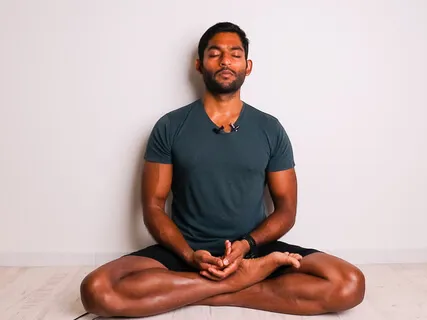
Let us close our eyes.
Take a posture that is comfortable with the spine erect.
Head straight,
Shoulders down.
And the body rested on its own weight.
Take a nice deep breath,
Inhale from the nose and also exhale from the nose.
And with that exhalation,
Allowing your body to rest,
Allowing your mind to settle,
To calm down and your awareness on your breath.
Your awareness focused on your breath without trying to change the flow of your breath.
The breath flowing in and out naturally.
You're simply observing the flow of your breath.
Establishing dharana,
Establishing the flow of uninterrupted awareness on your breath.
As the awareness settles,
Move closer to the breath.
Feel the breath along with being aware of the breath.
With every breath,
Aware and closer to the breath.
From dharana to dihana and to samadhi,
Being so close to the breath as if you're one with the breath,
As if you are the breath.
Now relax.
Awareness on the breath dharana moving closer to the breath in awareness dhyana and merging in the breath flowing in and out samadhi repeat these cycles reminding yourself of dharana being aware of the breath dhyana moving closer to the breath in awareness samadhi being one with the breath don't try to change anything don't try to force anything let the breath flow naturally and your awareness effortlessly becoming dharana,
Dhyana,
Samadhi repeat these cycles reminding yourself of the breath in awareness awareness of the breath moving closer to the breath merging into the breath repeating this process of samyama dharana letting go of all process allowing your awareness to be free,
To move,
To expand,
To rest,
At nothing in particular and a sense of silence arising in your being a sense of centeredness in awareness in awareness stay in this meditative silence as long as you like,
Or very gently and slowly you may open your eyes with me maintaining this sense of awareness,
Silence,
Centeredness and focus,
Not only in this moment,
But also taking this into your daily life please pass on this message of yoga,
Of Patanjali,
Of meditation to your family and friends thank you very much,
Namaste