Hi,
This is Dhyansi and you're listening to Dhyansi Meditation Podcast.
This meditation session was held on 3rd of September in Basel,
Switzerland.
Here I talk about the subtle energies that are present in our pranic body,
The eera,
The pingala,
The sushmana,
And how to achieve an inner balance.
Hope you enjoy the talk and the meditation.
Welcome to this Monday evening meditation session with me,
Dhyansi.
This session happens almost every Monday from 7 to 8 p.
M.
And I'm very glad to see there are people who are regular,
They have been with this group since its starting in January.
And those who are regular can see that we do not practice only one way to enter into meditation.
In every session we open up a completely new door into our silence,
Into our consciousness,
Into meditation.
So if some of you are here just for relaxation or you're here for more introspection,
For self-enquiry,
To understand yourself,
For spiritual growth,
Whatever your reason is,
There is something in it for you in this session,
Provided you're open,
Provided you're sincere,
Provided you're here.
For the next 60 minutes allow me to guide you in this subtle art of meditation.
Have you ever noticed that when you are in different situations of life,
Sometimes you're more creative,
Sometimes you're more analytical,
Sometimes you're more passive,
Sometimes you're more active,
Sometimes you're more introvert,
Sometimes you're more extrovert,
Sometimes you're more feminine,
Does not matter whether you're male or a female,
But sometimes you're more masculine,
Does not matter whether you're male or a female.
Has this happened to you as well?
Please raise your hands.
Why does this happen?
Do we understand that,
Why we as one single person behave sometimes very emotional,
Sometimes very rational?
What is this oscillation?
What is the swing?
What are these two forces?
What are these opposites that act in us?
We do not know.
Yet these forces,
They work undercover in us and make us do things,
Make us select things,
Make us decide for things and so on.
Today we are going to enter into a topic which is very intricate,
Very subtle.
It's Kundalini Yoga.
It's Swara Yoga.
These philosophies,
These concepts were designed thousands of years ago,
Even before when we had any instruments to actually measure anything.
How these sciences were developed in such sophistication,
Such intricate details is simply because those who developed these sciences were on a higher consciousness,
On a higher level of consciousness.
Today in science,
When we want to validate something,
We want that thing to be physical.
We want it to be measurable.
But before we did not want everything to be measurable.
We did not want everything to be physical.
So the consciousness in which these concepts were built,
That was somewhat different.
There was someone higher.
What we are going to discuss and experience and go into today,
You do not have to believe it.
Just take it as an assumption.
Take it as a concept.
Allow yourself to be open to the concept.
Maybe it just does not remain as a concept.
Maybe it turns into your experience.
So whatever goes through your consciousness,
Remain honest to that,
Remain open to that and see what happens.
For this session,
We are going to find this answer of why this swing is happening from A to B,
From emotional to rational,
From illogical to logical and so on.
Why is this happening?
We are going to find the answer to this in yoga,
In Kundalini yoga,
In Swara yoga.
There are two forces that are acting on us which we are not aware of.
They're a part of our system,
Whether we are aware of it or not aware of it.
In yoga,
These forces are known as Ida and Pingala.
This is a part of just a framework of understanding our energy system,
Our pranic energy system,
How our entire body,
Mind and all its energies are organized.
So take it just for the sake of understanding that all that is affecting the left side of the body is physically left side of the body and mentally the creativity,
The emotion,
The passive,
The feminine,
That all that force,
If you summarize that force,
You can call it as Ida for yoga.
And the right side,
Which is the male,
The aggressive,
The analytical,
The active,
All that force,
All that energy,
You can summarize this as Pingala.
This is the same in Chinese or Asian traditions known as the Yin and Yang.
In Hindu systems,
It's known as the Shiva and the Shakti.
And in many other systems,
If you see,
Even in Greek mythology,
There is the symbol of medicine which has these two snakes going all the way up and there is a sword in between,
Something like that.
This concept of these two different forces is there in all traditions,
All ancient traditions from the East to even the West.
And let us understand what these forces are,
How they are acting on our body.
These forces,
Ida and Pingala,
The left,
The right,
The creative,
The analytical,
They are functioning alternately in us.
They are in a certain dance,
In a certain harmony.
Sometimes Ida is leading,
More dominant,
Sometimes Pingala is leading,
More dominant.
When Ida is dominant,
You are more creative,
You're more passive,
You're more feminine,
You're more emotional,
You're more intuitive.
When Pingala is dominant,
You are more aggressive,
You're more analytical,
You are more male,
You're more rational.
And this shift happens in all of us,
Irrespective of male and female.
And if this balance,
If this shift from Ida to Pingala,
If this transition is not happening,
There is something somewhere wrong.
You feel not balanced.
You feel unwell.
And you don't know why you're not feeling well.
Everything is alright in your life.
You have everything that you want,
But somehow you don't feel good.
Somehow you don't feel well.
And it's not just a subtle inner feeling.
If this balance is disturbed,
You also have physical ailments and they can be traced back to the imbalance of Ida and Pingala in yogic systems.
So just for the sake of simplicity,
Remember that there is this dance,
There is this tango of these two forces that is going in our system from Ida to Pingala,
From right to left.
And this is in harmony with the existence as well.
Because in our existence also,
There are thousands of forces,
Cosmic forces,
Cosmic energies that are acting on us.
We do not really know how they act.
We cannot measure it,
But they are there.
In correlation to this Ida and Pingala concept,
You can just take the example of the lunar force,
The force of the moon is what is driving Ida and the force of sun,
The solar force is driving the Pingala.
In this balance,
Now if this balance is shifted,
If Ida is moving to Pingala and Pingala is moving to Ida,
There comes a point where they are in balance.
In this transition from Ida to Pingala and from Pingala to Ida,
There is a moment where none of the forces are dominant.
And when that happens,
A third channel opens up in our energy system which runs from the bottom of our spine to the very top on our head.
And that channel is known as Sushmana.
This is one of the goals of Yoga to bring a balance in these two energies so that you can channel your energy through the middle channel which runs in this column,
This vertical column through your spine,
Not present physically but on the level of pranic energy and the energies reaching to the top and all its implications,
All its descriptions which you read of illumination,
Of enlightenment and so on.
So this is one of the goals of Yoga where they use the mechanics of these two energies to somehow alter these energies,
Somehow play with these energies to create a balance between Ida and Pingala.
Now one small experiment you can do right now,
You can check your breathing and see are you,
Right now when you are breathing,
Is it equally coming in and out from both your nostrils or is there one nostril dominant than the other?
Just give it a try,
Check that when you are breathing right now,
Very normally,
Is there one nostril more dominant than the other or not?
Which one,
The right or the left?
The left.
For anyone right,
How many of you have the right nostril dominant right now?
How many of you have the left nostril dominant right now?
How many of you have it both in balance?
How many of you do not know what's happening?
So we try to today do those breathing techniques which were designed by these Yogis,
They are known as Pranayama in the science of Yoga.
Pranayama means prana,
The life energy.
Yama means to regulate,
To control,
To take charge of.
If you do not take charge of,
Then naturally they are in movement,
They are in natural order,
But if you take charge of them,
You can make things happen,
You can change these patterns.
Either you just leave them the way they are,
It's also fine,
There's nothing wrong with it or you can manipulate them for what you want.
And this science which now sounds all hookah-spokah was earlier not even taught to normal people because the normal crowd was never in that state of consciousness to be able to understand that and also utilize the implications of it.
This was such a secret science of Svarha Yoga which was only taught to the kings,
Only taught to the scholars,
To the learned ones because you can utilize it for the good and you can also utilize it for the bad.
Just not for yourself but for the others.
So what we are going to do today is very very light glimpse of what this could mean for your balance.
What we aim for in these practices is the sense of balance,
Is the sense of centering,
Is the sense of harmony that arises when we are balancing the Ida and the Pingala,
The right part of the body and the left part of the body.
When we bring a balance to it,
You will see that you will naturally feel more meditative,
More silent because your energies start to flow through the middle channel and when that happens you sit in silence,
You enjoy that silence,
You enjoy that bliss for as long as you want.
How are we going to do this as a meditation technique?
What are the steps?
The first step is we will activate this prana energy through each of the channels.
So listen to me very carefully how we are going to do that.
If it's unclear,
Ask.
Once it's fully clear,
Then we will do this together.
I will guide you through this step by step but right now let me just give you what we are going to do as all these steps so that you understand them fully before you do them yourself.
So as a first step,
We are going to take our right hand with the thumb,
We are going to close the right nostril and just breathe normally 10 breaths with our left nostril.
And then we are going to close our left nostril and then just breathe from the right nostril 10 times as normally as you always do.
There's no need to alter the pace of it,
There's no need to modify the breath.
The only thing that you're modifying is that you're either breathing only from the left nostril to start with 10 breaths as a second step,
Breathing from your right nostril 10 steps or 10 times as a second step.
In the third step,
What we will do is what is typically known as alternate nostril breathing,
Where we will close the right nostril with the hand with the thumb and breathe in from the left nostril and then close the left nostril and breathe out from the right nostril.
That's half the cycle.
And then we will keep the left nostril closed,
Breathe in from the right nostril,
Close it and exhale from the left nostril.
So there is a very nice cycle from left nostril to right nostril to right nostril to left nostril that is known as alternate breathing.
This establishes a certain harmony between the eera and the pingala,
These two different forces in you.
We will do that for a few minutes.
And once we have done that mechanically,
We will put our hands down and we will try to do this without using our hands,
Which means we will try to use the power of our mind to simulate this.
To imagine that you're breathing from the left nostril and then you're only exhaling from the right nostril and then you're inhaling from the right nostril and going back exhaling to the left nostril.
If you cannot do it,
It's absolutely fine.
Nobody can do this in the first go.
But try it.
Don't stress yourself about it.
If it does not happen,
Keep this in your awareness.
Keep this in your imagination that you're breathing only from the left nostril.
You inhale and then exhaling from the right nostril.
Then you inhale from the right nostril and exhale from the left nostril.
So we'll do this for a few minutes,
Maximum five minutes.
And then we will also leave this process of alternate nostril breathing.
As a fifth step,
We will keep our awareness on the nostrils,
On the nose,
On the nasal cavity and just very softly,
Gently try to make sure that we are breathing from both nostrils at the same time.
If it's not happening,
Absolutely fine.
If it's happening,
Keep maintaining that breathing from both nostrils at the same time.
Few more minutes,
We will stay in this awareness,
Stay in this somewhat of an effort to make sure that we are breathing from both nostrils at the same time.
And you'll see that there will be automatically your nasal cavity will open up and you will feel that the air,
The breath is coming from both nostrils at the same time.
Again,
I'm repeating myself.
If it does not happen,
Nothing has gone wrong.
It's absolutely fine.
Just keep on breathing on a normal pace,
On a very rhythmic,
Smooth pace as you always do.
Once you have gone through this exercise,
It will be almost 10 to 15 minutes.
And then for the rest 10 minutes,
We will sit in silence,
In complete silence,
Enjoying this,
The effect of what has happened after this breathing exercise,
The silence that it has created in us,
The meditativeness it has created in us.
Any questions how we're going to do this?
Is it clear?
All right,
Then let's start the breathing technique.
Before that,
Please close your eyes.
Keep your back straight,
Shoulders down,
And your body nicely relaxed to enter into pranayama.
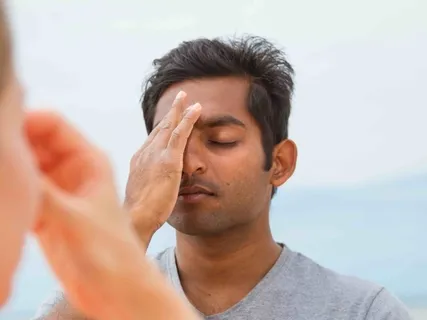
Now raise your right hand and close your right nostril with the right thumb.
And just breathe in and out with your left nostril.
If you want to keep a count,
We'll breathe 10 rounds just with the left nostril.
Take a nice deep breath in and out from the left nostril.
Take a nice deep breath in and out from the left nostril.
Two more breaths.
And now open your right nostril and close your left nostril with your fingers.
Breathe in and out from your right nostril.
All your awareness and attention on your breathing.
And nicely breathing in and out from your right nostril.
Three more breaths.
And put your hand down.
Allow your breath to settle,
To reorganize,
To find its own pace.
While you remain aware of the rising and falling of your breath.
Your body has nicely settled in.
And you can move on in this pranayama.
Take your right hand up again.
And we're going to start alternate nostril breathing.
Breathe close the right nostril first.
And breathe in from the left nostril.
And then close the left nostril,
Open the right nostril,
And exhale from the right nostril.
And then inhale from the right nostril.
Close the right nostril.
From the left and exhale.
Inhale from the left.
Close it.
Open the right.
And exhale from the right.
Again inhale from the right.
Close the right.
Open left and exhale.
Now do this at your own pace ten times.
Full cycles of inhaling from the left.
Closing,
Exhaling from the right.
Exhaling from the right.
And exhaling from the left.
Keep on doing these cycles at least ten times at your own pace.
With every breath,
Allow yourself to settle in these cycles.
Keep all your awareness on these cycles.
If your hand feels tired,
Bring it closer to the body and do a few more rounds.
And finish off your cycles with exhalation from the left front.
Left nostril.
Once you have finished your cycle,
Put your hands back in your lap or on your thighs.
And try to mentally continue these alternate nostril breathing.
Feel that you're breathing in from the left nostril and exhaling from the right.
And vice versa.
Keep the rhythm of your breath relaxed,
Gentle,
Soft and natural.
Keep on making these imaginary cycles and let your breath follow along.
IX The pace of the breath,
Gentle and normal.
And your full awareness on this imagination that you're breathing from alternate nostril at your will.
Keep your face relaxed and continue these cycles.
Let them become more smoother,
More natural.
And very slowly allow these cycles to fade.
With every cycle,
It becomes less and less.
And you're only left with breathing from both nostrils.
Keep your awareness at both your nostrils.
And feel the air flowing in and out through both your nostrils.
With every breath,
Let go of everything.
And just remain aware of your breath flowing in and out of both nostrils.
Allow yourself to find the center,
This balance that your breath has taken.
Maintain this sense of balance,
This sense of centeredness as you keep on breathing in and out from both nostrils.
Let go of everything and keep your awareness on your breath.
Let go more and more in this centeredness.
In this balance,
In this harmony,
In this silence,
Keep on breathing in and out.
And out.
All your energies are in harmony and settled.
No more movement.
Simply stay in this silence,
Remaining aware of your breath.
Now you will leave the breath.
Just remain aware of yourself.
Allow everything to happen on its own accord.
While you simply remain silent and aware for the next minutes.
Don't touch anything.
Don't touch your body.
Don't touch any thought.
Remain silent.
Don't touch anything.
This is the moment of silence.
Go into it.
Stay in it.
Stay in it.
Just like this.
And bring your awareness back to your breath.
And watch it rising and falling as you breathe in and out.
And very gently and slowly,
You may open your eyes.
Looks like today you wanted to stay a bit longer into the silence.
I made sure that in today's session we do not stretch like in the last one.
I think in the last one we were sitting in silence for 40-45 minutes,
Which was not the easiest for everyone.
So,
In this session this was a glimpse of how you can use the breath to come back into the moment.
Bring back your energies in harmony.
When you do that at home,
You can sit longer after the session,
As long as you want,
For another half an hour.
And go deep into silence.
This is one of the best ways to prepare your body and mind to enter into meditation,
To enter into silence.
And otherwise as well,
When you are feeling anxiety,
When you are in a situation where you are fearful,
Nervous,
Anything where your energy system is in turmoil,
If you do this pranayama,
It brings you back to your center,
It brings you back to where you should be.
Any questions?
I didn't find it actually working.
What's your thought on that?
Yes,
I told you before as well.
So,
The question is that she did not find it working,
That one of the nose nostrils that were blocked mentally could not open those blocks.
I told you before that it will not happen immediately,
That you could mentally control this kind of a system in your body.
If it does not happen,
As I said,
It's absolutely fine.
But if you practice this,
That much I can promise you that it will start happening.
But it takes a bit more practice and for now what you could do is you could just use your hand to forcefully clear up your nostrils.
Don't push it too hard if you are having cold or for some reason your nasal cavity is blocked,
Do something else.
It seems like in the sinus,
It's nothing but like forced out or something.
If this is something which is not naturally coming to you,
Then there are so many other ways.
Do this when your nasal cavity is clear,
There is no physical reason why you shouldn't be doing this.
Anything else?
I have some questions about left and right.
So it's the whole right side including the right brain,
The masculine side and the right side.
This concept is also somewhat,
When you go into these theories that are there for the right hemisphere and the left hemisphere of the brain,
It somewhat correlates to that theory which means that when you are either the left part is active,
That your right hemisphere of the brain is more active,
More dominant.
So it's actually crossed.
I do not see any reason why we need to map this to the brain.
Just the fact that your right side or the left side is more dominant and a certain characteristic in your psychology is also dominant in a certain situation is to me kind of a proof enough that at times one aspect is more dominant and other times the other aspect is more dominant.
In yogic research,
They even put up an average time to that.
They said on an average,
And this is dependent on the person,
This is dependent on the situation,
On the season,
On many,
Many,
Many different things,
But on an average,
This shift happens every 90 minutes.
So every 90 minutes you're breathing more dominantly from one of the nostrils and your characteristic,
How you're functioning,
What you're bringing in,
What you're psychologically bringing into that moment is changing every 90 minutes.
And if you are curious enough,
You can bring,
You can plot this data for yourself just for 24 hours.
See when is it changing.
It could be every 90 minutes.
It could be changing every two hours.
It could be changing every half an hour or never changing at all.
Try to just for one day,
If you have time,
If you're curious enough about this Svaraj yoga,
Put yourself on a paper,
Just the time and every hour or every two hours,
Make a note which nostril is more dominant and see if there is an alternate nostril that is becoming more dominant.
And when that happens,
You can utilize this to different situations.
In situations,
And now this sounds an overstretch of the concept,
But if you want to be more creative,
If there is a moment where your creativity is more needed than your analysis,
Try to change your breath or try to activate your breathing from the left nostril and see if there is a slight difference in how you're feeling about the situation,
How you're psychologically into the situation.
Just experiment with it and don't need to believe any of these things unless it becomes your own experience.
It's actually quite interesting because it does correspond to the Chinese meridian system.
Like every two hours,
You alternate between the young meridian and the young meridian of each pair.
That's the same concept.
These things are not created,
These are more coming out of the observation of human system,
How energy system is behaving and all these indifferent traditions have been,
Same realizations have been made and sciences have been developed on top of that.
Actually the scientific concept of sleep cycle is between 90 minutes or 70 minutes to 120 minutes and young people,
And it runs through the day as well.
And maybe last comment on that,
For meditation,
Why we say dawn and dusk are the best times for meditation is exactly because of this reason.
Because when there is dawn or dusk,
When there is neither day nor night,
When there is this transition,
Like right now,
Or in few minutes when there is neither day nor night,
In this transition,
Your body is also shifting gears from earder to pingala,
But this gear shifting,
This neutral point is much longer,
There is this moment where you feel much more at peace.
It's not because you came back from office and now everything is done,
It's because of this transition between day and night that you,
In those moments,
You feel more silent,
More meditative.
You can go more consciously into it,
You can elaborate this further by doing pranayama,
Which is a very very easy process,
A very easy exercise.
Anything else?
Otherwise I will close the session.
Alright then,
Thank you very much for joining me in this session.
You guys are an awesome group.
I have done many many groups,
Meditations in different locations.
I have never come across a group with such an energy.
I personally enjoy doing this with you guys and I hope it's also bringing you something.
So see you next time once again next Monday.
Thank you.