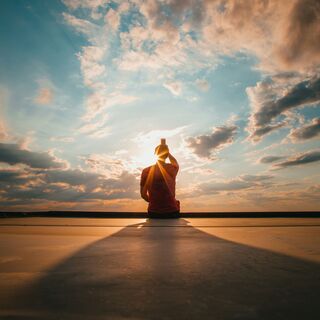
Welcome to today's meditation.
We're exploring the practice of letting go of time.
Letting go of tracking minutes.
Letting go of past stories.
Letting go of imagining ourselves in the future.
Instead,
We'll practice touching the timeless part of ourselves.
The part of us that is beyond schedules,
Beyond clocks,
Beyond thought.
This is the timeless part of ourselves that is always present,
Always watching.
Let's begin.
Take a moment to find a comfortable meditation posture,
Whether you're seated in a chair,
On a cushion,
Lying on the floor.
What matters is that you find a position where you are comfortable,
Supported,
And relaxed.
Where you can remain alert without straining.
And when you're ready,
You've found that position,
Go ahead and gently close your eyes.
Let your hands rest naturally on your lap,
By your sides.
Take a moment to notice where you might be holding onto some tension.
Your brow is furrowed.
Your jaw is clenched.
Your shoulders are pulled up.
Wherever you might be holding on to some tightness,
Where you might be gripping,
Allow those parts to settle and release.
And then bring your awareness to your breath.
Notice the in-breath and the out-breath,
The rise and fall of your chest,
Rise and fall of your belly,
Cool air entering through your nose,
Warm air leaving.
And when we first begin meditating,
The start of each session,
Our breath can be a bit choppy or rapid,
Or we control it a little bit.
And see if you can just let your body breathe on its own,
Allowing that air to move in and out of you without any effort.
And that same lack of effort,
We're now going to bring to our sense of time.
And you don't need to keep track of time.
We often do,
Even when meditating.
We pick a meditation that's a certain length of time,
Fitting it into our schedule,
Our constant awareness of the clock.
And when we meditate on the breath,
Letting go of thoughts,
We're also teaching our minds to let go of time,
To just rest in the present without being aware of how many seconds or minutes have passed.
And as your mind wanders,
Which it will,
To the past,
To memory,
To what you were doing before this meditation,
Which is the future,
Whether that's what you're going to do right after this meditation,
Later in the day,
Big picture questions about your life,
Let go of your clock.
Let go of your calendar and the to-do list.
Let go of the question,
How long have I been meditating?
How much longer is this going?
Just notice your mind's desire to know time,
To keep track of time.
And how anxious or agitated or active it can become when it can't keep track of time.
And that's what your mind always does,
Tries to keep time,
Tries to keep busy,
Filling it with stories.
The mind really doesn't like empty time.
And when your mind wanders,
Just gently coax it back to the breath,
Letting your breath be its anchor.
And then when you notice the breath,
The sensation of your chest or belly rising and falling,
The sensation of the air moving in and out of your nose,
Do your best to simply be with those sensations.
Don't count the breath.
Don't use it to keep track of time.
Just feel,
Rise and fall,
In and out,
Cool and warm.
When are you now?
The question might seem like a paradox.
I didn't ask you,
Where are you now?
I asked,
When are you now?
Are you in the past?
Are you in the future?
Are you in the present?
We're trying to figure out,
How much longer is this meditation going to last?
The longer we spend in silence,
The more our minds are going to want to work with that emptiness.
Begins to feel bored,
Restless.
But if we continue to practice,
The mind can settle.
This is what the breath offers.
Very gentle,
Natural pleasure,
That rise and fall of the chest,
The air moving in and out of us.
Feeling that sensation,
That calmness,
Comfort,
Can help quiet the mind.
And we're going to remain in silence for some time.
Now,
Returning your awareness to your breath,
To your body,
To the room you're in,
To any sounds in your environment.
Take a moment to notice how your body feels.
Take a moment to notice how much your mind wanted to fill that silence with stories.
And what kind of stories?
Notice the stories had a theme.
Theme was worry,
Entertainment.
It's a moment to just get to know your mind,
And then set the intention that you can reflect on that and explore that later.
We'll go into our final moment of silence,
For the next several minutes.
And notice what your mind does,
Knowing that the end point is coming.
But there are only a few minutes left in this meditation.
And if that knowledge can help it relax and be at peace.
Again,
Bringing your attention back to your breath,
Noticing how much your mind has wandered,
All of which is perfectly normal.
Maybe for a brief moment,
Your mind was at peace,
Not filled with stories,
Not tracking time.
Or you caught a glimpse,
That timelessness,
That timeless part of you within.
We'll take a moment to reflect on how your mind has evaluated your meditation.
Is it telling you that you did a bad job,
That your mind wandered a lot?
You were really fixated on time.
Is it praising you and telling you what a good job you did of letting go of time?
Our minds love to evaluate our meditation practice,
When all that matters is that we did it.
And as we come to close,
Take a few deep breaths.
Begin to revive your body.
Deep breath in and out.
Another deep breath in and out.
Take one final deep breath.
And when you exhale,
Gently flutter your eyes open.
Come back into your room,
The space around you,
And be present.
You've just spent time cultivating a space beyond time.
You might not feel like you've left time that you let go,
But you began that work.
Let that sense of timelessness stay with you,
Even as you go about your day,
Carving up time with your clock,
Your calendar,
Your to-do list.
And see if throughout your day,
You can just pause briefly and let go of time,
Even for just a few seconds.
Thank you for joining me for this meditation.
If you'd like to continue practicing together,
Please just join me again in the future.
Until next time,
Take care.
You