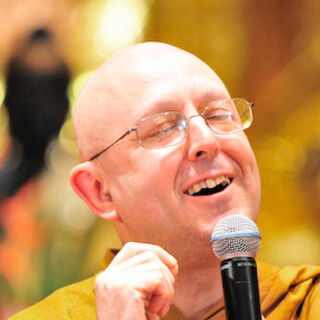
So you get yourselves comfortable.
Today is another meditation afternoon for those who have meditated before.
If you come here for the Beginners' Introduction to Meditation class,
Actually I think I recognise everybody here,
You're all the old-timers,
But if you come for the Introduction to Meditation class,
That is the room on my right.
This is for those who have meditated before,
Because we do about a 45-minute meditation later on.
Please make sure your mobile phones are turned off,
So it's nice and quiet.
Even though we ask people to do this and we turn off the mobile phone,
There's always a dog which barks or somebody starts their lawnmower or some kids start their radios or CD players or whatever.
There's always noise no matter where you go,
So it's important to be able to learn how to deal with the distractions which happen in meditation from time to time.
The most important thing with distractions is that usually we take that distraction,
We give it an importance which it does not deserve.
Whatever you value and think is important takes centre place in the screen that is your field of attention.
So if you can imagine that English phrase,
Having a field of attention,
Whatever you value actually takes centre stage.
By saying value,
Whatever is most important,
So if you do hear the sound of a dog barking or the sound of somebody moving or whatever,
If you really think that's important,
If that becomes a problem,
It becomes the centre of your field of attention,
That's what you really focus on and everything else falls away,
Which means you lose your way in meditation.
By giving it value it has become a distraction.
However,
If you gave it no value at all or gave it limited value,
If whatever else you were watching was more important,
Then you wouldn't hardly hear the sound of the dog.
Just saying this to a couple last night,
He was saying,
Oh,
His mind was so restless,
He couldn't focus on his breath when he meditated and because he was a Sri Lankan,
I said to his wife,
Does he like watching the cricket?
And of course it was a pretty good gamble that he does because most Sri Lankans love the cricket.
And so he said,
Yeah,
He's always watching that cricket.
And he said,
When you go and talk to him during the middle of the game,
Does he pay you any attention?
And she glared at him and said,
No.
And the reason is because once you're watching that cricket,
You're just so absorbed in what's happening,
You give that so much value,
You just can't hear your wife or you can't hear the telephone ring,
You can't hear the dog bark when you're really engrossed in that cricket match.
Now that was just an example of what we mean by focusing and how to overcome distractions in one's meditation.
If you were meditating,
You had enough focus,
The same degree of focus as you do when you're watching a favourite movie or a football match or whatever else you like to watch on that TV,
If you had the same amount of attention and involvement in what you were doing,
Then you just wouldn't hear the dog,
You wouldn't hear the neighbours,
You wouldn't hear anything.
In fact,
If you were really involved with the meditation,
You wouldn't even feel the aches and pains in your body.
So what we're saying here is that one of the ways to focus in meditation is to give the object of meditation great value and take away the value from other things.
So what does that mean in practice?
It means you start meditating and what I have been doing recently is just to do a quick body sweep before you even start on present moment awareness and give that value,
This is important,
You want to do this,
You have to do this.
And if you do that body sweep meditation,
Feeling the sensations in your body and you really think that's important,
You'll find you won't hear anything else,
You won't get distracted.
You only get distracted if the source of the distraction gets more value than what you were doing beforehand.
So you put value into this,
It's important to relax the whole body.
And one of the reasons it does work is because people are very conscious of their physical health these days and because physical health is important,
It's high on the agenda of people,
The very fact that you're relaxing and dealing with the well-being and health of your body gives it extra importance,
Gives it high value,
So when you're feeling the sensations in your body,
It's a high value activity,
It's important for you.
So you tend not to be distracted by the sounds outside or you don't be distracted by all the things you are to think about later on,
All your problems and concerns because the body is important,
I'll put off those concerns till later on,
Your mind doesn't wander because body awareness is given high value.
And then when we start to go to the deeper stages of meditation,
We start to do present moment awareness right now,
Hopefully by the time you've done a little body sweep that you really are in the present moment and the present moment has high value for you.
It's part of my job to try and market the present moment,
To say how important it is,
How valuable it is,
Because if the present moment is very valuable for you,
Then of course you won't be distracted by the past and the future.
Same with the next stage of silence.
The only reason why thoughts invade the mind and remain,
Why you keep on thinking of so many things,
Is because you assume those thoughts are important.
You give them a value they don't deserve.
So this is really an interesting thought,
I must follow this,
I may get a solution to my problems.
You give thinking far,
Far too much value.
So instead of giving value to the thinking mind,
You give value to the quiet mind,
The silent mind,
Which is why I do all these little techniques to try and get you to understand what silence is.
So you value it,
It becomes a high value experience.
And when you really value that silence,
The thoughts just can't come in.
No more you can hear your wife,
When you are watching a movie,
No more you can hear the dog,
When you are really reading an important book,
When you are really right there,
Because this thing you are doing is high value,
Other stuff just fades away.
So you give high value to these things.
When you go into something like the breath,
Again,
If you go to the breath too soon,
You say,
What's the big deal about the breath?
It's just an ordinary thing,
It's got no value to you at all,
Which is why when people start to watch the breath at the beginning of meditation,
Maybe they do it for one or two times,
Then afterwards,
The thoughts,
The feelings,
Aches and pains,
Conversations happening around them are more important,
So that's why you wander off from the breathing.
But if you give the breath very,
Very high value,
This is really important,
Then you find it's easy to stay with the breath.
That's why people in very difficult situations,
Say you are going for an interview,
Or you've just been told you've got cancer,
You're having an operation,
When it's really important you meditate,
You find you can meditate.
When the activity is given high value,
It's easy to do.
So understand this,
The value systems which we have in our mind,
Dictate what our mind pays attention to,
Not what we want to do,
But what we give value to.
Then you have a good idea of how to stop the mind from missing out on the beautiful,
Peaceful path of meditation.
You give value to what's going to give you peace.
So the very beginning,
It's important to give value to the body sweeping,
To make sure the body is nice and relaxed,
Then you give value to the present moment.
It's important to be now.
Forget about the past,
Now is the place where the future is made.
Give value to this moment,
It's important.
Then the present moment will stay.
Give value to the silence of the mind.
Silence is golden,
And gold,
The price of gold has gone up so the newspapers say.
So silence is very,
Very valuable.
And you should know that because,
Gee,
We go crazy with how much we have to think about.
And just the beauty,
The peace,
The wonder of silence,
It is such a valuable,
Valuable,
Valuable thing.
So when you give value to it,
It will stay with you.
And when you start watching the breath,
It's important the breath is what feeds you the oxygen which gives you life.
It takes out all of the waste products of the respiratory system.
And it's also a pathway which has been used for 25 centuries to deep stages of peace for fulfilment and insight.
So when it's really important to you,
In other words,
You give it value,
It's easy to do.
So in each stage of meditation,
Remember to give the object of meditation value.
And then you find focusing is so easy.
So there's another little trick of how to meditate,
How to become enlightened in 12 easy lessons.
Well,
Maybe 12 easy months,
Well,
Maybe 12 easy years,
Or at least 12 easy lifetimes.
Being Buddhist and believing in reincarnation,
We're very,
Very patient.
So any comments or questions about that before we set off on our journey into inner space?
Oh yeah,
Ah.
Okay,
Well first of all,
Just remember all the thoughts you've been thinking about all your life.
And if they ever got me anywhere,
They usually get me into trouble more than anything else.
And they're just so burdensome of having to think about these things.
So first of all,
You see the danger,
The negativity,
The problem of thoughts.
That's why many people actually come to learn meditating because they know they think too much and get so stressed out,
Get so angry and get so crazy.
So first of all,
See the negative side of thinking.
And it never really gets you into any insight,
Not any real deep knowledge or wisdom.
It's always superficial.
And then,
Experience and notice the beauty of,
And the peace,
The happiness,
The silence.
Unfortunately in our modern societies,
Times of silence are very rare.
So you forgot how beautiful,
How wonderful,
How refreshing silence is.
Having a moment of peace reminds you from your own experience,
How silence is just so important.
So use that double strategy,
By undermining the value of thought,
By remembering just what thought ever got you,
What's it done for you,
Has it really ever given you anything really,
Really worthwhile?
And then counterposing that with what silence has meant for you,
And how wonderful that has been.
Another sort of very fascinating point is that you usually get many more insights,
You solve more problems from a place of silence than you ever do through thinking things out.
You know what it's like,
You've got a problem,
Something to solve,
And you think,
Think,
Think.
Usually it goes around in circles,
You know,
Sometimes it's promising,
It looks like you're getting close to some solution to the problem,
But you never really do.
If you're just quiet and silent,
Trusting that silence,
It's amazing just how insights come up.
Just like me on a Friday night,
You know,
You've got to give another talk.
And I don't know how many talks I've given here,
And they're all put on the,
On recorded.
So many of you have heard all these talks,
So you've got to try,
I've got to do something new,
Something different,
Or rearrange something.
But I always know that if I start thinking about what I'm going to talk about,
It's just a waste of time.
So I always like just to make my mind very peaceful and silent.
From the side of it,
You get much better insights coming up.
So for me,
Silence is the best problem solver,
Not thinking.
So that's why I really value silence.
So that's the two things there.
First of all,
See the negative side of thinking,
And see the positive side of silence.
Does that make any sense,
John?
Okay,
So now we can go into the world of the silent mind.
So if you're not sitting down already,
Please sit down,
Please wiggle about,
Fidget,
Scratch,
Whatever you want to do,
Cough,
Yeah,
So you can get into a calm,
Peaceful,
Beautiful posture before we begin the meditation.
Okay,
Once again,
And I think you're all here,
If anyone has come for the introduction to meditation class,
That's the room on my right.
We're going to sit now for about 45 minutes.
So when you're ready,
Just close your eyes.
And with your eyes closed,
Bring attention to your body.
We'll do a quick body sweep first of all.
Start with your toes.
How are your toes feeling now?
If you'd like to wiggle them,
If you can't feel any sensations there,
Or press them against the floor,
So you can get a connection between you and that distant part of your body,
Your toes,
Until you can notice the sensation of the furthest part of your body.
Once you have awareness of a sensation around your toes,
Then send kindness down to your toes.
Send compassion,
Loving kindness,
And feel that sensation relax,
And have a greater sense of ease.
And you feel that as the sensation changes subtly,
It feels more calm,
More relaxed,
More open,
More soothed.
You added kindness to your awareness of your toes.
Then you move up to the foot,
Soul,
The uppers,
The bones,
The muscles inside your foot.
You contact any sensation there.
Can you feel anything down there?
Once you have contacted the sensation,
Send loving kindness.
May you be at ease,
May you be comforted,
May you relax.
And with that intention of kindness,
The result is sensations again change,
As they begin to tell you that things are relaxing and calming down.
And you go around the heel to your ankles.
You can go slower if you like,
But I am just going through this reasonably quickly today.
Feeling any sensations in the heels and ankles,
The back of your feet.
When you notice a sensation there,
It means you have made contact.
Add kindness,
And relax all the feelings,
All the sensations until the feet are like tingling with comfort,
With warmth,
With ease.
The closest description I can give is a feeling when you wake up in the morning after a good night's sleep,
Cozy and comfortable.
Now the whole of the bottom,
The whole of your feet feel like that,
At ease and rested.
As you move your attention,
Inch by inch,
Up the lower leg,
Noticing the sensations as you go up the leg,
And adding kindness,
Which is the ingredient which relaxes and soothes and comforts all the muscles,
The blood vessels,
The bones,
The skin in your lower legs.
As you are doing this,
You are building up your awareness and your ability to relax through kindness.
You don't leave that part of the body until you feel it is relaxed to the max.
Because this is an important thing which you are doing,
You find you do give it value,
You find you are focusing on this activity,
You can hardly hear the noise around you.
There is not many thoughts in your mind because this,
Relaxing the body,
Is more valuable.
You feel those sensations in the lower leg until you can move up towards the knee.
Many people have knee problems because we don't give these parts of the body quality attention.
Now with your knee,
Notice any sensations there.
Don't try and give the sensation a name,
Just feel something around that area.
Then send it kindness and care and comfort.
Feel the sensations relax.
Through the feeling you can know that part of the body is actually relaxing.
That your kind energy is going down to that part of the body.
Soothing and comforting everything.
Stay with the sensations in your knee until they are tingling and warm and fully relaxed.
Then you start moving up your leg,
Your upper leg,
Your thigh,
With so many muscles which do so much work.
You are beginning to sense the sensations.
What does it feel like in your legs?
In your upper legs?
When you contact any type of feeling or sensation,
Add the kindness and the whole sensation will show you the muscles,
The skin,
The bones are all relaxing.
Opening out,
Expanding,
Like the thighs are sinking into the softest of cotton cushions.
With no pressure or tension on them at all.
So if your whole lower legs and upper legs are all relaxed and at ease.
Now you build up your awareness and your kindness to start working on the more important parts of the body as you go up to your bottom,
Noticing the sensation,
Being with that feeling and being kind to it.
Allowing the mind to instruct the muscles how to relax and be more at ease.
Then you go to your waist.
It's not just the area on the outside of the waist,
All the organs,
The colon,
Other things inside that part of your body.
What feelings and sensations can you pick up from your waist area,
Both on the surface and inside?
When you've contacted a sensation,
Add kindness,
Metta,
Just like a mother looks down on her sick child.
The child feels better just because of care.
You find a feedback mechanism where the more care you give to those feelings around your waist,
The more you feel relaxed.
So the more you add care until you've relaxed so much.
That area tingles with comfort.
As you stay in that lower part of your torso,
With mindfulness and kindness,
Relaxing all the feelings before you move up the body to your kidneys and liver,
The intestines.
You move up slowly,
You pick up sensations and you add kindness.
It's important that you care for your body,
Otherwise it causes you many sicknesses,
Much pain and discomfort.
Now you're deliberately pausing,
Contacting any feeling.
If you can't contact a feeling,
You can almost imagine something there.
Once those lines of communication have been made,
Then you can be kind,
Be soft,
Be gentle,
Wishing that part of your body be at ease,
Comfort and health.
You feel that part of the body,
Again start to relax and be at ease.
You don't have to do this just because you're sick.
Even when those organs are healthy,
You still benefit from kind attention.
You move further up the body,
Past the lungs and the heart,
Noticing any sensations there,
Adding the kindness until you learn how to relax,
Relax a specific part of the body.
You feel it relaxing,
You feel the sensations become more peaceful,
More calm,
More easy.
You recognize what relaxation feels like.
You pause there,
Enjoying the feeling of comforting your body.
This is important,
It brings you health.
You move up the attention to the shoulders.
Can you notice any feelings in the shoulders?
Whatever sensations you notice there,
Add compassion.
Feel everything relaxed.
Come to deeper sense of ease.
You move down your arms,
Your upper arms first of all.
Don't go too quickly,
Can you feel any sensations in your upper arms?
After a while you get good at this,
Picking up sensations where you hardly ever thought any feelings were.
Noticing those feelings,
Sensations,
Calming them by caring for them.
And even places like your upper arms which you think are not important,
They relax and feel at ease.
And your elbows as you go down your arms.
After a while of practice you can feel the sensation which is located around the elbow area.
You have to notice the sensation first before you can do anything.
Once you have the sensation,
You have a measure of comfort.
And you notice by just a small amount of care and kindness that comfort grows deeper,
More ease,
More peace.
So go to your lower forearms.
You feel the sensations here.
Comfort them,
Care for them.
And to the lower part of your arms you feel so nice,
So warm,
So cozy.
Until you go to your hands and your fingers.
There are so many nerve endings there it is so easy to pick up feelings and sensations around your hands and fingers.
Now you have made a bridge between your mind and that part of your body.
Along that bridge,
Over that bridge,
Send kindness.
My hands,
My fingers,
I wish you well-being.
And feel those sensations relax.
Feel the ease and comfort.
How to improve them and how to relax these parts of the body.
You go back up to the shoulders.
There is a great seat of tension there.
So notice sensations there.
Having noticed the sensation for a few seconds,
Send kindness to those muscles once more.
To the whole upper body and arms you feel so comfortable,
You relax them all.
And then you go up your neck.
You may have an irritation in your throat from a cough or soreness or whatever.
Whatever sensation,
Even if it is an unpleasant sensation,
Stay with it.
Be kind to it.
And the chances are it will relax.
With mindfulness and kindness you learn what relaxation is and how it happens.
I like to expand those sensations.
Having a bit of an itch on my throat right now.
I expand it.
And the bigger it gets,
The less irritating it feels.
It is like evaporating a drop of water.
Expanding it until it can hardly be seen.
When it is concentrated at a point,
That is when it is hard and a problem.
Moving up to your face,
What sensations can you pick up around your eyes and your mouth and nose?
Add kindness to those feelings.
So your whole facial muscles all relax.
See how relaxed those muscles can become and what that feels like.
Now you can go inside to your brain.
Apparently the brain has no sensations but just imagine them.
Imagine a feeling in your brain.
Calm that feeling down.
Add kindness because your brain works so hard.
You just give this beautiful compassionate energy to your brain.
You feel a greater sense of mental relaxation.
Now feel your whole body completely relaxed as much as possible.
Feel it tingling at ease.
Through this exercise not only have you relaxed the body,
You have also learned how to focus in the present moment.
Learn how to not be so caught up with your thinking mind.
Just with this body and its feelings.
Now don't give importance to the body.
Now your importance is just with this present moment.
Whether it is the sound,
Feeling in the body,
Whatever is happening now,
Contact it with your mindfulness so you know this moment and then send kindness to it.
Be kind to whatever you are experiencing now so the experiencing of now relaxes and becomes comfortable.
Just being in the present moment and being kind to this moment.
Valuing the importance of now.
And also value the importance of silence.
You don't need to think.
Instead notice the space between your thoughts.
Recognize it.
Be familiar.
To your ease with no thinking,
With no words.
Bringing kindness to the silence.
Attacking in the importance.
Thank you.
.
.
.
.
.
And when you are ready,
You can pick up your breathing.
What's the feeling which tells you the breath is going in?
Or the feeling which tells you the breath is going out?
You contact the feeling of the breath.
Once you have contacted that feeling,
Add kindness,
Add metta,
So the feeling of the breath relaxes in the same way you relax your body.
.
.
.
.
.
.
.
.
.
.
.
.
.
.
.
.
.
.
.
.
.
.
.
.
.
.
.
.
.
.
.
.
.
.
.
.
So how do you feel now?
Towards the end of the meditation period.
How does the meditation work today?
This is a time to review all that's happened.
Especially to know what works and what it feels like.
To have a degree of peace,
Freedom and kindness inside your heart.
.
I'm now going to ring the gong three times.
Please listen to every sound from the gong.
And only when the last ringing of the gong fades away,
Only then come out from your meditation.
.
.
Here we go.
So every Saturday afternoon try and add something more,
A little bit different.
So that when you go home and meditate at home by yourself,
There are a few more little techniques,
A few more tricks of the trade,
A few more different ways of adding and enhancing to your repertoire of meditative skills.
So you just become like this person who goes to training to enhance their skills.
So they become much better at their job.
But here their job is actually learning how to relax.
First relax the body and using the similar skills to relax the mind.
Even little things like learning how to be kind to your breath,
Adding that kindness makes a huge difference.
So the breath starts to feel really nice and peaceful.
And when it becomes peaceful it's easier to give it value.
Because what's nice,
What's enjoyable,
It obviously has an intrinsic value.
And after much meditation,
When you learn just how important meditation is,
Now just a few moments of peace,
It's not a waste of time but it's an investment.
It's resting the brain,
Resting the body,
So you don't have to waste so much time.
Either with sickness or with the mental agitations which cause so much social and personal problems in your life.
So half an hour,
Forty minutes meditation saves hours and weeks later on in your life.
Or later on in your day.
So never think of meditation,
Yeah I haven't got time to meditate.
If you are a busy person you can't afford not to meditate.
In other words you need that skill of being focused,
Being rested.
Otherwise you just burn out and get angry and upset and get sick.
So the more busy you are,
The more you think you haven't got time,
The more important it is to meditate and learn how to rest.
So use your body and your mind more efficiently.
Okay so are there any comments or questions about the meditation we did today?
Yes?
Inaudible Inaudible Yeah you just,
Well you're picking all that up?
Very good,
Excellent.
So I don't have to repeat the question,
It's nice.
It's in a very profound sense,
Whatever you are experiencing in that moment,
That's what you are.
So when you are thinking you are the thinker.
When you are silent you are the silent one.
When you are paying attention you are the attentive one.
But the power of attention is that you can find that you can focus this consciousness rather than being out of control.
In the same way you learn how to drive your car,
You can actually focus the engine of the car or focus the direction of the car so you can turn up constant streets and then announce a way to get here.
You learn how to drive your car efficiently.
In a way you have to pay attention,
You learn how to focus the mind and focus the body so you can drive it efficiently rather than going on the wrong side of the road and getting into a problem with your partner or getting into a problem with your body.
So the idea of paying attention is being a bit more efficient the way you use your body and mind.
But it's also,
You can see,
Focusing on the silence or focusing on the breath,
Paying attention to those things and adding the kindness.
It's not you are any one of these things,
It's just whatever thing is there at that moment,
That's really what you are.
You are the quality of your attention and what you are attending to.
So that's what makes you feel I am a peaceful person now,
I am a happy person now,
Because you have paid that attention on peace,
You have grown peace,
You have grown happiness and that's what you have become.
Does that answer the question or have I missed it?
Ok,
Ask the question again.
Questioner 1- Who directed the attention on the feet?
Ok,
Who is the one who directed the attention on the feet?
Well actually the answer to that was me,
Because I suggested it.
So that's actually the culprit if you like.
Because a lot of the time what we think of as will,
This is I think what you are asking,
What is this will which drives the attention here,
Decides to do this and decides to do that.
If you look at what the process of will is,
It's so heavenly influence by others,
By the environment,
By what happened before,
By your training,
By the culture in which you live.
Sometimes you see that the will,
The driving force,
The choice behind your actions,
Paying attention or thinking or whatever.
After a while of understanding,
Investigating,
You find that it's not coming from you,
It's just what we call the empty process of will.
It becomes very clear,
Many people have heard me talk on this subject before,
If you hypnotise,
If I hypnotise John in the corner there,
I can make him dance on one leg all the way.
The other day we were looking at John Cleese's The Ministry of City Walks.
I can get John,
John over here,
It's not John Cleese,
It's John Treasure.
I can get him to do a city walk in front of everybody by hypnotising him.
I asked him,
Why did you do that?
And for him it would appear that he freely chose to do a city walk.
But everybody who saw him being hypnotised knows it wasn't him at all.
It was a hypnotist who told him to do that.
That's an extreme example but it's very clear that even though what he takes to be free will has been conditioned into him.
So it's a scary thing but it's a very true thing and you find this,
That's why I talk like this at the beginning of the meditation.
It's always like to condition you,
To train you,
To be able to do it in this particular way.
Then you can do it by yourself because you find that the joy,
The happiness,
The peace will drive the will.
The mind wants to re-experience what it found to be valuable,
Peaceful,
Content,
Free,
Happy.
So nature of your consciousness always to incline towards the happiness and the peace.
However,
Sometimes when it gets confused what really is happiness and peace,
It will be driving towards things which aren't the real thing.
But after a while,
Using the influence of say the teacher,
You experience peace and happiness for yourself,
A much more valuable,
Truthful,
Realistic experience of peace and happiness in meditation.
Once you have enough experience of peace and happiness in meditation,
Then the memory of that will drive the attention,
Will drive the whole meditation.
So it starts coming from outside of you and then it's your experience will take over.
The same way that you've been taught so far in your life,
It was the words of other people,
Your parents and your teachers drove you until you became mature enough to use your own experience to drive you.
I don't know if that's clear,
But I was obviously in quite a deep question about the nature of the will,
The driver of this process.
Is that any clearer?
Okay,
Good enough for now.
Okay,
Is there any other questions about the meditation?
Hopefully that you gained some new ideas on this meditation.
The one to take away with you is like giving value,
Just saying,
Not what's really valuable to thinking or silence.
And afterwards,
You can think afterwards when you go home,
But when you're meditating,
Give the full value to the silence,
To the peace,
To the freedom and then you won't be so obsessed with this random,
Useless,
Restless mind.