Hi,
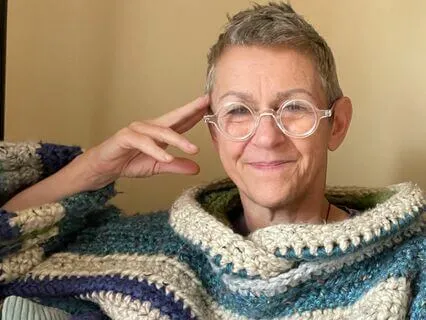
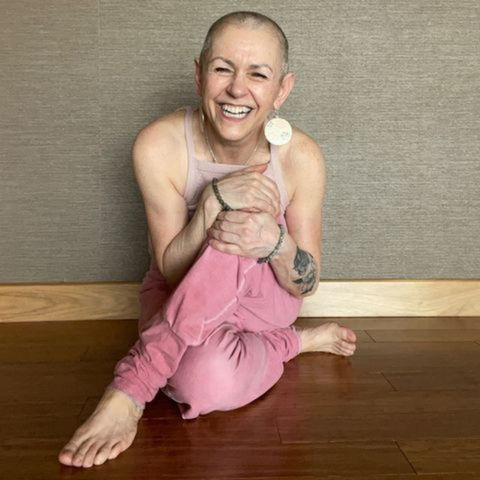
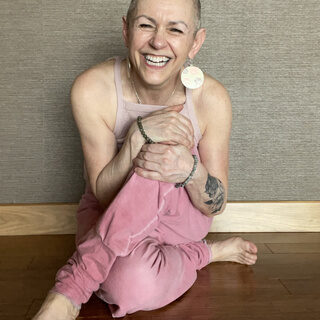
My name is Karen.
Thank you for joining me today on this sit.
I hope that you're feeling well.
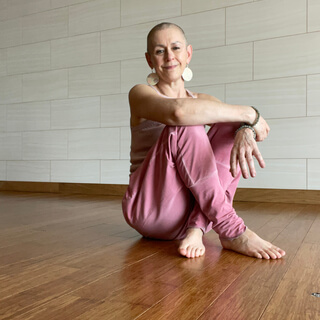
Taking a moment to arrange your body into a comfortable position,
One which allows you to breathe freely in and out.
If seated,
Lengthen your spine,
Not allowing it to be rigid.
Instead,
Allow some movement.
Find where it is comfortable to place your hands.
If on your lap,
Palms turning up or turn down.
If in a chair,
Shift slightly forward so that your back is away from the backrest of the chair,
And arrange your feet so that they are flat on the floor.
Eyes can be open or closed,
And if closing your eyes is not something that's going to work for you today,
Soften your gaze and turn it slightly downward.
Let's begin by acknowledging what's here with us,
Checking in.
Become aware of any thoughts.
Not searching for thoughts,
But instead,
Letting the thoughts move through you,
And so releasing them as you become aware of them.
Not continuing to write a story.
Instead,
Allowing each one to pass,
Just as you would watch a leaf floating down from a tree.
Let it go,
And so allowing your thoughts to fall,
Just as a leaf does from a tree.
The tree doesn't try to hold the leaf.
It lets it fall.
Become aware of any emotions.
Emotions travel with our thoughts,
And it is usually our embellishment of those stories that lead to more intense emotional reactions.
If you find yourself wrapped up in an emotion,
Rather than pursuing the emotion,
Begin to notice how the emotion feels in your body,
And where you feel it.
And now,
Scanning your body,
Check in and see if there are any places in your body that feel uncomfortable or painful.
In both cases,
There's no need to explain it or excuse it.
It is simply present.
And so we begin from where we are.
There is no expectation of perfection.
There is no guarantee of ease,
But we allow ourselves to rest in this space,
Just as we are.
Let's take a deep breath in,
Breathing in through your nose,
Deeply,
And exhaling slowly through your open mouth.
And now allow your breath to simply find its natural rhythm and cadence.
So not trying to organize the breath or alter it in any way.
Instead,
Become the observer of your breath as it comes,
As it goes.
Where do you feel it most vividly in a physical sense?
This could be in the nostrils,
The chest,
The belly.
Let your attention lightly rest there on the breath.
And now begin to draw your focus of the breath upward in the body.
If you're already at the nostril,
Stay there.
If you're in the belly or the chest,
Shift your attention upward with the breath to study it at the tip of the nose.
You can study the breath moving in and out,
Aware of temperature or movement.
The sensation of tiny hairs across the upper lip shifting as the breath moves in and out.
Again,
Noticing that the breath moves of its own accord.
You're not controlling it.
Breath will change.
Notice the changes in your breath.
Some inhalations are deep and robust,
Others shallow and almost silent.
There will be changes as well to your out-breath.
If you find yourself trying to control your breath,
Simply note the fact that you're trying to control it.
And then allow yourself to once again release that desire to control the breath,
Becoming again the observer of the breath,
Not the controller,
The witness to it.
When we recognize that the breath,
Whether we're sleeping or awake,
Trying to control the breath or not,
Will continue.
We build a relationship of understanding,
Understanding the nature of the human body.
And each breath is changing,
Filling the need of the body.
The body will breathe in exactly as much as it needs and will release all of that breath.
It's only when we want to control the breath that we begin to retain breath.
Notice the transitions between the in-breath and out,
And the transition at the backside of the breath,
Between the out-breath and the next in-breath.
At the height of the breath cycle,
The transition is very brief.
But before you get to that place,
There's a moment when the body will feel quite satiated,
Full with breath.
Even with the most shallow breath,
It will be enough.
And as you exhale,
When you often think that all of the breath has been exhaled,
You might notice that there is still a slow stream of exhalation.
And then a moment where there's no breath at all.
There's no need to be frantic for the next breath in.
The body will breathe in when it needs to.
You learn to trust the wisdom of the body.
You might notice that some breaths are more pleasing to the body than others.
Simply notice that.
Without trying to pursue it,
Simply notice.
Where is there the greatest sense of calm in the breath cycle?
The greatest sense of stillness?
When is the call for action within the breath?
And where is the greatest expansion or draw of energy?
Simply noticing.
Noticing what is pleasing within the breath cycle and what is perhaps not pleasing.
And then observe the willingness to simply let the breath go.
To let the moment pass.
Becoming the observer.
And that which is observed is then released.
Coming to a mind that rests in equanimity.
This is known as upekka.
And so remind yourself when a thought comes.
Let it go.
When an emotion comes,
Release it.
Just as you release the breath.
Just as a tree allows a leaf to fall.
We cannot hold on to these things.
We can only exist in the present moment.
Namaste.