All right,
We're going to begin with a lift for the spine,
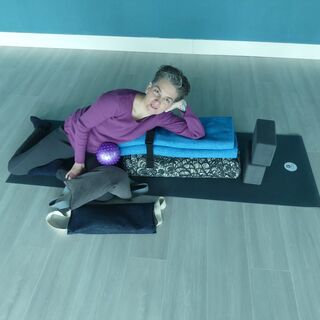
So you're going to need to have a blanket,
Bolster,
Pillows,
Anything that can stack up that has a little extra height where your head's going to be,
And then it'll allow the spine to have its natural arch.
Okay?
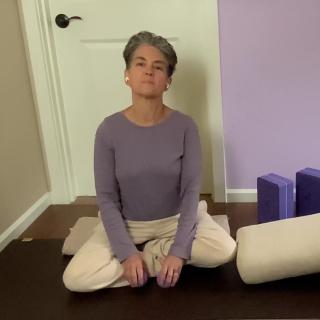
So you're going to sit in front of your maybe bolster lift spine ramp,
And you're going to sit with your seat right in front of this,
And I want you to bring your blocks.
If you have those,
You can do this with or without the blocks,
Besides your upper thigh,
And your knees are going to poke up with their bend up to the sky.
You can feel where the back of your pelvis touches onto the short end of the bolster or pillow.
Okay.
Anticipate an arch.
So walk the feet in as close as you can.
And then as you guide the spine back,
The broadness of the back of the pelvis into the kidneys above,
And you're going to place the two tennis or tuna balls at the deep buttock muscles,
Which would be called really piriformis.
So if you're not certain,
You're going to place the balls so they're at the eyebrows of the buttocks,
And they're going to be kind of sort of in the same line across from each other.
So you can get,
You know,
A millimeter up on one side or the other,
Depending on how your piriformis performs on the ball.
But as you let your weight naturally arch into the deeper buttock muscles,
Which are presented by having the ball push into them,
We're going to bring the soles of the feet together and guide the blocks under the upper outer thigh.
Tuck the block in so it actually kind of pushes into the skin,
Because even though the blocks are not round,
They are actually going to start to tease the tissues that we're going to be rolling,
And these upper outer thigh tissues can be quite nerve-rich.
So I want you to provide some pressure into those upper outer thighs with the blocks.
Or if you don't have blocks,
You could use like a toilet paper roll.
Just have each side the same size.
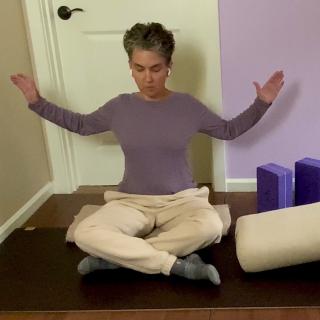
Stretch your arms open.
Feel that vast expansiveness of the chest,
And make an appropriate height for your head on the ramp.
So if you have the ramp built up with a little pillow on the top or a towel,
Let that natural curve up into the brainstem,
Relax.
And it's all up to you.
If you don't want to have any pillow under your head and you want to have the throat just a little more open,
It depends on your sinuses,
Right?
If you're pretty clear there in the nose area,
Focus on breathing in through your nose,
And Just let the belly feel its motion,
Both inhale and out-breath.
Notice if you can be okay with these things that are pushing in,
Right?
You've got blocks perhaps,
If you don't have blocks,
And you have the two balls at the piriformis,
You can feel them kind of nuzzle into those glute muscles.
And we're going to be really exploring a nice blend of restoring with the rolling today.
So it'll be something for everyone,
Not just those that like to do a lot of rolling in deep tissue.
Both pathways will be represented.
So feeling just the weight into the ball at the backside,
At the buttocks,
And if you've got blocks under the thighs,
You can keep them,
Or you can start to slide them down to the lower height perhaps,
Or without them at all,
And start to butterfly the legs.
So the knees are going to go back towards each other,
The inner thighs,
And then back out,
Butterfly the legs.
Knees out,
Knees back in towards center.
Just get the leg pits and the ankles to have that mobility,
And then step the feet apart so the bottoms of the feet feel the ground,
And just let the hips go side to side like you're wagging your tail.
Arms are open,
Spread open the chest,
The breathing muscles,
Let the arms extend back overhead if that's possible for your shoulders,
But anything is possible.
If you decide that that doesn't align for you,
Let your arms relax on the floor.
But what's nice is having something under the back to let the spine feel supported and fulfilled without having to hold it up as we do sitting and standing.
Just feeling this therapeutic motion,
Take a few more moments,
And now we're going to move into another restorative blend.
So I want you to just gently reach down to the back space of the rear and move the balls out to the side,
And you're going to bring the knees over to the left,
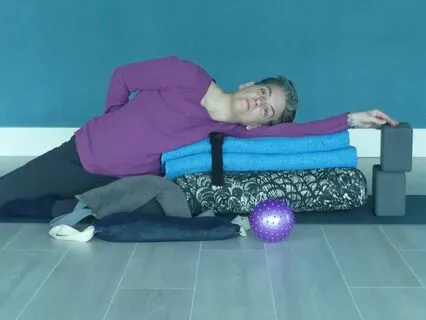
And you're going to take what's called a sleeping sage pose,
Or I like to think of it as a sleeping twist.
So we're going to work our waves of reach from our hip,
Kind of our hip pack.
So my left hip bone is settled,
The thigh is turned out,
Right?
So this is kind of a half lotus position for my leg,
And then when I rotate off the front back thigh,
The hip flexor,
The femur bone turns,
And then I just relax down onto my pillows and hug the bolster or your pillows,
Let your head turn towards the right.
If the left hip is down first,
That's the direction you turn is to the right side,
Opposite of the hip,
And then embracing the twist through the side abdominals,
The side waist,
The kidneys.
Let's just lay in here for a few more cycles of breath,
But really feel that basin of the hip on that left side,
That weight,
And then we'll switch sides.
So between the two sides,
You might have some interest in a down dog or a cat-cow.
I'm going to go to windshield wiper,
So I'll just turn away from the bolster,
Blanket,
Pillows,
Whatever you have,
And let the knees switch side to side.
So I put some weight back into the hip side band,
So I want you to let your body weight press across,
Press across,
Press acrossity,
New word here.
So let the weight layer into the glutes,
Because when you just push into them without the ball but just the floor,
You're going to have a broader effect on them.
So roll to the right hip and find that hip basin close to the bolster or the pillows,
And then take that twist into the liver,
Liver twisty.
So as I turn down onto the props,
I'm going to let my head turn left,
My right hip is pressing,
And this is important,
Even though it may seem like,
Where's the roll?
We're getting into it.
We're going to let those tissues have a fantastic blend of restoring,
Replenishing,
Just regenerating from the touchdown,
And when you create that rotation,
Feel the waist stretching up,
Lay down into the bolster,
Relax the hands,
Either hug the bolster or arms are open.
If you haven't hugged your bolster today,
This is the time,
And the ribs try to stretch wide,
Take a few moments here.
So enjoy the wake up call into your breathing muscles,
Right,
Into your upper respiratory,
Into the upper back part of the lung,
The chest,
Bring the palms to press down and come on up,
And now whatever's behind you,
It's going to go in front of you,
So you'll take your pillow or bolster down to the base where your feet are,
And if you've got a blanket or a towel,
Anything,
You're going to have it at the lowest height,
It could be like a quarter fold,
This is pretty good,
But when we take a quarter fold under our head,
We're going to have two variations,
One with a ball roll and one with a roller.
So what I'm going to show first,
Because I'm up,
Is the roller.
So if you're going to use a roller for the glutes,
We're going to have several glute opportunities,
Getting glute free.
So you're going to place the right foot down and the left ankle crosses over the right knee,
And you're going to flush into that left glute.
You're going to do the same idea on your back if you're using the ball,
But you'll have your spine down completely on the floor.
So I recommend if you're using the roller that you sit up on the edge of the glute to the glute medius,
The side band from the thigh,
Then connects into the hip,
And gliding up and down,
And don't go too far up to the hip or the waist.
Find that really sweet spot into the left glute.
We'll do several glute things today,
But if you don't have the roller,
Come onto your back and place the left ankle to the right knee,
Cross it over.
Please don't cross the whole leg over the right leg,
Just the ankle to the right knee,
And then lift up and place the balls back to the piriformis.
So those deep buttock muscles.
So if you were to find out where about your sitting bones is,
It's several inches above the sitting bones,
And it's below the SI joints.
So the eyebrows of the buttocks is probably a good aim.
And then let your hips go side to side,
Door one.
This is the easiest,
Okay?
Door two,
Knees to chest.
You can't do a lot of side to side when you go knees to chest,
But you're actually slipping that groove in that low back to lengthen and hold the back of the right thigh.
So as you hold,
This is a nice anchor for the pelvi to strengthen.
And if you're on the roller,
Then come down and join us in this one so you can at least get a figure four pose on your back,
Left ankle to right knee,
And rock side to side.
You can also have the roller under your pelvis on this one versus the ball.
That works out great.
Take a few more moments,
Just kind of warming up just below the kidneys,
And then let's switch sides.
So bring both feet down to the bolster or the floor,
Cross the right ankle to the left knee.
And then as you bring the knees into your chest,
Option,
Hold the back of the left thigh or have the left foot on the floor of the bolster and let your hips go side to side,
Wagging your tail.
Okay?
Those of you that are going to work with the roller instead are going to have the same balance with the ankle,
The right ankle on the left knee,
But instead of that ball,
You're going to have the roller.
You kind of want to mount on the roller,
And just so you can see how the back side focuses,
I'm not on my sacrum,
Right,
And I'm not on my tailbone,
I'm on the side of that upper outer right thigh.
So feeling kind of the muscle belly,
Which is sort of tricky for glutes because there's three glutes,
Right,
And the maximus is going to feel just like such a thick tundra because it's our strongest muscle,
But you can roll through it,
Which helps our back.
It's going to help so many things that are tied up and tightened.
So find that looseness,
Helps our walking muscles.
Okay.
So those of you that are on your back,
We're going to join you in a few moments.
So come on down and let's all get the ball out and the roller out and take the right leg over the left and knees swing to the right side to an IT band stretch.
If you've got a ball,
You can use the left hand to the upper outer left thigh and just rub into that area in the TFL,
And below that,
Where that right leg crosses over is IT band,
So it's getting kind of a snug pull and traction.
It may seem kind of silly to use the ball and push into the leg to massage it,
But some of these skills that you learn,
You're going to get good at self-massage work.
You could go up higher into the rear with that ball,
Kind of nudge some of those tissues back to where you were just rolling,
Right,
Into that glute medius,
Right?
You might notice,
Oh,
That's kind of tight stuff.
You could do a little bit of tapping,
Not abrupt hitting,
But just tapping so it's to popant.
That can feel kind of good to do.
And you can also put the whole palm of your hand onto that ball and just try to get some massage into your hand.
Okay.
All right,
Let's get a little bit of excitement here.
So if you can stay with the IT band stretch,
I want you to take the ball to the upper left side of the back,
Between the shoulder and the spine in your trap,
And just let that left arm stretch open.
Give a few more moments here.
If the legs need to uncross,
Then you can simply uncross them and have them side by side in a fetal position to the right.
Okay,
That might be actually helpful for some of us to do something a little less intense and see if you can get a little bit of that trap time.
So we're going to do several,
Another time in the traps,
But for now,
Just encouraging you to recognize this.
My ball with my legs in that IT band stretch,
It's at the upper left side of my back.
So I just roll it under.
It's between my shoulder and my spine in the trapezoid.
Okay.
So just kind of get a feel for that for a few more.
You can always just simply shrug your shoulders.
Just shrug them up and down.
Might be crunchy in there.
Okay.
All right,
Now come on out and then change sides.
So I want you to bring the left leg,
Cross it over the right.
If you need something in between,
Like windshield wiper,
Feet wider than hips distance,
Rock the knees side to side,
And then left leg over right.
Knees to the left.
You can use a block under the knees on that left side if it's feeling a little bit challenging on the knee joint,
And then take the ball under that upper right side of the back.
Okay.
So get a feel if the ball can get stuck in there,
That upper right side of the back,
Your knees are already tilting left.
So it might already be kind of intense with this hip crossover,
But the upper body certainly could use some activation,
Right?
So even though you might want to be kind of sleepy in that upper zone,
Just get a little bit of blood flow into the upper lung here.
It's not only a muscle,
What's behind the muscles that are protecting right above the muscles here is going to be the lung,
Upper lobes.
So this could be quite helpful if you learn things in acupressure,
Meridians in the body.
They all line up,
Right,
With the fascia.
So we kind of know they're accurate,
Even though they've been studied a little bit longer,
Right?
In the alternative medicine,
That's kind of actually been around a little longer,
The Chinese medicine.
So kind of learning those techniques of massage.
So I've got the ball high up on my right,
Upper side of my back,
Between my shoulder and my spine,
And I'm just shrugging my shoulder and moving my right arm out and around.
Okay.
So if you're not sure,
Where's that ball she's got?
She must have one in her upper back.
It's up here.
It's probably easier to get it this way versus tuck it under the armpit,
Right?
So this would be,
Not armpit,
But rhomboid,
Right?
This would be a little challenging.
No Gomukasana arms,
Right?
Okay.
Maybe Garudasana you can do.
Okay.
Take a few more moments.
And now through the chest.
Stretch the right IT band.
I almost forgot,
You can also use a ball on that upper outer right thigh,
Extras.
Okay.
I kind of feel the connection that seems like it's seamless,
Right?
Between a thigh and a hip.
It's so nerve rich in there.
We're just warming up to some very intense deep tissue work ahead.
So take it easy so you can definitely get in there.
You can do a little bit of tapotement,
Tapping,
For those massage therapists in the class.
All right,
Ball goes aside for a moment.
Let's go upside down.
So part of going upside down is to reverse the flow of gravity.
Also in the muscles,
Right?
Not just like heart and inversion qualities,
But also the pull on our muscles from standing and sitting.
So take a block or a roller under the back of your pelvis,
And it's kind of near tailbone.
If the block is at its lowest setting,
It should be completely supportive of your pelvis.
It's wide enough,
Right?
And the legs go up.
If you love challenges for balance,
You can also put a foam roller under the back of your pelvis,
And then if it's kind of round,
Right,
It will kind of take you off your balance sometimes.
So you have to recruit that lower core.
Arms in goalposts.
Stack everything up here.
So from the feet stacked up from the hips,
And the thigh bones just rest into my hip sockets.
And just give enough time for the blood to move from the extremities to the vital organs.
So you want enough time for the physiology to respond.
Meaning the feet get cool,
They get tingly.
You know the blood is moving from them when you feel that.
If you get tingly or numb,
The circulation is changing,
Right,
In an area.
So it gives you a sign,
Right?
If my feet go to sleep,
Right,
I'm in this too long.
For whatever reason,
My circulation,
I have some work to do.
So right now I'm good.
But you might find going legs upside down is very therapeutic,
Very calming,
But reverses that muscular pull in the legs.
Draining out the leg pit,
Groins.
Okay,
Now as you soften through the knees,
Just notice what's above the knee,
Right,
The quad.
So bring your hands,
If you can,
To your front thighs,
Just above the knee,
And kind of press into those thighs so the legs are vertical,
Right?
In Iyengar yoga,
We would use a block here,
Even though there's a block under you.
You place a block at your abdominal space,
And then just push that block into the thighs so you don't bring the legs overhead,
Because we want to have that reverse flow back to the heart to lower the heart rate and the blood pressure.
So it's not about muscular flexibility,
Right?
It's about the circulation in the body.
That's part of what Roll and Restore is focused on,
Is it's kind of a health plan on its own in some ways.
So as we bend through the knees,
It kind of wakes up the quads.
These quads are going to get a stretch now.
Stretch the legs down,
Take this for a few moments.
Moments is okay,
Because we're going to stretch them in the other direction with hands and knees down,
But push into your feet.
Now I'm really just grateful there happens to be a wall there,
So I can push into my feet and really regenerate into my hip flexors and my psoas,
And then relax your buttocks so there's no glute tension.
And let that swirl around your head when you're stretching the hip flexors.
That's something to think on.
We kind of forget that when we are working these hip flexors and we're stretching them,
We tend to tighten the glutes a lot,
Which is not bad,
But we'll see where we go with it.
So walk the feet in,
Bending the knees,
And then lift up the hips and take the block away.
You can do a spinal roll or two.
You can do a couple draw bridges,
Lift and lower,
To come up to all fours.
So either a spinal roll or a roll to the side.
And let's come on up.
Okay,
So take a kneeling position.
I want you to have,
For this one,
A blanket or a towel under your knees,
And when you move your hips forward and reach,
You can have your hips on a roller.
Here's the focus point.
The thigh lids are going to be on the roller.
I got the little budget one here.
It's kind of tiny,
But it works.
You can have a roller or a bolster or a,
You know,
Like something that would be thick like a towel or a blanket roll up would be fine too.
But if you happen to have a roller,
You're going to do something a little different.
So,
Those of us with a roller are going to lean into it.
Those of us with a bolster are going to lean into it and just stay with that up dog,
Okay?
I actually prefer that.
But if you're going to use a roller,
Watch out what's in front of you,
But you're going to roll the quad.
So you want to get the roller so it's below the hip flexor,
Onto the quadriceps,
And you're going to use your feet flexing to draw up and down the quad.
Try to keep it so your quads are close together,
Like you have a uniquad.
And then see if the feet can float up.
And try to go all the way through that center of the belly of the muscle,
Belly of the quad.
Muscle belly.
If you've done a little bit of the roller,
Come back on up if you've got the bolster.
You're going to place it in front if you don't already have this.
And I want you to let your hips stretch forward and down,
And then bring your head down onto your hands.
So your elbows open,
Your forehead onto your hands.
The glutes have to relax now,
Right?
The last few moments they were holding,
Right?
You were pushing.
You were creating that core,
The tummy time support.
But here,
Tummy time is actually tummy time out.
Okay,
So forehead down,
Elbows wide,
And just feel that pressure of the belly pushing into the bolster and expanding out.
So massaging the organs.
So using props,
Right,
Tool-based therapy to massage the body.
In fact,
Some of you might decide you want your bolster lengthwise,
Like so,
Like you would be creating support for a locust pose.
Okay,
You can also put another blanket on top,
And that will feel so much easier on your back.
So the higher you go with the props under your core,
The softer it is on your back.
So take a few more breaths here when you are fielding that reach at the back space,
Expanding and centering.
Relax the brain.
Frontal lobes release down.
Move the hands to your sides.
The quads might wake up,
But mostly the glutes,
Right?
So as you come on up to up dog,
See if you can feel the thread of the front of the spine from the navel center up,
And then toes hook under.
And then when you come back,
Think about that navel center and then tailbone.
So when you motion your back into flexing and arching,
So feel the tailbone and the navel center.
So what might help us is to have the pelvis scooping towards navel center and then rocking back the tail and stretching the navel lengthwise towards the heart.
Take a few moments here.
Now stretching back into a child's pose.
This variation I find near and dear to my heart.
So I like to take a blanket or a towel and make it really into a tight little tube here.
If you just happen to have a pool noodle around,
That would work really good too,
But it's just a little too squishy.
So you want something with a little density.
So something that is fabric that is going to hold,
And you're going to place this and wedge it to the back of your knees as best as you can stuff it in.
So I just push the blanket up on top of my calves,
And then I let the hips reach back and,
Oh that's a good one,
Into my calves I go.
So you can place your forehead on a block,
A bolster,
Elbows relaxed.
Another thing you can do on this one is you can place a ball also at each calf,
Because guess what,
We're going to get really into the calves.
So this is going to be really intense,
Right?
If I try to get the ball between my hamstring and my calf,
And then lower down.
If you're able to accomplish that,
You definitely,
I will give you a heart.
That is so interesting.
So feeling that pull of circulation and blood flow into the calves,
Child's pose.
Come up and pedal out the legs,
So you're going to come up to table,
You'll bring the hands to press,
Toes under,
Hook the toes under,
Stretch up the hips,
And alternate bending your knees,
Walking out your dogs.
Just feel that pulse back through the heel,
The ball of the foot,
And maybe your head between the arms releases for a few moments.
This is a great way to help our spine.
It's not a fully rounded or flexed,
But there's the intention of an extension of my back.
Especially good for those of us that are a little worried about our bone density here.
We're working on not flexing,
But extending.
Okay,
Now come on down to the knees.
All right,
Okay,
Let's come on to our seat.
So we're going to go all the way around into a calf rollout.
So what I want you to have is a roller or a block.
I'm going to show it with a block and a ball,
But if you happen to have a roller,
You can do both calves at the same time.
It's not as intense,
Unless you have like a roller that has spikes on it,
Which they do make those.
These aren't quite spikes,
But I prefer the ball and the block.
So what I'll encourage you to do is have a block at its lowest setting so that you have the whole surface,
Right?
You don't want to have just a narrow ledge.
And you're going to place the calf on it and then kind of roll the ball under.
You can sit on a blanket,
You can sit on a bolster,
Or sit on the floor.
And then place the ball at the center of the back of your left lower leg,
And you're going to lean back into your hands,
Right knee bends,
And you can either have the right foot down or you can turn the foot out,
And then roll as far down towards the Achilles as you comfortably can.
You can kind of feel that notch in there.
It's a whole notch.
It's a little valley.
You're creating a pathway,
And you can flex or point your left foot,
Or maybe even close your eyes and just notice,
Do you notice anything?
Or circulation in your calf can be pretty crazy.
So flow through the calf.
Okay,
Those of us that want to keep it kind of basic,
Massage in the calf can stay up and down the calf.
And then you have the option of maintaining the balance on the ball,
But have the opposite leg cross over the left leg to the shin.
It's kind of across the tibia.
And then just little rocks on the ball.
You can move the ball a little lower,
A little higher.
Ooh,
Feels good.
And by now,
You might start to find out that you're getting a need for some water.
So about now,
After rolling a little while,
We're going to do a full hour of this rolling and restoring.
So if you need some fluids,
This is a good time to start,
Because you don't want to get too woozy after a class,
Because there's so much movement.
It's churning the fluids in and out,
Right?
So it's remodeling tissue,
Hydrating the tissues,
And it has to take it from somewhere.
Okay.
Yeah,
The final part on the calf,
I'd say,
Is go to the peroneals.
So you can turn the block across to horizontal,
And then you're going to just turn your leg so it turns out,
And hold on,
Get the ball to the side of that left lower leg,
And then you're going to go across.
So it's a little bit of a saw-like motion,
Holding the leg,
Cross-fiber the peroneals.
This helps our feet a lot,
So if you've got issues in your feet,
Plantar fasciitis,
You just have a foot that grips more than the other,
It just feels like it's stuck,
Then this peroneal massage work can be good.
It doesn't have to go low on the leg,
Like that low,
Because that can be kind of bothersome for some of us,
Because if you get acupuncture,
Some of these areas can be very nerve-rich.
But the ball is nice because it's going to help you get a broad effect on your skin and your surface muscles,
And then switch sides,
Switch to the other calf.
Okay,
I hope you're feeling this,
Huh?
In the calf we go,
Right calf on the ball,
On the block,
And then I could even just wiggle my leg a little bit,
Just feel like you're trying to learn how to massage these tight areas.
Since we stand on our feet often,
Right,
They're stood on a lot,
So these lower areas get quite a bit of fluid retention,
Right,
We know about that.
Some of us know that we've had some issues,
Or maybe if you've been sitting for a long time,
Or you have to lay in a bed for a while,
These areas can get swollen.
So when I glide up and down,
Trying to reduce that,
Right,
So that also inflammation that surrounds our knees often,
Things that we can help with that are like legs up,
Upside down,
We don't want to put the ball behind our knee ever for rolling.
That's a no-no spot,
There's a few of them,
But that's definitely a no-no.
So I'm going to push a little bit,
So I like to just kind of sit on the sitting bones,
Cross the other leg on top of the right,
And then just sit up,
Try to get my spine up,
And just let the leg wobble back and forth here.
Okay,
Yeah.
So you might feel these areas are just kind of throbby,
Right,
In the calves they can feel boggy.
This is a really good one to add to your routine,
Maybe even if it's three times a week,
You schedule like 10 minutes of calf roll before you walk,
Or even better,
After the end of the day,
They might feel tighter than the beginning of the day after they've been resting,
But at the beginning of the day they might have more fluid retention,
Who knows,
Everyone's different,
Right,
How their body holds things.
Great,
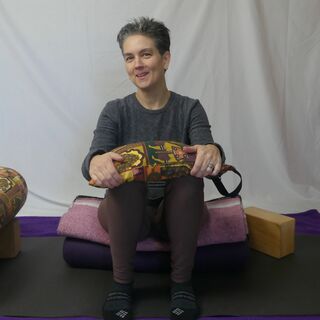
So let's get our belt.
This is when I want us to have something different today,
It was a belt or a scarf or something that you can stretch your calves thoroughly after the roll.
So what we're going to do,
Oh sorry,
We didn't get peroneals on this side,
I got so excited about adding the belt.
Okay,
So peroneals,
Stay on the block.
So those of you that were using your roller,
I know some of you know about rolling the calves,
So peroneals would be my side of my lower leg,
So the side strip,
Right,
So you're working on basically gliding and shearing,
They call it more cross fiber,
Okay.
Keep going with that,
I'll show the roller one.
So if you felt neglected about the roller,
Here we go,
So we got our roller,
I got the quarter size one it looks like,
Huh,
And I just go back and forth,
So it's pretty easy.
This you can do kind of any way,
You can even just sit still and roll and not have to slide back on your wrists and all.
You can lean forward and circle the feet,
Give yourself a little bit of pressure points before we get the belt into stretching our leg and then let's stop on the ball here or the roller.
So come on to your back,
You're going to need some things to help out.
Get a bolster or a big pillow down at the base,
Get a little blankie or a pillow,
Whatever you want under your head,
Probably a little more height than you're used to for where we're going with the deep massage work and first thing,
I won't tease you,
We're going to do the belt focus first and then we're going to get deeper into the glute,
Okay.
So as we take the belt,
If it's already buckled up,
Don't worry about it,
You want to have the belt so it's as wide as you can get it,
Right,
Whether you have a scarf or anything,
Don't let it be all tied up,
Bring it under your feet and then push your feet out wide so you're in a wide stance with the back of the pelvis centered.
Take a few moments with the legs upside down,
Feet are wide,
So with that leg float,
Right,
Even if it doesn't feel like they're floating,
We're going to slide the pull on the belt or the scarf and you're going to slide your feet together and walk your hands up on the belt and then lower the left leg down on the bolster,
You can always step into your foot or let the leg relax through the calf and then maneuver that belt through the center of that right foot and stretch the calf,
Push the belt a little higher up at the ball of the foot,
Really stretch that calf.
It might even feel different than you're used to when you do a calf stretch with a belt since we rolled the calf,
Might feel like,
Hmm,
Some good circulation in there,
It doesn't feel maybe as spicy,
But it may even be spicier for some,
Okay.
Now bring the left foot up,
Switch the side,
If you decide you want to do in between things like cross the leg over,
Perfect,
So if you go,
I'm going to hold the belt and swing it leg side to side,
It's up to you,
Okay,
But I'm emphasizing kind of site-specific areas that we're going,
Like we're doing a class plan,
Like a specific sequencing,
So the flex of the foot pulling,
The bottom leg relax,
Feel that leg sweep,
Breathing,
Intending to work on the tender calves here,
Okay,
Now when you feel that flex,
It's a little different than when you have the ball at the calf,
There's some similar circulation events going on here,
But when you're rolling,
Right,
You're pulling fluid into these areas,
You're churning it in and out of the area,
Not just in.
Where does it end up?
It's going to end up around the collar bones where it moves down through the,
From into the blood to the organs of elimination,
So there's a good reason to get your leg upside down for that purpose for circulation as far as we go with our lymphatic system.
So as you bend through that left knee,
I want you to slide the right foot up on the bolster or the pillow,
And then we'll just take the belt off the foot,
Wasn't a lot of belt,
Was it?
And get the balls,
Not the roller,
Okay,
So my hope is you all have some of these,
We're going to do a kind of a mad intensity with deep tissue work,
So let your hips kind of wag a little side to side like you're wagging your tail,
A little bit of tail motion,
Feet are just gently pressing,
Find the sacrum center,
And now we're going to put the balls to the left side of the hip,
So I want you to place both of them,
You don't have to be good at juggling or anything,
Holding them,
But I want you to put them besides your upper outer left thigh and the hip,
All kneels to show you exactly where they go,
But first I want those of you that know this drill to get right into it.
So you're going to move your knees to the right,
Swish them to the right,
Then roll the balls to that left buttock,
Keep them close together,
And then mount up on the balls as your knees go back left and then move your hips side to side,
This way you're not tightening your glutes to get on the glute massage,
Right,
I don't want you to have to push up in a pelvic tilt or a bridge pose,
I want you to just smooth out the glutes,
Okay,
Keep going,
We'll do this for about a minute,
So it's,
I'm looking at my time here,
We're going to go way over today FYI,
So we got our hip here,
Hip,
Glute,
Okay,
Ball in between,
Okay,
So the balls are both together so it's less intense,
So if you want to make it more severe you can have one ball,
But the two disperses the sensation.
So really let your hips go side to side,
So you want to glide across,
So you're going to be going into the maximus that goes all the way towards the gluteal fold,
Which is the crack,
But you're not going into it,
You're not going into the crack,
The ball's not going to go there,
It's just across the maximus,
Which is the strongest muscle in the body,
Right,
As far as muscle goes,
Strongest,
Okay,
Some people might say jaw would be,
You know,
A little bit faster,
But I find that this area when we know about strength and movement,
And we might not be that empowered there,
So we're trying to roll through it to help turn over in these tissues,
When it's working with all the three muscles in the rear,
It will help our back,
Help our posture,
That's probably biggest,
Right,
How we hold ourselves and our walking,
So glide,
You can swerve the knees left,
You can keep them pointed up,
But really move those hips,
Like you're doing a hula,
Right,
So feeling movement into the left glute,
Does anyone feel that,
Into their left buttock,
Pressure,
Okay,
So back to the right cheek,
Knees right,
Take the balls over to the right cheek,
Right,
To the right side,
Knees go left,
Bring them back center and mount on the ball,
Okay,
Or two balls,
Sorry,
So the hips are going to glide side to side,
If you can't see,
So here's where we're at,
Right,
We got the balls right up to the upper outer side medial,
So it's glute medius is what you're going to,
So that for many of us are going to consider our hip rotators and we got a lot of hip rotators,
But for the event we're in here,
You want to make a meaningful attempt to massage this area,
It's pretty rich supply of muscle,
Fibers,
Kind of gliding and shearing into this muscular band,
Feels pretty good,
Okay,
Use your body weight plus movement,
So massage is pressure plus movement equals the art of massage,
Okay,
So if you get to the edge,
Like you're not going to get all the way to the gluteal fold,
If you go that far,
It's like you're off the muscle and you're into bone,
So it is true when you do rolling myofascial release,
You do want to stay on the muscle,
On the soft tissue,
Even though it feels like knots,
I don't want you to be right on the bone,
Right,
We won't roll our knee or patella,
We're not going to roll our elbow,
Right,
We're not going to roll those areas,
But we're rolling in the muscle,
Where all that fluid moves into and take a few more moments here,
Really rub into those tight tissues,
Tease them,
The same time you're trying to stretch your breathing muscles by breathing,
It only helps,
Body weight and movement,
Okay,
If it gets really stuck,
Like let's say your hamstring,
It feels like it's cramping,
Then just come down to the back of the pelvis and hug the knees into the chest and go circular,
So let's do that,
Let's bring our knees into the chest,
Okay,
And then hug the legs,
Either the backs of the legs,
Behind the knees or to the knees and circle around the outer rim of the sacrum,
Yeah,
And consider even though it doesn't look like we're doing balance work,
We're not standing on one leg,
We are working on that influence of integrating the circulation of the tissues,
Kind of reviving,
You know,
It really helps us with our sensitivity to all of ourselves and our ability to balance in the bones that are hopefully provided with muscles that respond to help keep us current on wellness,
Health and vitality,
Go both directions if you haven't already or repeated that to yourself and then bring the feet down,
Take a block,
You're going to either do one of these variations,
So what I'd recommend is push the bolster away,
Have either a block under your pelvis and the balls are going to go to the upper back to trapezius massage,
Blankets right at the shell for the back of your skull,
So not at the neck,
I'm going to show the roller and the ball version,
Okay,
I like them both,
I think I like to do both of them,
Not just one,
So if you have the balls,
The pelvis is lifted on the block and then you're going to place the balls,
One on each hand,
Back to your upper side band between your neck and your shoulder and you're going to lift up your chin and then lift up your upper back and roll the balls under into your trapezius,
So it's not on the spine but it's to the side of the spine,
Between the spine and the shoulder and we did do this earlier with one side at a time,
So when you lie your head back on the blanket,
You want to feel like the jaw has just this lift and relax the jaw,
Maybe manipulate it with your fingers and then as the balls are tucked in there,
You're going to move the arms out,
I got to get them right in a good notch here,
I'll show you where they go in a moment if you're not sure,
Arms are going to open out and around,
This one could be sometimes nicer with a tennis ball versus the tune-ups because these can feel kind of intense,
If you got a lacrosse ball,
Oh boy,
Or a golf ball,
So arms go out and around,
Then they alternate lifting up like you're going up a rope and the last version would be shrugging the shoulders up and down,
Okay,
I'm going to show a couple other things,
So those of you that are with the balls at the back,
You've got your pelvis up and the balls are up at the back and you're doing alternating arms reaching up,
Rolling,
Shrugging,
Okay,
So one other thing you can do also is you have a roller,
Some of you just come up and then lie back on the roller around the rhomboid,
So it's upper back above the back of the pelvis at the ribs and above the ribs,
So they're going to be ribs that you're rolling anyway,
But when you do lift your head and hold on,
Well,
You got to lift your head,
You're going to hold the back of your head and roll up and down,
Okay,
So you're going to bring your chin a little bit in,
But don't force that neck flexion,
See if you can either do this with the hands holding your head or the arms stretching back,
Your head leaning back,
It can be pretty crunchy in there,
Now those without the roller get a little deeper work here,
Okay,
So keep rolling on the roller if you've got that,
If you're going to use the balls,
You might even put them back so you know they're about going to stay apart,
Okay,
And then when I come on down,
Elbows are down lower than the balls,
Right,
So quite a bit lower and I'm going to hold the back of my head and I'm going to roll up and down,
Okay,
So this is going to maybe for some of us kind of pull to the scapula,
So you might have to be careful and be on the flesh between shoulder and spine,
Okay,
So try this,
This is very,
Very,
Very deep,
Okay,
And it kind of pulls down through the scalenes,
Right,
And that area can be just so frighteningly tight,
So if you find that it's just so tight up there,
You can just rest your head back on the blanket with or without the block under your pelvis and taking some breaths,
Right,
Maybe maneuvering the ball so you know they're perfect across from each other as far as you can tell,
They feel pretty much set and then work on the lung,
Just take a few moments here,
Feel the shoulders shrug back,
Deep work,
Arms could be reaching,
They could be out,
Feeling the lung,
See if you can get your shoulders to go down the back,
You might get some sensation in your hands,
The conduction of energy,
Right,
Into those referred sensations into our hands,
Those nerves have it,
Don't they?
Okay,
Now those on the roller,
Keep rolling away until you're ready to come out,
Which is probably soon,
Those of us on the ball,
I don't give myself enough time to do this one,
I think this is super,
Super important.
Okay,
Now let your head nod side to side and then roll to a side and then come on up,
Let's restore.
Okay,
So balls go to the side,
Take a bolster,
A big stack of pillows and I want you to lie on your side on that bolster,
You're going to need a blanket under your head,
I would not skimp on the height of it so your neck can have some comfort and if you happen to have a block or if you don't have a block and you've got a chair on the other side of the blanket,
Use that,
Just be hip side on the bolster of the pillow and stretch your left arm overhead to the block or the wall or chair and then roll to the side and then come on up.
The right arm is between the bolster and the blanket or pillow for your head,
So the right arm is right between that notch of the cushions,
The supports,
The left knee can be on top of the right knee,
The left knee can be on the right foot and you can also stretch it behind you and like a scissor kick,
Come into the side sage pose,
See if you can get the side abdominals to actually stretch and move,
Thank you sissy,
Feeling that range of motion,
Keep the bolster under the ribs,
Where else would it go,
Let the left arm release from overhead and then simply just roll onto your back with support under your upper back,
The bolster,
Walk the feet in towards your seat,
Stretch the chest wide,
Lay your head relaxed back on the blanket or pillow under your head and as your arms spread open,
Just feel that circulation in the pecs,
The upper chest,
Yeah and this might be,
You know,
Recently a little bit achy from rolling on the trapezius,
So you might feel a little lingering soreness there,
So just let that release wide,
Breathe,
Breathe,
Very nice,
Now just roll to the left,
So the left tip is next to the bolster or the pillows,
The left arm is between the notch of the bolster and the blanket or pillow,
Right arm is overhead on a block or a wall and the right knee can be next to the left foot,
It could be on top of the opposite left knee or you can stretch back,
Yeah,
And we need sensation in the thigh lids,
Right,
The hip flexors need that release,
Right,
They definitely get hinged most of the day,
So give them the opportunity to feature stretching the abdominals,
The side abdominals and feel that oblique reaching and the weight of your head rests,
Okay,
Draw the right thigh to the left and then roll to the left ribcage and then I want you to take your blocks and place them side to side,
So they're at the second setting or the third setting and we're going to build a bench for our legs to recline and the feet to float,
So if you feel like I need a little bit more roll,
What I'd recommend that you might roll would be your feet,
You can stand up and put a ball one at a time under a foot and roll out the flesh because that's such thick skin and then take your legs up either at the bolster bench or a chair or a wall,
But otherwise since the mind is kind of sedate from all that deep roll,
You might feel kind of rolled out,
So then we'll take our legs up on top of the the bolster bench and add everything you can,
In fact if you've got a another blanket,
Pillows,
You might want to make a roll for the calves and then place that leg set,
You got a leg set,
You're lucky,
Okay,
Feel gratitude for having that,
If you do and if not,
You're working the best you can with one that operates,
So we want to find the circulation back towards the heart,
Okay,
So whether I got one leg to lift up or both,
But we want to enable that frequency back towards the heart,
One thing I'm going to mention,
Those of you that have a ball,
One of the totes that the tune-up balls come in,
If you have a sock,
It's great,
You can put the tennis balls in a big sock like a tube sock and you can make a a cranial,
We're going to do a cranial still point,
So if you've got the tune-up balls in the tote,
What I want you to do is place that at the occiput,
So that's the shelf at the back of your head,
Okay,
Your legs are up and you would place the ball here,
The tote,
The sock,
Whatever you have to here,
Okay,
You don't want anything higher than the height of a tennis ball,
So you won't want to use a foam roller,
That's not going to be good for the neck,
Right,
So we want to have something so I still have that arch in my neck,
Not the rounded slumping,
So I'm continuing that arch all the way up into the brain stem,
So this I think is magic for our brain,
Having that still point,
If you have one ball,
You can use,
If you don't have a sock or a tote,
Little tote,
I would use one ball at that occiput,
So if you've ever studied like the skull and how that seams in,
That's the very,
That's the attachment of the trapezius,
So the muscle we are rolling at the upper back,
That is the attachment is at the occiput,
So if you have just one ball,
That can be pretty cool too,
That could be really good,
So if you have one,
Use one there,
If you're like,
Whoa,
This is a lot,
Just try it,
If it's too much,
Go without,
Let your head rest on the floor or pillow,
Arms are open,
Vacate,
Have a little vacation here of breath,
Let the belly lift and lower and feel that swaying motion of abdominal organs,
Heart and lung,
And just maybe you touch into the pulse of the body,
Right,
The rhythm,
The timekeeper of the body is the heart,
Maybe it decides how much time,
Right,
We're here,
So just noticing if you can that,
Maybe it's so subtle,
You can't quite touch into your pulse,
Just being in this shape,
But feel how your breath slowing down,
Calms the heart and the brain,
You can start to feel it probably now,
Right,
The pulse,
The heart motion,
It might be fast,
It might be trying to slow down,
And if you need to get rid of the balls at your,
At the cranial area,
You can just move them aside and put something soft under your head,
If it's really curious for you,
Just keeping that and notice the connection from cranium,
Cranial sacral,
So that would be the sacrum area,
That rhythm between the cranial area and the sacral area,
So let the arch of the spine happen,
Like your tail presses back,
Cranial sacral,
Your cranium presses into the ball,
Then let the feet circle,
So rotate through the feet,
Feel the bones of the feet,
Then let the feet circle,
So rotate through the feet,
Feel the bones of the feet reaching open,
Flesh of the feet moves,
Go both directions,
Circling the feet,
And just setting your intention to receive wellness from this practice,
Whatever it may be,
Just consciousness of the areas that you were kind of soaking up in circulation,
Bask in that for a few more breaths,
Let the legs relax,
If you need to stay in it a little longer,
Just do so,
No need to get up,
If you can stay,
And those of us that have the ball at the back of our skull,
And I want you to get a hold of your back of your head with one hand,
So it holds below the ball,
So give a nice little press into that,
And then you're going to just roll the ball out,
And then carefully with both hands,
Hold the back of the skull,
And just let it stretch down,
Or you might not feel energy holding the ball,
You might not feel energy holding the ball,
Or you might not feel energy holding and kind of caressing the back of your head,
Just feel that release back at the skull,
And maybe scratch your head a little bit,
That could feel really good for the brain,
Just that scratching motion into the hair,
To the follicles,
And then the arms reach back,
Stretching,
Head resting,
Brain rest,
And then draw one leg at a time in towards the chest,
Circle through the back of the pelvis,
Holding the knees,
And those of you that want to stay on your back,
Do so,
And roll to the side for me,
Bring your hands towards your heart center,
And take a moment,
Just providing that space,
Focus for the whole collective,
Whether you're still in your back,
You're sitting up,
Breathing into that space behind your heart,
And with exhales,
Bowing into the peace behind your heart,
And gratitude,
Namaste.
Okay,
Let's see what our recording is doing here,