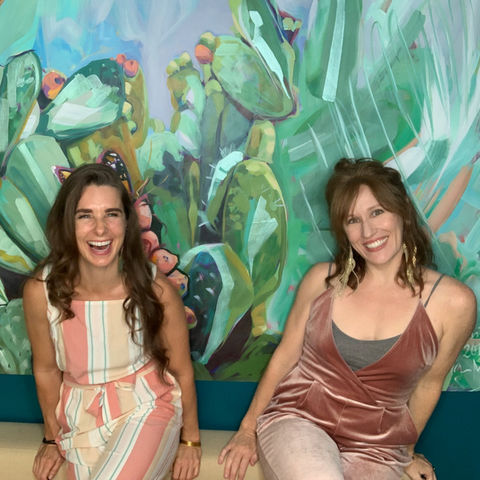
Thanks for joining us here on Pretty Spiritual where we're attempting the unthinkable about how to navigate this messy,
Beautiful,
Imperfect life with spiritual tools,
Principles,
And our own personal stories.
So we're not experts,
We're not religious,
We're definitely silly.
We're honest,
Real,
And willing to share.
So join us as we connect,
Bond,
And grow together.
Hi everybody.
Thank you so much.
Hello.
Hello.
Welcome to Pretty Spiritual.
We are so glad to be visiting you,
Coming at you from our tiny boxes here in quarantine.
Our life?
What?
We're up in the teen.
We're very excited to be here.
I'm Lindsay Poney and I have a couple of little boxes looking back at me.
Ella.
Hello,
I'm Ella.
That is the voice of Ella and we also have a voice of Annie.
Hi,
I'm Annie.
So today we are going to talk about feelings,
Emotions,
How to allow,
Tend,
And nurture,
Get to know our emotional bodies.
In the spirit of we've got to feel,
To heal,
Let's do this.
This approach of recognizing and accepting our feelings has felt radical to me.
I'm recognizing all the ways I've denied,
Pushed away,
Pretended feelings don't exist.
In this short amount of time,
I have felt real freedom.
This week I'm inspired to talk about feelings,
Specifically the feelings we are feeling or choosing not to feel.
How to name them,
How to feel them,
Maybe even heal them.
Instead of hiding or subsiding our feelings,
Let's bring them out.
What are some feelings you've been having this week?
What's it like?
Let's get real about feelings.
Ella.
Thank you,
Lindsay,
For choosing such a confusing topic for all of us.
I was laughing on the phone when I was talking to Lindsay last night because I had been doing this guided meditation with Gil Fronsdale,
Who is one of our favorite Vipassana teachers.
We're in the body and we're feeling sensations.
I was like,
I know how to do this.
Then he's talking about,
Well,
What are the emotions and feelings connected with those sensations?
I had this moment where I was like,
I literally have no idea what feelings are.
I was like,
How did I ever think I knew what they were?
Maybe I've never known.
It is great because I've had this week.
There's a lot to feel.
I had an experience where I made a mistake and hurt someone who I really care about.
It's interesting because when I was actively saying the things that were hurtful,
I was stuck in this experience of pride.
Then when I was feeling badly about how I had hurt this person,
I started to feel the self-judgment,
Self-blame,
Self-loathing,
And those all glommed together to create this shame experience.
For me,
Shame is a different way to say pride in reverse.
There are these two extremes where I'm either stuck in pride or I'm caught in pride in reverse and on both ends of the spectrum,
There's a lot of suffering.
For me,
It's like,
How do I feel those feelings without getting stuck?
What helps me to recognize that I'm having feelings is to pay attention to the full body mind experience I have and look for,
We like to call them signposts.
When I can see and acknowledge the signposts that go with certain feeling experiences,
Then it's a lot easier for me not to get caught.
So what pride feels like as a kind of embodied experience for me is a lot of pressure and squeezing.
There's this sense of urgency that I need to prove something.
I talk fast and forcefully and I'm prone to interrupting or stopping people when they try to talk.
It's so cringy to even talk about what that looks like for me because I like to think of myself as someone who doesn't do things like that.
There's some more suffering for the pride.
Then on the other end of the spectrum,
When I'm caught in shame,
What that feels like is this really murky space where I'm not sure about anything.
I'm often physiologically spaced out,
Like my body is twisted into some weird shape and I'm doing some kind of compulsive behavior,
Like picking at my head.
But my brain is working over stuff about how I'm like a monster and how I have no business being in close relationships with people because I'm toxic and I only ever cause harm.
So there's this physiological experience of being not here,
But also trying to check out,
Disappear.
And then there's this brain activation experience where all I can see is my own swampy toxicity.
And I'm also not sure about what belongs to me,
What belongs to other people.
So it's just this very confusing landscape.
Now that I have a sense from living both of those experiences many times,
It's easier to orient myself inside shame or inside pride.
The other thing that is helpful for me to just say out loud is that we have feelings,
Right?
And a lot of the time we like to say,
Oh,
I'm feeling this way because,
But what we point to when we point to anything as like the cause of a feeling,
In my experience is a very limited scope.
With these feelings,
I had something to point back to,
To say like,
Oh,
This is the cause.
I can attribute my bad feelings to this thing that I can see and understand.
But for me,
That's not really how feelings work.
That can be a part of it.
There can be an event that's a trigger,
But then the feelings themselves are kind of not,
I don't get to understand where they come from.
It's like our brains and bodies are association machines and something can trigger an association that triggers another one that triggers feelings that have been stuck in our bodies or memories that are stuck in our brains.
And then we're like caught in this experience that,
Yeah,
Maybe there was a trigger that we can point to,
But the actual feelings,
We don't really get to understand where they come from.
And so for me,
That's a helpful thing because when I,
When I get caught by feelings,
It helps me to look around and see what else is getting brought up by the experience because usually that experience alone isn't causing the shame.
It's all these other associations and past experiences that get me so caught.
So when we get to the tools section,
Hopefully I'll talk about something useful having to do with that.
Thanks,
Ella.
Thanks so much.
Annie,
Would you like to share with us about feelings?
Oh my gosh,
I would just be so excited.
Thank you,
Ella.
Thanks Pony for this topic.
I like in your intro,
I loved your intro.
I loved all the rhyming and I also like how you narrowed it down to this week,
Like our feelings this week,
Because my feelings change all the time.
And so this week I felt a lot of joy.
I often feel gratitude and those are easy feelings for me to have.
I enjoy them and so I roll with them.
But then I want to share about a negative feeling that I had this morning because negative feelings are harder for me.
I'm like,
Ooh,
I don't feel good.
I always have to feel good.
So I was walking my dog Ruby this morning and I live in the Oakland Hills,
Which is a beautiful place,
But it's a very densely populated on these pretty steep hills.
And I realized just this morning,
I've lived there for six years.
I've been walking dogs in this neighborhood for six years.
Just this morning I realized how I'm often filled with negative feelings by the nature around me.
And it's because I have this fear that it's all going to catch on fire.
This is a fun story.
So there are tons of eucalyptus trees in the Oakland Hills.
They're an invasive species.
They're not native to this area in Northern California and they're highly flammable.
They're filled with eucalyptus oil.
It sparks right up.
They have really dry bark and they grow super tall.
They're like 100 feet tall and they have a really shallow root system.
So it's kind of this bad recipe for being on these very steep hills where there's often like lots of fall and it erodes the trees anyways.
So every time I look at these trees,
There's thousands and upon thousands of them in my neighborhood.
This is what I think,
Right?
Danger,
Fire,
Destruction,
Flooding.
Both the neighbors on either side of my house have had 100 foot eucalyptus trees drop from above the hill and crash into their house.
So it's like those are the images that I think of when I look at these trees,
Which is pretty sucky because I'm outside a lot.
I walk my dog a couple of times every day and I have this feeling and I don't even acknowledge it as a thought.
It's just this kind of fact that comes into me and it's this feeling of fear and danger and safety and like anger.
I'm actually angry at the trees I realized.
So they're really beautiful.
So I just this morning I realized how this feeling of fear has blocked any real enjoyment I have from looking at eucalyptus,
But also it just clouds my whole experience anytime I step outside my house.
So in fact,
Anytime I just look at one of these trees,
I have this whole story play through.
So in my tools,
I'm going to share what helped me recognize that I had this feeling and then it's translated into this fear story that I've been carrying around since I lived here.
The tool that's kind of helping me that I'm just a baby beginner at,
Because obviously I just started trying it this morning,
But it helped a little this morning.
So more to come.
Thank you both so much.
Yeah,
I really have been forced into recognizing my feelings.
Isn't that great in all the work that I'm doing in trying to recognize my dysfunctional patterns.
I became more aware of the stuffing of feelings and how that's been a strategy of mine.
I've really gotten into how much I don't notice my feelings and how much I stuff them and then what it's been like to have an experience with them.
Just the whole other life that has sprung up and you both were really talking a little bit about that and what it's like to notice and become aware of and then be with these feelings.
It seems like such a bigger universe to me than the narrative of the story that I was more interested in than the actual feelings that were here.
It's been such a cool spiritual path and journey to get on and explore.
So thank you both for being willing to talk about feelings that are here and just how many feelings that I have within a day.
It's been really fun for this to be the topic this week because what I started writing on Monday,
Let alone to what's come up just yesterday and then today this morning,
I was going to talk about two quick feelings because one that really shocked me,
Which is a good feeling,
Right?
Because the good feelings are shocking to me that I would be proud of myself.
It's been so sweet because I've been working really hard on some behavioral patterns and doing a lot of writing and doing a lot of work and I'm doing it.
Even though I have all these other things to do,
Really been noticing,
Feeling really proud of myself and giving myself that kind of loving encouragement has felt really good.
I think also coupled with that,
What's really interesting is I'm scared to feel proud of myself.
Oh,
If I feel proud of myself,
Then I'll quit or it's not good to feel proud of yourself.
All of the things that come in and that is why I'm going to.
.
.
Then the other feeling that I've been noticing that's here most of the time and Annie,
You were talking a little bit about this,
Is all the manifestations of fear and how incredibly fearful I am.
I think a strategy that I had very unconsciously was that if I don't look at this fear or feel this fear or recognize this fear,
Then I'm going to be okay.
I'm going to be safe.
It's going to be all good.
What's been happening for me lately is the more that I play with and recognize and allow this fear feeling to be here and to really trace back within my emotional body where this taps into what's going on with it,
It kind of has a birth,
A life and a death.
I think all of the feelings probably do.
The more that I allow it to be here and get really curious about it and then to be with it,
I've just been noticing that my strategy for getting rid of pushing,
Pretending that it's not here really felt like it stunted the natural progression of this feeling,
Having a reason for being here and it being okay to be here and then it kind of moving on and all that that feeling has to teach me.
It's been really sweet to notice,
Observe,
Allow feelings to be here,
What they are,
What they feel like,
What it's like in my body and then what they have to tell me.
That's why I'm really interested in curious and feelings because before my strategy of just stuffing them,
Pretending that they weren't here,
It's not working anymore and it would get kind of,
They would end up coming out sideways and I wanted to have the story of why this feeling was here,
What this is attached to and what I'm noticing now is that my emotional body,
Just like Ella was talking about,
It doesn't have to have a story or a narrative and that's where I really get off track.
I really want to go and have the story,
Have this fit,
Understand why this feeling was here all the way back when my emotional body might be working something out that I have held and suppressed from when I was very small and today is the day that I get to really just have these big waves of emotion,
Whether it be grief or fear or there's a whole feelings list that we have on our website that you can check out.
Now that we've identified and shared our experience with feelings,
Let's talk about tools for identifying feelings and allowing them.
How do we get better at this or whatever?
Let's do it.
Thank you,
Pony.
I do love that of having a feeling or an emotion come up in just letting it be like maybe our body's releasing some thing that I don't have to know why I'm sad today.
Maybe that's just what needs to come through my nervous system and work its way out.
My tool is just really specific to this situation,
So hopefully it's relatable for some people.
I guess it could be applied to any really repetitive,
Not helpful feeling.
In this case,
I can't remove the thousands upon thousands of eucalyptus trees that surround my neighborhood.
When I see them,
Then I have this thought,
This subtle fear comes,
It's really immediate and I have a feeling of not being safe,
A feeling of unhappiness,
A feeling of dissatisfaction of like I have to change something.
My tool this morning was to have a visitor's mind.
It was so interesting.
I was walking up the street and all of a sudden it's like this film kind of lifted up from my eyes.
I was like,
I have this thought a million times and every time I have these feelings.
It was like this thing kind of opened up on my eyes and I was like,
What if I had a visitor's mind?
Because my wife and I travel a lot and when we go someplace,
I don't have a whole story on the trees or all the little things about the neighborhood.
I don't know.
I just go and I enjoy it,
What I'm experiencing for that moment.
What if I didn't have all this back dad on eucalyptus?
Took out my neighbor's master bedroom.
No,
Took out my neighbor's master bedroom.
Thank God she wasn't there with her kids.
All this stuff,
Anytime I see a tree or not just eucalyptus,
But whatever I decide the problem is.
What if I can just look at this beautiful tree with silvery,
Sagey leaves and fascinating roots and papery bark and just walk?
To get in the visitor's mind,
I had to even notice that I was competitive.
I just want to point out it's taken me six years to have that moment of awakening.
So obviously I needed a lot of practice for this tool.
I really think that having some meditation and some space is the thing that lets me have these little glimpses of awakening when they come because they're so brief.
And if I don't have my heart open to it,
Then they zip away.
I think underneath of it all,
Of like this fear and this feeling and this story is thinking that I have control.
So if I think enough about all the problems that can happen,
Somehow I'm in control and then I'm safe.
And it's obviously just reducing my enjoyment of life.
And to use a technology analogy,
It's like there's all these systems running in the background of a computer that I'm not using,
But they're just draining the battery.
So it's like this constant fear,
Feeling,
Thinking is just draining my juice instead of like,
Oh,
There's practical things I can do to prepare if there's a fire and that's all I can do.
You know?
So maybe I can just practice enjoying their beauty and then noticing that repetitive thought.
And then just really briefly,
I want to share that we all talk about this a lot and I learned this from these girls,
But RAIN meditation is really good for also just acknowledging that like I do have a feeling and it is fear and I don't have to,
Like Pony said,
Just shove that down.
Like it's a real thing that's happening,
But I can tend to it in a way that acknowledges it and nourishes it and then kind of safely contains it instead of it just being this rampant part that constantly runs through my brain.
So that's my tool.
So great.
RAIN is everything for all the feels helps so much.
Yes.
Andy,
Thank you so much.
I RAIN.
Yes.
I'm glad somebody mentioned that.
So I was just thinking,
Listening to you guys talk about how Tara Brock,
Who's one of the teachers we really liked,
Does this thing where she draws like a circle to represent awareness and then a line,
Which is like the things that are below the line or below the level of consciousness.
And when our feelings are below the level of consciousness,
They're driving us,
But we don't,
We don't get to see how.
And so for me,
That is such a helpful reminder of like why this work matters and why we care about doing it.
So I was talking about those signposts for me,
And those are really helpful in identifying feelings.
There's fight or flight and then all the other variations and freeze,
Spawn,
The other stuff that I can't remember all of right now.
And then on the other side of that,
There's attend and befriend.
And so it's like,
How am I going to allow and make friends with my feelings today,
Especially when they're shame,
You know,
Or like other really,
Really difficult feelings.
So one of the first things I did when I was like noticing how caught I was down a fears list,
It's just like all the fears I had about,
You know,
What,
What this means about me,
You know?
And so I got those on paper and out of my head and that by itself is really helpful.
And then I started to see these associations.
So I noticed how what the experience I was having reminded me of these other experiences where I've acted in a similar way and hurt people.
And so not only was I experiencing the feelings with this last encounter,
But then my brain was also going to these places by association of other times I had caused harm.
And this was like more evidence for the shame spiral.
But when I saw that it was like,
Oh,
Okay,
This isn't just about this,
You know,
Like there's this whole other pattern.
I was noticing that there was pride and pride in reverse,
Like I was talking about and seeing how these are opposites,
But they're both they're like different ends of the spectrum,
But they're both opposed to humility.
And I really love this definition of humility.
It says a clear recognition of what and who we really are,
Followed by a sincere attempt to become what we could be.
And if I am having this intense experience,
One way to think about feelings that's really helpful to me is that they're real,
But they're not true.
So like they're really happening.
It really feels like this.
But the ideas I have about myself that like I have to be right or that I'm the most horrible,
Toxic person in the whole world,
Like,
Yeah,
Those feelings are really happening,
But that isn't the truth.
And that really helps me to kind of put stuff in perspective,
Which I think is another way to think about humility.
And so the tool of humility is like the sincere attempt to become what I could be is I don't have to swing from extreme to extreme.
I don't have to swing from pride to shame.
I can actually get closer to the middle path.
I wish there was like a less messy way to find the middle path than by swinging from extreme to extreme,
Because I think that for me,
That's been the way,
You know,
But I noticed that as I continue growing in humility and growing in a sense of humor that I don't have to go so far and get so stuck as I used to.
In the aftermath of this,
I get to clean up after myself.
So I get to make amends to the people I hurt and work on changing these noticing and changing these behaviors that cause harm.
And I also get to let myself acknowledge that I'm a human,
That it's okay to be a human.
There's this one koan in Zen that I love so much,
I made it into a part of an altar once.
And they're talking about walking this spiritual path and the kind of like description is mistake after mistake,
One continuous mistake.
And it's like,
Oh,
If that's what this walking the spiritual path is going to be like,
Maybe I don't have to be so hard on myself about it.
Like,
Maybe I could just learn from these mistakes and let them do what they're here to do,
Which is teach me more about how to be kind and loving and accepting of myself and others just as we are.
Yay,
Tools.
I love it.
For my tools,
I really had to start by understanding myself.
And so if you're anything like me,
And your strategy was just to not feel one of the things I tell myself when and if I recognize that a feeling is coming,
I say,
I am allowed to have feelings.
I am allowed to have feelings,
Because my habitual already I see a feeling coming and I'm like,
No,
That's not there,
Whatever it is.
So I really love changing that for myself a little bit,
Which is really important.
And I also say there's enough room here for my feelings.
So I'm allowed to have feelings,
There's enough room here for my feelings.
One of the practices of the tools that I have been doing,
Because the feelings have been such an iceberg locked up in my body,
Is that I need to get in the habit of allowing,
Believing there's room,
That's where these mantras come in.
And then also I need to know how to identify feelings.
And how I do that is that I have a feelings list and I send my feelings,
Three of them,
To another tripod.
Sometimes I'll just read the list and I'll be like,
Not that,
Not that,
Not that.
And then I'll see a word and I'll be like,
Oh,
That's what I'm feeling.
And then I'm able to write a sentence of,
I feel when.
And then I,
So I do that three times,
I would like at least once a week,
But I am in the practice right now of doing that a couple of times,
It's really sweet.
And another tool that I like is to observe the life of a feeling.
So first I'm allowing,
Right,
The allowing piece is so important.
And I'm really glad that we talk about like compassion.
I forget that part too.
So allowing and then the compassion,
This can be here.
It's okay to have feelings.
It's okay to be human.
And then to really get to observe the life of it.
What does this feel like in my body?
Where,
Where is this?
What,
What,
What is the life of this feeling like?
And then to even notice how long that it lasts.
And oftentimes if I don't get involved with the story,
Then the feelings kind of come up like a wave,
You know,
They come and they go.
And it's been so interesting to really interact in this way with feelings.
And then I really,
Annie was talking a little bit about this with the traveler's mind.
And it's so important for me to remember that we can name the feelings objectively rather than subjectively.
So what that means is instead of my story of what's going on with this feeling,
I can be more objective about it.
And so that can be instead of,
I am angry that subjectively I can say anger is here,
You know,
And it really reframes for me.
Oftentimes when I recognize a feeling and I start,
You know,
Identifying with it and really getting into the story and what this means and who I am now.
And if I can start practicing and saying and reframing,
Oh,
Anger is here.
Oh,
Fear is here.
Okay.
Fear is here.
What's this like?
What's this seem like?
What's this connected to?
What's it feel like in my toes?
It really helps me to reframe all of it being so personal and it helps it to be more of an experience and experience that I'm having and to be more objective has helped me in so many ways in my life.
That's one of my most favorite tools is for me to recognize that very subjectively this is all about me.
This is very personal.
And to be able to how does one reframe it objectively?
What would that look like?
And for feelings,
It's just as simple as like,
Oh,
Pride is here.
Shame is here.
And it can really help me to get into it in a different way and to recognize and understand my emotional body and how it kind of has its own life.
It's really cool.
I've been thinking about my emotional body outside of myself and just like showing up to situations and it has a whole other like when shame shows up,
It's just like totally balled over.
And I've been having really a lot of fun letting my emotional body kind of lead me and see what it looks like in life in front of me.
And then it kind of helps me to show up and tend to it and give it what it needs so that it can be more integrated.
So feelings.
Yay,
Actually so much.
Pony,
I love how you said that you can identify it but not identify with it.
So like,
Oh,
Shame is here.
Yeah.
It's so helpful for me because when I like especially with something like shame,
It just engulfs me.
I'm like,
That's the reality.
That's my existence.
I am that.
I am that.
I love to,
Especially with those feelings that feel so personal and like bad to instead of saying like my shame to say the shame or our shame,
You know,
And I think about how we get to use our personal experiences to to like have a conversation about a spiritual solution and way of life that even though the circumstances are particular to our personal experience,
It's this bigger thing that isn't about us.
It's about all of us making this effort together.
And it makes it so much easier for me to just relax into the flow when I know that it's not me,
You know,
It's us.
And my my last mantra that I'll leave you all with that I've been using so much is it's not personal.
It's not perfect.
It's not permanent.
It's one of my favorites.
So thanks,
Everybody,
For exploring feelings and coming in like this way.
I hope that our listeners can take some time today and really check in with about what they're feeling.
Thank you all so much for listening.
We love you.
Love you.
The new life day.