Welcome to the mindfulness meditation podcast.
I'm your host,
Dawn Eshelman.
Every Wednesday at the Rubin Museum of Art in Chelsea,
We present a meditation session led by a prominent meditation teacher from the New York area.
This podcast is a recording of our weekly practice.
If you would like to join us in person,
Please visit our website at rubinmuseum.
Org slash meditation.
We are proud to be partnering with Sharon Salzberg and the teachers from the interdependence project.
In the description for each episode,
You will find information about the theme for that week's session,
Including an image of a related artwork chosen from the Rubin Museum's permanent collection.
And now,
Please enjoy your practice.
So we're talking about perception this month.
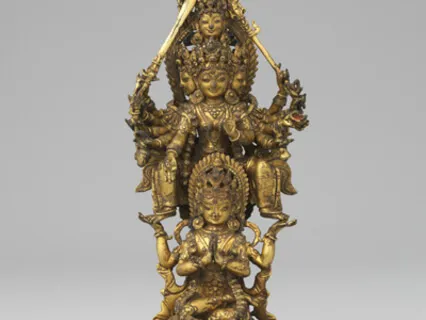
And today we have for you a sculpture,
A 17th century sculpture.
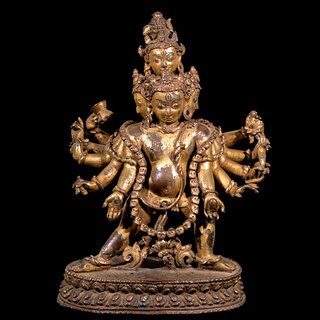
This is an esoteric mother goddess,
Siddhala Akshami.
And she's from the Hindu tradition and in Nepal.
And Siddhala Akshami is,
As we can see here,
Depicted with many faces,
Many heads that look in different directions.
And this is to symbolize her ability to see from many different perspectives.
So to see in different directions and to see clearly.
The instruments that she's holding in her hands are swords that symbolize the cutting through of delusion.
So this ability to see from many different perspectives and then this kind of,
You know,
Rather wrathful instrument here of the sword cutting through symbolizes a kind of focus and ability to let go of delusion.
It's interesting to note here that she is actually being supported by Shiva,
Her consort.
So we are definitely seeing a,
You know,
Often we'll see a figure and their consort in an embrace in that kind of a relationship.
But here we're seeing something really quite different.
And this is a very kind of supportive pose that Shiva is offering here,
Hoisting Siddhala Akshami on the shoulders.
And then below there's the figure on the very base of the lotus there.
Do you see that?
A kind of human figure.
And that represents the ego being overcome.
So lots of symbolism here in this one for us to take away today as we think about perception and how important that is to our practice and our lives.
Kimberly Brown is here with us today and it's great to have her back.
Thanks for being here,
Kim.
She has degrees in physics and literature and trained as a psychodynamic psychotherapist and is here with us from the Interdependence Project,
Which is one of our partners for this series.
She's a graduate of the first year long interdependence meditation teacher training program at the Interdependence Project.
And she studies Tibetan and American Buddhism.
And her teachers include Lama Norla Rinpoche and Sharon Salzberg.
Please welcome her back,
Kim Brown.
Okay.
Hello,
Everyone.
I'm glad to be back here at the Rubin today.
Thank you for having me.
How many of you have been keeping up with your practice since January 1?
Oh,
Amazing.
Terrific.
Terrific.
And how many of you are trying to keep up with your meditation since January 1?
Great.
Great.
Me too.
And is anyone here new today to meditation?
A couple of you.
Great.
Welcome.
Welcome.
Thank you.
So the theme this month at the Rubin is perception.
And Buddhism ostensibly is all about perception.
How can we use techniques of meditation and wisdom and see what is actually arising?
Can we have a direct experience of what we taste,
Smell,
Touch,
See,
Hear?
What's arising in our hearts and minds?
And can we notice our judgments,
Reactions,
Stories that arise on top of those?
And I believe many of the mindfulness teachers that come here will point out how mindfulness can help us see those add-ons.
In the stories about the Buddha,
The historical Buddha,
It said that he got enlightened.
This is the story.
He got enlightened.
Whether you're a Buddhist or not,
You hear about enlightened beings.
I was very excited about that when I first started studying and practicing meditation.
And I was mentioning to Dawn,
I had an idea that through these practices,
I would suddenly be this creature transcending my humanness into just light and love.
And then a teacher a couple years into my practice said,
Well,
You know,
Another way you can think of the Buddha's enlightenment is that he saw confusion.
He saw his confusion.
So what we're really talking about is misperception.
And can we begin to have a recognition of what we're misperceiving and how that misperception leads us into delusions and confusions?
There's one,
I was told by one teacher that the Buddha saw the dust motes of confusion.
He awakened.
Very powerful.
So certain misperceptions are very prevalent in our contemporary world.
Our misperceptions come from ourselves,
From our society,
From our history.
One of them is that we're born alone and die alone.
And this is demonstrably untrue.
Everybody is born with their mom.
And in this country,
In this time,
It's so unlikely there wouldn't be other people there helping you.
And then of course,
For most of us,
We will not die alone.
There will very likely be many people nearby at least with us.
So I point that out because if one has a misperception that you're born alone and die alone,
You are likely to make decisions that won't be quite beneficial to yourself and others.
You won't understand the interdependence of our lives.
This beautiful sculpture has Lakshmi standing on shiva.
Now Lakshmi is supported.
She's supported by her consort.
She is not alone in any way.
And for her to cut through her misperceptions and delusions,
She relies on someone else.
Her misperception,
This is one I struggle with and many people I know struggle with today,
Is that perhaps we don't have inside ourselves the necessary conditions to develop the qualities of compassion,
Of kindness,
Of concentration,
Of wisdom.
And maybe we think,
Hmm,
I could never do this.
I don't have great attention.
I think to myself,
Kim,
You're angry?
You shouldn't be angry.
You've been meditating for years.
It must be something wrong.
I think that means that's a sign that I don't have the right conditions to wake up.
You might think,
Well,
I need to buy this mala because this is going to help me with my meditation or I need to get a really pretty cushion.
So we have all the conditions necessary to do this work.
And again,
This artwork reminds us of that.
Siddha Lakshmi has so many eyes and heads to see so clearly.
She has the causes of happiness and happiness in this tradition is freedom from mental suffering.
She has that we know we can see her.
She has swords to cut through her delusions and her misperceptions and again,
She is supported.
In the Tibetan tradition,
In certain schools,
The first thing you learn is the first reminder.
There are four reminders.
They're also called the four thoughts that turn the mind to truth.
This first reminder is the fact that we have the causes and conditions necessary already.
Everyone in this room has an inclination to work with their heart and their mind.
You're here.
Everyone in this room has enough leisure time to work with your heart and your mind.
Everyone in this room has enough health to be able to do this work with your compassion and your clear vision.
We all live in a time where the teachings are available to us.
We have many teachers,
Many books.
We also live in a place where there is no war or famine.
We don't have a natural disaster and we don't have to struggle too much for our daily needs.
None of us have to go to the well three times a day.
All of that are the necessary prerequisites to doing this work,
Being able to access and develop our qualities of compassion,
Of patience,
Of generosity,
All of which we already have.
We can take this opportunity to use it for ourselves and others.
The Tibetans say this is what a precious human life means,
To have a precious human life.
It is very rare,
Very rare.
Now of course through their belief system it's rare because it's rare to be born a human,
Right?
Very rare birth.
Now I don't know about reincarnation or not,
But I do know this may be the only human life I ever have.
Certainly the only one is Kim.
So I feel that it's very important to use it and develop it to its finest degree.
And also through doing so I recognize how valuable it is,
How valuable each of your lives are too.
So in the spirit of waking up to these misperceptions and actually seeing how things really are,
We're going to do our meditation with our eyes open.
If you really can't do that,
Close your eyes,
But I encourage you to give it a try today.
And although we'll be seated,
I want you to think that you're standing up in your seat.
And what I mean is this is about waking up,
Not going to sleep.
It doesn't mean you have to put your shoulders way back.
It means your intention is to be clear and present for yourself right now and to seize this opportunity.
So with your eyes open,
You will gently allow them to gaze probably at the chair back in front of you.
So you'll be gazing at the chair back in front of you.
Keeping your eyes still.
They're not looking around just picking a spot.
Keeping your hands still.
They can be on your lap if you'd like on your thighs.
And bringing your attention to your feet.
Keeping your feet on the floor.
Noticing your seat,
Your belly.
Bringing your attention to the center of your chest.
Taking a moment to allow your intention to arise.
Your intention is whatever brought you here today.
And really appreciate it.
Noticing your feet.
Feeling the palms of your hands,
Your belly,
The center of your chest.
Really feeling your forehead and your cheeks and your jaw.
Allowing sound to enter your ears.
Feeling your feet.
Bringing your attention to your seat,
To your belly,
The center of your chest,
Your shoulder blades,
Back of your head.
Allowing sound to enter your ears.
Taking an empty breath or Bronchcontrol wheel,
IR neutralizing your voice electrocute by Noticing where you are,
Bringing your attention to your feet,
Allowing yourself to directly experience your feet on the floor.
Noticing your seat,
Your belly,
The center of your chest,
Allowing sound to enter your ears.
Noticing if your eyes have closed,
Considering opening them,
Feeling your feet.
Noticing your seat on the chair,
Bringing your attention to your shoulder blades,
The center of your chest,
Your forehead,
Your cheeks,
Your jaw,
Allowing sound to enter your ears.
Noticing the air on your skin.
Noticing your feet.
If you're feeling sleepy,
Stand up.
Keep your eyes open,
Feeling your feet,
Noticing your seat,
Your belly,
Center of your heart,
Allowing sound to enter your ears.
Noticing your seat.
Noticing your seat.
Noticing where you are,
Gathering your attention,
Paying attention to the experience of your feet,
Just allowing yourself to feel your feet.
Noticing your seat,
Your belly,
The center of your chest,
Your shoulder blades,
Feeling the palms of your hands,
Allowing sound to enter your ears.
Whatever you're doing,
Do a little less,
Allowing sound to enter your ears.
Noticing your seat.
Noticing your seat.
Noticing where you are.
Noticing where you are.
Noticing where you are.
Gently choosing to return to the direct experience of your feet on the floor,
Happening in this moment.
Feeling your seat,
Your belly,
Bringing your attention to your heart center,
Noticing your shoulder blades,
The back of your head,
Gently feeling your forehead and your cheeks and your jaw,
Resting in sound,
Allowing sound to enter your ears.
Noticing where you are.
Noticing where you are.
Remembering your great good fortune to have leisure time to practice,
To have teachers and teachings available to you,
To have support from so many other people working on their mind and their heart,
To live in a time and a place in which your needs are met,
There is no great disaster,
And you have enough health to work with your heart and your mind and develop the qualities you already have of compassion,
Of generosity,
Patience,
Wisdom,
Concentration,
Happiness.
Noticing your feet,
Bringing your attention to your seat,
Noticing your heart center,
Just bringing your attention to the center of your chest.
In a moment,
You'll hear the bell.
Please stay still until you can no longer hear it,
At which time if you'd like,
You can offer a bow to yourself for gratitude for practicing today.
Thank you everyone.
That concludes this week's practice.
If you'd like to attend in person,
Please check out our website,
Rubinmuseum.
Org slash meditation to learn more.
Sessions are free to Rubin Museum members,
Just one of the many benefits of membership.
Thank you for listening.
Have a mindful day.