Welcome to the mindfulness meditation podcast presented by the Rubin Museum of Art.
We are a museum in Chelsea,
New York City that connects visitors to the art and ideas of the Himalayas and serves as a space for reflection and personal transformation.
I'm your host,
Dawn Eshelman.
Every Monday we present a meditation session inspired by a different artwork from the Rubin Museum's collection and led by a prominent meditation teacher from the New York area.
This podcast is a recording of our weekly practice currently held virtually.
In the description for each episode,
You will find information about the theme for that week's session,
Including an image of the related artwork.
Our mindfulness meditation podcast is presented in partnership with Sharon Salzberg and teachers from the New York Insight Meditation Center,
The Interdependence Project,
And Parabola Magazine.
And now,
Please enjoy your practice.
Hello,
Good afternoon,
Everybody.
Welcome to mindfulness meditation online here with the Rubin Museum of Art.
Nice to have you join us today.
My name is Dawn Eshelman.
And as many of you know,
We are a museum of Himalayan art and ideas in New York City.
And here we are in our weekly program that pairs art and meditation practice.
So yes,
We'll take a look at an art from artwork from our collection.
We'll hear a brief talk,
And then we'll have a short sit together,
Just 15 to 20 minutes.
So happy October.
We are,
We're talking about growth this month.
And throughout our entire year,
We've been exploring this theme of impermanence that many of us have throughout the year experienced in ways that we did not expect.
And growth is a type of change,
A type of impermanence that,
While may offer some discomfort,
Right,
Often we have to get a little uncomfortable in order to grow.
But it is often an optimistic aspect of this idea of impermanence,
This sense that growth is part of our nature.
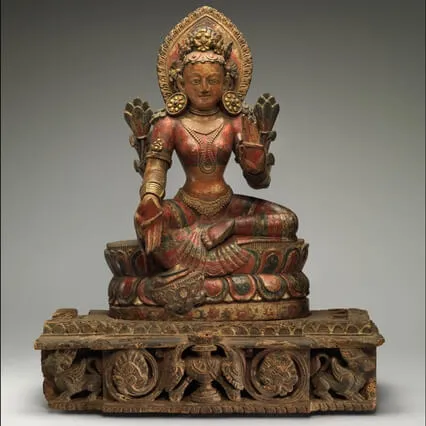
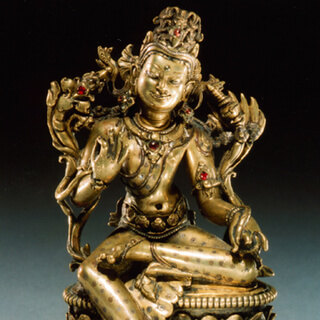
And so we're looking today at a beautiful sculpture made of wood from 1600s Nepal.
This is Lakshmi,
The Hindu goddess of wealth.
And if you're looking at this sculpture through a Buddhist lens,
You may identify this goddess here as Tara.
And in fact,
It's unclear which deity this was meant to depict,
But they're often referred to together and are,
You know,
It's this is this interesting interconnectivity between cultures and religions,
Right?
So as Lakshmi here,
She is the daughter of the mother goddess Durga,
And the wife of Vishnu.
And she is unequivocally this goddess of wealth,
Bounty of the harvest,
And not just physical and monetary wealth,
But spiritual bounty,
Right?
So both worldly and spiritual.
And we see that her abundance and her bounties depicted here in the ornaments that she is wearing all over her body,
We see a crown and earrings,
Necklaces,
A belt,
We see bracelets,
And a beautiful multicolored cloth and clothing.
And this is a wooden sculpture,
As I mentioned,
But it is painted here.
And also gilt.
And we're seeing her seated on a lotus throne.
We've talked so much about the lotus and what it represents.
And here also,
We're seeing these lotuses that are blooming everywhere around her,
Over her shoulders,
Underneath her.
And this also refers to this sense of bounty of beauty.
So this is also a time of year where Lakshmi is celebrated.
And so it's great to be able to spend a little time here looking at her together.
I'd love to hear a little bit from our teacher today about this idea of growth and how it relates to meditation,
But also the beautiful Lakshmi.
So delighted to have here with us today,
Lama Arya Droma.
Are you there?
Hello.
Hello.
How are you today?
Welcome everyone.
Thank you all for joining in today from all around the world.
I want to thank Dawn and her team,
And thank you,
Rubin Museum,
For hosting us in this virtual platform.
And so we could all come together.
I'm so absolutely delighted to connect with you all.
Although I can't see you all,
I hope you can feel my love.
So here's this beautiful artwork,
Goddess Lakshmi,
A very popular Hindu from the Indian tradition,
From the Hindu tradition.
She's the goddess of wealth,
Fortune,
Love,
Beauty,
Joy,
And prosperity.
And the lotus in her hand symbolizes the spiritual aspect,
Which is self-realization and spiritual liberation.
So she's the goddess of wealth and prosperity.
And during the Hindu New Year,
Which falls in October or November every year,
And this year it's in November 14th,
The devotee,
All the Hindu devotees from all around the world perform Lakshmi Puja,
Which is a ritual during Diwali,
The festival of lights.
And according to the legend,
Lakshmi,
The goddess of wealth,
Will visit her devotees and bestow gifts and blessings.
So to welcome the goddess,
We perform ceremonial pujas,
Rituals,
And the devotees all light their house with lamps to show her the path so she can come and bless the house with wealth and prosperity.
And it's about new beginnings and the triumph of good over evil and light over darkness.
And it's all about new growth.
So every year the devotees celebrate Lakshmi in the form of rituals,
And she's always prayed daily.
There are prayers offered to her daily in all these Hindu households,
So she bestows wealth and prosperity.
So I was originally born in India and practiced the Hindu tradition,
And I'm familiar with all these Hindu deities and enjoyed all these wonderful festivals associated with all these deities.
So it was praying to Lakshmi,
To Saraswati,
To Lord Ganesh,
To Lord Shiva.
And during my school and college years,
I studied Christianity,
And over a decade ago,
I formally studied and practiced Tibetan Buddhism and also learned Zoroastrian and the Islam tradition.
I feel so very blessed and so enriched to have the opportunity to study from these diverse religious and spiritual traditions.
In all these diverse multicultural,
Spiritual,
And religious tradition,
There's one important factor that connects them all.
And that is the practice of meditation and with the intention to transform oneself and to grow spiritually.
And now the artwork from the Buddhist tradition,
The deity is known as Tara.
And my name,
Drolma,
Is from the Tibetan Buddhist tradition,
Which also means Tara,
The liberator.
And Tara,
The deity Tara,
Is known as the mother of all Buddhas.
Tara is the most popular deity in the Tibetan Buddhist tradition.
Every Tibetan,
Whether you are in the monastery or you are outside the monastery,
Does the practice of Tara.
And every Tibetan monastery all around the world will chant Tara's praise daily to invoke her blessings,
Especially monastics like me who are in the spiritual path.
We pray to mother Tara for her protections and blessings and for her guidance.
So we will always be in the path and to lead us to enlightenment.
So Tara is a very,
Very beloved deity.
Here in this artwork,
The deity Tara,
She's seated upon the lotus flower.
And the lotus flower is a very sacred symbol associated with purity,
Enlightenment,
Compassion,
Transformation,
And growth.
And while she's seated on the lotus,
It's symbolic that she's fully enlightened.
And when you're fully enlightened,
You have the most compassion and a loving kindness.
That's what your heart is all about.
So her right hand is facing outward in the mudra of supreme generosity,
Indicating her ability to provide beings with whatever they desire.
And she's also seated in a very distinctive posture.
Her right leg is extended out to show that she's always ready and comes swiftly to anyone who immediately asks to assist anyone who calls for their help or anyone who prays to her with devotion.
Her compassion for all being a stronger than the mother's love for her children.
So her mantra is Om Tare Tu Tare Ture Soha,
Which means praise to the Tara hail.
More importantly,
As a spiritual practitioner,
You and I,
The ultimate purpose we pray to mother Tara is to develop the same qualities she possesses,
Such as peacefulness,
Loving kindness,
Generosity,
Compassion,
And wisdom.
And all the while,
The ultimate goal is to seek enlightenment.
Most of us often we think negatively about ourselves.
We have a lot of self doubt,
Fear,
Anxiety.
And if we think negatively about ourselves every day,
Gradually it becomes a habit and these negative aspects become stronger and stronger.
Example,
When we become very angry or fearful,
We find it very hard to calm ourselves.
So the ideas,
Especially during these challenging days,
There's so much uncertainty,
There's so much hopelessness and there's fear and you're wondering what is going to happen to my future.
And so each day when you have this fear and anxiousness,
You tend to make it into a habit and that's what you're giving your attention to.
But whereas here,
When we pray to mother Tara or pray to Lakshmi,
We are really asking their blessings to elevate us from these anxiety and fear.
And also they are symbolic of their beautiful qualities,
Which is our own innate nature,
The qualities of peacefulness,
Loving kindness,
And compassion.
And through them,
We try to acquire those qualities by chanting prayers to them or visualizing them or with our spiritual practice or,
And with meditation.
And so the reason we invoke mother Tara's blessings and pray to her is so we can transform our own minds and become more peaceful and compassionate person,
Which is our true innate nature,
Our Buddha nature,
And which we cannot see right now,
All this,
The Buddha nature that we have within us,
We cannot see it because we have our minds have so many obstacles and it's like a mirror covered by the dust where we can't see our own reflection.
And Tara,
The daily Tara is the manifestation of what each of us can become.
As such,
She shows us the good qualities we can cultivate like loving kindness,
Generosity,
Compassion,
Peacefulness,
And all the Dharma practices such as meditation,
Chantings are designed to transform our minds and purify our minds to experience our true selves,
Our own potential,
Becoming the best and attaining the qualities of Tara,
Which is our true nature.
So why am I emphasizing on these deities and their characteristics?
What is so important about them?
It's because during these challenging time,
Many of us feel,
Like I said before,
Anxiety,
Fear,
And stress,
And we're concerned and worried about our health,
Our financial situation,
And all this lead to grief and the loss of normalcy.
Nothing is normal today.
Everything has changed and these emotions can become overwhelming and we can get anxious and we may feel all alone facing the world.
And during these times,
It's very important to know that you're not alone.
You have Mother Tara,
Lakshmi,
And all these beautiful deities,
Buddha,
Whoever you choose to pray to,
To call on them to help you,
To protect you.
And whoever you are familiar with,
You don't need to be a Buddhist to receive Mother Tara's blessings.
Anyone can pray to Mother Tara and she will bestow her blessings.
And why is it so?
Because she is enlightened and there is no distinction from her that whoever prays to her,
She will bestow the blessing.
She'll protect them.
And Tara is known to protect people.
And during these challenging times,
We can practice mindfulness.
We can learn to deal better with negative thoughts rather than reacting unconsciously.
We can learn to be calm and peaceful during these adverse times.
And when you're calm and peaceful,
Your mind is more spacious to make the right decisions,
The right,
You can take the right actions.
So mindful meditation can be defined as learning to bring our attention to the present moment by focusing our breath and simply seeing whatever comes up without any judgment.
So what do we do normally?
We live in the past or we live in the future.
And that is why there are so many fears.
So when your attention wanders off to the future or to the past,
Your mind is constantly anxious and stressful.
And with meditation,
We bring our mind constantly to the present moment.
We learn to cultivate peace and calmness.
And by returning to the present moment,
We can actually cut through all this accumulation of stress and anxiety and develop clarity,
Strength and stability in everyday life.
Meditation is not just about peacefulness and calmness,
Although it's very simple,
It's really about,
It's very,
Very profound.
And with every day when you practice meditation,
Your intuition will only progress and learn through meditation,
The path to enlightenment.
So let's start the meditation today.
And today we'll use the breath as an anchor to focus our minds.
This is very popular method because we breathe all the time and it's very easy to put our attention on our breath.
And I'll give you a guided meditation.
When we start the meditation,
There are two essential points.
The first essential point is your posture.
So in this meditation,
We will sit upright and keep your spine as upright as you can,
But also be very comfortable.
I know there may be people who may have some pain at the back,
So do your best,
But sit upright and keep your spine straight.
And now the second essential point.
The second essential point is your mind.
So the mind is what actually does the meditation.
So the mind should be relaxed in the present moment of awareness.
This means if your mind is still in the office or at home or somewhere else,
You bring your mind's attention to your body.
And how do we do that?
By putting attention on our breath.
So the mind is like a monkey mind.
It jumps from one thought to another.
And so what does that mind need?
Mind needs anchor and the anchor is the breath.
There are many ways to anchor your mind.
You can do it,
Anchor your mind on an object,
On sound,
On tactile sensations.
But today we will put our mind's attention on our breath.
So today we are focusing on our breath.
So let's put our mind's attention on our breath and just to all come together and settle in,
Let's all take three deep breaths.
And when you exhale,
Just gently breathe out all your tensions and negative thoughts.
So let's do one.
Inhale deeply.
Exhale out.
The second breath.
Inhale deeply.
Exhale out all your stress and negative emotions.
And the third breath,
Inhale deeply.
Fantastic.
That's three breaths together we took.
Now please breathe normally and breathe at your own pace and rhythm because we all have different rhythms and paces.
So please breathe normally,
Okay?
And I will give you a guided meditation.
Again,
Please sit upright and you can put your gaze downward.
You can close your eyes if you want or you can keep them open,
Whatever you prefer.
So inhale and exhale.
Breathe in,
Breathe in normally and see your breath go all the way into your abdomen.
And as you breathe out,
Breathe out to the front of the space in front of you.
Just rest in that present moment of awareness.
And we will sit together putting our attention on a breath.
Breathing normally and keeping a mind in the present moment of awareness.
Now in the midday,
Just lying at the subscribers' place.
.
Inhale and exhale and as you exhale just breathe out into the space in front of you and just rest in that present moment of awareness.
Inhale and exhale just breathe out into the space in front of you and just rest in that present moment of awareness.
.
.
.
.
.
.
.
.
.
.
.
.
.
.
.
.
.
.
.
.
.
.
.
.
.
.
.
.
.
.
.
.
.
.
.
.
.
.
.
.
.
.
.
.
.
.
.
.
.
.
.
.
.
.
.
.
.
.
.
.
.
.
.
.
.
.
.
.
.
.
.
.
.
.