Welcome to the mindfulness meditation podcast presented by the Rubin Museum of Art.
We are a museum in Chelsea,
New York that connects visitors to the art and ideas of the Himalayas and serves as a space for reflection and transformation.
I'm your host,
Dawn Eshelman.
Every Monday we present a meditation session inspired by a different artwork from the Rubens Collection and led by a prominent meditation teacher from the New York area.
This podcast is a recording of our weekly practice.
In the description for each episode,
You will find information about the theme for that week's session,
Including an image of the related artwork.
Our mindfulness meditation podcast is presented in partnership with Sharon Salzberg and teachers from the New York Insight Meditation Center,
The Interdependence Project,
And Parabola Magazine.
If you'd like to join us in person,
Please visit our website at rubenmuseum.
Org slash meditation.
And now,
Please enjoy your practice.
Impermanence is the idea that things change.
And our theme this month here in our meditation program is happiness.
You may wonder,
How do we connect the dots between an idea like impermanence,
Which to many of us might seem like a pessimistic idea or concerning,
To this idea of happiness,
When in fact,
Through the lens of Buddhism,
It's a very central idea to achieving happiness.
The way to enlightenment is through embracing impermanence.
And we'll talk about this topic more throughout the year,
But for today,
I'm going to ask you to just imagine a recent dinner party that you had,
Surrounded by loved ones,
Eating something yummy.
I hope maybe you all have had a chance to have an experience like this recently.
If you haven't,
20-20 goals,
You know.
When we embrace change,
This is our definition of impermanence with this idea in mind,
The present moment comes alive and we awaken to connection,
Curiosity,
And even possibility.
So I'll let you chew on that while we talk about happiness here today.
And I'm so,
So delighted that Sharon Salzberg is our teacher for this,
Our very first Monday.
She is the co-founder of the Insight Meditation Society in Barre,
Massachusetts,
As many of you know,
And she is beginning again with us today in another way.
Today we are celebrating with Sharon the release of the 10-year anniversary edition of her beloved book,
Real Happiness.
This one right here.
Does it look familiar?
So this one,
I think,
Has some updated exercises and new tidbits for all of us,
And new guided meditations as well.
And it is being released here today in this program.
And Sharon will be signing copies right outside in the art lounge afterwards,
And we decided we were going to make a little celebration out of this.
So it's the new year,
It's the new decade,
It's our first Monday,
Sharon's releasing her book,
We're going to have a tea party.
What the heck.
So please join us afterwards for a little tea and book signing.
And I'm curious,
Too,
If anybody is here for the first time today.
First timers,
Welcome,
Great to have you.
Who comes every week if they can?
Great.
Somewhere in between.
Somewhere in between.
Great.
Thank you all for being here.
And today especially,
I just wanted to say howdy to those people listening via podcast,
Because we know some of them are folks that used to be with us here on Wednesdays every week.
So let's just give them a little round of applause as a way of saying hello.
We didn't forget about you.
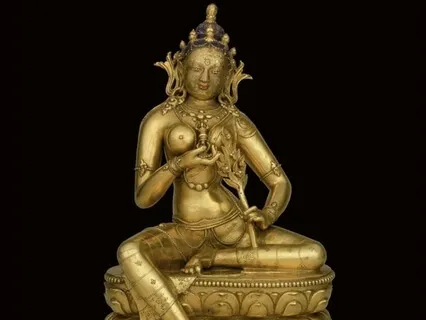
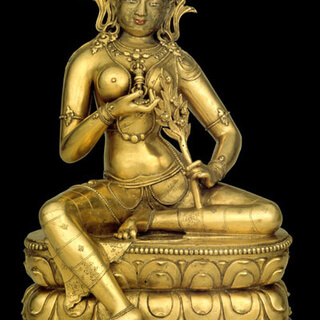
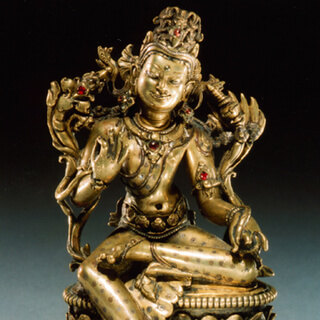
Today we're looking at a beautiful artwork from Mongolia,
17th century.
This is Dawn of Merici.
The goddess of the dawn is depicted in many forms.
Sometimes she rides a white horse through the sky,
Banishing the darkness and driving back the night with the orb of her son in her outstretched right hand.
This form of the goddess is in a relaxed pose,
Showing us how easy it is to banish darkness with light.
And the symbol here is really that of,
In a meditation or a spiritual practice,
Light overcoming dark.
The light of beginning again.
And it reminded me of this quote from Sharon's book.
It's never too late to turn on the light.
Your ability to break an unhealthy habit or turn off an old tape doesn't depend on how long it has been running.
A shift in perspective doesn't depend on how long you've held on to the old few.
When you flip the switch in that attic,
It doesn't matter whether it's been dark for ten minutes,
Ten years,
Or ten decades.
The light still illuminates the room and banishes the murkiness,
Letting you see the things you couldn't see before.
It's never too late to take a moment to look.
Please welcome Sharon Salzberg.
Hello.
Happy New Year.
I always say as a Buddhist and a Jew and an American,
I get three a year.
It's kind of good.
And there's all that attendant feeling of,
Well,
There are lots of feelings.
In Bering Mass,
The Insight Meditation Society and the community that grew up around the center,
We used to have a ritual.
They may still do it.
We have wood burning stoves and things like that in houses,
Not at the center,
Or fireplaces.
And we would take the previous year's calendar month by month and tear off January 2019 and say,
Oh,
And throw it in the fire,
Or February.
Not so bad,
But then there was that,
And we'd throw it in the fire.
And then there was a new year.
And that sense of beginning again,
As Don said,
And all the attendant possibilities.
And it is true that in the Buddhist tradition,
When they talk about impermanence,
There are different aspects to it.
There's the exhilarating opening sense of possibility.
Nothing is static.
We don't have to be frozen.
There's beginnings.
There's creativity.
There's emergence.
There's reemergence.
There's renewal,
All of that.
And then,
Of course,
There's the sense of everything's fleeting.
It's passing.
It's moving.
We can't actually successfully hold on to anything.
And herein lies so much of our suffering in that we keep trying,
Rather than acknowledging fully like,
Yes,
It's all in flow.
That's the nature of things.
And the Buddha used really beautiful images to describe this kind of combination of the two.
It's the wonder of the world that can exist and its ephemeral nature that we can't hold on to anything.
And he talked about life being like an echo,
Like a dream,
Like a rainbow.
Life being like a drop of dew on a blade of grass,
A flash of lightning in a summer sky.
It's all happening,
And yet it's all moving.
It's all changing.
And that's kind of the magic.
That's the wonder of our lives.
And I was especially happy to be talking about happiness,
Both because of the re-release of the book and just because partly through the original release of the book,
I began to see that it's,
From my point of view,
It's an often misunderstood quality.
The title of that book,
Real Happiness,
As many of you I'm sure have heard me say,
Was not the original title of the book.
It was going to be called Why Meditate?
And that's actually what it's about.
So it's always good.
And then somewhere in the process,
Before it went to print,
I got an advance copy of my friend Matthew Ricard's next book,
Which was called Why Meditate?
His book was going to come out in September.
I think mine was coming out the following January,
Something like that.
So clearly I had to find a new title.
And it was kind of a scramble.
And the publisher came up with Real Happiness.
I was a little bit torn.
On the one hand,
I thought,
That's what we actually want.
We want something that will sustain us,
That we can renew,
That we can access in all kinds of situations or circumstances,
Because those situations and circumstances will keep on changing.
So that's what we actually want.
And on the other hand,
I thought,
I'm going to get in trouble for this title.
And sure enough,
That's what it was called.
And as soon as I went out on a book tour,
People were challenging me.
The first interview that I did for the book,
The journalist said to me,
Are you saying that when I have a lovely dinner with my wife,
That's not real?
And I said,
Of course,
I do think it's real.
That is happiness.
And if anything,
If we paid more attention and we were less distracted and we had more gratitude for the wonderful things that come our way,
We would appreciate them more.
And yet what I said to him was,
What about the night you don't like your dinner all that much is all lost?
And I thought,
But did not say,
What about the night you don't like your wife all that much?
That happens too.
And then when I went on tour,
People,
It's the word happiness,
I think,
That triggers or activates a lot of feelings in people sometimes.
People can associate happiness with being happy-go-lucky.
Feeling superficial.
Only endlessly,
Relentlessly seeking pleasure,
Which we do anyway.
You don't have to buy a book for that.
But for me,
Happiness meant something much deeper,
Really a sense of resource.
It's like if you look at any description of,
Say,
The stress cycle,
We have the incident,
The occurrence,
The encounter,
Whatever it is.
And we have the way we're meeting it.
And this is something that is,
I think,
Very important to look at.
Because sometimes we can change the external circumstance,
And certainly we should try.
This isn't an invitation to just be inert and let anything happen.
It's not like that.
But we tend to overlook,
Because it's just not part of the culture,
Pretty much how we are meeting the situation.
And so we are disempowered.
We're defeated before we even try,
Or we feel isolated and alone.
Whereas really we could have a sense of community,
Perhaps in meeting that challenge.
We have strengths that we don't have.
Or we have a sense of possibility that gets blunted,
And we just feel stuck.
We know that just from life.
You can be in the most beautiful place in the world,
Like Hawaii,
The waterfalls,
Rainbows,
Surrounded by friends.
But you can't receive the love that's coming your way for some reason.
Something is blocked or obstructed,
Or you're frightened,
Or you're depressed.
You're not having a good time,
Even though you're in this gorgeous situation.
We can have a time of adversity of some degree or another,
Even a very big degree,
A large degree of challenge.
But we don't feel so alone.
We feel connected to others.
We feel we can receive the love and the care coming our way.
We have a sense of possibility.
We have a kind of commitment in our life.
No matter what happens to me,
I will try to be generating goodwill on this earth,
Or whatever it might be for you,
That gives your life meaning.
And so even in this really difficult,
Difficult circumstance,
You have that that's supporting you.
And it's a very different kind of experience.
And so we cherish this idea of an inner resource to really cultivate that,
Which I'm calling happiness,
Not in the ordinary sense,
But really meaning this,
That we have the possibility.
And this is not something that's being self-satisfied or self-preoccupied or overlooking the needs of others,
Or it's not about giving up or just being half asleep or something like that.
But it's a real critical look at what are the tools or what are the elements that really need to be in place for me to keep caring and keep moving and keep trying and all of that.
And that's one we can call happiness.
And of course for me,
A great deal of that has been born from my meditation practice.
It's really been,
For me,
Very powerful,
Really the primary way that I've been able to access and cultivate this kind of quality.
So let's do some practice together.
In honor of the new year,
We can just begin again and again and again and again.
So see if you can sit comfortably.
You can close your eyes or not,
However you feel most at ease.
See if you can have a posture where you can feel your back is straight,
But you're not stiff or uptight.
You're also relaxed.
And find the place where your breath is predominant or its strongest or clearest for you.
The nostrils,
The chest or the abdomen.
You can find that place.
In this system,
It's just a normal,
Natural breath.
You don't have to try to make your breath deeper or different.
Find the place where it's strongest,
Bring your attention there and just rest.
See if you can feel one breath.
I had a lot of performance anxiety in my early practice.
I had never taken a breath before.
And so I used to say to myself,
You're breathing anyway.
All you need to do is feel it.
So you're breathing anyway.
All you need to do is feel it.
And I say rest your attention lightly the way a butterfly rests upon a flower.
And while you may hear your breath or get an image of the breath,
We're really aiming toward feeling your breath one breath at a time.
If you want to use a quiet mental notation like in,
Out or rising,
Falling to support the awareness of the breath,
That's a great experiment to make.
But if you choose to use it,
Very quiet.
So your attention is really going to feeling the breath.
Okay,
Good.
Suarez.
.
.
.
.
.
.
.
.
.
.
.
.
.
.
.
.
.
.
.
.
.
.
.