Welcome to the mindfulness meditation podcast presented by the Rubin Museum of Art.
We are a museum in Chelsea,
New York City that connects visitors to the art and ideas of the Himalayas and serves as a space for reflection and personal transformation.
I'm your host,
Dawn Eshelman.
Every Monday we present a meditation session inspired by a different artwork from the Rubin Museum's collection and led by a prominent meditation teacher from the New York area.
This podcast is a recording of our weekly practice currently held virtually.
In the description for each episode,
You will find information about the theme for that week's session,
Including an image of the related artwork.
Our mindfulness meditation podcast is presented in partnership with Sharon Salzberg and teachers from the New York Insight Meditation Center,
The Interdependence Project,
And Parabola Magazine.
And now,
Please enjoy your practice.
Hello,
Good afternoon,
Everybody.
Thanks so much for being here with us.
My name is Dawn Eshelman and you are joining us for mindfulness meditation online.
We're here with the Rubin Museum of Art virtually and we actually just reopened.
We're so excited to share the galleries with you again if you are in New York City,
Which is where the Rubin Museum is for Museum of Himalayan Art and Ideas.
And it's just beautiful to see people coming in to enjoy the museum anew and a reminder that the change can be a beautiful thing and it's great to be able to welcome you all back.
So thanks for joining us for our weekly program here where we combine art and meditation.
And like we do with all of our sessions,
We're going to take a look at a work of art from our collection and then we'll hear a brief talk from one of our amazing teachers and we'll have a short sit,
15 to 20 minutes.
And today and this month,
Actually,
We're talking about change because change is in the air here in New York City,
The thick and heavy and hot air of summer is giving way to these cool breezes of autumn.
And that is just one reminder that seasonal change,
That change is actually around us every day.
And sometimes it's difficult and sometimes it's gorgeous,
But it is our constant.
So we're talking about that this month.
And we know that meditation can help us ride those waves of change because it helps us be more compassionate and accepting of the change that's going on within us.
So speaking of compassion,
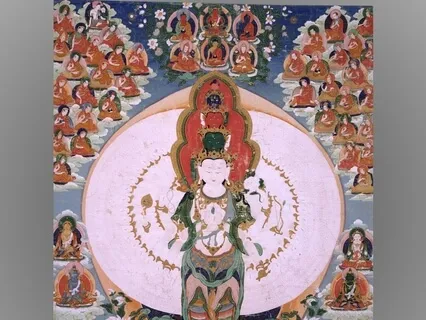
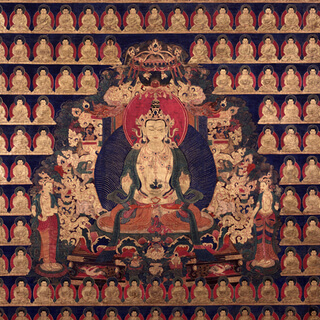
We are looking today at a beautiful thangka painting.
This is from the Ruben collection from 20th century,
Central Tibet.
This is a bodhisattva of compassion,
Avalokitesvara,
In a very peaceful expression and surrounded by generations of teachers,
This lineage,
This kind of evidence of a very meaningful kind of change throughout time,
All of these teachers connected in tribute to these teachings.
And the identity of Avalokitesvara has changed and adapted throughout time and cultures too.
So in China,
Avalokitesvara is known as a goddess,
Guanyin,
And in Tibet,
Chinrezig.
And in Avalokitesvara's different appearances throughout time and cultures,
He takes on different qualities,
Different attributes.
And from the Tibetan tradition,
There's a story I'd like to share about how Chinrezig got his thousand arms.
Because if you look closely here at this thangka,
You can see that there's this big white halo right behind the central figure of Avalokitesvara.
And that is actually,
If you can see the detail,
Many,
Many,
Many,
Many arms and even eyes that are embedded right into his palms.
So the story goes that as a bodhisattva,
Chinrezig wanted to dispel all of suffering,
All of samsara.
And so he did his divine best.
And even though he thought he'd done it,
He looked and there it was still all that suffering was still there.
And he was so devastated that he shattered into a thousand pieces this mighty God as delicate as glass.
He had a bad day,
Right?
Can you relate?
But as many of us do,
When we are struggling,
We get some help.
He got some help,
Some tools,
Some compassion from the Buddha Amitabha,
Who actually comes down,
The Buddha comes down from his pure land and changes those broken pieces into a thousand arms and eyes and 11 heads.
So he can see everything with clarity.
And this not only becomes a symbol for Chinrezig's ability to see clearly,
But each arm represents a different tool,
A different skill.
And this multitude of approaches conveys this kind of commitment to healing and a willingness to adapt to what kind of compassion is needed.
So I'd like to share with you a quote from another teacher,
Another teacher in our midst who we are very lucky to know.
And it goes like this.
We have the space to cultivate insight and discernment,
To break out of old habitual perceptions and take action on a different level.
This is where creative efforts are born.
Unexpected collaborations are nurtured.
Rigid timelines are disrupted and actions based on a greater vision of interconnectedness can find support.
And of course that is by our teacher today,
Sharon Salzberg.
And today we are here to celebrate her new book.
Hi Sharon.
And the book is called Real Change,
Mindfulness to Heal Ourselves and the World.
And what a great tool for this moment.
We're so excited to celebrate this launch of this new book and a real resource for people right now.
Sharon,
Thank you so much for joining us and congrats on your book.
Thank you so much.
It's a great delight to be with you all.
I keep thinking I'm in New York City now,
Which of course I'm not.
I see someone has joined us from New Delhi,
India,
Which may be the furthest distance and with the miracle of the internet,
No distance at all.
So thank you all for coming.
And I am so delighted that the museum is open again.
I'm sitting here in Bering,
Massachusetts next door to the Insight Meditation Society,
Which I co-founded in 1976.
And when we would have a retreat,
Especially a long retreat,
People would tell me from all over the world,
I kept thinking there were people on retreat there.
And that was so helpful to realize that somebody was doing an immersion into meditation.
Somebody was taking the time to just be with themselves and their own experience.
And even though I was busy working or whatever,
I kept thinking,
Oh,
That's there.
And so that's how I feel right now in terms of the museum and all of the imagery and the statues and thought,
Oh,
They must have been so happy that people are back there.
And I'm so happy that people are back there so that I have this feeling like,
Oh,
It's there.
It's alive and it's welcoming.
So that's a really good reflection.
I think personally when Avalokitesvara split into those thousand pieces,
That one of them probably became the Statue of Liberty,
Who is my personal icon.
And somebody pointed out to me that the color of the cover of my new book,
Real Change,
Is the same color as the Statue of Liberty,
Which made me so happy because I have,
I confess,
All of these chachkas,
These little eraser things and all kinds of things in the shape of the Statue of Liberty because she has meant so much to me.
And there are certain similarities between Chenrezig or Kuan Yin or Avalokitesvara and that imagery for me.
I mean,
Here is a person,
A woman,
Who is welcoming anybody,
Saying,
You have a place here.
You can find a time of belonging here.
You can have a home here.
And you have gone through such tremendous change,
Perhaps,
In getting here,
No doubt.
But here we are.
And it's fine.
You're going to be okay here.
And even you,
Wretched that no one else wants,
I will welcome you.
I will take care of you.
I will be present in the sense of,
Let me be your entryway into a new life.
I just found that so riveting.
And what I really did not understand or think about so completely until I was writing the book was that the Statue of Liberty is a woman on the go.
She has like a leg up.
She's not moving.
She's in mid-stride.
Usually we think of,
You know,
Maybe the torch or some other,
The poem or some other part of her existence,
But she is on the go.
And that reminds me of some of the imagery of the goddess,
The Bodhisattva Tara,
Who has a leg up in front,
Or you think about a thousand arms.
What do you need a thousand arms for?
Because there's lots of suffering in this world.
And that effort to hold it,
To be present takes a lot.
And that movement,
That sense of movement is in some ways a part of what compassion is all about.
It's not just recognizing the difficulty and it's actually not being overcome by the pain or the difficulty,
Which would just deplete us and not leave us with the energy to like take that step.
It's considered,
Compassion is considered a movement toward to see if we can be of help.
And that is just embodied in,
I think,
Not only iconography like the Statue of Liberty or Tara or Avalokitesvara,
But in our day to day lives,
It's that one step and the one thing we can do,
The one way we can respond.
I mean,
It certainly is a time of incredible change and disruption and chaos.
I say,
Lost you at this point,
So many things.
And it's hard to remember that change has many faces.
Like I'm sitting here in Massachusetts,
I'm looking out the window at these leaves that seem to be changing color.
And I'm kind of astonished because I came up here not expecting to be here all summer,
Which I was,
And you know,
And I had air conditioning and like dealing with the heat.
And I keep thinking,
Oh,
It's going to be so hot and it's not so hot anymore.
And the leaves are changing and time is moving on.
It's just it's a rhythm of being that sometimes we feel discordant with.
It's too much.
But change does have a lot of different faces.
Not only is there what we have all experienced,
That kind of rupture of the expected and the recognition that we cannot hold on to anything and that life is uncertain,
Life is fragile,
Life is moving.
It is also the beautiful face of change,
Which is openings and beginnings and not being stuck and a sense of possibility.
And they're both actually true.
And to be able to encompass both and recognize both puts us in a position where we can take a step in regards to seeing pain or suffering instead of feeling either avoidant and trying to deny or overcome,
Which are the two extremes that we generally go into,
To be able to hold both and to see,
Yes,
It's a tremendous state of loss for so many and so much difficulty in adjusting that.
And there's all that possibility as we open up to just that incredible rhythm of change.
And here we are.
There's so much that we can talk about or reflect about as we look at change.
But the most important thing seems to be really being able to have that almost that sense of balance and presence that can encompass the difficulty and the poignancy and kind of the sadness,
Even the sorrow of not being able to hold on,
Not being able to count on what we expected to be the case.
Somebody wrote to me and in writing back to them,
I had to look up an old email of theirs and the last email they had sent me was on New Year's Eve in 2020.
It was the last day of 2019.
And it was all like,
I can't wait for 2020.
Wow,
What an amazing thing.
A new year.
This has been a tough year,
2019.
And I just have the feeling of this arising moment.
So that was ironic.
And even with the recognition of all of that,
To have that sense of possibility,
To have that sense of just the capacity we all have for finding one another,
For caring about one another,
For compassion,
And compassion that includes compassion for ourselves,
It's really an incredible thing to have a big enough mind,
Big enough consciousness to be able to hold both aspects of change at the same time.
And it's really what we need to do.
It's the place from which wisdom will arise,
Insight will arise,
Much greater depths of compassion will arise,
Equanimity will arise,
And peace will arise.
So let's sit together.
One of my really favorite considerations these days is the word rest.
And using meditation as a place of rest,
Not sleeping,
But having a kind of sense of spaciousness,
A little bit of space from the maelstrom of thoughts and feelings and impressions and worrying and everything that may be going on.
That doesn't mean trying to discard those things or make them go away,
But it's having a place of rest so that we can watch things come and go without either being enmeshed in them or disliking them and pushing them away.
We just have some space.
So one of the primary ways we do that is through resting our attention on the feeling of the breath,
The actual sensations of the breath.
It is a place of rest because we don't have to contrive it,
We don't have to make it different.
Just to settle our attention and simply be.
You don't have to worry about what's already gone by,
You don't have to lean forward for even the very next breath.
And then as various objects of attention come and go,
Images,
Sounds,
Sensations,
We allow them to arise and pass away.
It's like looking at the sky,
That open,
That unconfined and all these different clouds and things are moving through,
It's great.
Our minds,
Our hearts can be as big as that sky.
So let's sit together,
You can close your eyes or not,
See if you can sit comfortably.
We'll start by listening to sound,
Whether it's the sound of my voice or other sounds.
It's a way of relaxing deep inside,
Allowing our experience to come and go.
And then bring your attention to the sound.
Bringing your attention to the feeling of your body sitting,
Whatever sensations you discover.
You can feel the earth,
The ground supporting you.
You can feel space touching you.
And then bring your attention to the feeling of your breath,
Just the normal,
Natural breath,
Wherever you feel it most distinctly,
The nostrils of the chest or the abdomen.
In that spot,
Bring your attention there and just rest.
If you like,
You can use a very quiet mental notation of in,
Out or rising,
Falling to help support the awareness of the breath,
But very quiet.
So your attention's really going to feeling the breath,
One breath at a time.
Surfaces may come and go,
Sounds may come and go.
Sensations,
Emotions can allow them to rise and pass away.
Just the clouds moving through the immense open sky.
If you get lost or confused,
Come back to the breath.
It's right there for you.
It's right there for you.
It's right there for you.
It's right there for you.
If you find yourself just completely lost in thought or you fall asleep,
Don't worry about that.
See if you can gently let go.
Just bring your attention back to the feeling of the breath.
It's right there for you.
It's right there for you.
It's right there for you.
It's right there for you.
It's right there for you.
It's right there for you.
It's right there for you.
It's right there for you.
It's right there for you.
It's right there for you.
It's right there for you.
It's right there for you.
It's right there for you.
It's right there for you.
It's right there for you.