Welcome to the Mindfulness Meditation Podcast.
I'm your host,
Dawn Eshelman.
Every Wednesday at the Rubin Museum of Art in Chelsea,
We present a meditation session led by a prominent meditation teacher from the New York area.
This podcast is a recording of our weekly practice.
If you would like to join us in person,
Please visit our website at rubinmuseum.
Org slash meditation.
We are proud to be partnering with Sharon Salzberg and teachers from the New York Insight Meditation Center.
The series is supported in part by the Hamera Foundation.
In the description for each episode,
You will find information about the theme for that week's session,
Including an image of a related artwork chosen from the Rubin Museum's permanent collection.
And now please enjoy your practice.
Hello,
Everybody.
Welcome to the Rubin Museum of Art and to our mindfulness meditation practice.
Great to see you be with you here today.
My name is Dawn Eshelman.
So we are talking this month about beginning again.
And we're talking about it now in January,
Because lots of us think about that kind of fresh start at the beginning of the year.
And then we also have the Lunar New Year coming up.
So we got a second chance.
But actually,
As meditators,
We know that beginning again can happen at any time.
And it happens actually many times during the course of a sitting meditation practice.
And that through that act of beginning again,
We can develop a true kind of response of compassion for ourselves.
So it's a practice of recognizing how we're treating ourselves when we realize that we need to begin again,
And bringing compassion into that moment.
And that's something that Sharon talks a lot about as that is the practice,
How we treat ourselves in that moment,
Which is such a helpful thing to think about.
And of course,
That idea of compassion is present as an overarching theme in much of the artwork that we have here in our collection at the Rubin,
Which is often Tibetan Buddhist art and certainly art from the Himalayan region.
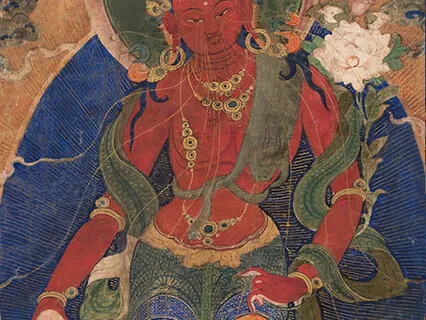
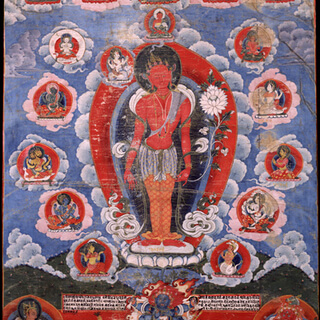
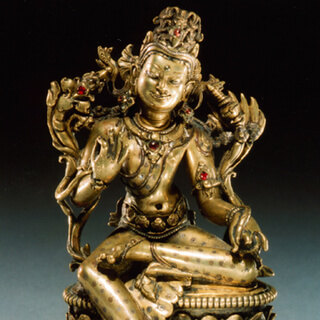
And so we're looking today at a work of art that depicts the Bodhisattva of compassion.
This is Avalokiteshvara.
And in this depiction,
Avalokiteshvara has red skin.
And this is common in the Nepali depictions of Avalokiteshvara.
And we see him wearing the jewels that a Bodhisattva would wear.
And Bodhisattvas are beings that have reached enlightenment,
But that have chosen to remain on earth in order to help others attain enlightenment as well.
So they have often are depicted in this regal way with princely jewels.
So we see here this beautiful crown and earrings and necklaces.
Also Avalokiteshvara here is showing us an important gesture with his right hand.
And that is the gesture of supreme generosity,
Giving gesture.
And then in his left hand,
He holds the stem of a lotus blossom.
And that stem kind of winds around his arm there and blooms over his shoulder.
And that lotus blossom is something we see over and over again as the symbol also of enlightenment.
But if we remember that the lotus has its roots in the muck of the pond and really draws upon that muck to present this beautiful pure blossom,
The symbolism there is also that we can do that in our lives,
Right?
And the clothes that Avalokiteshvara is wearing here are really quite beautiful and multicolored.
We see this beautiful green scarf that's weaving around his arms and torso.
And this multicolored skirt.
And then finally,
He stands upon this throne that depicts the moon and then underneath that the lotus blossoms again,
That's thrown.
And then out of his body all around him emanates these worldly gods and this kind of amazing assortment,
This fabulous party of gods here surrounding him.
And that includes at the top Vajradhara,
This blue figure with his consort holding the Vajra.
And then on the bottom left,
If you can see,
There is a little depiction of Ganesh,
The elephant,
Multilimbed there standing on his blue rat and even some wrathful protectors.
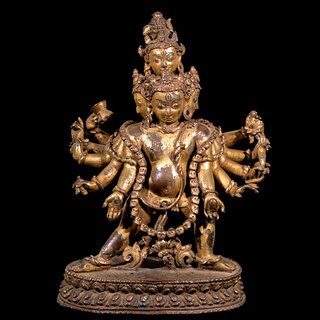
And we've been talking a lot about the wrathful protectors the last couple of weeks.
So you can see they're present here too on the bottom.
But this all goes back to this larger concept of compassion and that being a value and a tool that we can use most often first to direct it at ourselves in this practice and that help us begin again in a way that is useful and meaningful in our practice.
So we can put that into practice in just a moment here.
Sharon Salzberg is with us here again.
And it's been a treat to have her here all month.
We've been joking about beginning again and again and again and talking about this a little bit like Picasso's blue period,
You know,
These creative constraints,
Exploring this theme from different angles.
And it's been great to have her do that with us.
She is of course the co-founder of the Insight Meditation Society of Barrie,
Massachusetts.
She is a beloved teacher and author and her many books can be found up in the shop including Real Love.
Please welcome her back,
Sharon Salzberg.
Hello.
Welcome.
It's springtime.
And it's going to last,
Right?
This is it for this season.
Oh,
I'm so happy.
It's spring.
And speaking about beginning again,
Here we are.
This is my blue period.
It was actually just before you all came in talking to Dawn that it occurred to me what to say.
So that's really interesting.
But all of these topics,
You know,
They're so subtle and there's so many layers and they're so vast and you can approach from so many different angles.
And plus,
You know,
As I mentioned here before,
The kind of nature of Asian monastic pedagogy is constant repetition.
And they don't see anything wrong with that.
You know,
They think that's education.
That's,
You know,
The search for the novel and the entertaining makes no sense in that context.
You just hear the same thing again and again and again and again.
Strangely enough,
It kind of sinks in.
But what occurred to me was actually because of the introduction of compassion as well as part of the theme.
It was really,
It's actually more literally around the idea of forgiveness.
And forgiveness is a very difficult thing to talk about because it's a word that is interpreted and felt differently by so many different people.
As my friend Sylvia Boerstein would say,
Forgiveness is not amnesia.
You know,
So I'm not talking about wiping the slate clean.
I'm not talking about being stupid or reckless or,
You know,
Endangering yourself or somebody else or trying to forget the consequences of an action,
Whether you did it or someone else did it.
It's something much more subtle and refined and kind of precise than that,
Which has to do with like the remembrances of the possibility of always beginning again.
Not the certainty,
Right?
And again,
It's not sort of forgetting,
You know,
Common sense and intelligence and wakefulness at all.
But it's just a certain recognition.
Looking at ourselves,
For example,
We may not be exactly the person who did that very thing we're so freaked out about all these years later,
Right?
Time has gone on.
We've learned a thing or two.
According to Maya Angelou,
She said something like,
When you know better,
You do better,
Right?
And we're all in this process.
So it kind of came to me very strongly at a time when I was,
I learned that it also is part of Asian monastic ritual.
Very often,
There's a kind of almost a ceremony of asking and extending forgiveness when you end something.
You end a retreat or you end a program where you've been together over some time.
And it's not meant to in any way overlook like,
You know,
Terrible flaws or really harmful actions.
But it is setting the stage for the possibility,
Just the possibility that the next time you meet,
Should you meet again,
Things may be different.
Right?
So it sort of came home to me when,
You know,
I co-founded this retreat center in Barry,
Massachusetts in 1984,
Which is getting to be quite some time ago.
We invited this Burmese meditation teacher,
A monk named Sayada Upandita to come teach a three month retreat,
Which I was sitting and many of my friends were sitting.
I'd never met him before.
And we invited him because we heard he was a really fantastic teacher,
Which he was.
But what we hadn't heard was how incredibly like fierce and demanding and intense and even like ferocious he was.
And it was like,
Whoa.
He showed up one day and we began sitting the next day.
And he and I had a great relationship and it,
You know,
It worked out really well for my practice and all of that.
But I could also tell that,
I mean,
You know,
I helped start the center and I could just tell there was a lot going on behind the scenes.
To properly take care of a Buddhist monk or nun is often complicated.
If they adhere to rules very,
Very strictly,
They don't touch money,
For example.
So imagine this scene.
This was a new Pandita thing.
But,
You know,
One year we had a monk arriving at Logan Airport in Boston in a blizzard and didn't have any money and didn't have a credit card and no limo service would let him get in without having prepaid.
And they wouldn't let us prepay.
That was a complication.
It's kind of like that,
You know.
So I could just tell that that wasn't happening with Upandita,
But there were things happening.
For one thing,
There were very strict rules about where you sleep.
And he kept sleeping in different places and I was just like,
Why did he move over there?
You know,
And like,
That's weird.
And then he moved over there.
And at one point they built a wall and a corridor and then they took it down.
It was like,
Awfully strange.
But I was on a silent retreat,
You know,
So I didn't really know.
I could just kind of tell there was tension.
And this was also his very first trip to the West,
Actually,
Altogether.
And,
You know,
Something that is really priceless,
I think,
Within the heart of Buddhism is you can always ask questions.
You can insist on seeing the truth for yourself.
But these are also cultures of a lot of respect,
You know.
So you ask the question in a certain way,
You know.
You don't kind of say,
Show me,
You know,
Or you don't get an instruction and respond immediately with prove it.
You know,
Show me why I should do it.
I don't think so.
You know,
So it's both.
The questioning is always,
Always welcome.
But there is just a general flavor of respect,
Which did not exist here.
So there he was in the West for the first time.
And my guess was that there was an awful lot of,
Well,
I don't think so,
You know,
Or show me why.
So there was a lot under the surface.
So then he was the only person I spoke to for three months because it was a silent retreat.
And then the last day of the retreat,
He got up on the stage,
You know,
To say goodbye.
And to my surprise,
He said,
If you have hurt or harmed me in any way,
Knowingly or unknowingly,
I forgive you.
And if I have hurt or harmed you in any way,
Knowingly or unknowingly,
I ask your forgiveness.
And it was kind of an incredible moment because I realized that he and I did have a very good and strong relationship.
But I also realized that should I try to see him again,
I wouldn't have to worry that he was going to look at me and think,
You're the one that started that center.
They don't even know how to treat monks,
You know.
And also that I wouldn't look at him and think,
Well,
You're the one who came to the West totally unprepared for what you were going to find,
You know.
It's like we could meet again.
We could start over.
And in fact,
That's exactly what happened.
And just a year later,
I went first to Nepal and I went to Burma for three months.
And that's where I began loving kindness practice,
Which,
You know,
Changed the whole course of my practice and my teaching in my life.
So there it was,
You know.
It was an overt recognition that we may not be the same people in a year.
We don't have to hold on to what has happened before.
And again,
You know,
I'm not counseling this for like horrible harm or,
You know,
Where there are a lot of other considerations.
But there's a lot that happens in our life that we hold on to.
Assumptions and prior impressions that may not be that complete.
And we do it for ourselves too.
Right?
I could still think of myself,
It's not true,
But it wouldn't be that hard to think of myself as the person who was terrified of public speaking.
I mean,
There was a time,
As I'm sure I've talked about here before,
Where if I would have gotten on the stage and looked at and seen all you people,
I would have thought,
Oh my God,
You know,
What if?
What if I blow it?
I think I talked about it last week,
Right?
You know,
Like,
What if I make a mistake?
What if I,
What if my,
And my big fear is what if my mind goes blank?
We just sit here and I,
You know,
I speak for a minute and I say,
Let's sit.
You know,
Like,
Which I'm about to say,
Anyway.
You know,
It's so easy to hold on to those old ideas about ourselves,
Old ideas about others.
And we're not saying that they're all wrong.
But at least we want to have the space to check it out again in a kind of full on honest way.
Because there are so many surprises when we are able to meet life as it's unfolding.
And we're not just carrying all of that baggage,
You know,
From the past.
So let's sit.
So again,
You can sit comfortably.
If you like to start with just listening to sound,
Which is a way of relaxing deep inside.
Just let the sound wash through you.
And when you feel ready,
You can move your attention to the feeling of your body sitting and then to the breath.
Just the normal natural breath,
Wherever you feel it most distinctly.
The nostrils,
The chest or the abdomen,
You can bring your attention there and just rest.
Titans We If you like,
You can use a quiet mental notation,
Like in-out,
Rising-falling,
To help support the awareness of the breath,
But very quiet.
So your attention is really going to just feeling the breath as it appears,
As it changes.
And when you find your attention has wandered,
You've gotten lost in thought,
You've fallen asleep,
Whatever's happened,
You can appreciate the next moment as the chance to practice letting go and practice beginning again.
It's a new moment.
See if you can gently let go of whatever's distracted you.
Just shepherd your attention back to the feeling of the breath.
OK.
Thank you.
Thank you.
Thank you for listening.
Thank you.