Welcome to the mindfulness meditation podcast presented by the Rubin Museum of Art.
We are a museum in Chelsea,
New York that connects visitors to the art and ideas of the Himalayas and serves as a space for reflection and transformation.
I'm your host,
Dawn Eshelman.
Every Monday we present a meditation session inspired by a different artwork from the Rubens collection and led by a prominent meditation teacher from the New York area.
This podcast is a recording of our weekly practice.
In the description for each episode,
You will find information about the theme for that week's session,
Including an image of the related artwork.
Our mindfulness meditation podcast is presented in partnership with Sharon Salzberg and teachers from the New York Insight Meditation Center,
The Interdependence Project,
And Parabola Magazine.
If you'd like to join us in person,
Please visit our website at rubenmuseum.
Org slash meditation.
And now,
Please enjoy your practice.
Hello,
Hello there.
Welcome to the Rubin Museum of Art and to our weekly mindfulness meditation practice.
You're all here on a Monday.
It's wonderful.
Thank you for being here.
And my name is Dawn Eshelman.
I'm head of programs here.
Anybody here for the first time?
Welcome.
Who comes every week if they can?
Welcome back.
In between.
Hello.
Shout out to our podcast listeners.
So this is our second Monday together.
As those of you know,
Who've been coming for a long time,
We are new to Mondays.
And it's exciting to see that many of you are able to be here,
Many familiar faces and then some new faces too,
Which is awesome.
So if you were here last week,
You heard me mention that we are engaging here at the Rubin in kind of a year long conversation about impermanence.
This is such an interesting one,
Because I think there are a lot of associations that come up at first when you think about this idea of impermanence or change that can be really challenging.
But in fact,
When we spend time with the idea and really unpack it,
You know,
We come to understand that it's a very exciting concept,
This idea that nothing stays the same,
That our ability to embrace change is really what keeps us feeling alive and connected to each other.
So it is with that kind of positive side of impermanence that we're talking about happiness here this month,
As our monthly theme here in mindfulness meditation.
And again,
You may think that,
You know,
It's a challenge to link this idea of impermanence with happiness.
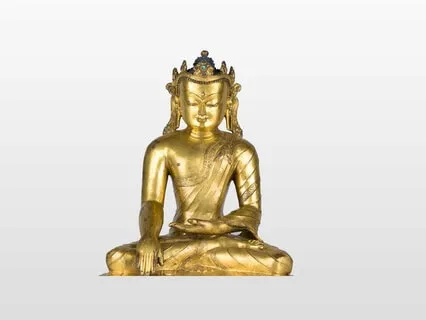
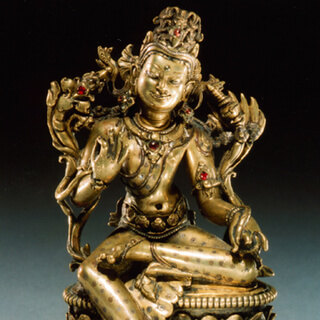
But if you were asked to ask this peaceful gentleman behind me,
He would tell you that it was absolutely essential.
This is the first step in embracing a truly happy life is to really look at all of the experiences that life brings,
Including suffering,
Which is something that connects all of us.
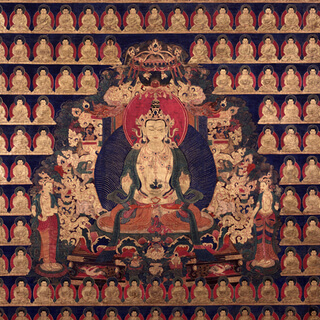
So this is,
Of course,
The Buddha,
Shakyamuni Buddha.
We're seeing him here in his princely robes and jewels.
So the big jewelry hanging from his earlobes there,
You will see in other depictions of the Buddha,
He will have holes where his jewels used to be,
Right?
And that depicts him after the time that he has given up his princely wealth to really go searching inside of himself for this end to suffering.
And we see his crown as well here.
He's seated on a lotus blossom throne.
And again,
The lotus is the symbol we see throughout Tibetan and Himalayan art that reminds us that we can,
Even if we're rooted in the muck,
We can blossom purely,
We can really transform that into nutrients,
Right?
And last but not least,
He's touching the earth.
And this depicts a very famous and crucial moment in the Buddha's life,
When he has sat for so long,
Really trying to understand enlightenment and move beyond suffering.
And he does this,
Long story short,
He really achieves this in the moment where he asks the earth to witness him in the present moment.
And that is the point at which,
By touching the earth,
He becomes enlightened.
So,
The path to happiness starts from an understanding of the root causes of suffering,
Says the Buddha.
And also,
Since we're meditating here today,
It tells us that meditation is not about detaching from the world,
Rather,
It's a tool to really engage with the parts of ourselves that struggle and to have compassion for them,
And acknowledge them and move through them.
And it is again,
That earth touching gesture that really resonates with this idea of impermanence,
This moment of just acknowledging not the past,
Not the future,
But just right now,
The now that connects all of us.
Tracy Cochran is back.
So nice to have you back,
Tracy.
She is a writer and the editorial director of Parabola Magazine,
Which is a beautiful tome,
Which you can find up in our shop,
And also online at parabola.
Org.
And in addition to teaching here at the Rubin,
Tracy teaches at New York Insight and every Sunday at Hudson River Sangha in Tarrytown,
New York.
You can find her via Parabola on Facebook or Twitter or TracyCochran.
Org.
Please welcome her back.
Here I am.
Hi.
Happy New Year.
And I love teaching here.
And so I wanted to tap into and tackle this assignment of this suggestion of happiness.
And I have to confess,
It plunged me into despair.
It really did.
It really did,
Because I had a deep wish to bring something real and sincere.
And the more closely I looked at the world and myself,
The more I despaired.
How can we be happy?
And I expect that some of you have made resolutions.
Is that right?
It's like there's like a nervous tick in us.
We just can't help it or think that we should.
And I've been sitting with that word,
Resolution.
And remember,
It doesn't just mean a firm intention to change something.
It also means in music to come to another harmony.
Discord becomes harmony.
And it also,
At Parabola,
We're often asking people for high resolution pictures.
And you send that in high res.
It means more detail,
To see more closely.
And so I began to experiment with looking at myself with at least a wish.
We start there,
To see myself with a broader vision.
Can I see more?
Can I include more?
And can I bring an attitude of acceptance to what I see?
That is also resolution,
High resolution.
But still,
The world,
Am I right?
The world,
Impermanence isn't just a passing of moments.
It can have the scariest feeling,
The climate.
It was so pretty out this weekend,
But I bet I'm not alone in feeling a little bit of anxiety,
Right?
It's beautiful out.
It's not supposed to be like this.
This can't be completely good.
And this feeling that something,
Anything could happen next.
Anything could happen at any time.
This is also a definition of impermanence.
But I kept searching,
And with a wish to see clearly,
And I got more and more sad when I thought about the climate and the animals and the strife in this country and the implosion of the working class.
The doors are locked.
You cannot escape.
And I'm going to keep telling you things to feel incredibly sad about.
In addition,
Now let me get to your own lives now.
And that I was thinking,
What do I need to be in place to feel completely happy?
And not just pleasure,
But happiness,
Which would be a feeling of satisfaction and ease and meaning and peace.
And I began to make a list.
It was quite a list because it began to include the outer world.
And everywhere you look,
There's suffering.
And then in complete desolation,
This is the way it often is.
I made a discovery.
It's like a spring appearing in a desert.
I noticed that when I look back,
And you can try this,
Even as you sit here or listen,
When I look back at my life,
It opens up so that I begin to notice tiny moments of happiness,
True happiness that appeared,
And often in the midst of the most difficult conditions.
In the time of sorrow,
There was some connection with a friend.
There was a moment of real happiness with my daughter,
A shared meal.
And I began to see that happiness is not what we think it is when we make our lifts and our resolutions.
There's something that opens in us.
And a clue is when we come here to sit together,
Or when we sit alone,
There's something inside us that knows that there's more to us than our biography,
Than what we think we are.
Even if we're carrying heavy burdens,
There is also a presence in us that can see and receive with not just acceptance,
But forgiveness and love.
But I wanted to tell you a quick little fairy tale,
Because I think it makes this point more eloquently than I can with these words.
And it's an ancient tale,
As many of the best tales are,
Including the great myth of the Buddha's awakening.
And in this tale,
Which happens to be in the current parabola,
It's,
Listen to it,
In my version,
There was once a woodcutter.
This is how he made his living.
He cut wood.
And there are still people who do this.
And he was very poor.
And they're still very poor.
He owned an axe and two meals.
And that was it.
And with working from dawn to dusk,
Cutting wood and selling it,
He supported his wife and his family.
And one day,
After decades of this,
He despaired,
Because he was still poor and getting poorer.
It's like the minimum wage just staying at $7.
25.
And he was so disheartened,
He took to his bed and refused to get up.
And his wife was very alarmed and said,
Get up!
You're always hot before dawn to go in the woods.
And he said,
I just can't do it anymore.
I can see where this is going.
Have you ever woken up with that feeling?
I have.
It's like you wake up and you know where this is going.
Not just the day,
But life.
And there is no point in helping it along.
And this is how he felt.
So finally she gave up.
And he just stayed in bed.
And a stranger came to the door and said,
I notice your two mules in the yard.
And I need to carry something today.
Could I ask your husband to help me?
And the wife said,
You can try,
But I don't think it's going to work.
And up the stairs he went.
But the man refused.
No,
Thanks.
No,
Thank you.
I am not going to do another terrible day's work for nothing.
Well,
Can I take your mules then?
Yeah,
Sure,
Go ahead.
So the man went off with these two mules to a field where he found a hidden treasure.
It was a treasure that he knew belonged to the sultan.
Because this is a tale from Asia Minor.
But he was going to take it.
And so he did.
He loaded it up and strapped it to these mules who were practically buckling under the weight.
And off they went.
But there were soldiers on the road.
And the man knew that he would certainly be executed if the sultan discovered he was confiscating his wealth.
So he ran away.
And these poor mules knew nothing more but to plot their way home.
So they came lumbering into the courtyard laden with treasure.
And the wife was like,
Oh my God,
This is something.
You got to go.
You better come downstairs.
No,
I don't care what it is.
So she opens a sack and gold coins fall out everywhere.
And now he comes downstairs.
That gets his attention.
That just by giving up completely this incredible wealth appears.
And in the traditional telling he is going to stop chasing happiness and fortune because the ancient root of the word happiness,
Hap,
Means what happens to us,
Our fortunes.
And he is going to take to his bed until fortune or having us comes to him.
And so this might seem like just a tale.
But I invite you to see as we prepare to sit that there is an attention in you,
A capacity for presence that can bring a kind of gold into your life,
Into all of our lives,
Exactly as they are with oppression and injustice and money problems and health problems and work problems and kid problems and everything problems.
No matter what we are stressed about or burdened with,
We are also capable of being touched by an awareness that operates at a completely different resolution that sees us and accepts us with complete acceptance and forgiveness and love.
We are welcomed here.
There was an image of touching the earth.
You belong here on earth.
You're welcome exactly,
Exactly,
Exactly as you are today.
Not some improved version that you have as a fantasy,
But what's here right now.
So let's sit together.
And notice how it feels to have your feet firmly on the floor and back straight.
And just see how you are,
Feel how you are.
And just see that whatever you find,
Tension,
Ease,
Everything is welcome to be here.
And begin to see that this attention is a kind of light to see by and a warmth to a feeling of being present.
And see that in the light of this attention,
You can begin to relax just as you are.
And see that you can always come home to the breath and the sensation of being in a body.
Seeing the earth of your body.
And see that when you come home to the breath and the body,
You don't close,
You open.
Let's do it.
And there are all kinds of thoughts and sensations.
And memories that appear and you let everything be just as it is.
And come home to sensation.
Seeing that there is a light of attention in you that isn't thinking and judging.
That sees without judgment.
And you can see that there is a light of attention in you that isn't thinking and judging.
And there are all kinds of thoughts and sensations in you that isn't thinking and judging.
And you can see that there is a light of attention in you that isn't thinking and judging.
See that there is a vibrancy inside you,
A life that's warm and responsive.
It's sensitive.
See that you don't have to think to open to receive life.
It's constantly being given to you.
And you have a capacity to receive.
See that there is a light of attention in you that isn't thinking and judging.
And you can see that there is a light of attention in you that isn't thinking and judging.
When you get lost in thinking,
Just come home again,
Touching the earth,
The body,
The sensation of being present.
And allowing yourself to see that there is an attention present that sees without judgment,
That accepts and forgives.
See that there is a light of attention in you that isn't thinking and judging.
See that there is a light of attention in you that isn't thinking and judging.
See that there is a light of attention in you that isn't thinking and judging.
See that there is a light of attention in you that isn't thinking and judging.
See that there is a light of attention in you that isn't thinking and judging.
See that there is a light of attention in you that isn't thinking and judging.
See that there is a light of attention in you that isn't thinking and judging.
Seeing that this stillness is very alive and fine.
See that there is a light of attention in you that isn't thinking and judging.
See that there is a light of attention in you that isn't thinking and judging.
See that there is a light of attention in you that isn't thinking and judging.
And see how it feels to be completely forgiven.
To be seen with complete clarity and acceptance and love.
See that there is a light of attention in you that isn't thinking and judging.
See that there is a light of attention in you that isn't thinking and judging.
See that there is a light of attention in you that isn't thinking and judging.
Whenever you get lost you can come home again and find welcome.
Thank you.
Thank you.
Touching the earth of this body and this life we also open to an awareness that sees with complete forgiveness,
Clarity,
Compassion.
Thank you,
Tracy.
That concludes this week's practice.
If you would like to support the Rubin Museum and this meditation series,
We invite you to become a member and attend in person for free.
Thank you for listening.
Have a mindful day.