Welcome to the mindfulness meditation podcast presented by the Rubin Museum of Art.
We are a museum in Chelsea,
New York City that connects visitors to the art and ideas of the Himalayas and serves as a space for reflection and personal transformation.
I'm your host,
Dawn Eshelman.
Every Monday we present a meditation session inspired by a different artwork from the Rubin Museum's collection and led by a prominent meditation teacher from the New York area.
This podcast is a recording of our weekly practice currently held virtually.
In the description for each episode,
You will find information about the theme for that week's session,
Including an image of the related artwork.
Our mindfulness meditation podcast is presented in partnership with Sharon Salzberg and teachers from the New York Insight Meditation Center,
The Interdependence Project,
And Parabola Magazine.
And now,
Please enjoy your practice.
Welcome to mindfulness meditation online with the Rubin Museum of Art.
My name is Dawn Eshelman.
And for those of you who are new to us,
We are a museum of Himalayan art and ideas in New York City.
And we're so happy to have you all joining us today for our weekly program where we combine art and meditation online.
For today's session,
We will look at a work of art from our collection.
We'll hear from our wonderful teacher,
Sharon Salzberg,
Who is back with us.
We've missed you,
Sharon.
And we'll then have a short sit,
15 to 20 minutes.
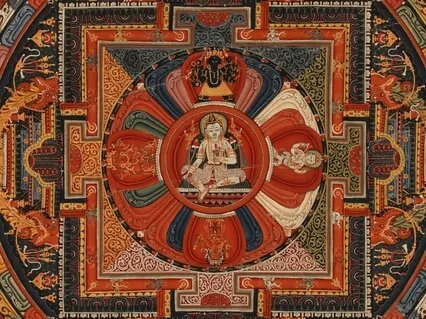
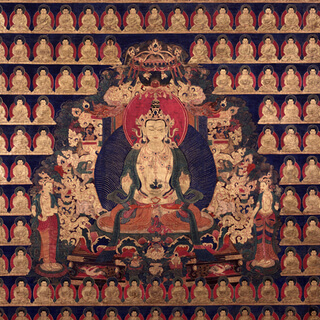
So we're looking today at this beautiful mandala.
This is from 15th century Nepal.
And this is the mandala of Amoghapasha,
Five deity mandala.
And Amoghapasha means unfailing lasso.
So it refers to this unfailing compassion like a lasso,
Which is constantly reaching out to all sentient beings and inviting them into the state of compassion and happiness,
Which ultimately can lead to enlightenment.
So if there was ever a cowboy for compassion,
This would be Amoghapasha,
With this lasso reaching out.
Amoghapasha is a complicated deity and subject in tantric Buddhist iconography and actually is another form of Avalokitesvara,
A deity that we talk about on a regular basis here.
And actually at the center of the mandala is Avalokitesvara,
Surrounded by other deities.
Immediately there are four around him there.
And then in the four corners of the outer section of this painting,
You can see four additional deities and figures,
Including Buddha Shakyamuni at the very top left.
And a mandala,
If you remember from our previous conversations,
Kind of exists in many realms.
We have this very kind of literal practical overview of as if we were looking from the top down of a palace.
It is kind of like a footprint of an actual palace with the center room being occupied there by Avalokitesvara.
And then these four gates of entry at each of the four sides,
The four directions there.
But it is also considered a map of the cosmos and even in another reality,
The map of the inner self and is often used as a guide that practitioners can use to take steps closer and closer to the center of their practice,
Of what they are working towards.
So the main meaning of this mandala here today is this idea of that unfailing lasso,
This continual kind of reaching out of compassion.
And so that's part of the reason that we selected this with Sharon today to look at with you because of that sense of resilience.
And that's what we've been talking about all month today,
This idea of resilience and how we see that in the world around us,
In ourselves and in our practice,
How meditation can be a resilience practice.
So we'll hear from our teacher today,
Sharon Salzberg,
And what she has to say about meditation and resilience.
So Sharon Salzberg is the co-founder of the Insight Meditation Society in Barre,
Massachusetts,
And has guided meditation retreats worldwide for many years.
She has a beautiful new book called Real Change,
Mindfulness to Heal Ourselves and the World.
And you can find that at the Rubin Shop or anywhere books are sold.
And she has many other incredible,
Useful,
Practical,
And just wonderful to read books.
And they make incredible gifts too.
So I hope you will join me in welcoming her back.
Hi,
Sharon.
Welcome back to the Rubin.
Sharon Salzberg Thank you so much.
I feel almost like I'm there,
Which makes me very happy.
Sharon Salzberg That's so nice.
Yes.
Let's pretend.
And here we are together,
Which is a tremendous thing.
So thank you for all the work and fostering that and creating and sustaining this community,
Which is really great.
So the topic of resilience,
Of course,
Is a great and compelling topic.
Not too long ago,
I had to look up somebody's email address.
And the last time I'd heard from them was last New Year's Eve.
And ironically enough,
The email that they sent was full of eager anticipation for 2020 and how much better it was going to be than 2019,
No doubt.
And that sense of starting over or new beginnings.
And then,
You know,
Just this really overwhelming sense of difficulty and strife and struggle and chaos and disruption and loss and so many things that are really a part of this year.
And here we are,
We're about to have another new year,
Not too long from now,
Which will be really interesting.
But every day,
I think the question of resilience comes up,
You know,
That sense of beginning again or going forward.
Bouncing back is probably the most classical way of seeing the term.
And I often think that that that term,
That idea of bouncing back is a little static,
Like we're going to come back to just the way things were before.
We're going to have enough energy.
We're going to have enough stamina in order to return.
But the truth is,
Of course,
What we return to is not exactly the same and we are not exactly the same.
That it's a very fluid state and it's actually the very fluidity which marks the strength of resilience that we're not trying to mash the future into the past and say,
I'm back,
You know,
Let's just pick up exactly where we were before.
Life is never like that.
Life itself has changed.
And so when I think of resilience,
I think of the kind of imagery that supports that sense of supple strength,
That ability to be interested in what's happening in the sense of connecting to what is true right now with courage,
With a sense of energy,
With a sense of interest.
So it's not weak or passive,
But it is kind of fluid.
I think of water probably more than anything where we think of water as like the weakest thing in the world,
But actually it can wear away rock.
It's that sense of flowing.
We think of bamboo as an image of strength where,
You know,
If you're rigid,
If you're uptight,
If you have that kind of demand that things be just the way that they were,
You break.
Whereas that ability to flow,
To move,
To be mutable as is life is what allows us to survive.
It allows us to regrow.
It allows us to have that kind of forward thinking that we really need,
Not in the sense of grasping at the future,
But being able to adapt,
Being able to move,
Not kind of lost or locked into nostalgia,
But actually enriched by and replenished by the circumstances that we find ourselves in,
However they may be.
And so it's almost like holding both things at once,
The sense of loss and difficulty and genuinely holding it,
Not trying to deny it or diminish it,
But at the same time,
Not neglecting that capacity to flow and to adapt and to return,
To begin again,
To have some sense of renewal.
Somebody asked me just this morning what I felt,
I think everyone is in sort of a mood of like moving toward the new year.
Like they asked me,
What do you feel you've learned this year?
Which of course is many,
Many things,
But partly what has been so pronounced for me and a big part of my thinking about resilience is the sort of match of the strength of giving,
Of being generous,
Of being caring as we find in the imagery,
Like the bodhisattvas and the strength of receiving,
Of asking,
Of being vulnerable,
Of allowing ourselves to recognize those vulnerabilities,
Maybe express those vulnerabilities and ask for some kind of help.
And to see the match in myself and in everybody really,
I think has been the most powerful thing and the biggest learning that we have an ability to give,
To share,
To offer,
To care.
And it doesn't have to be like giant things,
You know,
Big exercises in compassion and generosity.
It's often the smallest gestures that other people will remember.
In fact,
That there is caring that it may seem so meager to us,
But when we listen,
When we pay attention,
When we care,
When we offer loving kindness,
When we are generous materially,
When that is within our ability to do it,
Not only returns us to a sense of wholeness and completeness that exists within ourselves,
It also connects so powerfully with others and it is a source of energy and joy.
And that joy gets metabolized into more energy so that we have a sense of resilience.
And when we can honor the frailty we feel or the confusion that we feel and realize that we could use some help in one way or another,
In any level.
And especially when we have the ability to express that,
But even just to honor it is a big,
Big thing.
But when we do have that ability to express it in some way,
I think that's the place where we find one another and we realize that we're not so alone and it's not just me and that it's okay.
That this is a part of life,
That life is big and contains all of the ups and downs and joys and sorrows and difficulties and strengths that we may not realize we've had before.
It's everything.
And so one of the clearest reflections of that is in our meditation practice where anything may arise.
It's not like,
Unfortunately in the eyes of some,
It's not like we move from serenity to joy to bliss to unfathomable peace,
Always in our meditation,
Anything may arise and it's okay.
Because what we're most concerned about is not what's coming up,
It's how we're relating to what's coming up.
And therein lies our power to be more accepting,
Spacious,
Understanding,
Kinder toward ourselves in the face of whatever may arise.
And so let's sit together now and put this into practice.
You can sit comfortably.
Remember that imagery of water or the bamboo,
You don't want to be like really stiff and uptight like you're going to resist everything that happens.
Just relax.
And you can close your eyes or not,
However you feel most at ease.
You can start by listening to sound,
I don't know if you can hear the rainfall here,
I can hear it,
Or the sound of my voice or any sound.
It's a way of relaxing deep inside,
Allowing our experience to come and go.
Of course we like certain sounds and we don't like others,
But we don't have to chase after them to hold on or push away.
Just let it come,
Let it go.
Let it go.
Let it go.
Let it go.
Let it go.
Let it go.
Let the water go.
Let it go.
You you you you you you you you and bring your attention to the feeling of your body sitting whatever sensations you discover see if you can feel the earth supporting you see if you can feel space touching you usually we think about touching space so we think about picking up our finger and poking it in the air but space is already touching us so you can shift into that kind of receptive mode you you you you and bring your attention to the feeling of your breath just a normal natural breath wherever you feel it most distinctly the nostrils the chest or the abdomen you find that place bring your attention there and just rest you see if you can feel one breath without concern for it's already gone by without leaning forward for even the very next breath just as one you you you you you the sounds or images sensations emotion should arise but they're very faint if If you can stay connected to the feeling of the breath,
Just let them flow on by your breathing.
If they get stronger and they start to capture your attention,
Just have a moment of recognition.
Oh,
This is what's happening right now.
No judgment,
No blame.
This is the experience of the present moment.
Joy,
The sorrow,
Whatever it might be.
Then see if you can let go,
Bring your attention back to the feeling of the breath.
And for all those,
Perhaps many times you're just gone.
You kind of wake up.
You have no idea where you've been or you actually do fall asleep.
Don't worry about it.
The next moment after you've been gone,
After you've been lost is the one we're really concerned about because that's such an opportunity to not judge ourselves,
Not put ourselves down,
But just gently let go and bring your attention back to the feeling of the breath.
Joy,
The sorrow,
Whatever it might be.
Joy,
The sorrow,
Whatever it might be.
Joy,
The sorrow,
Whatever it might be.
Joy,
The sorrow,
Whatever it might be.
Joy,
The sorrow,
Whatever it might be.
Joy,
The sorrow,
Whatever it might be.
Joy,
The sorrow,
Whatever it might be.
Joy,
The sorrow,
Whatever it might be.
Joy,
The sorrow,
Whatever it might be.
Joy,
The sorrow,
Whatever it might be.
Joy,
The sorrow,
Whatever it might be.
Joy,
The sorrow,
Whatever it might be.
Joy,
The sorrow,
Whatever it might be.
Joy,
The sorrow,
Whatever it might be.
Joy,
The sorrow,
Whatever it might be.
Joy,
The sorrow,
Whatever it might be.
Joy,
The sorrow,
Whatever it might be.
Joy,
The sorrow,
Whatever it might be.
Joy,
The sorrow,
Whatever it might be.
Joy,
The sorrow,
Whatever it might be.
Joy,
The sorrow,
Whatever it might be.
Joy,
The sorrow,
Whatever it might be.
Joy,
The sorrow,
Whatever it might be.