Welcome to the mindfulness meditation podcast presented by the Rubin Museum of Art.
We are a museum in Chelsea,
New York City that connects visitors to the art and ideas of the Himalayas and serves as a space for reflection and personal transformation.
I'm your host,
Dawn Eshelman.
Every Monday we present a meditation session inspired by a different artwork from the Rubin Museum's collection and led by a prominent meditation teacher from the New York area.
This podcast is a recording of our weekly practice currently held virtually.
In the description for each episode,
You will find information about the theme for that week's session,
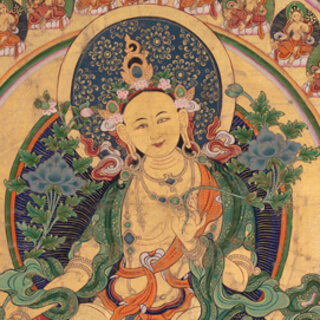
Including an image of the related artwork.
Our mindfulness meditation podcast is presented in partnership with Sharon Salzberg and teachers from the New York Insight Meditation Center,
The Interdependence Project,
And Parabola Magazine.
And now,
Please enjoy your practice.
Good afternoon,
Everybody.
Welcome welcome.
Welcome to mindfulness meditation online with the Rubin Museum of Art.
I'm Dawn Eshelman.
It's great to be here with you.
And it is a cold,
Blustery day.
Actually it's here in New York City where I am.
It is quite chilly outside and the snow has settled,
I think,
For the day.
But my very old radiator is clicking in the background.
So if you're hearing that,
That's what it is.
So glad to have you join us.
We the Rubin Museum of Art are a Himalayan museum of Himalayan art and ideas in New York City.
And so great to have all of you join us for our weekly program where we combine art and meditation online.
As always,
It's fun to see where everybody is joining from near and far.
And great to see some familiar names there in the chat.
And some new folks too.
So welcome.
So here today,
As we do every week,
We are combining art and meditation online.
We'll look at a work together from our collection.
We'll hear a brief talk from our teacher.
And then we'll sit together for a short guided meditation,
15 to 20 minutes.
So let's take a look at the beautiful work that we were looking at earlier.
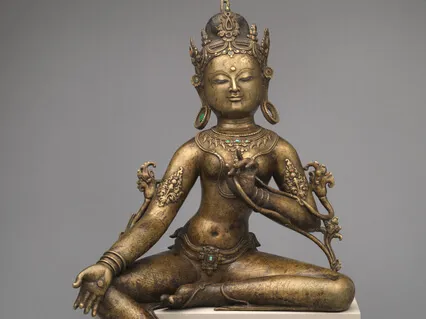
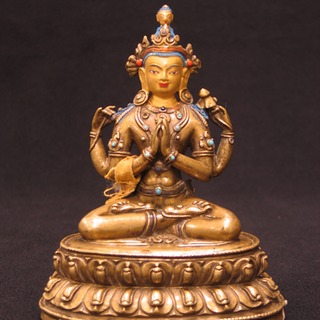
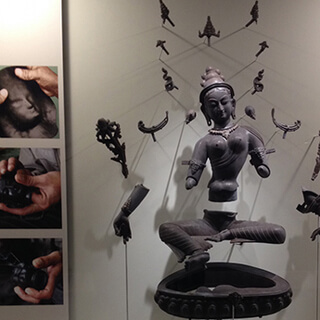
This is Green Tara.
And this month,
Here as part of our practice,
We kind of choose a different theme each month to explore through the lens of meditation in our practice.
And this month,
It's love,
Because why not?
And also,
It really gets to this core of a lot of Buddhist teachings,
Compassion,
Love,
Loving kindness.
And it's just a beautiful framework to consider when,
You know,
There are so many other challenges out there just to remind ourselves of what is important.
So here we're looking at the beautiful Green Tara.
This is from Tibet,
13th century brass with inlays of silver.
And she's about 18,
19 inches tall,
And just about 12 and a half wide.
And the goddess Tara,
As we know her,
Epitomizes not just love,
But loving kindness,
Right?
She's a protector.
She is someone who helps us combat our fears,
And can bring about a very beautiful,
Special type of love.
This sculpture has strong Indic aesthetic,
And a finely modeled face.
And her proportions are,
You'll notice that her head is a bit bigger,
And there's a big emphasis on that kind of grand,
Beautiful head and her crown,
Her large knot of hair at the top.
And then of course we're noticing that she's rather bejeweled,
Right,
Even though it's,
Her clothing is sparse.
There's a beautiful crown,
As I mentioned,
And earrings,
Those big hoop earrings.
Her necklace,
Her armbands,
She has bracelets around her wrists,
And all the way down to her belt and her anklets around her feet,
Right?
She's sitting in this pose that we know of as royal ease,
But also her foot is jutted out.
And we know that that symbolizes her readiness to help,
Her ability to jump out if we should need her.
And her right hand is open in this gesture of supreme generosity,
This ultimate act of love,
And her left hand holds this stem of a lotus.
So let's bring on our teacher today,
Tracy Cochran,
Who will talk to us a little bit more about this idea of love and what that means or can mean to us in our practice.
And Tracy,
Hi there.
It's great to see you and be with you.
Tracy Cochran has been a student and a teacher of meditation and spiritual practice for decades,
And she is the founder of the Hudson River Sangha,
Which is now virtual and open to everybody.
The link for her weekly meditations can be found on her website,
Tracycochran.
Org.
And in addition to teaching here at the Rubin,
Tracy has taught mindful writing at the New York Insight Meditation Center and various locations.
She is the writer and editorial director of Parabola,
Which is a beautiful,
Acclaimed quarterly magazine that seeks to bring timeless spiritual wisdom to the burning questions of the day.
There's a new issue out,
I believe,
And it's all about wellness.
You can find more about Tracy,
Her writings,
Podcasts,
And other details on tracycochran.
Org and also parabola.
Org.
Tracy,
Welcome.
So nice to have you here.
I'm so happy to be here.
And I picture all of you who have taken the time to show up today.
And I wonder if you,
Like me,
When I look at this beautiful,
Graceful figure of green Tara,
I can't imagine a bigger contrast between Tara bejeweled in her sparse attire and myself sitting here in my sweater,
Because it's freezing here.
And the ground is covered with snow.
And in many senses,
We're in the depths of winter.
Most of us are still in conditions of quarantine.
I think all of us,
Really.
And it might be the last thing that you want to do is think about love right now.
Or entertain a goddess who is associated with new life and rejuvenation and healing,
Because it still feels so far off for us.
And this morning,
I went out for a short walk,
Short because it's so cold.
But it's a custom of mine before I come to teach to go outside and look up at the trees.
And they're all there except the pine trees and offer the trees a kind of wish,
Like,
Please let something come out of my mouth that's real,
That's useful.
And I love to do this,
Because I'm reminded of a wonderful poem by Mary Oliver among the trees,
Where she goes outside among the trees when she says she feels so distant from hope for herself.
So distant from a feeling of her own goodness.
From that state of ease of not hurrying.
Like that image we saw of that beautiful goddess.
Because the way we usually are,
We're to some degree worried.
We're hurrying.
We're contracted.
We're trying to figure things out.
We feel lonely or restless or bored or sad.
Anything but that royal ease.
And when I look up at the trees,
And when that beloved poet would look up at the trees,
Sometimes I would get a feeling,
As she did,
That there's another way to be in this life right now.
And that other way to be is to go easy,
As Mary Oliver wrote,
To just be easy.
To be filled with light.
And to shine.
Which is not to say that we don't have plenty of challenges and plenty of suffering.
But when we take a moment,
Just a moment,
To bring our attention back to ourselves with kindness and curiosity,
We can begin to remember that we also have this capacity to be easy.
To just open to what's here.
What's real.
Including this goodness in ourselves.
And last night I was telling some friends the story of the Velveteen Rabbit,
Which I won't tell in great detail today,
But it's a beloved children's book about a stuffed bunny who is longing to be real.
Who is sitting in his little cupboard,
As you might feel in your apartments or your houses,
Lonely and cut off from life.
And he longs to be loved by a little boy because that will grant him this feeling of being real.
Beloved.
And eventually this happens.
And he's so happy.
Until it stops.
The little boy takes him everywhere.
Everywhere.
Outside.
Inside.
And then one day the little boy falls ill.
And the stuffed bunny patiently keeps him company.
Through his scarlet fever until he recovers.
And then you know what happened.
The stuffed bunny has to be thrown away.
He has to be gotten rid of because he's infected with scarlet fever germs.
So all his hopes have come to an end again.
He's loved and love ends.
So he's sitting in a heap with the other toys and he cries because it's a children's book so stuffed animals can cry.
And with each tear a flower grows just like the lotus.
Up comes a flower and it opens and inside is Tara.
Inside is a being that has the capacity to grant this little stuffed bunny new life.
And she takes the bunny into the trees into the forest and gives him a kiss that brings him to life.
Now you might be thinking what am I listening to?
What does this have to do with Buddhist practice?
Just this.
When we bring our attention home to the sensation of being present in the body.
When we allow ourselves to go easy as Mary Oliver said in her poem about the trees to just be easy with ourselves.
We begin to get in touch with part of our self that shines.
That has a light of attention and a capacity to be kind.
And we begin to sense and we begin to see that we are beloved.
That we are loved literally.
It's a force inside us that we cannot be separate from.
There is a capacity for goodness and presence that doesn't have to be bestowed from outside whether it's a little boy or your dream valentine.
It's something you already have inside you.
So let's sit together and see.
We take a comfortable seat and let your back be straight and it's fun sometimes to picture yourself like a tree.
Let yourself take root.
Notice the feet on the floor or your seat on the cushion.
And notice how it feels to really take up space.
To be deeply and strongly rooted in your life.
And if you feel comfortable,
Let your eyes close.
The better to notice how it feels to be here right now.
And notice that there is an attention inside you that doesn't need to judge.
It doesn't need to comment.
It just sees.
Welcoming.
Welcoming whatever is present.
Notice that you can always come back to sensation.
Back to the feet on the floor.
Back to the sensation in the hands.
In the face.
In the back.
And see that this sensation opens you to an attention that's not in your mind.
An attention that sees without judging.
With kind curiosity.
Let yourself rest in this stillness.
This presence that sees without judgment.
Let yourself rest in this stillness.
Let yourself rest in this stillness.
And when you get tangled up in thinking,
Just come back again to the body,
To sensation.
And notice that you open to an attention that's a light that just sees.
Let yourself rest in this stillness.
And notice that you open to an attention that's a light that just sees.
Just let yourself rest in this attention.
This presence.
Be easy with everything that comes up.
Beginning to remember how alive you are inside.
How good.
And see that you can begin again any time.
Open to sensation.
And notice that you open to an attention that's a light that just sees.
And notice that you can begin again any time.
Open to sensation.
And notice that you can begin again any time.
And see that the stillness that surrounds you is kind.
And notice that you can begin again any time.
And notice that you can begin again any time.
And notice that you can begin again any time.
And notice that you can begin again any time.
And notice that you can begin again any time.
And see that when you come home to presence,
You don't feel alone,
But open to life inside and outside.
And notice that you can begin again any time.
And notice that you can begin again any time.
And notice that you can begin again any time.
And notice that there's an energy inside you,
A vibrancy that could be called love.
A basic kindness,
A goodness,
A wish to be here.
Without fear.
And notice that you can begin again any time.
And notice that you can begin again any time.
And notice a hope inside you that isn't words or pictures,
But a willingness to open to what appears.
And notice that you can begin again any time.
And notice that you can begin again any time.
And notice that you can begin again any time.
Not alone,
But accompanied by a force of compassion,
Of love.
And notice that you can begin again any time.
And notice that you can begin again any time.
And notice that you can begin again any time.
Coming in a presence that sees without judging.
Coming home to sensation.
Taking root in your life.
And see that you shine.
And notice that you can begin again any time.
And notice that you can begin again any time.
And notice that you can begin again any time.
And notice that you can begin again any time.
Thank you,
Tracy.
Thank you.
If you would like to support the Rubin and this meditation series we invite you to become a member.
Thank you for listening.