Welcome to the Mindfulness Meditation Podcast presented by the Rubin Museum of Art.
We are a museum in Chelsea,
New York City that connects visitors to the art and ideas of the Himalayas and serves as a space for reflection and personal transformation.
I'm your host,
Tashi Chodron.
Every Thursday,
We present a meditation session inspired by a different artwork from the Rubin Museum's collection and led by a prominent meditation teacher from the New York area.
This podcast is a recording of our weekly in-person practice.
In the description for each episode,
You will find information about the theme for that week's session,
Including an image of the related artwork.
Our Mindfulness Meditation Podcast is presented in partnership with Sharon Salzberg and teachers from the New York Insight Meditation Center,
The Interdependence Project,
And Parabola Magazine,
And supported by the Frederick P.
Lenz Foundation for American Buddhism.
And now,
Please enjoy your practice.
Hello,
Everybody.
Tashi Delek.
And welcome.
Welcome to the return of in-person mindfulness meditation at the Rubin Museum of Art.
I'm Tashi Chodron,
And Himalayan Programs and Communities Ambassador.
It's so wonderful to see so many familiar faces here.
So I'm curious,
How many of you have attended mindfulness meditation in person in the theater?
May I see your hands?
Okay,
Wonderful.
And how many of you are first time?
Wow,
All right.
So it's like 50-50.
But for the last three years,
We've been doing virtual,
And I'm curious to know how many of you have attended virtual meditation online?
Okay,
So we are very even.
Wonderful.
So those of you who are first time,
We are a museum of Himalayan art and ideas in New York City,
And we're so glad to have all of you join us for our weekly program where we combine art and meditation.
And inspired from our collection,
We will take a look at work of art from our collection.
We will hear brief teaching from our teacher,
And so thrilled to,
You know,
So fortunate to introduce Kimberly Brown today to have her back.
And we will have a short sit,
About 15 to 20 minutes for the meditation guided by Kimberly.
And I'd like to show you the art connection for today,
As well as the theme for this month.
So this month's theme is Loving Kindness.
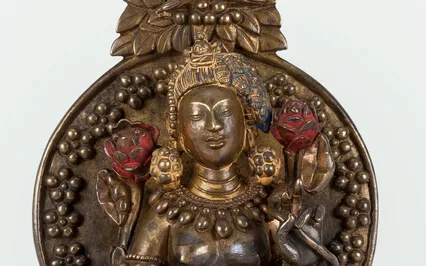
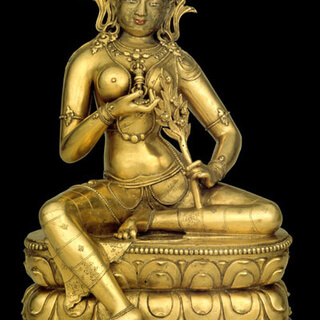
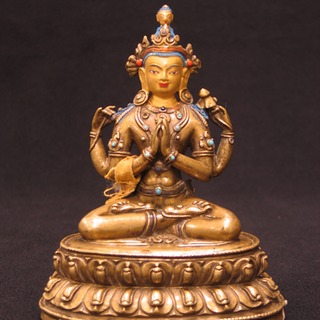
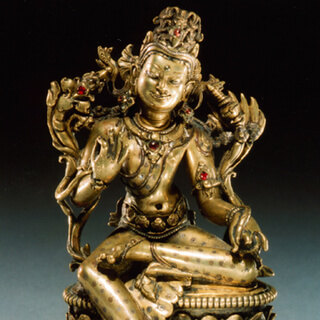
And the art connection for today's session is this beautiful sculpture of Green Tara.
In Tibetan,
She's known as Dolma.
Tara emanates in 21 different forms.
Out of the 21 forms,
Two of the most popular and the common Taras are White Tara and Green Tara,
Each associates with certain role.
And so the Green Tara associates with enlightened activity,
And how you can identify which Tara it is,
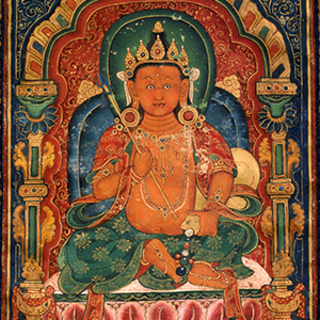
In the painting you can see the colors,
White Tara comes in white in color,
Of course,
And then Green Tara comes in green in color in the Pankha painting.
But whereas in the statue,
How you can identify which Tara it is,
Is you look at how she's sitting.
So Green Tara is often sitting in a royal ease position,
As you see here,
Left leg folded,
Right leg extended.
So this is a royal ease position.
And the Tara's left hand is holding a lotus stem,
And the lotus flower is sprouting on her left shoulder.
And the lotus symbolizes awakening,
Purity,
All of beautiful symbolization.
And then the right hand,
The mudra,
Is in a supreme generosity.
You see her palm facing up,
Resting on her right knee.
So this is a supreme generosity.
Tara is often referred to as the Mother of All Saviors.
So she's a perfect expression of loving kindness.
So this beautiful sculpture is origin from Tibet,
Is a 17th century sculpture.
Artist is Karmapa,
The 10th Karmapa,
In fact,
Who is the head of Karmakajuk school,
Which is one of the four schools in Tibetan Buddhism,
That is Nyingma,
Sakya,
Kajup,
Gelug,
And the Venn pre-Buddhist.
Now some of the signature of the very individualized style of 10th Karmapa is those beautiful birds that you see sitting on top.
If you look right on top there,
With this beautiful arch flower in the nestle in the middle of the flower,
The Karmapa is known to love animals,
Especially associated with the birds in his art.
And then these really bulky,
Like very,
Wow,
Volume like hairdo on the left side of Tara,
This is another signature look of Karmapa.
And now let's bring on our teacher for today.
We're so fortunate to have Kimberly Brown back.
Kimberly Brown is a meditation teacher and author.
She leads classes and retreats that emphasize the power of compassion and kindness meditation to reconnect us to ourselves and others.
Her teachings provide an approachable pathway to personal and collective well-being through effective and modern techniques based on traditional practices.
She studies in both the Tibetan and inside schools of Buddhism and is a certified mindfulness instructor.
So please help me in welcoming Kimberly Brown.
Kimberly,
Thank you so much for being here.
This is the first time that I've taught indoors with people since pre-pandemic.
It is,
It's such an honor and a delight.
And I would like all of you just to take a moment,
If you're able,
Just to look around.
You might have to look behind you and just notice that we are together again.
It seems sometimes like,
Oh,
You can meditate by yourself.
You can meditate anywhere.
You're just being quiet.
And yet to be in the presence of others,
With others in silence,
There is still a communication and there is still a presence that we feel.
So thank you for coming tonight and today and sharing your practice again.
So the theme is loving kindness.
Right?
Many of you know loving kindness,
The original Pali word,
Which was from the early Buddhist tradition,
Is metta.
And the Sanskrit word for loving kindness is maitri.
It's translated to loving kindness,
Which is kind of an awkward word.
We don't use that so often.
But it's used because its literal translation,
Love,
Is a bit mixed up for many of us.
We love our new shoes and we love a television program and we cling to someone we want to love us.
So we use loving kindness as a way to express a certain sort of love,
A love that wishes us to be happy and everyone to be happy.
Right?
And this quality of love is related to compassion.
It's related to joy.
And of course,
It's related to wisdom.
You know,
All three.
And I work with a lot of students to develop compassion and usually for their selves,
For myself.
In our culture,
Many of us feel selfish to offer ourselves love and compassion.
Or we feel maybe we have to keep it all to ourselves and we can't give it to anybody else because we don't have enough.
Right?
And so what's really the most valuable,
I think,
Valuable thing about practicing and sitting quietly with ourselves is we start to notice that we already have this quality of compassion.
We already have the quality of love,
Of joy,
And of wisdom.
And it's just there for us to develop it.
We also have it in a way that it's boundless.
So we have to worry about having enough of it.
And it's indiscriminate.
That means everybody here deserves it.
Right?
And no one here deserves love and kindness more than me.
And I don't deserve love and kindness more than any of you.
A great Indian teacher,
Shanti Deva,
Wrote the importance of equalizing self and other.
And so in our practice today,
And if you've ever done loving kindness practice,
Part of the experience of it is beginning to give it not only to ourselves,
Not only to people we like,
But others,
Strangers,
People we don't like,
Even animals.
So before we begin our practice,
I would just like to remind you all that you do have these qualities.
And this Tara statue,
It's a representation of a quality that we all have.
And Tashi Chodron pointed out that this is still a living tradition.
And it's a living tradition right here too.
In Tibetan,
We translate this as a deity,
But the word is yidam,
Y-I-D-A-M,
Yidam.
And that has a sense of a connection.
Our mind streams are all connected to Tara.
Now you don't have to believe in an outside God to know that you have compassion and joy and wisdom and love inside of you.
So keeping that in mind,
Keeping that knowledge,
That trust that you too have a Tara within you.
So everyone go ahead and close your eyes and also relax.
Hey,
You don't have to sit bolt upright.
Just notice that you're breathing,
Bringing your attention to the sound entering your ears,
Smell,
Taste,
The weight of your body in your seat.
And in the silence,
You might recognize,
Notice the presence of others.
And I'd like each of you to remember,
Recognize,
Recall the motivation that brought you here today,
The intention.
Each of you have an individual personal intention.
Maybe you just thought it'd be fun.
Maybe you're struggling and you'd like to learn to be more understanding of yourself or maybe of others.
Whatever your intention is,
Please appreciate it.
Rejoice in your beneficial wisdom because practicing like this benefits you and others.
So I'm saying thank you to yourself and also maybe thank you to the Rubin Museum for having us back here again and hosting us,
For creating a treasury of these beautiful,
Beautiful images.
Thanking each other for coming out on a cold day today,
Bringing your attention now to your feet,
To your seat,
To your belly,
Your shoulder blades,
To the back of your head,
Bringing your attention to your forehead and your cheeks and your jaw,
Allowing sound to enter your ears and smell.
And you might notice thoughts,
Plans,
Associations,
Feelings,
Just as you notice light entering your eyes and smell and choosing now to rest your attention on your heart center,
The center of your chest.
If you'd like,
You can place your hand there and I'd like you to make a connection with what is usually traditionally called a benefactor.
This is a being who has loved you so easily and delighted in you.
And if you cannot think of one,
Use Tara today.
So bring this benefactor to your mind,
To your heart.
You might imagine them,
Visualize them,
Or just feel their presence here with you and give them these wise phrases of metta.
May you be gentle with yourself.
May you feel safe and strong.
May you be gentle with yourself.
May you feel safe and strong.
May you be gentle with yourself.
May you feel safe and strong.
And continuing to silently repeat these phrases just for a couple of minutes,
Like you're giving a gift to this benefactor,
Just using your awareness to notice where is your attention.
Maybe you have to recollect with this benefactor and begin again.
May you be gentle with yourself.
May you feel safe and strong.
And for just two more minutes,
Silently repeating these gifts.
May you be gentle with yourself.
May you feel safe and strong.
And you can let go of this connection with this benefactor,
Noticing your breath,
Allowing sound to enter your ears,
Light to enter through your eyelids,
Feeling the weight of your body and your breath.
And now connecting with yourself.
You could imagine yourself,
Maybe imagine you're looking in the mirror or imagine yourself in a time of struggle or difficulty.
Or maybe just connecting with your beautiful presence by putting your hand on your heart and giving yourself this same metta,
The same loving kind.
May I be gentle with myself.
May I feel safe and strong.
May I be gentle with myself.
May I feel safe and strong.
May I be gentle with myself.
May I feel safe and strong.
And silently repeating these phrases gently,
Like you're giving yourself a gift.
Once again,
Just paying attention.
Where,
Where are you right now?
If you've lost your connection with yourself,
It's okay.
Come back.
Begin again.
May I be gentle with myself.
May I feel safe and strong.
And just for two more minutes,
Giving yourself this wisdom.
May I be gentle with myself.
May I feel safe and strong.
And just taking a moment here to include,
Include the benefactor,
Include yourself,
Include everyone in this room,
Include whoever's calling,
Include your family,
Your friends,
Your pets.
Also include all the people you don't like that annoy you and frustrate you.
And all the strangers that you'll never meet.
May we be gentle with ourselves.
May we feel safe and strong.
You can let go of this technique.
Allow yourself just to rest here for a moment.
I'm going to invite the bell to ring.
And please stay still until you can no longer hear it,
At which time you can move,
Open your eyes,
Bring your attention to our conversation.
Thank you.
Thank you so much,
Kimberly,
For that beautiful session.
Thank you.
Thank you.