Welcome to the Mindfulness Meditation Podcast presented by the Rubin Museum of Art.
We are a museum in Chelsea,
New York City that connects visitors to the art and ideas of the Himalayas and serves as a space for reflection and personal transformation.
I'm your host Tashi Chodron.
Every Monday we present a meditation session inspired by a different artwork from the Rubin Museum's collection and led by a prominent meditation teacher from the New York area.
This podcast is a recording of our weekly practice currently held virtually.
In the description for each episode,
You will find information about the theme for that week's session,
Including an image of the related artwork.
Our Mindfulness Meditation Podcast is presented in partnership with Sharon Salzberg and teachers from the New York Insight Meditation Center,
The Interdependence Project and Parabola Magazine and supported by the Frederick Lentz Foundation for American Buddhism.
And now,
Please enjoy your practice.
Hello and Tashi Delek.
Welcome to Mindfulness Meditation Online with the Rubin Museum of Art.
I am Tashi Chodron and so nice to be back after a short summer break.
Since the last mindfulness session three Mondays ago,
I went to Nepal from Ladakh and right now I'm in South India.
In fact,
I'm in Bangalore City,
The Silicon Valley of India.
It's been raining here a lot.
I hope the weather is nice wherever you are and I'm so happy to be your host today.
We are a museum of Himalayan art and ideas in New York City and we are so glad to have all of you join us for our weekly program where we combine art and meditation online.
Inspired from our collection,
We will take a look at a work of art from our collection.
We will hear a brief talk from our teacher and then we will have a short sit,
15 to 20 minutes for the meditation guided by her.
Now let's take a look at today's theme and artwork.
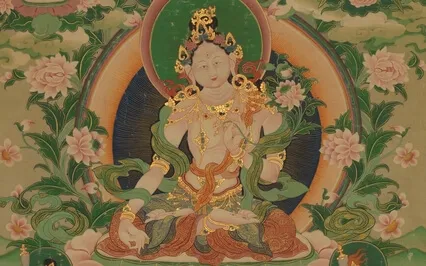
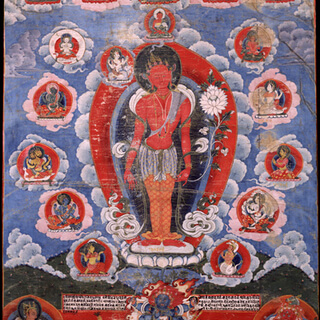
The theme this month is perspectives and the artwork for today is this beautiful Thangka painting of white Tara with long life deities.
It's originated from Tibet and it's a 19th century pigment,
Mineral pigments on cloth and the dimension is 27 and a half into 18 and a half into two and a half.
That's the estimate and it's a beautiful painting.
The Tara's perspective in other spiritual practice is like the Mother Mary in Christianity and the Lakshmi,
The goddess in Hinduism.
So the connection with another identity of Tara as well.
The description of this beautiful painting,
As a female Buddha,
Tara works for the benefit of all beings and has many manifestations.
This form known as white Tara associates with longevity or long life,
Bestows longevity.
Her right hand rests on her knee displaying the gesture of infinite generosity or supreme generosity giving,
Bestowing while the left holds the stem of a pure white lotus blossoming above her left shoulder.
The reverse of the painting which is the flip side of the painting is particularly interesting.
It contains a depiction of a stupa with a mandala drawn in its dome and handprints of a Buddhist master.
Prayers and dedications written in gold on the stupa's body state that this painting was commissioned by Yeshe Lopsang Tenpa,
Likely the 8th Taktsar Rinpoche from 1760 to 1810.
Taking refuge in Tara,
He dedicates the merit of the painting's creation to preventing untimely death and other dangers for all sentient beings and asks to bestow the blessings of a long and auspicious life.
The handprints and the small seal prints underneath them may be his own.
Tara is known as Jetun Drolma.
She is most revered in all schools of Tibetan Buddhism and how you can identify that this is the white Tara is you look at how she's sitting.
So if you look in the central figure here,
Her legs are in Vajra position in full meditation posture and then her right hand doing the supreme generosity bestowing and left hand holding the stem of the lotus flower.
Now let us bring on our teacher today,
Kimberly Brown.
Thank you so much Kimberly for being here despite your busy schedule.
Kimberly Brown is a meditation teacher and author.
She leads classes and retreats that emphasize the power of compassion and kindness meditation to reconnect us to ourselves and others.
Her teachings provide an approachable pathway to personal and collective well-being through effective and modern techniques based on traditional practices.
She studies in both the Tibetan and inside schools of Buddhism and is a certified mindfulness instructor.
Her new book,
Navigating Grief and Loss,
25 Buddhist Practices to Keep Your Heart Open to Yourself and Others,
Will be published on November the 1st and an updated edition of Steady,
Calm and Brave will be released in January 2023.
Both are published by Prometheus Books.
You can learn more about Kimberly on her website.
Kimberly,
Thank you so much for being here.
Thank you,
Tashi.
It's nice to see you and I'm glad to be back at the weekend.
You know,
Today,
The theme I'm told for this month at the Rubin Museum is perspective.
And in keeping with that,
I immediately,
What came to my mind is the difficulty and the struggles that I and I think almost all of my students and nearly everyone I meet,
That we struggle with our thoughts,
With our own thoughts.
If they're painful or upsetting,
We don't want to have them and we kind of get in a fight with them.
If they're unkind or critical,
Then just a thought can bring up shame for us or embarrassment when we think they mean something,
That we're a bad person.
Many of us have a lot of anxiety and anxiety is the result of thoughts about the future.
Thoughts that aren't happening right now,
Nothing's happening right now,
But our anxiety is creating,
Or rather the story creates an anxiety.
And so this relationship with our thoughts is causing us a lot of suffering because we believe that they're true and because we get caught in them.
We want to push them away.
We're having like a fight.
There's a famous Zen teacher,
Suzuki Roshi,
He once said,
Stop the war with yourself.
So one way we can stop this war with ourselves is to begin to gain some perspective,
Some space.
And the way that we can do that,
And one of the most useful skills is through mindfulness meditation.
It allows us to get some distance from our thoughts and it gives us some space from our thoughts.
And in doing so,
They don't seem so real because they're not,
They're just arisings,
Right?
They're just thoughts.
They're not facts.
There's nothing happening out here.
They're just thoughts,
Right?
So the practice of mindfulness meditation is when we take the time to be quiet and pay attention to what's arising in our awareness.
And thoughts are just a type of arising,
Just like sound is an arising,
Right?
My breath is an arising,
Taste and smell,
These are all arising from moment to moment.
And they come and they go,
Right?
And it's funny because for whatever reason,
We privilege our thoughts more.
We think of them as somehow more real than sound,
More lasting,
Right?
But that's just because we're kind of folding onto them and fixing them and we're not able to get a lot of space,
Right?
So in mindfulness meditation,
We pay attention to everything that arises,
Right?
Thought that arises about lunch and the sound of a siren and our breath,
Right?
And as we practice and practice,
You can start to notice that all of these arisings are impermanent.
They come and they go,
Right?
And we can further start to develop a capacity to allow them to come in,
To not have to grab onto thoughts that we like,
You know,
Oh,
What am I going to have for lunch?
Oh,
I'm going to have,
Blah,
Blah,
Blah.
And to not push something away,
Oh,
I just had that,
My sister drives me crazy,
I shouldn't think that,
Oh,
I don't want to have this.
Instead to allow thoughts to come and go,
Not give them any more charge.
In fact,
In Buddhist psychology,
It's said that the way we perceive is that we have an eye sense and the eye receives the light.
We have an ear sense and the ear receives the sound.
And in the same way,
We have a mind sense and this mind sense receives the thought.
And what that's pointing at is that most of our thoughts,
We didn't choose to have them.
They arise just like sound or taste or light.
There's one thing,
Thinking,
You know,
Choosing to work on something,
To study,
To read,
That is thinking and that's a conscious deliberate act.
And we need to do that.
It's wonderful.
We're lucky to have such thoughts.
But most of our thoughts simply arise through causes and conditions.
I am sure all of you,
Or I'm going to guess,
Have had an experience of walking down the street and some old song pops into your head for no reason.
The reason is simply the light was a certain way and you had certain unconscious associations and up popped that thought.
So you didn't put it there.
So you're not going for it and you can allow it,
You know,
To come and to go.
Of course,
It takes practice and we have obstacles to doing this and the obstacles are our habits and our conditioning,
Right?
Some thoughts seem more desirable,
Some have more charge,
Some are old ingrained habits or even our thoughts that someone else told us about ourselves,
Right?
So when these thoughts arise,
They seem so real and they seem so full of energy and we get really caught.
What do I mean by caught?
Well,
We start building on them.
We start proliferating,
Thought proliferation.
So you know,
A simple example is I'm sitting here,
I'm practicing,
I'm thinking about lunch.
Now I can,
With mindfulness,
Sit with it,
Let it come and go,
Notice the light and the sound,
But I might start thinking about lunch and where I'm going to have it and what it's going to look like and is there enough food in my refrigerator for that?
Oh,
I might have to go to the store,
Okay,
And off I go.
That's getting caught and the practice is to start to notice where we're caught,
Bring ourselves back and let ourselves begin again.
Now in practicing in this way,
What we're doing,
And this is part of the perspective,
Is we're creating that sort of space,
Right?
There's more distance between our ability to be aware,
Our awareness and our thinking and our thoughts,
Right?
You'll hear certain teachers,
They'll say we're building a bigger container.
You'll often hear we're creating space,
Right?
These are really common ways of starting to understand how we don't have to be so caught and so fraught with our thinking and our thoughts.
We don't have to allow them to create suffering for us,
Okay?
Allow them to be,
See them for what they are and let them come and go.
One of the reasons that the White Tara is the selection today is because Tara is the deity or one of the deities that we can call upon to help us remove obstacles.
We can ask her to remove illness or ill health so that we have physical health,
Those obstacles,
And we can also ask her to remove the obscurations and hindrances that we have to well-being in our own minds,
Right?
So we are free from suffering.
So today,
We'll do a practice to help us open up with mindfulness to what's arising,
To help us receive,
Receive light and smell and taste,
Receive thoughts,
Receive feelings,
And just let them come in.
When they go,
Let them go.
We don't have to push them around.
We will do a little breathing and body mindfulness.
We'll do a little bit of metta meditation,
Loving kindness meditation to focus and concentrate our mind and open our heart,
And then we'll do a little bit of open awareness mindfulness.
We will get to develop that sense.
You can have a taste of making a little space around your thoughts.
So wherever you're at,
Find a place where you can sit still and be comfortable.
And wherever you are,
Please put your devices out of reach,
Okay?
I'm imagining you're watching on a computer or a phone.
That's great.
Just set it aside,
Right?
Don't check your emails.
Just give yourself this next 20-ish minutes just to be,
Do something nice for yourself.
And as you're settling,
I am going to request that Tara come to our meditation today.
And you can believe in her as an actual deity,
Or you can believe in Tara as being the wise and compassionate aspect of all of us.
So Om Tare Tutare Ture Soha,
Om Tare Tutare Ture Soha,
Om Tare Tutare Ture Soha,
Tara,
Please come here to the Rubin Museum mindfulness session.
Please protect us all and please help us remove the obstacles to our good health and our mental well-being.
So I'd like you to go ahead and you can just close your eyes and start to notice that you're here.
Okay,
What does that mean?
Well,
You'll feel perceptions and notice your body sensations.
So allowing sound to enter your ears,
Allowing taste,
Allowing smell,
Experiencing your feet,
Your seat,
Your belly,
Relaxing your shoulder blades,
Relaxing at the back of your head,
And relaxing your forehead and your cheeks and your jaw.
Experiencing that you're breathing.
Experiencing the top of your head,
Experiencing your forehead,
Your cheeks,
Your jaw.
Experiencing the back of your head,
The back of your neck.
Experiencing your shoulder blades,
The middle of your back and your lower back.
Experiencing your throat and your chest,
Your belly and your abdomen.
Experiencing your shoulders and the tops of your arms,
Your elbows,
Your lower arms,
Your hands,
The tops of your hands and the palms of your hands.
Experiencing your seat,
The backs of your thighs,
The tops of your thighs,
Your knees,
Your lower legs,
The tops of your feet,
And the soles of your feet.
Experiencing your head,
Experiencing your torso,
Experiencing your arms,
Experiencing your legs,
Experiencing your body,
And I'd like you to bring your attention to your breath.
Now,
You can find a spot,
Find where you can feel this breath.
Maybe the tip of your nose,
Maybe your chest,
Maybe your belly.
Okay?
In fact,
It would be useful if you could take your hand and put it on your belly and just starting to count your breaths.
One inhale,
One exhale is one.
The next inhale,
The next exhale is two.
We're counting at your own time up to five.
When you get to five,
Begin again at one.
We're just going to do this for a minute or so.
And the trick is,
Can you be with your breath without trying to manipulate it,
Change it?
Just resting on your breath,
Count to five,
Begin again.
Counting one more full breath,
And now bringing your attention to your heart center,
The center of your chest,
And make a connection with someone who's easily loved you.
Easily loved you,
Not a complicated relationship.
It would be a pet,
Teacher,
An aunt,
An uncle from your past,
In the present,
Either way.
And just giving them this loving kindness and wisdom phrase.
May you be free from inner and outer harms and dangers.
May you be free from inner and outer harms and dangers.
May you be free from inner and outer harms and danger.
Continuing to repeat this phrase silently as though you're giving a gift to this loved one.
May you be free from inner and outer harms and dangers.
Keeping this connection with this benefactor,
This one who's loved you easily.
Keeping that connection and now adding yourself.
You might imagine the two of you together.
You might just feel both of your presence and giving both of you the same wisdom.
May we be free from inner and outer harms and dangers.
May we be free from inner and outer harms and dangers.
May we be free from inner and outer harms and dangers.
And just taking a minute here to silently repeat this phrase as though you're giving a gift to both of you.
And beginning to include more beings,
Including everyone you're close to,
Your family,
Your friends,
Your pets.
May we be free from inner and outer harms and dangers,
Including some people you really are frustrated by or angry with or don't like.
May we be free from inner and outer harms and dangers,
Including everyone on this call today,
On this mindfulness session.
People you might know and lots of strangers.
May we be free from inner and outer harms and dangers.
May all beings be free from inner and outer harms and dangers.
And coming back to your breath,
Letting go of these phrases.
See if you can anchor your attention in one spot where you feel your breath.
Maybe your belly,
Maybe your chest,
Maybe the tip of your nose.
And if you struggle with this breathing meditation,
Which I did,
I have asthma.
You can use sound.
Just rest all your attention in the sound entering.
But either way,
Pick a spot and just rest your attention,
Receiving the breath or receiving the sound.
And now using your wisdom,
If your mind is very busy and it is not settling down today,
That's okay.
There's nothing wrong.
And continue to keep your focus on your breath or on keeping your mind steady.
But if your mind seems pretty steady today or if you're feeling kind of sleepy,
Then you are invited to begin to open up to receive other sensations.
You can keep your anchor.
If you get lost,
Come back to the breath or sound.
But opening up with mindfulness and noticing what's arising.
Thoughts,
Smell,
Taste,
Light entering your eyes.
A tense muscle,
Your breath.
And as you practice,
Do as little as possible because you only need to receive just for about two minutes.
Checking in,
Where is your attention?
If it's caught in a thought,
A plan,
A story,
That's great.
You get to notice that and choose where you'd like to bring your attention.
Bring it back to your breath or sound.
Let yourself rest here.
And opening up again.
Paying attention to the unfolding of light,
To the rising and falling of thoughts and perceptions.
And for the next minute or so,
You can stop meditating.
But keep your posture.
Keep your stillness.
Just allow yourself to rest here.
Not meditating and not not meditating.
Thanking yourself for your practice today.
Using your mindfulness to recognize that this is a beneficial action.
That it's useful and skillful for you and everyone in your culture.
And whenever you're ready and comfortable,
You can bring your attention back to the screen,
To our conversation.
Thank you.
Thank you.
Thank you,
Kimberly.
That was such a beautiful session.
That concludes this week's practice.
If you would like to support The Rubin and this meditation series,
We invite you to become a member of The Rubin.
If you're looking for more inspiring content,
Please check out our other podcast,
Awaken,
A podcast that uses art to explore the dynamic paths to enlightenment and what it means to wake up.
Available wherever you listen to podcasts.
Thank you for listening.
Have a mindful day.