Welcome to the Mindfulness Meditation Podcast presented by the Rubin Museum of Art.
We are a museum in Chelsea,
New York City that connects visitors to the art and ideas of the Himalayas and serves as a space for reflection and personal transformation.
I'm your host,
Tashi Chodron.
Every Thursday,
We present a meditation session inspired by a different artwork from the Rubin Museum's collection and led by a prominent meditation teacher from the New York area.
This podcast is a recording of our weekly in-person practice.
In the description for each episode,
You will find information about the theme for that week's session,
Including an image of the related artwork.
Our Mindfulness Meditation Podcast is presented in partnership with Sharon Salzberg and teachers from the New York Insight Meditation Center,
The Interdependence Project and Parabola magazine and supported by the Frederick P.
Lenz Foundation for American Buddhism.
And now,
Please enjoy your practice.
Welcome to Mindfulness Meditation at the Rubin Museum of Art.
I'm Jacqueline Smith,
Manager of Programs and Education,
And I'm delighted to be your host today.
We are a global hub for Himalayan art with a home base here in New York City,
And we are so glad to have all of you join us for our weekly program where we combine art and meditation.
Inspired by our collection,
We will first take a look at a work of art.
We will then hear a brief talk from our teacher,
Michel Pascal,
And then we will have a short sit,
15 to 20 minutes,
For the meditation guided by him.
Now let's take a look at today's theme and artwork.
Our theme for the month of March is Reawaken,
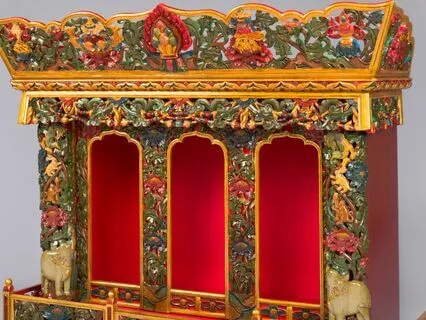
And the artwork that we have chosen for today is this Tibetan shrine cabinet,
Which is on view in the Tibetan Buddhist Shrine Room on the fourth floor of the museum.
This intricately carved shrine cabinet,
Adorned with auspicious symbols of enlightenment,
Cultivates a spiritual atmosphere in a private space.
Having such a sacred space within one's home helps us to reflect on our inner self and guides us towards reawakening.
These shrine cabinets are also known as dharma displays.
They are meant to house deities.
They usually resemble small temples.
Shrine cabinets can be relatively simple in design or ornately carved and painted.
This elaborate example was specifically commissioned for the Tibetan Buddhist Shrine Room at the Rubin.
It has three niches framed by decorative carvings of foliage.
The crown of the cabinet is carved with symbols representing the three jewels of the Dharma – Buddha,
Teacher,
Dharma,
Teachings,
And Sangha,
The community of practitioners.
The crown also contains the eight auspicious symbols of Tibetan Buddhism.
The outer columns of the shrine cabinet feature the elephant,
Monkey,
Rabbit,
And bird from the tail of the four harmonious friends.
Beholding the shrine cabinet is a powerful visual reminder to adhere to the teachings and integrate them into our essence.
Now let's bring on our teacher for today,
Michelle Pascal.
Michelle Pascal,
A meditation teacher for 25 years,
Has led successful programs for prisoners which help prevent suicides and reduce reoffending.
He's written 20 books on spirituality,
Including Meditation for Daily Stress,
10 Practices for Immediate Well-Being.
Known as the Medicine Voice,
He performed at Carnegie Hall on multiple occasions and played at the Peace Day concert in Times Square this past September.
This December,
He presented his methods at the United Nations.
Michelle,
Thank you so much for being here and for leading us in today's practice.
Thank you to the Rubin Museum.
Thank you to each of you to take care of the sanctuary of the Rubin Museum.
Thank you.
Tashi Delek.
So,
Today our topic,
It's dialectics.
The awakening starts when we calm our mind.
This is the difference between to talk about the awakening and to live the awakening.
Intellectually,
Everyone,
We can understand the concept of the awakening.
We can read a lot of books.
We can listen a lot of exceptional Rinpoche,
High Lama,
To talk about the awakening.
And we can understand.
But it's not because we understand intellectually that we live practically.
It's totally different.
Most of times,
We think in America that the more we understand,
The more we live.
But it's totally different.
We can understand intellectually.
We can study during many years,
But never live the awakening.
So for me,
Living in New York and working with the prisoners of Los Angeles,
The awakening starts when we calm our mind,
Especially in New York City.
The awakening starts when,
For example,
In the subway,
In the train,
We are calm.
We are sitting at the rush hour,
But quiet.
Our mind is clear,
Like a pure lake.
And we feel that in the train of New York City,
We are grounded.
We are stable.
We are not busy.
We are in eternity.
The awakening starts at the workplace,
When we arrive,
Facing our colleagues,
When we are facing our computer.
And suddenly we feel grounded,
Stable,
Not busy,
But in eternity.
The awakening starts when we take a coffee.
We go in a coffee shop.
We sit.
We enjoy our coffee.
My coffee today,
My cappuccino,
Is my awakening.
We are in the traffic,
But we are grounded in our car.
We are stable.
We are not busy.
We are in eternity.
So this is the experience of the awakening.
The experience of the awakening,
You see,
Suddenly we realize that life is beyond emotions.
There is no life without problems.
There is no ocean without waves.
And we receive a lot of waves,
A lot of emotions,
A lot of perturbations,
Especially when we live in a big city like New York City.
But when we calm the mind in the middle of the chaos,
We realize there is something beyond the wave.
There is the horizon beyond the waves.
There is the awakening beyond the emotions.
It's like we arrive in a pure land suddenly.
It's not we don't care of the emotion.
We see the emotion.
We take care.
We need also to manage our life.
We need to take care of our money,
To take care of our health,
Of our nutrition,
Of our body.
But we realize it's not enough.
There is something beyond that.
And this is also what we learn in the Art Sutra.
When we realize that all what we see,
All what we think,
All is an illusion.
Form is emptiness,
And emptiness is form.
So how to develop the awakening?
This is our question.
How to live during our lifetime something we never die?
The pure nature of our mind,
The pure nature of the Buddha inside of us and around us.
When I was with my Rinpoche,
One day I asked to him,
Rinpoche,
What means meditation?
Can you explain to me?
And I want to share with you his answer.
So Chepa Dorje Rinpoche was living in Paris.
I met him in Paris.
And he was also the last descendant of Marpa.
You know Marpa,
The first disciple who wrote the teaching.
So I said,
Rinpoche,
What means meditation?
How can we feel the awakening in the chaos of our world?
And I will never forget the answer of Chepa Dorje.
It's a very enigma answer.
Rinpoche said,
Michel,
Meditation doesn't exist.
Nothing exists.
He said,
Just sit down like a mountain,
And you will feel all in your heart.
Sit down like a mountain,
And you will feel all in your heart.
These words resonate in my heart 20 years after.
And I have adapted to meditate like a mountain in the chaos of our world,
To feel more grounded,
To be in eternity.
And just I want to share also with you something fascinating.
I was yesterday invited at United Nations with a team of the mayor of New York City.
And we talk between interface.
And it's fascinating to know that in Christianity,
In Orthodox Christianity,
There is a way of meditation.
And the first practice,
This is to sit like a mountain.
It's fascinating to see that in Orthodox Christianity,
Like my Rinpoche said to me in Enigma,
He said to me,
Michel,
Sitting down like a mountain,
And you will feel all in your heart.
So I invite you to meditate with me like a mountain in the middle of New York City.
And you can keep this podcast with you like an audio guidance to practice with me in the train,
To practice in a coffee shop,
To practice at the workplace,
In any stressful place.
And if you want,
You can also practice in Times Square.
This is the place where I give many sessions to train people to live the awakening in the world,
The symbol of the chaos,
Times Square.
So let's meditate like a mountain.
We are sitting down like a mountain.
We do nothing.
First we are sitting down like a mountain.
And we visualize a mountain,
A huge mountain.
The mountain is grounded,
Stable.
And in New York City,
We need to be grounded,
Stable,
Like a mountain.
So we visualize a mountain.
We see the mountain is stable.
And we will breathe in mentally the stability of the mountain.
And when we will exhale,
We will diffuse mentally the stability of the mountain in our body.
So let's practice.
We visualize a mountain.
We see the stability of the mountain.
And we breathe in mentally the stability of the mountain together like that.
Diffuse stability.
Breathe in stability.
Diffuse stability.
And immediately,
We feel grounded,
Stable,
Like a mountain.
Let's go deeper in the practice.
Every day we say,
I am busy.
I am busy.
But when we meditate like a mountain,
We are not busy.
We are in eternity.
So we visualize a mountain.
We see the mountain is in eternity.
And we breathe in mentally the eternity of the mountain like that.
Diffuse eternity.
You feel the eternity of the mountain in your body.
You feel the peace of the mountain in your body.
Let's do it again.
We visualize a mountain.
We see the eternity of the mountain.
And we breathe in mentally the eternity like that.
Diffuse eternity.
You feel the peace of the mountain in your body.
And we stay like that,
Like a mountain,
Three seconds.
Three seconds in eternity.
One.
You feel the eternity,
The stability of the mountain inside of us.
This is not I meditate.
But the mountain is meditating inside of us.
When we meditate like a mountain,
In the train,
At the workplace,
In the traffic,
In a coffee shop,
In a supermarket,
In the street,
When we meditate like a mountain,
We become a mountain.
And this is the awakening.
Thank you so much for leading us in that meditation,
Michel,
We are most grateful to you.
Thank you,
Jacqueline.
And let's finish our class singing,
Crying,
Omani Pemeu.
Omani Pemeu.
Omani Pemeu.
Omani Pemeu.
Thank you so much.
Thank you so much to reach us.
It means a lot for me to come at the Rubin Museum,
Because many times,
Before to give classes,
I was coming just to pray in the shrine room,
Because the shrine room for me,
It's a sanctuary of peace.
To travel in the time when we enter at the Rubin Museum,
We are in another time.
And if we calm our mind,
We can feel the energy through any sculpture,
Any Tanka painting,
Because it's a sacred place.
It's more than a museum.
It's a sanctuary.
So many times in the shrine room,
Or just when I was walking in the museum,
I will say I enter in a sort of dialogue with the divine world.
It's like we feel that the masters teach us in the silence,
Soul to soul.
It means that the energy of the masters,
Since many centuries,
Are at the Rubin Museum.
And when we calm the mind,
When we spend time,
Not when we walk fast,
But when we spend time facing a statue,
A Tanka painting,
I invite you to live the moment you receive the teaching,
You receive the blessing.
The blessings at the Rubin Museum are very active.
It's like we are facing some Rinpoche.
When I go into the shrine room,
The first time I was shocked.
I close my eyes and I say,
There is a presence.
They are.
The High Lama,
The Rinpoche,
Are present.
So to come at the Rubin,
For me,
It's a spiritual experience when we receive the blessings of the masters.
Thank you for sharing with all of us what a meaningful place that the Rubin holds in your heart.
It means so much to know that.
Thank you,
Michel,
For your practice.
Thank you.
And I want to finish with an amazing news that I want to share with you.
A few days ago,
Los Angeles Time has published the last data of our work with the prisoners of Los Angeles.
92% of the prisoners never go back to jail.
This is the highest result of America.
It's not only me.
It's not only meditation.
It's a holistic approach with Amity Foundation,
What we name the Therapeutic Community Program.
But the result is the result.
In New York,
For example,
Around 60,
70% of prisoners return to jail two,
Three months after.
In Los Angeles,
80% of prisoners return to jail.
But with the programs that we develop,
92% never return to jail.
That is astounding.
It really shows the power of meditation that you're able to transform.
We can change our minds.
This is what you say,
Jacqueline,
The awakening.
We need to awake.
We are born to wake up.
Absolutely.
We're born to reawaken.
Thank you again,
Michel,
For being here.
Thank you,
Jacqueline.
Thank you to everyone at the Rubin.
Tashi delek.
All my love.
Tashi delek to you.
That concludes this week's practice.
To support the Rubin and this meditation series,
We invite you to become a member at rubinmuseum.
Org slash membership.
And to stay up to date with the Rubin Museum's virtual and in-person offerings,
Sign up for a monthly newsletter at rubinmuseum.
Org slash e-news.
I am Tashi Chodron.
Thank you so much for listening.
Have a mindful day.