Welcome to the mindfulness meditation podcast presented by the Rubin Museum of Art.
We are a museum in Chelsea,
New York City that connects visitors to the art and ideas of the Himalayas and serves as a space for reflection and personal transformation.
I'm your host,
Dawn Eshelman.
Every Monday we present a meditation session inspired by a different artwork from the Rubin Museum's collection and led by a prominent meditation teacher from the New York area.
This podcast is a recording of our weekly practice currently held virtually.
In the description for each episode,
You will find information about the theme for that week's session,
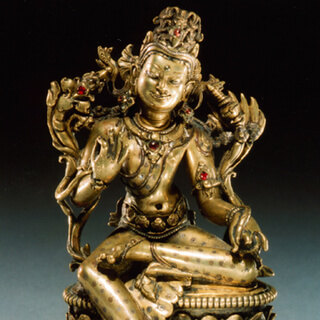
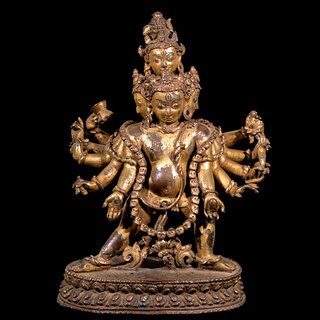
Including an image of the related artwork.
Our mindfulness meditation podcast is presented in partnership with Sharon Salzberg and teachers from the New York Insight Meditation Center,
The Interdependence Project,
And Parabola Magazine.
And now,
Please enjoy your practice.
Welcome to mindfulness meditation online with the Rubin Museum of Art.
I'm Thalini Savara and I will be your host for today.
For everyone joining us for the first time,
We are a museum of Himalayan art and ideas in New York City and we are so glad to have you all join us for our weekly program where we combine art and meditation online.
The museum is open to all and our staff on ground is following strict protocols such that you can have a wonderful and enjoyable and safe experience.
You can book your tickets in advance and come visit our beautiful exhibition Awaken,
A Tibetan Buddhist journey towards enlightenment,
Which explores the steps in the journey of self-knowledge and transformation.
From chaos to awakening and everything in between.
Our monthly themes have been inspired from this exhibition and this month we've been discussing the theme of wisdom.
Today we'll have a look at a work of art from our collection,
Hear a brief talk from our teacher Sharon Salzberg,
And then have a short sit of 15 to 20 minutes for the meditation guided by her.
Before we invite our teacher for today,
Let's look at the artwork we have for you.
Keeping in mind theme of wisdom,
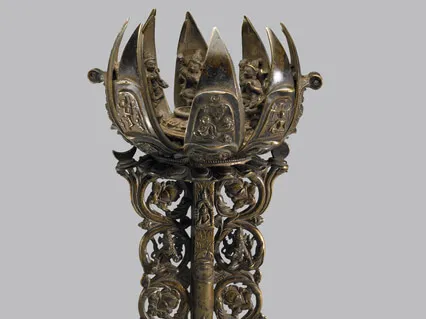
We're looking at this beautiful sculpture called Lotus Mandala of Devajra.
The origin of this artwork is from northeastern India and is dated from the 12th century.
Lotus Mandalas count among the most fascinating objects of esoteric Buddhist art.
These three-dimensional representations of a deity's palace typically feature a deity at the center of the flower that stands atop a tail stem.
With that deity's retinue placed on the hinged petals around him or her.
The sculpture's mechanical hinges allow for these petals to close around the central deity so that the sculpture resembles a flower bud.
While a lotus with its roots in muddy water rises above the mud to bloom clean and fragrant,
It is commonly a symbol of purity.
However,
A lotus can assimilize a lot more.
Rising above the mud to bloom requires great faith in oneself,
In the practice and in the Buddha's teachings.
So along with purity,
A lotus also represents faith.
A blue lotus usually represents the perfection of wisdom and is associated with the Bodhisattva Manjushri.
On the other hand,
A red lotus represents compassion while a gold lotus represents enlightenment.
When looking at this beautiful masterpiece,
We can focus our energies and emotions towards building a stronger and kinder self.
The beautiful flower with its multiple representation shows us how our faith can help us grow into and out of muddy times to use our wisdom and be compassionate and kind at the same time.
Let's welcome our teacher for today,
Sharon Salzberg.
Sharon is the co-founder of the Insight Meditation Society in Barre,
Massachusetts.
And she has guided meditation retreats worldwide since 1974.
Sharon's latest book is Real Change,
Mindfulness to Heal Ourselves and the World,
Which is available for purchase at the Rubin Shop.
She is also the author of several other books,
Including the New York Times bestseller,
Real Happiness,
The Power of Meditation.
Sharon has been a regular participant in many on-stage conversations at the Rubin and we're grateful to have her here.
To know more,
You can always visit SharonSalzberg.
Com.
Sharon,
Thank you so much for being here today.
So welcome.
I love the image of the lotus.
It's intriguing to me that different colored lotuses represent different qualities and the overwhelming sense I always get thinking about a lotus or looking at a calligraphy or painting or something or a sculpture is,
Of course,
That sense of rising up out of the mud and not being disassociated from the mud because after all that is the birthplace.
That's the ground out of which the lotus arises,
But nonetheless not staying encapsulated by it,
Enclosed by it,
But being able to rise up.
And that very much has me think about the quality of wisdom.
We learn wisdom.
We earn wisdom through life,
You know,
Life experiences,
Whether that's in the kind of condensed form in a meditation practice or just in a day in a relationship and a job and whatever it might be.
We learn about the nature of things if our eyes are open,
If we're actually paying attention and if we have a certain openness or interest in actually learning and that propels us to as connected as we are to all of life's events,
To have some perspective,
To have a broader view.
And usually there's something about ignorance that is,
I think,
Quite imprisoning and narrowing and we have this sense of being stuck.
Whereas with wisdom,
There's a much greater sense of expanse and openness.
We have a different perspective.
We have the capacity to actually look in a whole other way.
And the consequence of that,
I think,
Is that our lives get infused with a sense of meaning.
So I was looking up things I had heard about in terms of research,
Primarily about different kinds of happiness that people experience in life.
And the,
You could say conventional kind,
The ordinary kind,
The kind we expect to experience of pleasure is hedonic happiness.
It's enjoyment and it's received by us through the experience of delight,
Joyful impressions,
Nice conversations,
Good meals,
Beautiful breezes on a hot day,
Things that give us pleasure.
And this is wonderful.
You know,
This isn't something I think to be scorned or condemned,
But when it's our deepest sense of happiness,
We're in trouble because every one of those experiences is impermanent and outside of our control.
So we are subject to the winds of change.
You know,
What happened to that breeze?
It went away or the meal's over or the relationship is that complicated or whatever it might be.
So while I think it's really important to appreciate and not disdain those experiences of pleasure to understand that ultimately they will always change.
They're vulnerable,
We're vulnerable,
Life is fragile.
And that while we can enjoy them,
I don't know that it's that wise to have them be our absolute deepest sense of happiness.
The other kind of happiness is a little harder to pronounce.
It's eudaimonic happiness.
It's E U D A I M O N I C.
And it's not so much the,
Um,
Experience of pleasure.
It's the experience of meaning meaningfulness in a relationship,
Whatever the disposition of the relationship is to be learning,
To be growing,
Uh,
To be giving,
To have it be a meaningful encounter,
Even with a stranger,
Which would depend a lot on the quality and the fullness of our attention to be able to accept ourselves.
And that means our entire selves to have,
Um,
The wisdom to understand that we all have conditioning.
This is part of being human that we fall down,
That the important thing is the learning.
The important thing is how we relate to that,
Say bitterness or,
Or fear that keeps arising,
Not somehow struggling to with tremendous futility,
Keep it from arising at all.
Cause that's not going to work.
That's wisdom that,
Uh,
We have incredible power to relate differently.
We don't have to take everything to heart.
We don't have to believe utterly every thought.
We don't have to compare ourselves mercilessly to some image of,
Of how we think we should be or who we think we should be.
We can practice actual acceptance and that will give us perspective and wisdom,
But to have acceptance doesn't mean we have no purpose.
You know,
We're not like floundering.
I think we can have a tremendous intentionality in our lives,
Not control or seeking control,
But intentionality it's like aspiration.
And it could be something like,
Um,
In order to find meaning in my job,
Which is not maybe a great job.
Um,
According to the hopes and dreams you have cherished,
But you might say something like,
I am going to try to bring loving connection into every encounter I have with someone at work,
Even if they're complaining,
You know,
Even if I'm going to end up saying no,
Because I don't agree with their,
Their lead,
But nonetheless,
I'm going to try to have that all happen in an environment of loving connection that gives us meaning.
It's like the wisdom to know that,
Uh,
The deeper value of what we do may be something we infuse into the activity.
Not something we will necessarily find as given in the job description or the definition of the activity to have it a sense of,
Um,
You know,
We've talked about it before.
It's almost like a theme in your life.
What's your North star.
What do you navigate your life by?
And with the wisdom of that,
Really that's something that can accompany us anywhere times of delight and joy and times of adversity and challenge and times that are just kind of ordinary and boring.
No matter what we can have that kind of thread.
Wisdom also shows us where,
Um,
We might learn new skills,
Communication,
Um,
Or we might just practice things like generosity.
You know,
We may have an impulse to give something away,
Something material,
And we practice in a way that,
Um,
As long as that gift is not going to harm somebody,
You know,
Like I think I'll give away everything in,
Uh,
My family will forget them.
You know,
It's not like that,
But if you have a strong impulse to give something and it's not going to harm anybody,
Then practice giving,
Even if your next 50 thoughts are fearful.
Like,
I don't know,
I've carried that book through four moves.
I haven't read it of course,
But I,
You know,
Doubt if I read it,
It's going to be the only book I ever need to read because I'll be enlightened.
And,
But you know,
I better keep it right.
And so you pay attention through the impulse to give you pay attention to the fearful withholding.
You pay attention as you give it,
You pay attention to see if you actually ever have any regret.
And so through the force of,
Of awareness or mindfulness,
That quality of paying attention,
We learn,
We have wisdom,
We have understanding,
And then the next time we can stretch a little easier.
We're not so timid.
We're not so identified with the fear as compared to the impulse to give.
So we have a love of learning through wisdom and it can carry us through anything.
So all of that in a way that's very distinct from the experience of pleasure,
As delightful as that can be,
Is really the basis of the most kind of solid,
Reliable,
Accessible kind of happiness that we can have.
Okay,
So let's sit together.
See if you can sit comfortably.
You can close your eyes or not,
However you feel most at ease.
Can start by listening to sound.
Now I'm in New York city.
I'm providing more sound than I have in the past.
The sound of my voice or other sounds.
It's a way of relaxing deep inside,
Allowing our experience to come and go.
Of course we like certain sounds and we don't like others.
We don't have to chase after them to hold on or push away.
Just let them come,
Let them go.
If you're not responsible for responding to a certain sound,
You can just let it wash through you.
And you can bring your attention to the feeling of your body sitting,
Whatever sensations you discover.
See if you can feel the earth supporting you.
See if you can feel space touching you.
Not through picking up a finger and poking it in the air,
But receiving.
Space is already touching us.
It's always touching us.
And bring your attention to your hands and see if you can make the shift from the more conceptual level to the world of direct sensation,
Picking up pulsing,
Throbbing pressure,
Whatever it might be.
You'll have to name those things,
But feel them.
And bring your attention to the feeling of your breath.
Just the normal natural breath.
Wherever you feel it most distinctly at the nostrils,
At the chest or at the abdomen.
You can find that place.
Bring your attention there and just rest.
See if you can feel one breath.
And if you like,
You can use a quiet mental notation like in,
Out,
Or rising,
Falling to support the awareness of the breath,
But very quiet.
See your attention is really going to feeling the breath one breath at a time.
And as images or sounds or sensations or emotions might arise,
They're not very strong.
If you can stay connected to the feeling of the breath,
Just let them flow on by your breathing.
It's just one breath.
If something is strong and it like picks you up and pulls you away,
You get lost in thought,
Spun out in a fantasy or you fall asleep.
Truly don't worry about it.
See if once you realize you've been distracted,
You can gently let go and simply begin again.
And if you have to do that over and over and over again,
That's fine.
Okay.
Thank you.
Bye.
Bye.
Bye.
Bye.
Bye.
Bye.
Bye.
Bye.
Bye.
And amazing.
Where our attention goes,
We can always,
Always let go and begin again.
Bye.
Bye.
Bye.
Bye.
Bye.
Bye.
Bye.
Bye.
Bye.
Bye.
Bye.
And when you feel ready,
You can open your eyes or lift your gaze and we'll end the meditation.
So thank you for that.
That concludes this week's practice.
If you'd like to support the Rubin in this meditation series,
We invite you to become a member.
If you're looking for more inspiring content,
Please check out our new podcast Awaken hosted by Laurie Anderson.
The 10 part series features personal stories that explore the dynamic path to enlightenment and what it means to wake up.
Now available wherever you listen to podcasts.
Thank you for listening and thank you for practicing with us.